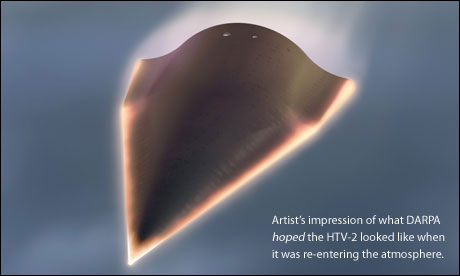
The US Military seems to have lost their new ultra hi-tech Falcon HTV-2 ‘hypersonic’ aircraft. The plane, which undoubtedly cost kazillions of dollars, ((Funny how the military never seems terribly impeded by financial market woes…)) was being tested over the Pacific yesterday when it suddenly (some ((Oh yes, some are already saying it…)) might say ‘mysteriously’…) stopped communicating with the US Defence Advance Research Projects Agency engineers.
Now, now. I can hear you snickering there Acowlytes. A little more sympathy please. We all know how distressing it can be to lose something. Why, only last week I lost my reading glasses and it was causing me all end of grief. I remembered, however, advice my dear old Dad gave me when I found myself in such circumstances, and I herewith offer that advice up to DARPA. ((After all, we don’t want to be too hard on DARPA – they are the reason I’m able to be here chatting with you, Faithful Cowpokes!))
•Take a deep breath and don’t flip out. That doesn’t help.
•Ascertain that the item is actually missing, and that your Mum didn’t put it away in the cupboard.
•Check your pockets. The missing item turns up there 90% of the time.
•Don’t play the blame game. The odds are that you lost it through your own stupid actions (as much as I was predisposed to think that China stole my spectacles, it was more likely that I had misplaced them).
•Retrace your steps (you might be amazed how many stops you made between Vandenberg Air Force base and the troposphere).
•Search the obvious places twice. I mean – guys: The Pacific Ocean? Are you sure you checked everywhere?
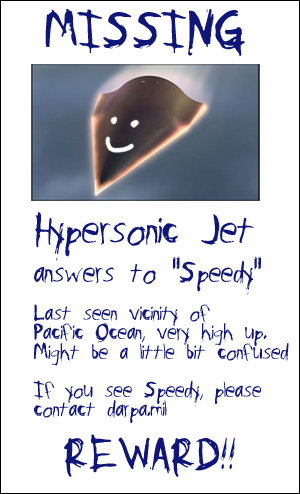
•When all else fails, try putting up some posters around the neighbourhood. I’m totally sure that if North Korea found your plane they’d be happy to give it back, especially if you offered them a reward.
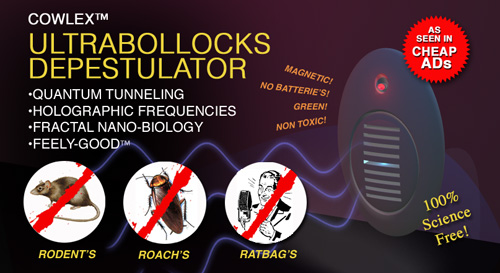
Some ways back, I dipped my toe briefly into the sludgy pool of grandiose claims and unsupported hogwash that makes up the field of ‘ultrasonic’ or ‘electronic’ pest eradication. A few days ago Faithful Acowlyte Matthew reminded me that I’ve been meaning to revisit this daft corner of Wooville when he sent me this recent offering from Pest Control Peddlers Pestrol.
As if they’re still living in the ’60s, Pestrol seems to think that it’s impressive to point out that their product, Pestrol Rodent Free is ‘seen on TV’. In their FAQ they are equally eager to boast that it’s ‘advertised on talkback radio Australia wide’ which I gather is intended to imply something other than ‘we paid some irritating radio personality to advertise it’. Are people so stupid that these kinds of vapid endorsements get them reaching for their wallets? But silly me – I guess that anyone with a brain is not the main market for this product, as we shall see.
This ‘latest technology’ that the Pestrol seems so overjoyed to introduce is that of ultrasonics. Since ultrasonic devices have been round for decades, this seems rather a lot less impressive than if they’d said it used, oh, quantum tunneling or carbon nanotubes, two other technologies that would be just as effective at repelling rodents as ultrasonics (ie, not at all, if you haven’t guessed) and are a lot more current and cool sounding. I might even be tempted to buy a rodent repelling device that claimed to use quantum tunneling. At least it wouldn’t be quite as easy to completely ridicule as one using ultrasonics.
The Pestrol Rodent Free technique emits a disorienting pulse that startles and frightens away insects and rodents from your home or office.
O-k-a-a-a-y… and the science to support the idea that that rodents and insects don’t like those ‘disorienting’ ultrasonics pulses comes from… where… exactly? What’s that you say? You heard it from a friend of a friend?
The fact is, evidence for ultrasound being an effective deterrent against rodents is slim. It is vaguely possible that the noise irritates them somewhat, but since rats will repeatedly endure full electric shocks to get at human food, it is unlikely that a slightly bothersome noise is going to have much of an effect.
The Pestrol Rodent Free will need to be plugged into a power point approximately 0.2 metres from floor level in order for the ultrasonic to run along the ground, living rooms and hall ways.
Now, are you forming a picture in your minds, dear Acowlytes, of ultrasonics ‘running along the ground’ through your house? I know I am. Because everyone knows that sound (ultrasonics are nothing more than high frequency sound waves) behaves just like that – seeping along at floor level. Even if ultrasound did work, it would not matter one whit where in the room you put the device as long as it was relatively unobstructed.
Pestrol Rodent Free combines electromagnetic, ultrasonic and ionic technologies to help free your home of rats, mice and aids with the control of cockroaches.
Yes friends, Pestrol Rodent Free deploys a veritable Holy Trinity of implausible techniques to keep your home pest-free. There’s our old friend ‘electromagnetism’ that well-known bane of pests of all kinds, and a new player in the game: ionic technology.
Animals are naturally sensitive to negative ions. ((Who says so? And in what way? This claim means absolutely NOTHING in this context.)) Long before a lightning storm, insects and rodents sense a change in the environment and look for protection away from the storm.
So let’s see – the negative ions are supposed to simulate a thunderstorm so the rodents go looking for shelter… in your house. Good one Pestrol!
This is a shining example of what I call ‘selective woo’. Elsewhere you will find gadgets being peddled under the claim that ‘negative ions’ are actually beneficial for the very reason that rats and cockroaches don’t like them. In other words, the arbitrary decision by humans to decide something is a pest is all it takes to turn the power of ions from desirable to repulsive. Amazing!
Selective woo comes into play with other aspects of the Pestrol Rodent Free, too. The makers claim that it is effective against rodents and insects and even possums (which in this country are marsupials), and yet will not effect your pets. How can this possibly be? Well:
Pestrol Rodent Free has been used for many years by thousands of satisfied customers in Australia and NZ. Will not affect dogs, cats, birds, or fish as they have a different genetic structure to rodents and cockroaches
Ah. It’s the genetic structure. Of course! Rodents, as any student of biology surely knows, are much more closely related to cockroaches than they are to cats and dogs or other mammals. Or marsupials. Or birds or fish.
This is, I’m sure I don’t need to tell you, complete and utter claptrap. Elsewhere you will find that these kinds of devices are supposedly effective against deer, rabbits, skunks, squirrels, bats, foxes, raccoons, chipmunks and armadillos. And, paradoxically it would seem, cats and dogs as well, should you find them vexatious rather than cute and fluffy. In fact, the chief benefit of Pestrol Rodent Free-style devices seems to be that they will repel anything that you decide you don’t want hanging around, and won’t affect anything else! I wonder if it is effective against people selling pseudoscientific crap?
‘But Reverend,’ I hear you interrupting ‘there’s a 30 Day Money Back Guarantee! It says there in BIG WRITING. How could they possibly offer that if there wasn’t anything to it?!’
Aha, young Acowlyte, that’s another trick to get you to part with your hard-earned cash (All $119.00 frigging dollars of it in this case). You sure can get your money back if you return your Pestrol Rodent Free within the 30 days specified… but what’s this in the FAQ?
How do I know if my Pestrol Rodent Free is working?
You may see increased activity as rodents and cockroaches are forced from their hiding places. Often it can take up to 3 weeks to remove rodents. Cockroaches may take longer as eggs can lay dormant for many months before they hatch.
Right. So you may not see the desired effect from the device for 21 whole days. ((Indeed, you may see INCREASED rodent activity – the exact opposite of the desired outcome – in the first 3 weeks of use!)) Factor in a week or so for postage and there goes your money back guarantee. You’ll certainly have blown your cash if you wait around ‘for many months’ to see if the Pestrol works on cockroaches.
Lest there is any lingering hesitation in your minds, dear Cowmrades, that the Pestrol Rodent Free might still have some slim remaining shred of credibility, let me quote from a US Federal Trade Commission finding on similar devices:
Between 1985 and 1997, the FTC brought law enforcement actions against six companies that allegedly made false and unsubstantiated claims about the effectiveness of ultrasonic devices in controlling rodent and insect infestations. Each of those cases was resolved by consent order. In those prior actions, the FTC challenged the following types of claims:
• Eliminates rodent infestations;
• Repels insects;
• Serves as an effective alternative to conventional pest-control products;
• Increases or assists the effectiveness of other pest-control methods;
• Eliminates fleas on dogs or cats; and
• Scientific tests prove product effectiveness.
Prior FTC complaints alleged that any reaction by rodents to ultrasound would be temporary at best because rodents become accustomed to ultrasound and will return to their nesting or feeding areas even in the presence of an ultrasonic device. Furthermore, previous FTC complaints alleged that ultrasound devices do not control insects.
These findings were handed down over a decade ago and yet, performing a Searchâ„¢ for ‘ultrasonic pest repeller’ returns literally hundreds of thousands of hits, the first few umpteen thousand pages apparently for people selling the damned things.
One of the big topics in the skeptical community at the moment (like everywhere else I guess) is the climate change issue. It’s a subject that is as fraught with debate as that of Evolution vs Creationism, and indeed, has many of the hallmarks of that particular tussle. What makes it particularly volatile in this setting, though, is that many of the people who claim that there is no need to worry about global warming paint themselves as climate change skeptics, and take the position that they offer a rational approach to the debate. What they are in fact doing is voicing opinions that are in contradiction to MOST of the world’s knowledgeable climate scientists. Though they like to think of themselves as skeptics, this stubborn entrenchment in a belief system has earnt them, instead, the badge of climate change deniers.
I pretty much stay out of the climate change argument, just as I stay out of the Creationism debate. It’s not that I don’t have a strong view on global warming. I think the scientific evidence is conclusive that we have a looming disaster on our hands, and that it’s a disaster of our own making. Bothering to argue with the deniers though is the mental equivalent of jabbing a sharp pencil repeatedly into the back of your hand – a sensible person stops doing it pretty quickly.
The main problem is that, as with evolution, climate science deals with concepts that don’t come easily to the natural human way of thinking. With evolution it has to do with vast amounts of time (which we’re not good at comprehending) and the complexity of the vectors that come to bear on natural selection. With climate science, it’s all in the maths. I’m going to attempt in this post to show you why, even if you haven’t kept up with all the marginalia of the climate discussion, you should be afraid of what we’re doing to the planet.
At the outset I will state that my essay takes one idea as a given: that global warming is a human-instigated phenomenon. You should understand that a cornerstone of the denier’s ‘argument’ is that it isn’t, but I will stand behind the overwhelming scientific viewpoint on this matter. ((If the deniers are right on this and global warming is an inevitable natural process, then we’re in a handcart to hell anyway, and it doesn’t matter what we do. So we may as well make efforts to ameliorate the situation as not. An argument of financial imperative (‘it will ruin our economy’) is quite irrelevant because in a hundred years there won’t be an economy.))
OK. We’re going to talk about math in this, but you don’t need to understand numbers. And I promise you, it won’t be dull. This is a very scary story. I’m going to divide it into three chapters.
Chapter 1: Boiling the Frog
There is an old fable – it’s probably apocryphal but for our purposes it doesn’t matter – that says that if you take a frog and put it in a bowl of water over a burner and slowly raise the heat, the frog, unable to feel the very slow rise in temperature will make no effort to leave the water and happily sit there until it is boiled to death. In other words, it either doesn’t realise there is a problem, or, by the time it does, it’s too late.
The story illustrates a psychological phenomenon called ‘creeping normalcy’ (or in science, the ‘shifting baseline’ problem). Put simply, it says that if you have changing reference points, you can only judge what is ‘normal’ by what you’re familiar with at any given time. In this way, familiarity changes the baseline of ‘normal’ to whatever you get used to, and if things change slowly enough, ‘normal’ can wander an awfully long way from ‘acceptable’.
The first step towards understanding why the climate issue is so deadly is to understand that humans think like this as a default. Our brains don’t work well on timescales in excess of a few years. Our horizons are small. I’m not the first to mention the Boiling Frog concept in relation to the climate change situation, so its appearance here is no big revelation. But you need to keep it in mind as we head off to chapters 2 & 3:
First a philosophical point: Climate Change is claimed to be complex. I claim it is NOT. It is simple physics – add more energy and the world warms up.
Mr Dodds’ opinion typifies the way in which most people believe that the planet’s climate system behaves – something like a Big Clock. A wheel here, a cog there, a spring yonder – all ticking away in a simple predictable manner that can be completely described if you do the right calculations. Most people think, therefore, that if we’ve caused some kind of problem with the climate, then all we need to do is to ‘oil the gears’ on the clock and everything will go back to the way it was. They believe that the problem is proportionate to the actions we take to correct it.
This is a massive and perilous failure of understanding. It’s a mechanical Newtonian notion of the way things work that is fine for pipes and balls and clocks, but breaks down catastrophically when applied to something like climate behaviour. To grasp why, we have to venture into the frightening, mind-bending and completely unintuitive world of complex systems.
First, let’s consider the pendulum in our Big Clock. As physical systems go, this is about as unadorned as you can get. A swinging pendulum exhibits what is known as simple harmonic motion ((For small angles of swing. As the angular acceleration increases things become a little more complicated, but for our purposes we can assume true simple harmonic motion.)) and it is a very reliable behaviour that allows us to build a clock that will behave predictably and dependably. A simple pendulum is mathematically very straightforward. Its properties can be described completely in terms of the length of the ‘rod’ of the pendulum, gravity, the mass of the ‘bob’ on the end of the pendulum and the angle of swing. If you know these things, you can predict exactly how this pendulum will behave. This uncomplicated mechanism works great for a clock, and it’s fairly tolerant of perturbations in the system: if you push the pendulum a little hard, it will dampen down to its normal swing pretty quickly. You need to be pretty violent to cause the clock to have problems big enough to effect its function.
This is the kind of path we could expect the bob on the simple pendulum in our clock to trace. Every time:
Unfortunately for us, the climate system isn’t driven by a simple pendulum.
Let’s consider a physical system only a tiny step away from our Big Clock’s single pendulum: the double pendulum. A double pendulum makes one small alteration to the simple pendulum model – instead of a simple bob at the end of the pendulum, you add another pendulum. This very unassuming variation has sudden and profound effects.
Here’s a computer simulation of the path traced by the tip of a double pendulum:
If that looks weird and science fictiony to you, let me assure you that double pendulums behave exactly like that in reality. There are dozens of YouTube videos that show them in action.
You can see how this one small change to our pendulum quickly throws a simple harmonic oscillation into a volatile and complex motion. The double pendulum system can be very easily described, ((We still know the lengths of the rods, the mass of the bobs and the gravity coefficient.)) but its ultimate behaviour cannot. Each time you set it swinging its bob will trace a completely different path in space because, crucially, a double pendulum is very sensitive to initial conditions. Unlike our clock’s pendulum, we can’t accidentally give it a bit too much of a shove and have it simply settle back into its predictable ol’ groove.
Imagine, now, that you have a pendulum with n arms, each with a bob with a mass that is a variable coefficient ofn, n points of articulation on each arm, and variable gravity. It doesn’t take much of a leap of imagination to understand how wildly such a device will behave. In fact (and this is where most people fall off the bike), for surprisingly small values of n, no amount of computing power in the universe can ever predict the path of motion it will describe!
Well, the Earth’s climate is exactly such a system.
Unfortunately one thing that tends to be a little confusing with this is that climate scientists often speak of ‘climate modelling’ and to many people this sounds again like they’re talking about some kind of Big Clock: you stick in all the variables into your computer and ‘ping’ – out comes the behaviour that the Big Clock will exhibit. If it were only that easy.
When you look up a weather report on your i-Device of choice, you’re seeing climate modelling at work. One thing I probably don’t have to tell you, is that you shouldn’t rely on the information more than a few days ahead. That’s the state of the art in climate modelling. We’re just not very good at predicting the behaviour of complex systems (like weather) even a few days in advance. Here’s the kicker: it’s not our fault! These systems are inherently unpredictable. Even if we had super-super-super computers, we couldn’t do it. Even if we had a computer that could take ALL the variables – and that’s a HUGE amount of variables – and then run the simulation in real time to see what it did, it would do us no good – we would get a different outcome every time we ran the program. Just like its very simple distant relative, the double pendulum, a complete detailed model of a complex system like the climate is critically dependent on initial conditions. (We actually do have such a computer – it’s called ‘Reality’. The only accurate simulation of what the climate will do is the climate itself).
So, when you hear scientists talk about modelling the climate, you should not understand that to mean they are trying different kinds of wood for the clock case, or a new type of oil to make the gears run smoother. They mean they are making their best educated guess at the Big Picture of what might happen if they picked enough of the right factors to plug into their equations. Just like you understand the weather man to be doing when he tells you that in a week’s time it looks like rain (are you starting to get nervous yet? No? Then you’re not following me).
So what’s the problem, right? We don’t know what the weather will do – why is that different from any other period in our history? Why are we suddenly worrying now? Well, one of the things that modelling can predict pretty confidently is trends. Just as we can say that a double pendulum pushed gently is unlikely to do the crazy loop-the-loops that we see in the same system dropped from a higher angle, models can tell us that when we change something in the climate system too much, we’re likely to see unpredictable behaviour. In recent times (the last few million years or so) the climate has been ticking along like a gently-pushed double pendulum; little flurries here, little irregularities there, but for the most part, predictable enough for life-forms to have evolved strategies to cope. Things do change, but they change slowly. The system keeps itself in check through millions of years of self-modification that has allowed it to reach a relatively stable, though delicately balanced, equilibrium. The evidence is clear, though, that over the last few hundred years (a VERY short period by geological standards) humans are swinging the pendulum’s arc wider and wider by the simple act of burning things. We’re taking carbon that has been for eons locked up in the biosphere and chucking it into the atmosphere where it has started to imprison the Earth’s heat. We can, therefore, state with a high degree of confidence (based on an enormous amount of accumulated data) that the planet is heating up monumentally faster than it ever has before, and that that heating-up is concomitant with the technological period of humans. ((We’re excluding events that happened in geological times of many hundreds of millions of years ago, where lots of weird climate events happened. They are not relevant to our argument because we weren’t involved. If we had been, we’d be dead, which is of course the issue at hand.))
But when climate modelling scientists make a ‘prediction’ that the temperatures will rise 3 or 4 degrees by the end of the century, you should not think of that as a jolly nice warming of the winter months, and the odd extra scorcher in July (or January, depending in which hemisphere you live). You should instead interpret it to mean ‘We figure the whole system is going to heat up, but how it delivers that heat, and to whom, depends on the swing of the double pendulum…’ What you should expect is periods when the weather seems just as it always has, interspersed with occasional outbursts of extreme behaviour. For a while this will seem normal, and you will be as happy as a frog in a warm pond. But this extreme behaviour itself will start to interfere with the system – it’s another phenomenon of mathematics which those in the know approach with respect: feedback. And that feedback will almost certainly affect the system in ways which we can’t even imagine. ((We don’t really have much of an idea of the way the climate system is held in such delicate check anyway – global atmospheric behaviour is without doubt one of the most complex systems we know. All we can say for certain is that that if it changes much, we are in trouble.))
This coupling of complex behaviour and feedback is the thing which frightens the scientists, because it’s something with which the world of science has become very familiar in the last fifty or sixty years. We know that a complex system exhibiting instability and feedback can suddenly and capriciously become chaotic. That is, the system is likely to reach a point where even modelling is completely useless – it just goes completely berserk.
Trust me when I say that we really don’t want to see our climate system go chaotic. If we hit that point, it is likely that the great majority of the human race will suffer. ((It should be understood here – because I often think that it’s not – that the planet is indifferent to this problem. You hear climate deniers putting forward ideas like ‘Well there have always been periods of global warming’ or that ‘Sea levels have changed many times though the Earth’s history’. Well, sure. But mostly, there were no, or few, humans around, and other creatures were affected by these events, often in the form of species-wide extinctions. The Earth was once a giant greenhouse, covered with plants. But WE could never have lived in it. The planet would probably survive quite extreme results of our global warming efforts – it’s just that we wouldn’t.))
Chapter 3: Jenga
The kind of critical instability that I’ve just described is a lot like the game of Jenga. The Jenga tower will remain upright as long as the system is stable around its centre of gravity. If you lived on top of the Jenga tower, you would probably be aware of nothing at all as pieces are removed. Maybe the tower might wobble a bit, but, hey, things look pretty normal. Every removal of a Jenga tile is exactly the same kind of small effort, but each one of these small efforts moves the system closer and closer to critical instability. When the Jenga system reaches this point, the collapse into chaos happens rapidly and catastrophically, with little warning.
Well, that’s where we are right now. The tower is wobbling a bit, but everyone is saying ‘Hey, the tower has wobbled before and we were OK – what’s the problem? Worse, we continue to slide out the pieces, because that’s what we’ve been doing for years and it’s been just fine.
Unfortunately, this kind of situation is the very worst sort of thing to try to get resolved by a ‘popular vote’. When you combine the Boiling Frog situation with the Big Clock scenario and stir in a whole lot of poorly educated ((I say ‘poorly educated’ because I think that even the great majority of people who are literate do not have a good grasp on science, nor on rational ways of thinking. Any of you who have been reading TCA for a significant period of time will understand exactly what I mean here.)) points of view, you just get lots of personal assessments of the problem – or debates about even whether or not there IS a problem – and a bucketload of total inaction. The grim truth is that it’s a state of affairs that seriously needs everyone on the planet to be in complete agreement, or we will, without doubt, plod our way into extinction.
The way it stands at the moment is that the vast majority of people are either uninterested or confused, a small minority is in denial and beset by superstition and petty agendas, and another small minority is informed but frightened, frustrated and powerless. I think that what we are seeing here are the ramifications of a massive failure as a species to improve ourselves by putting emphasis on the capacity to understand our world through observing it properly. That is, through science. It is of no use to put an appropriate course of action to a popular vote in this instance, because the holders of a popular vote aren’t equipped to understand what it is they’re voting on. And frankly, I think we’ve run out of time to get them up to speed. Added to that is the negative influence that whatever we need to do will, most likely, cause great inconvenience to a large number of people, and will include increased poverty, loss of jobs, deprivation of luxuries (and maybe even necessities for many) and a general willingness to just suck it up and take a beating. It doesn’t take much insight to see that we’re never going to get people to volunteer for that, unless they become very afraid indeed (by which time – I emphasize once more – it will be way too late).
If ever there was a time for the leaders of our nations to listen to the science, and act decisively and quickly for the good of human race, this is it.
My good friend Nick Stathopoulos is exhibiting the second in his Toy Porn series – paintings of the toys we know and love from childhood. If you’re in Sydney, you should really go along and see them in the flesh… er… in the acrylic. I’ve seen some of the first series at firsthand: they are truly beautiful artworks.
July 26 – August 13
NG Art Gallery
Upper Level
3 Little Queen Street
Chippendale NSW 2008
Sydney Australia
The paintings are all for sale, but I hear they’re being snapped up fast. Damn you empty piggy bank!!!
Residents of Lenoir County, North Carolina, have got it into their heads that this kudzu vine covering a utility pole about a mile south of the town of Kinston ‘bears a striking resemblance to Jesus’ crucifixion’.
A local citizen, Kent Hardison, almost took to the weed with pesticide until (we can only presume) God stayed his hand.
‘You can’t spray Jesus with Roundup’, he is quoted as saying in the Kinston Free Press.
I’m not entirely sure about that. I couldn’t find anything in the Bible actually prohibiting such an action. There’s definitely no Commandment that says ‘Thou Shalt Not Spray the Son of God with an Herbicide’.
In any case, how can the good folk of Lenoir know that God intends this obvious manifestation of His awesome power to be Jesus anyway? Maybe He had something else in mind and they are completely failing to understand the significance of His message?
Suggestions as to what God is actually trying to say to the people of Kinston are very welcome.