I really love science. No matter how much stuff there is to know, there is always some more to find out, and as we saw in my recent science experiment, even the simplest of ideas can be full of rich and surprising consequences. Today I hope you will join me as we venture into the world of magnetism, electricity and digital information.
Part 1
For this part of the experiment we will need:
•A small amount of fine iron powder or iron oxide
•A magnet
•An old credit card or similar swipe card
•A magnifying glass
You can get some iron powder by filing down an old key (an iron or steel one – brass or aluminium won’t work), or even easier, by finding some iron oxide – commonly known as rust – and scraping it into a small container. You don’t need too much, but it should be as fine as you can make it.
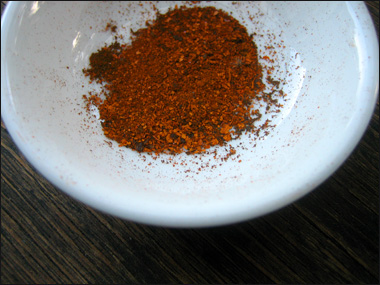
Now, I don’t think you will find it at all surprising that iron oxide is magnetic. If you take a magnet like this:
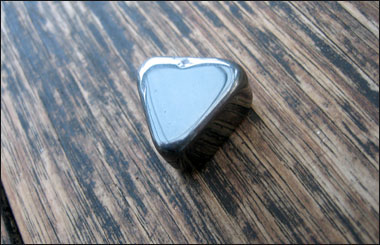
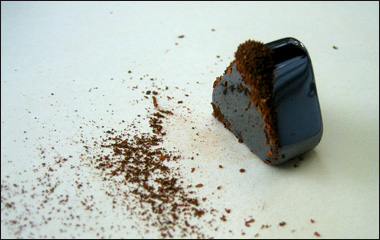
And hold it near the iron oxide, you will quite quickly see that the magnet attracts it:
The strip on a credit card is also magnetized. Here is one I’ve acquired for our experiment.
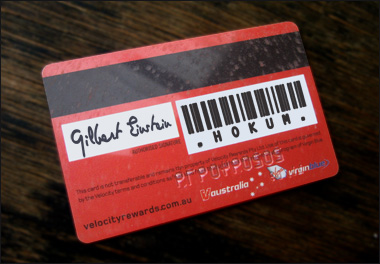
I don’t think Gilbert will mind us using his Virgin Frequent Flyer card (he doesn’t travel much anymore, after a clairvoyant told him he was going to die horribly in a plane crash). Gilbert’s card is fairly worn from carrying it around in his wallet, but we should not worry too much. The magnetic strip on a credit card is very robust and has been designed to cope with repeated handling. Although it is possible for the strip to be damaged by a very strong magnetic field, or through many years of wear and tear, the information recorded on it has a usefully long lifespan under most conditions, as I’m sure any of you with credit cards will know.
The strip on Gilbert’s card is actually really just a magnetic field that is recorded in various strengths to reflect a coding system for digital data. It is, in fact, just a magnetic field version of the common barcode with which I am sure you are familiar. The barcode records its data as a series of light and dark stripes, and the information of a swipe card is recorded in pretty much the same way, only with bands of varying magnetism. It follows then, that if we were to sprinkle something made of very fine metal powder, such as our iron oxide, onto the magnetic strip on Gilbert’s card, we would be able to see the particles sticking to the more magnetic parts of the strip.
Let’s try it!
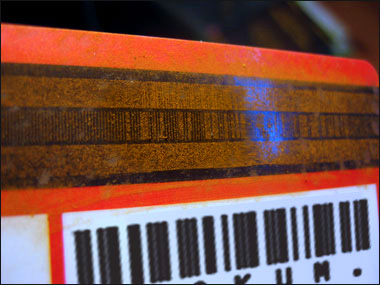
Let’s have a closer look at that with the magnifying glass!
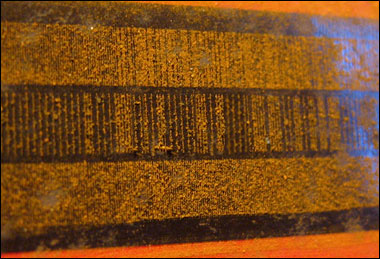
Amazing! The fine particles clearly delineate the data on the card! What we’re seeing here tells us lots about how a credit card works. First of all, you will notice that Gilbert’s card has three horizontal magnetic bands. This is the standard for all swipe cards. In most cases, information is recorded on one, or sometimes two of these bands. The two outside bands are called high density tracks and contain data at 210 bits per inch. If you know anything about computers, you will realise that the term ‘high density’ here is relative: 210 bits per inch, by modern data standards, is pretty damn lousy. To give you some idea, one of these tracks can carry about 79 x 6bit alphanumeric characters. Your credit card would typically have, on track 1, your name, your card number and an expiry date. That’s it. Not much.
The middle strip is called the low density track and is able to carry only 40 x 4bit characters. Often, the data is similar to what is on the first track, typically a repeat of the card or account number, and the expiry date. The third track is recorded at a lower bit rate than track #1 so can carry 107 characters at 4bits each.
The important thing to note here is that a magnetic strip can carry, on all of the three stripes combined, a total of roughly 1000 bits of data. ((1062bits, if you do the sums)) You may be more familiar with that as 1k. That data is encoded to be read as alphanumeric characters, and we’re talking about, at maximum capacity, 226 letters, numbers and punctuation symbols.
That’s about the same amount of information you can send in one single SMS ((SMS messages are encoded in 7bit characters: 160 x 7bits = 1120bits))
Part 2
For this part of the experiment we will need:
•Iron oxide powder (as above)
•A Shoo!Tag™ card
(You’re really glad you stuck with me, now, aren’t you?)
Shoo!Tag™ cards are available from some pet supply places. ((Just an aside here – when I purchased my ShooTags I asked the sales assistant whether they sold many. ‘Nah’, she said ‘They’re rubbish.’)) They are small plastic credit-card style tags that the makers claim use ‘a three dimensional or trivector signature imprinted onto the magnetic field of a three field magnetic memory card to create a protective barrier from pests.’ The Shoo!Tag™ ((I’m fairly certain that they don’t actually have a trademark for Shoo!Tag, but we shall see how that pans out)) vendors don’t explain anywhere how this amazing feat is accomplished.
Here’s one I acquired earlier. It’s supposed to be for keeping ticks off cats:
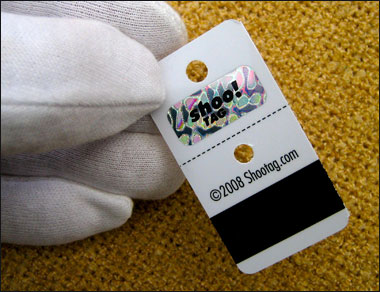
You’ll notice I’m handling it very carefully. I don’t want to damage any of the fragile ‘electro-hoodjy-goodjy vibes’ that the maker insists accompany this card. This is the packaging in which the Shoo!Tag arrived:
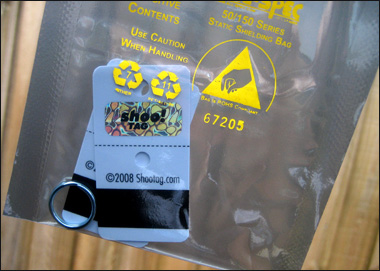
It’s a mylar anti-static bag, which, as you probably know, is designed to protect sensitive electrical components from static charges.
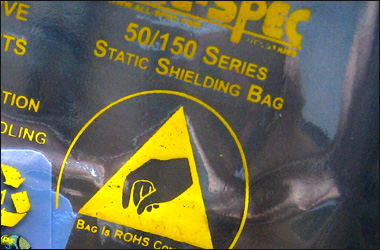
Now, static electricity has next to no effect on magnets. ((Unless we’re talking about lightning, which is a kind of static electricity. But no mylar bag is going to protect your ShooTag if it gets struck by lightning, I can assure you.)) And, as far as I can tell, there are no electrical components of any kind in the ShooTag card. ((Unless they are very very thin – alien technology, maybe? Well, that’s at least as plausible as the cards having any effect!)) What, then, is the purpose of this mylar bag? Has your American Express card ever arrived in the mail in a mylar bag? Does your bank advise you to keep your credit card in a mylar bag when not in use? They do not. Furthermore, you can build up a very decent static charge by scuffing your shoes on the carpet of your lounge room – enough to cause sparks to jump from you hand to a doorknob – but it will not effect the information on any of the credit cards in your wallet.
Ever.
But perhaps the magnetic strip of a ShooTag isn’t actually magnetic! Maybe it’s some other clever kind of technology that IS affected by static electricity. Surely it couldn’t be plain ol’ garden variety … magnetic data…
I can tell you’re ahead of me. Have you got your iron oxide powder at the ready?
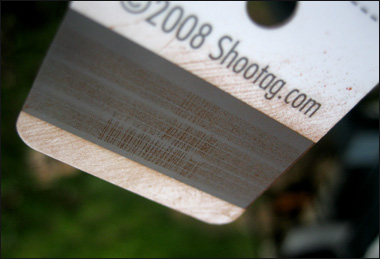
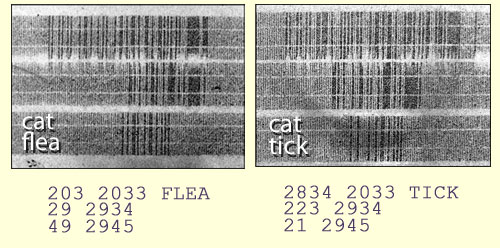
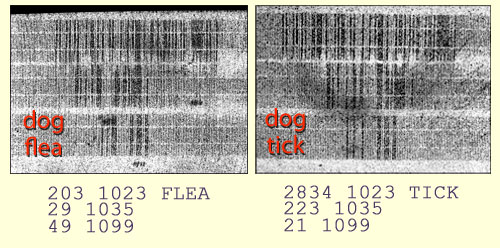
Well look at that. The magnetic strip on a ShooTag is just what you’d expect to find on a standard swipe card – three tracks encoding some data. Just like any ol’ credit card. Or a barcode. Let’s take a closer look at the actual data area of the code:
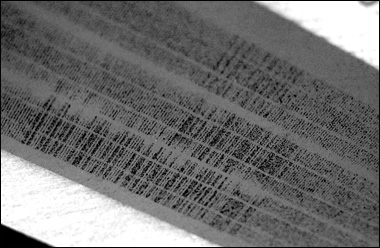
You can clearly see the actual encoded data – it forms the little segments that stand out in the middle of each of the three tracks. The uniform areas on either side, where there is no variation, are the ‘zero’ bits – null areas where the digital information message says ‘there is nothing here’.
I’ll outline it a little more clearly for you:
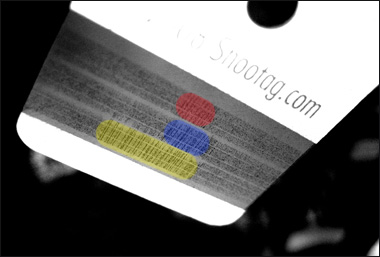
By my estimation, the actual area of the the magnetic strip that’s actually encoded with data is about a third of the total area. ((I’m being generous – it’s probably even less)) And, as you can see if you go up to the first ShooTag picture above, this card – the one for cats – is about one third the size of a standard credit card. So the information encoded on a ShooTag for cats is one third of one third of the amount of information on a standard credit card.
That’s one third of one third of the information you can send in an SMS. Roughly 17 characters.
This much:
FLEAS! PISS OFF!! ((The spaces count as characters))
Even if you assume that the digital information is not in the form of words or numerals, the total amount of data is only around 102bits. This, supposedly, is the sum total of the data used by ShooTag’s ‘physics, quantum physics and advanced computer software technology’ ((Verbatim from their ‘Science’ page)) to create the three dimensional electromagnetic field that gives it the awesome power to repel insects. Not only that, but the data also targets different insects according to which kind of card you have. Of course, this may all be explained by ‘the advanced computer software technology’ that the ShooTag creators claim they use, but in that case they are seriously in the wrong business; with data compression routines that impressive, they are trifling with a few dollars made of the back of plastic cards – they could be earning billions in Silicon Valley!
Let’s pause for a second and try and understand what kind of mechanics are supposed to be going on with these things. There is a reason, and only one reason, that information is encoded onto a magnetic strip on a plastic card. It’s a basic, practical and easy-to-understand reason: it’s so that you can swipe it through a card reader. Otherwise – seriously – WHAT IS THE POINT of recording magnetic information in this fashion? What the ShooTag people are asking us to believe is that some kind of magic happens when information is transferred onto a ShooTag magnetic strip that allows it to be scanned by… what?… the Universe? Fleas with miniature EFTPOS machines? God?
On their site the ShooTaggers say that there are ‘frequencies’ embedded in the magnetic strip ((because we can see the data, we have to assume they mean ‘recorded on’ rather than ’embedded in’)) which, using ‘earth energies similar to Schumann Waves’ (a piece of idiocy that we have discussed previously), somehow communicates with the supposed ‘bio-energetic field which surrounds all living things’. ((This is also silly doublespeak undoubtedly inherited from the misunderstandings surrounding Kirlian photography and other similar ‘proofs’ of ‘bio-energy’)) What possible mechanism could allow that? There is nothing known to science that says that a few trivial bits of magnetic data could meaningfully influence anything other a purpose-built magnetic card scanner (or some iron oxide particles, I guess). It’s nonsense of a truly breathtaking magnitude.
You will recall that I mentioned that I received 2 cards in my ShooTag package. The one we’ve been examining above is supposedly designed to repel ticks. Well, we don’t have much of a tick problem here, so I have been able to sacrifice any spooky vibes it may have had to our science experiment. The other ShooTag in my package is for the dispersal of fleas. I have been extremely careful with the other card. It has remained in its packaging and, as you saw, I have used cotton gloves whenever handling the mylar package containing the tags.
That’s because this experiment has a Part 3, and, with a certain feline helper, we are going to run our own field trial with the ShooTag. And I can assure you I will be undertaking this part of the experiment with as much rigour as any of the people who have submitted glowing testimonials on the ShooTag site.
Stay with me, won’t you?