Cuddly!

Now, as I mentioned at the end of that last post, before I got distracted by the whole V debacle I had set out to jot down a few thoughts on something a little more serious. A related topic, to be sure, but seriouser. And much more deeper. You’ll understand the detour I think – just keep in the back of your mind that it might involve lizards and you should keep up.

In a recent issue of New Scientist magazine, Dr Susan Blackmore (a scientist we quite like because she dyes her hair rainbow colours) made some interesting speculations about what she calls the ‘third replicator’ of our species. I’m not going to go into detail about her article (you can read it here if you like) but to precis, her idea is that there have been two important shapers of human evolution on this planet – genes and memes – and that we may now be looking at the emergence of a third replicator which will change us beyond what we can ever anticipate and probably do so even before we are likely to be fully aware of it. This third replicator (for which she invites us to invent a name) is something, she speculates, that is arising already out of our rather recently acquired human interconnectedness. I like the notion and I even think she may well be onto something, but that’s by-the-by; let’s push on a bit.

Toward the end of her item she brings up the subject of the perennial modern human quest to find life elsewhere in the universe. It is a pursuit close to my heart – I, too, would love to know if there is life out there. Really, who wouldn’t? Like about a zillion other people, I was happy to jump on the SETI@Home bandwagon when that started up, and for a while there I was pretty damn eager to help find the next Wow! signal. But then I started to reflect… The idea of making actual contact with aliens has always freaked me out a bit. While it would be nice to know if those lizard people are out there I’m not so sure I like the idea that they may consequently know we’re out here. Just think about it for a second: any civilization with whom we might make contact must necessarily be at least as technologically advanced as we are, and, more likely, somewhat further advanced. Can a situation like this turn out to be to our advantage? Given the only example to which we can refer – the history of the civilization of own planet – I think we can make an almost unassailable rule-of-thumb. I will call it the Reverend’s Law of Beads & Mirrors:

• If, by fate or design, two previously separated cultures are drawn together, the one with the least sophisticated technology always ends up with the worst part of the bargain.

I don’t think I can think of a single exception to this Law in the entire span of human history (although I would be completely delighted to be pointed to any counter-examples).

Further, I propose that this Law is exponential – the greater the difference between the two technological entities, the worse the outcome for the less sophisticated one. Again, my examination of human transactions shows no contradiction to this addendum.

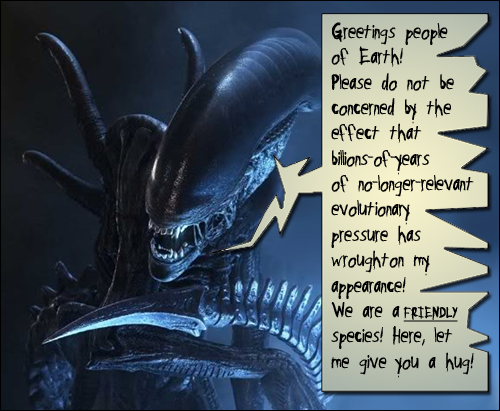
And so I ask: is it really such a good idea to buddy up with the lizard-folk? Won’t it just turn out badly for us? Call me xenophobic, but if an alien is offering his claw in friendship, I’m keeping my brain way out of reach of his telescoping mandibles.

“But Reverend,” I hear you exclaim, “If Professor Einstein was correct, even if the lizard people are super-intelligent, then the laws of physics won’t allow them to ever get here! So our hamsters are completely safe!”

Ah yes, but this is where we turn back to Dr Blackmore’s hypothesis, and the scary implication she has entirely missed (or perhaps glossed over, if she is, as I am beginning to suspect, a lizard person herself…)

After making a case for our human originated Replicator 3 (R3) somehow acquiring a gestalt ‘imprint’ of the sum of human experience that none of us individually may even fully comprehend, she says in her New Scientist article:

Perhaps intelligence and civilisation are not what we should be concentrating on […in our search to find extraterrestrial life…]. My analysis based on Universal Darwinism suggests that instead we should be looking for R3 planets

Hey! Whoa there Starbuck! Throttle back on the thrusters and pull up planet-side for a bit!

Can you see the full implication of what she’s proposing, Acowlytes? Not that we should be looking for life on other worlds, but that we should be looking for third level replicators on other worlds. Or, to fill in the step that she seemed to have… missed… (yeah, right, Ms Lizard Scientist): that we should be setting ourselves up so that our third replicators (you remember – they’re the ones over which we may not have any actual control) can get in touch with their third replicators. In other words – our souped-up way-brainier-than-a-hundred-Einsteins Hive Mind confabbing (behind our backs) with their souped-up way-brainier-than-a-million-reptilian-Einsteins Hive Mind…

The lizards are probably in parking orbit already.

Well, alrighty then! I’ve sure got a name for this R3 thingy: let’s call it a neme, after the word nemesis – something it will surely become. From the Greek nemein for ‘retribution’, personified as the goddess of divine punishment.

I’ve got a b-a-a-a-d feeling about this…

___________________________________________________________________________

Oh, and while we’re on the subject – I see from the poll that we now have two lizard people among the Cownoscenti! Praise Mangar-kunjer-kunja! I pray that he sends you a plentiful supply of flies and hamsters!

___________________________________________________________________________
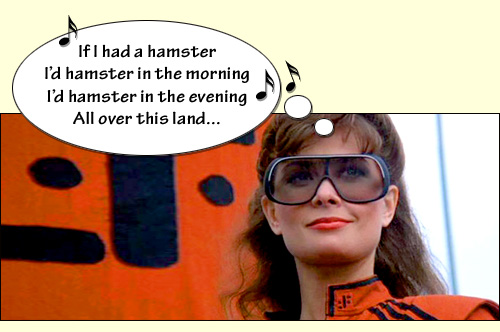

While in my local video store a few days back, in a rare moment of consumer weakness ((I’m not much of a ‘bargain’ shopper – I figure that bargain is just retail code for “We’ve got too many of these bloody things Hank – see what you can do to free up some shelf space…”)) I succumbed to a ‘buy-one-get-one-free’ offer and picked up a DVD compilation of all the episodes and the ‘movie’ of the 80s science fiction tele-epic V.

It didn’t seem like such a bad deal really – Violet Towne and I both had fond memories of V. You remember the schtick I’m sure: huge alien space ships the size of Donald Trump’s ego appear rather abruptly over a good number of the world’s major cities and hover there j-u-u-u-s-t long enough to give everybody the heebie jeebies. It turns out that the wait is merely due to the alien leader putting on her face. The doomsaying of a few negative Earthling Cassandras is, it appears, just overactive xenophobia. Shucks – the alien ‘Visitors’ are a jolly happy lot who want nothing more than to lend a helping hand to the struggling new kids on the intergalactic block. And to eat all our hamsters, steal our water and suck out our brains – but it’s not like anyone could have seen something like that coming, right?

Sure, there were a few troubling indicators, if you knew where to look: the aliens’ appalling dress sense (well, it was the 80s, so it’s not like they stood out that much), their insistence on wearing sunglasses indoors (that didn’t start happening for Earthlings until the 90s, so I guess that was a demonstration of the visitors’ advanced culture) and their habit of snacking on mice out of dumpsters (but hey – if you’re discreet…). Oh, and if you happened to tear their skin off, there was a surprise lizard underneath. ((In what must be one of the cheapest budget decisions made for a science fiction movie EVER, the Visitors never appeared as their lizard selves. Never. Not once. They goose-stepped around earth in their orange-uniformed monkey-suits, procreated with Earth women without giving anything away (now that must have been interesting) and relaxed in the privacy of their own off-Earth ships in their stretchy homo-prostheses. No alien in the history of science fiction has shown such dedication to keeping incognito!))


In any event, it didn’t take VT and I long to realise that our fond memories of V had taken on the rosy glow that only nostalgia can lend. The series (which David Icke probably thought was a documentary), was, in fact, pretty damn awful. The general structure of the thing certainly did have potential (ham-fisted Third Reich analogs notwithstanding) and the feeling of distrust and helplessness in the face of an implacable adversary is an idea that has a lot going for it. Our twenty-something selves evidently saw past the frightful soap-quality acting and into something of the concept’s promise – over the years our memories have thankfully expunged much of the dreadful dialogue and appalling plot contrivances.

Last night we got to the end of Series 2, in which, overcoming the sobering improbabilities of mammalian and reptilian genetic structures being anywhere near compatible, one of the cast gives birth to alien twins, the arrival of the second of which was undoubtedly supposed to instill terror in the viewing audience. But when the little toothy green reptile muppet ‘baby’ lunged ‘menacingly’ toward the camera (several times for good measure) Violet Towne and I simultaneously shrieked in unison, snorted our pinot through our noses and fell on the floor laughing. How did we ever accept such abominable bathos? I mean it’s not as if there wasn’t any better precedent – V post-dates Ridley Scott’s impeccable (and still mightily effective) Alien by a full 5 years! I guess we were just a lot better at the ‘willing suspension of disbelief’ in those halcyon days (and it was television – which in those times was in most cases notably inferior to anything you could see on the big screen).

At several times during our V marathon, VT and I remarked that it was surprising that no-one had attempted a remake of the concept, and, of course, teh internets piped up to let us know that someone is doing just that. It will no doubt thrill all you V aficionados down to your little webbed toes (and have David Icke struggling even harder in his straight jacket) to know that ABC is airing a new series of V this November. And the subset of those devotees who are also fans of Joss Wheedon’s lamentably short-lived Firefly will be doubly chuffed to learn that the Visitor leader is being played by Morena Baccarin – a woman so impossibly beautiful that apparently she can only get roles that require an impossibly beautiful woman who is really a lizard (well, seriously – after a smashing debut in Firefly, she fairly disappeared without a trace. WTF?) Alan Tudyk (Firefly‘s ‘Wash’) also has a major role in the new V ((One is inclined to speculate that people at ABC actually watched Firefly (unlike anyone at Fox, evidently) and knew a good thing when they saw it…))


I think we can assume that ABC is attempting a Battlestar Galactic-style remake of V, which, all things considered, could be kinda fun. At least we can expect the acting to be better, and hopefully something a little less lumpen in the way of allegory and story.

I have to confess, though, Faithful Acowlytes, that these musings have become something of a digression from my original purpose for this post – I meant to use my examination of the colourful antics of V to illuminate an entirely different matter involving aliens and earthlings. As this post has already become rather lengthy, I’ll forbear for now. But stay tuned for Part 2, in which we’ll ask some serious questions about alien/human interaction. And no, it doesn’t involve kinky lizard porn.


I dunno. The catchy slogan isn’t really selling it for me. Lose weight with your mate? It’s not like setting out on a hang-gliding adventure or forest walk together. “C’mon honey! The bathroom’s free! Now’s our chance to update the Captain’s log!”

At least we can be sure that they gave this concept to the right advertising person – someone who was totally full of shit.

(Spammers are sending me a most perplexing and inane variety of stuff lately – I’ve had them trying to sell me everything from sandals to magic wands (yes, that’s right – “magic” wands – not big penises). And psychics! I must get at least twenty advertisements for psychics per day. This tells me one thing for certain – they’re really not psychic. Otherwise they would have a very clear picture of what I would do with them – Hint: it involves large quantities of MaxColon)

The Return of the Wise Guys

Computers have become so powerful now that it is possible to do things that are quite mind boggling. I have no doubt that you’re all aware of what’s going on in the realm of digital image, but us sound dudes can do some pretty cool stuff too.

Let me tell you about convolution reverb.

It is a truth universally acknowledged that no matter what your level of vocal talent, you will always sound better singing in the shower. The technical reason for this is that bathrooms have nice shiny reflective tile surfaces, and the reverberation off those surfaces allows you to hear your voice more clearly. ((It’s pretty hard to ‘hear’ your own voice in your head. When you sing, you are using reflections off the space in which you happen to be to judge your pitch – this is the reason that people often sing out of tune when they’re listening to music in headphones.))

It follows logically, then, that if you sound good in the shower, you’ll sound really good on stage at, say, the Sydney Opera House, with all its great reverberant reflections and acoustic properties. Of course, it’s not possible for you or me just to whip up an a capella version of Copacabana on the Sydney Opera House stage on a whim… or, at least it hasn’t been possible until now! Yes folks, not only can you now hear how your best Barry Manilow impersonation would sound onstage at the Sydney Opera House, but we can precisely simulate your performance in any acoustic space – caverns at Carlsbad… Wembley Stadium… Abbey Road studios… in a glass jar, a metal bucket or even a broom cupboard (where Barry Manilow would, arguably, sound most appropriate).

All this thanks to fast computer processing and ‘convolution’ mapping of acoustic spaces (stick with me folks, it’s pretty damn cool…)

As I’ve already mentioned, we gauge the details of the sound of a room by the reflections off surfaces in that room. Our ears are able to hear very small variations in frequency, and our brains, by comparing the information from one ear with the other, determine the exact aural characteristics of the environment we’re in. Quite obviously, every acoustic space is completely unique – it has an acoustic ‘fingerprint’ if you like – and we are able to very accurately judge aspects such as size, shape, harmonic frequencies and surface qualities of our surroundings. All this happens completely automatically of course – you don’t think ‘Ooh, I’m in a room thirty metres long with a fundamental harmonic frequency of 160Hz and plasterboard walls!’, but rather ‘This is a big hollow space!’ or ‘This is a cupboard!’

So, how does that become useful? When we record instruments of voices in a studio, we mostly strive to get the ‘cleanest’ most unaffected-by-the-environment recording we can, so that we may add acoustic effects such as reverberation and delay at some later date. This is done for two reasons – one is that any reverberant characteristics originally recorded with an instrument are ‘stuck’ to it – you cannot remove them. A flute recorded in a big church will always sound full and awash with reverb – nine times out of ten, that’s not desirable. The second reason that we prefer a ‘clean’ recording, is that we can apply reverb and other effects judiciously as we need, to make for a better and more pleasing balance in the audio mix.

When it comes to music recording and film sound, then, you can understand that being able to call up particular audio characteristics on demand has significant value. Up until now we’ve relied on artificially created approximations of real environments – good enough to fool your ear, but nothing like the real thing. Now, we can get so close to the real thing that even experts have trouble picking the difference. In other words, we can now use on our recordings the beautiful, real, rich ambiences that have been created in performance spaces and studios around the world. Or, if we need to, the sound spaces of interior cars, hallways, schoolrooms, water towers, aircraft hangars or jam jars – you can see how we film people might like that kind of thing.

So how is this impressive audio magic done? Well, if I don’t go into too much technical detail, it’s actually quite simple. We take a sound – optimally a tone sweep ((This is basically a sound that starts off really low in pitch and ‘sweeps’ to really high over a few seconds. A sharp transient sound like a pistol shot, or an electrical spark or a balloon pop can also be used – hence the term impulse response that you’ve heard me use.)) – and play it in the environment we want to model, re-recording it in high quality within the acoustics of that place. Then, using some fancy software, we compare that with a ‘pure’ version of the tone sweep. The software calculates the difference between the two sounds and uses that to build a map of the frequency responses and delays of the actual space. It takes my computer about a second to process the file – incredible. From this I get a ‘convolution map’ that I can then use in my audio software to apply to any other sound.

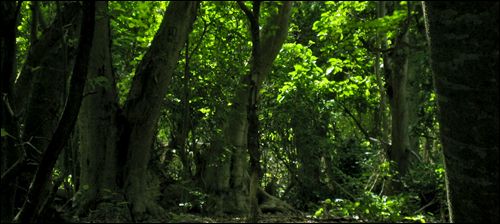
As I mentioned in my most recent post about Masthead Island, the Pisonia forest in the middle of the island had some very nice acoustic characteristics. I wasn’t able to take up equipment for making tone sweeps, but I recorded some ‘make-do’ resonses with sharp hand claps.

So, after such an exhausting technical lesson, I know you’ll want to hear some demonstrations of what I’ve been yammering about, and, lucky for you, I have prepared some earlier! So first of all, we need to start with our source sound, and I’m sure you’re way ahead of me with what that might be…

1. Here we have a duck’s quack as you might hear it in a field, with no acoustic reflections:

Download Raw Duck

2. Now, a duck as you might have heard it in the Pisonia forest on Masthead Island:

Download Forest Duck

3. Next, a duck on stage at the Sydney Opera House (as you might hear it from the stalls):

Download What’s Opera Duck?

4. And finally, a duck recorded in a washing machine just before you throw the spin cycle switch:

Download Washed Duck

There were, alas, no actual ducks on Masthead Island, but I can assure you, if there were, they would sound much like #2 above.

So, faifthful Acowlytes, that’s the TCA Crash Course in convolution spatial mapping. Your task for this week is to listen. That’s it: simply listen. As you walk about your daily lives, listen to the way your voice sounds in different rooms. Listen to the ambience on the street as sirens sweep by. Listen to yourself singing in the shower. Listen to how the sound of your voice changes as you walk from one room to another.

And marvel with me that we can now reproduce the acoustics of all those experiences exactly.

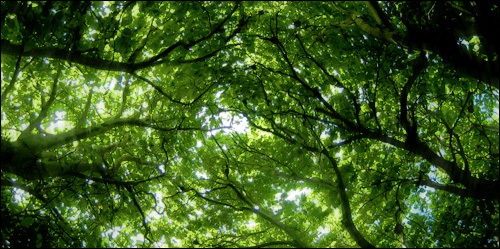
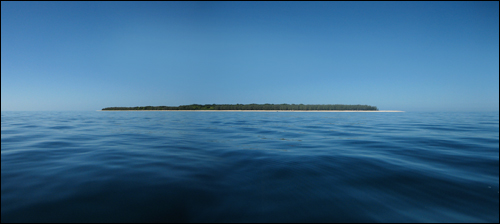
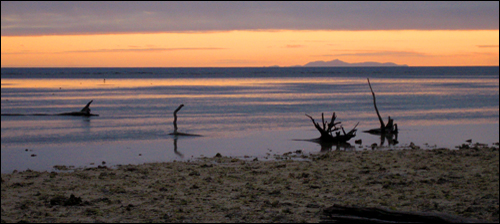
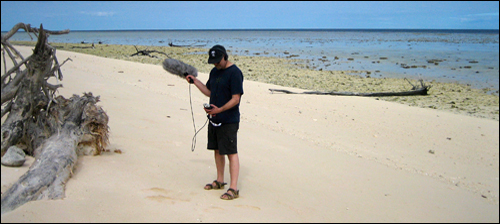
You know how good it sounded in the telling? It was better in the reality. If you can conjure up an image of a ‘Gothic Island Paradise’, Masthead Island is it. Probably just as well then that the film I’m working on is a ghost story…

My main regret is that I only had three days to spend on the island itself – the rest of the week was taken up with travel. It sure ain’t an easy place to get to. Or to escape from… (mwahahahaha!)

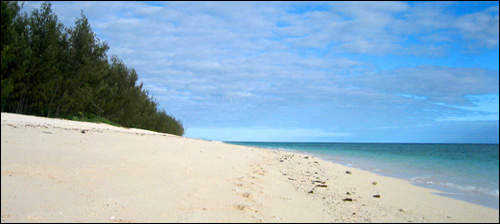
I can’t really talk too much about the film just yet – and anyway, no-one wants a creepy tale spoiled for them. Let me just say that the island itself is a significant character in the story and it fulfills its role better than I could have ever expected, with beautiful bone-white coral sand beaches, a lagoon the colour of nicely aged cyanide, and a dense interior of hollow Birdcatcher Pisonia glades edged with blurry casuarinas and Velvet Soldierbush, urgently whispering suggestions to visitors to leave before it’s too late…

I recorded the sound of waves on the distant reef, the shush of the casuarinas, the sombre lap of the incoming tide on broken coral. I made some wind chimes from shells and coral and recorded them in the quiet of the forest – a brittle, tinkling sound like dull glass merged with bamboo.

I also caught enough material to make the third CD in my Morphium series, Atoll.

I took some time to record some impulse responses inside the Pisonia forest – if that means nothing to you, stay tuned. Next post will be an explanation of a truly amazing invention of contemporary audio technology – a technique that allows us to make digital ‘maps’ of acoustic spaces.

« Previous PageNext Page »