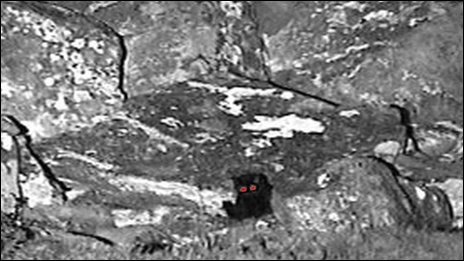
Glitch says he has never been to the Cairngorms.
Wed 8 Feb 2012
Posted by anaglyph under Cats, Spooky
[13] Comments
Thu 2 Feb 2012
Posted by anaglyph under Movies
[4] Comments
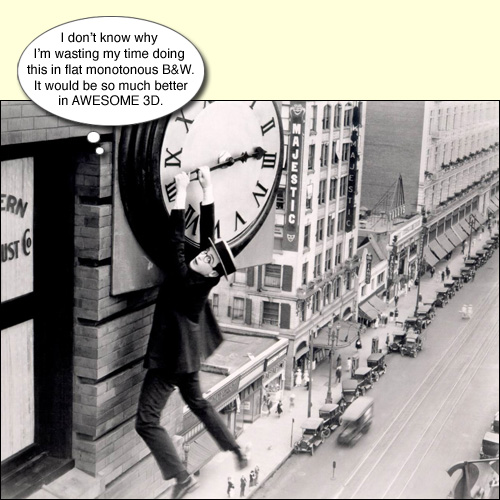
(This is Part 2 of my review of Martin Scorsese’s Hugo You can read Part 1, which is mostly concerned with the film’s 3D, here.)
Clocks. Trains. Paris. Books. Magic. Méliès. Movies. Scorsese.
You could’ve pitched this movie to me in just those words and I’d’ve plonked my money down on the table. A tale about a kid who lives in the steampunk recesses of a Paris railway station and steals clockwork bits in order to repair a damaged automaton that can write? Count me in! A paean to the magic of cinema, the magic of magic, the power of imagination and the genius and vision of the eccentric and wonderful Georges Méliès? I am SO there. A story about fixing broken things and discovering their purpose which is really a metaphor for human loss? I love it!
So how did this film manage to piss me off quite so much?
Well, as I said in the last post, the 3D didn’t help matters any. And it wasn’t just the technical side of the 3D, nor the 3D filmic technique, which I think I’ve covered quite thoroughly. This film suffers from core conceptual problems that start with the pretentious use of the 3D and infect pretty much every aspect of the enterprise.
Just to set the scene (I’m sorry, there will be spoilers. If you haven’t seen the film, and you care, stop reading now):
Hugo Cabret (Asa Butterfield) is a young boy who, when we join the story, lives inside the less-travelled parts of the old Montparnasse station. In a flashback near the beginning of the film, his father (Jude Law) appears briefly to introduce Hugo (and us) to an intricate clockwork mannequin, who, he reveals, is an automaton that he has ‘rescued’ from the museum where he works. It is broken, but when Hugo asks ‘Can we fix it?’ his father says ‘Of course we can fix it!’ For Hugo and his dad (and Hugo’s uncle Claude, a sodden inebriate rendered in outstanding cliché by Ray Winstone) are clockmakers, and fixing things is their game.
Hugo’s father promptly vanishes from the story in a fire, his expositional purpose satisfied, and Hugo is marched off from his home to his new digs in the dark, steam-filled recesses of the train station where his Uncle Claude keeps the clocks running. Well, it’s better than being sent off to the orphanage, or so the film tells us. Unfortunately for Hugo, it turns out that rounding up orphans in the train station is the main preoccupation of the film’s antagonist (and comic relief), the Station Inspector (Sacha Baron Cohen). As the film gets into its stride, we gather that Hugo has been methodically stealing mechanical parts from an old man (Ben Kingsley) who sells toys from a stall on the station concourse. This, we eventually learn, is none other than the visionary filmmaker Georges Méliès, his life and career all but forgotten, eking out an existence barely ten paces off the frozen Paris streets. It turns out that the mysterious broken automaton (that Hugo is now attempting to repair on his own) is one of Méliès creations, and so the boy and the cinema magician are inexorably drawn together.
Even synopsizing it here for you makes it sound like a proposition that can hardly fail to be entertaining, and yet, for me, fail it did.
The ongoing friction between the Station Inspector and Hugo is sketched out in the film’s opening sequence, in which Hugo steals a croissant from a trolley (excuse me if I’ve got this wrong somewhat – as I mentioned last post, I was struggling to get my glasses clean and my eyes working through this early part of the film, so the details may be somewhat variant from what actually happened) and a frantic chase ensues. Or something. Anyway, there’s a very choppy action sequence in which we get our eyeballs pummelled and which involves slapstick funny walks from the the mobility-challenged Inspector. It is also the first of the movie’s clumsy cap-doffs to various other cinematic milestones, this one to the works of Jacques Tati. Soon afterward, Hugo meets the beret-bedecked Isabelle (Chloë Grace Moretz), who will eventually play, via the disclosure of a special heart-shaped key, an important part in the restoration of the mysterious automaton.
Isabelle, her eyes popping almost as much as the audience trying to grapple with the 3D, is desperate to have ‘an adventure’, and seems like she’s been snatched directly from the pages of The Famous Five.
Which brings me onto my first major gripe with the film – why does everyone speak plummy stilted Enid Blyton-style English in this movie? ‘Oh mother, please may I have buttered scones for tea – I’ll be jolly hungry if I have to go off to Pirate Island on an empty tummy!’ It’s set in France for Pete’s sake! Now, just because a film’s mise-en-scène is early 20th century Paris, I don’t expect an American studio to make it in the actual French language, but please, an effort, people? An accent? Anyone? I swear: we have a cavalcade of English actors in this film, from Richard Griffiths through Ben Kingsley and Jude Law to Christopher Lee, as well as the two marbles-in-the-mouth English kids, ((Well, OK, Chloë Moretz is American, but they slapped an English public school accent on her so thick that she’ll probably spend the rest of her career scrubbing it off.)) and there’s not an ‘Aw-haw-haw, ma leetle cornichon’ within coo-ee. It’s as if any accent that isn’t American is good enough for Americans to believe a story is set in ANY foreign country at all. I may be wrong, but my recollection is that the only person who attempted a French accent (and pulled off a decent one, at that) was Michael Stuhlbarg (playing René Tabard) and he’s one of the few frikkin’ Americans in the cast!
An American film with English people playing French people in a quintessentially French piece of history, with no sign of Frenchness except the set dressing (and some accordion on the soundtrack)? What the heck is going on here?
This blurring of Frenchness into Englishness seeps into everything. Isabelle loves to read, we discover, and frequents a bookshop presided over by the stern Monsieur Labisse (Christopher Lee). Who’s her favourite author? Dickens! What? Where are Victor Hugo and Gaston Leroux? Oh – who are they? Hugo has fond memories of his father reading to him as a child – Dumas’ ‘Three Musketeers’, right? Nope – it’s ‘Robin Hood’. This is not Paris, this is some kind of set-dressed Harry Potter version of Paris with croissants and berets and cafés but absolutely no hint of French artistic culture! And Georges Méliès played by Kingsley with an impeccable English demeanour? Huh? It crosses my mind that Marty Scorsese is afraid, maybe, that Americans might start to figure out that a country that doesn’t speak English was historically responsible for the invention of the magic of the cinema! ((Oh, I dunno. I’m just firing off shots in the dark. It just perplexes me that they couldn’t have at least given everyone a soft French accent. These people are actors. It’s not like they couldn’t do it.))
Because I was almost constantly aware of this affectation, ((Seriously – every time Isabelle says something like ‘It’s an adventure!’ I just wanted to smack her. It was like watching some terrible 1940s English kid’s movie.)) I couldn’t really tell whether the performances in Hugo were underwhelming, or whether I just thought they were, due to the persistant dissonance with the soul of the story.
The two kids in the main roles are perfectly OK, but they are certainly not deserving of the accolades I’ve seen in some reviews.
Hugo is played with jolting melodramatic pathos, and the genetic blessing of bottomless, pale blue eyes
… gushes Lisa Schwarzbaum from Entertainment Weekly, making ‘jolting melodramatic pathos’ sound like it’s a good thing. Isn’t he just channeling Mark Lester in Oliver? Could it possibly be that the critics have just been sucked in by a cute kid?
Butterfield and Moretz have a wonderful transparency
… says David Edelstein from NPR. Transparency? Huh? What the fuck does that even mean?
When we see a clip of Charlie Chaplin’s The Kid at one point in the film, I thought ‘Uh-oh. Best not linger on that too long Marty, or we might start to make comparisons…’ Anyway, whatever, like I said, the kids were fine, in a Five Go Mad in Dorset kinda way. As were all the adults: fine. There are no stellar performances in this film. Kingsley plods through as a grumpy Méliès, Jude Law reels out an acceptable ‘gee-whiz-golly-gosh’ dad, and Sacha Baron Cohen does the kind of usual schtick he does outside his own material. ((For me he mostly wasn’t funny. Another tip for Mr Scorsese: if you’re going to have a slapstick character in your movie, best not to refer to clips of the great physical comedians of the cinema, like Chaplin and Keaton and Lloyd, in the same film. It only serves as a reminder of how great they were and how much of a shadow a lesser performer can be.))
If something is more bothersome than the accents, it’s the non-sequiturs, oddities and contrivances of the lumbering plot. Why is Méliès so darn tetchy? When he burns Hugo’s father’s sketchbook partway through the film, and gives the charred remains back to Hugo, he just looks like an intractable and nasty old bastard. It’s a deed that is cruel and petty and I’m not sure what it was trying to tell us about his nature, unless it was that he is a mean-spirited character prone to vindictive acts. It serves no real plot point, since Hugo manages to repair the automaton without the book anyway. I understand why Méliès took the book, and I can even understand why he might have destroyed it, but not why the filmmakers felt compelled to have him give the burnt remnants back to the obviously distraught young boy. There is a sadistic quality in the whole idea that, in my opinion, is not motivated and never redeemed. It’s almost as if the sole reason the sequence exists in the film is to deliver a spectacular shot with some nice flakes of floating 3D ash. Surely not.
The principle motivation for Hugo wanting to restore the complicated clockwork automaton is that he seems convinced that, when it starts writing (the task for which it seems to have been created), it will deliver a message from his father. Why Hugo believes this is puzzling, because his father quite clearly tells him in the expositional flashback that he doesn’t know where the mannequin came from, who made it or what it will do when it is repaired and activated. The father is not in anyway implied to have been instrumental in its purpose. I guess we are supposed to chalk the boy’s odd conviction up to the confusion of his emotional young mind, but it seems to me to be something that really should have been ironed out in the writing.
Anyway, there are numerous discontinuities of this kind in the film, but I won’t belabour the point. The most egregious problem with Hugo is not in the details anyway, nor, really in the length of the film, which is the thing that has attracted most of the flak in negative reviews (a long film is not necessarily a bad film, although you do need to be on your game if you want your audience to stick with you for 2+ hours).
The worst thing for me about the movie was that it takes a bunch of fundamentally great ideas and trashes them. From the orphan-finds-his-true-place-through-adversity undertones of Oliver Twist, through slapstick cameo interludes that invoke the spirit of Jacques Tati, to the old-man-instills-love-of-cinema-magic-in-young-boy patina of Cinema Paradiso, Hugo cribs from the best, but manages to make all its borrowed ideas into lesser ones. For a film about magic, it felt to me leaden and dull. The few moments of true wonder – the mechanical man revealing his cryptic message; the emotional discovery by the children of Tabard’s Méliès museum; the recreation of Méliès’ film studio and sets – are crushed by mawkish melodrama and by the overbearing, heavy-handed contrivance of Scorsese’s desperation to make a statement with 3D. A film using a poorly-executed technical novelty about a genius of technical innovation? C’mon. Pretentious, much?
A modern audience can’t help but see Méliès’ footage as quaint and amusing, but we must remember that at the time, these were astonishing and innovative special photographic effects, and the fantastical creatures and landscapes of A Trip to the Moon were probably as impressive technically as we view the alien world of Pandora in Avatar today. In my view, Scorsese absolutely fails to get this idea across. Méliès was a complete master of special effects, having taught himself every aspect of the nascent film craft from the mechanics of the camera, through developing his own film, to designing the sets and the costumes (which, incidentally, were not realised in the bright colours that Scorsese shows us. Méliès discovered pretty quickly that colours behaved unpredictably when photographed in black & white, and so had all his sets and costumes manufactured in shades of grey). To even come within bowshot of using a special effect technique to illuminate this story, Scorsese would have had to have pulled something really special out of his hat, and I’m afraid that the best he could do was to produce a rubber chicken. ((I do wonder whether, for many people who liked this film, the real reason is that they simply had never heard of Méliès before, and the revelation of his great cinema genius is like a magic trick in itself. I remember discovering him several decades ago and almost jumping for joy that such an inspired filmic lunatic had existed there, right at the Dawn of Cinema. I felt he was so much like myself at the time: he was bored in school as a kid, was constantly tinkering with gadgets, was fascinated by science fiction and fantasy (and real science too), loved photography and stage magic and had an unquenchable desire to illuminate the minds of audiences with bizarre and fantastical tales. He stands as one of the great visionaries of the cinema and is rightly deserving of wide recognition.))
At the end of the movie when we see documentary footage from World War 1 rendered into 3D, I was ready to throw stuff at the screen. When Scorsese had the temerity to do the same thing to the original Méliès footage in the following sequence I knew he’d lost all respect for the great man, for cinema and for his audience. Making an ‘improvement’ over the the films of George Méliès by making them 3D is a cheap concession to special effects. It’s a childish ‘We’re SO clever – just look at what we can do now!’ that adds exactly nothing to the idea except the sheen of Hollywood condescension.
Setting the Méliès story inside another more emotionally simplistic story felt to me intrinsically flawed, too. It might have worked, I suppose, but the young Hugo’s melodramatic tale, laced with workhouse pathos as it is, somehow points up the wrong things about Méliès work, reinforcing a modern perception of his filmic exploits as hammy and staged. The same problem is evident in Merhige’s 2000 Shadow of the Vampire. The makers of that film likewise interpret proto-cinema (in their case, Murnau’s astonishing Nosferatu) through modern sensibilities and attempt to couch the whole affair in a kind of pantomime. To do such a thing is to profoundly misunderstand the genius of these early moving pictures.
For me, the greatest disappointments in cinema often follow this model; the promise of something great is dashed by the filmmakers losing track of the purity and integrity of the original idea. I am left wondering if John Logan’s script could have worked in someone else’s hands; if, had 3D not been an issue, it could have been executed differently and survived its other flaws; if, indeed, that any director could convey the visions of Georges Méliès to a modern audience in a way that was true to his real brilliance? Possibly not. But one thing is for sure: for me, at least, Martin Scorses’s Hugo doesn’t even come close.
And that is a great pity.
Mon 30 Jan 2012
Posted by anaglyph under Movies
[22] Comments
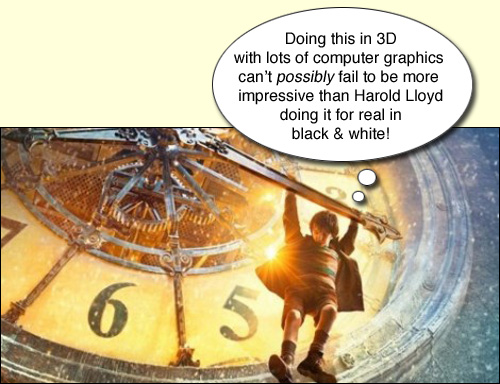
As you have no doubt already intuited, this is going to be one of my very rare movie reviews. And I’ll say it now – it’s a long one. I make no apology, because in this case, I’m really going against both critical opinion and audience acceptance (and probably the Oscar for Best Film) so you can be sure I will say controversial and entertaining things.
Yesterday I went to see Martin Scorsese’s fêted kid’s film Hugo. I made a special effort to see this film, and in 3D, because, you see I had been told two things about it (which turned out to be completely untrue): the first was that it’s ‘not really a kid’s film’, and the second that the 3D ‘is really great’.
Consequently, I will split this review into two parts, although there will inevitably be some overlapping. First, the 3D.
As many of you know, I have come to hate 3D in the movies. I didn’t always – I’ve long been a fan of the old anaglyph black & whites like ‘Creature from the Black Lagoon’ and ‘It Came from Outer Space’, and I have a fond spot for André de Toth’s seminal House of Wax and Hitchcock’s wonderful Dial M for Murder. These films, and others like them through the fifties and sixties, made admirable and necessary explorations into what seems like a logical direction for cinema to go. Unfortunately, there are many, many complications with making 3D work in the moving image domain, and those films never really conquered them. As a result, 3D was, decades ago, relegated onto a back shelf of cinema history, and despite several optimistic attempts to air it out through the 70s and 80s, it has never managed to get traction on the big screen. The difficulty in making 3D acceptable to an audience has always been blamed on the inadequacies of the technology – which is a fair criticism to a point – but as Hugo demonstrates very clearly, that’s only part of the problem.
Part of the problem it is though, and my experience with Hugo was no exception. This presentation was made using an active shutter system (XpanD, specifically) which basically entails a pair of 3D glasses that rapidly blank out alternating left/right images coming from the screen in such a way as to direct the appropriate image to the appropriate eye and so achieve stereoscopy. It is probably a superior system to the polarized X/Y axis technology (which I find supremely annoying) but only just. The first irritation became apparent as soon as the movie began – the damn glasses were greasy and dirty. So not only was I getting a dim murky image due to the attenuated luminance that 3D inflicts anyway, it was further degraded by great smears of refracted light in my peripheral vision. And try as I might, I couldn’t clean the glasses with anything I had to hand. So what – now everytime I go to the movies I have to remember to take a bottle of lens cleaner and a box of Kleenex with me? ((Later, as I left the cinema, I saw the staff frantically re-smearing all the XpanD glasses in preparation for the next show. I should have paid more attention to how they were doing this, but my eyes were still trying to adjust to seeing normally. My fleeting impression was that they were just wiping the damn things with a rag that was no doubt saturated with popcorn butter from all the glasses of the last five sessions. As with many aspects of modern cinema, the ‘advances’ in technology are mostly just creating more work for already underpaid people.)) This was almost distracting enough to make me want to leave thirty seconds into the film. When I pay $17 to see a movie, ((Violet Towne actually shouted me to this screening, so it was really her money. Sorry honey.)) I want to see the movie, not hazy tenebrous images filtered through the remnants of some kid’s hot-popcorn-butter-smudged fingerprints. Still, I had been told the 3D was ‘great’ in this film, so I persevered. I had, however, been distracted enough to miss the film’s set up. Good one 3D! Within a few minutes the major drawback of the active shutter system technology became apparent. The refresh rate of the LCD blanking technology is well below the frame rate of projected movie film, ((Unless the film is projected at a higher frame rate. Some systems are embracing a new standard speed of 48 or 60 frames per second to go some way to alleviating the refresh rate flicker problem. We shall see if that makes it any more bearable.)) and this creates an unpleasant strobing effect whenever there is a quick camera movement, or a bright, rapidly moving object in the frame. ((Moving 3D film images tend to have a problem with strobing on horizontal moving objects anyway, for very technical reasons to do with the way our brains detect rapidly moving hard edges.)) And guess what – this film has lots of falling snow. Little particles of bright 3D snow that zip and dart and STROBE across your field of vision. Horrifically distracting. And it hurts us, it hurts our eyeses, precious. Come ON, guys. Moving pictures have spent a century contriving to look fluid and seamless and now you expect us to put up with this kind of crap? To make matters worse, the opening sequences of Hugo are crammed with fast tracking sequences, fast action and rapid cutting. Scorsese flings the camera around like it’s a ball on a paddle bat. Technically speaking, for the moment 3D does not tolerate this kind of thing very well. ((And the corollary is that, for the moment, you should avoid doing it.)) It’s puzzling that Martin Scorsese, a filmmaker of extraordinary accomplishment, has not picked up on this fact.
And it’s here that I knew with absolute certainty that the 3D in this film was going to be anything but ‘great’. Oh, there’s a LOT of 3D, no question about it. Every shot is crammed with 3D-isms. There’s smoke and snow and dust and ashes and sparkles and cogs and dogs and shafts and fog and just about everything you could ask for to add visual depth to the image. It’s just a pity that it doesn’t add any other kind of depth. I can almost hear Marty screaming ‘There’s not enough 3D in that shot! More CG smoke – I don’t want them thinking I’m some kind of modern-day de Toth!’ ((André de Toth, the director of House of Wax was famously blind in one eye, so he could not actually see the 3D effect in the film. He evidently relied on the rest of his crew to make sure it was viable.)) The people who had been raving that the 3D of Hugo was ‘great’ just meant ‘there’s a lot of it’ – not unlike the people who tell me they think the sound in a movie was ‘great’ when what they actually mean is that it was ‘loud’.
Now, one of the the knock-on effects of having extravagant lashings of 3D in every shot is that your eyes want to look at stuff. In the real world this is what happens. Something moves in your field of view, you look at it. People talk, you look at them. A boat on a lake in the distance is pretty, you look at it. What never occurs in the real world, however, is that these things all take place within seconds of one another in a rapid replacement effect. There are two major catastrophic blunders that you can make with 3D, therefore, and Hugo makes them again and again and again and again.
The first is that you can’t just cut from one shot to another shot without any regard for where people’s eyes might be. In flat 2D filmmaking, we’ve spent decades honing our skills in such a way as to guide the eyes and ears of the audience in a carefully choreographed ballet of vision and sound. The art of montage – the ‘editing’ of the film – is an integral part of good filmmaking, and it’s one of the things that you study intensely as a young filmmaker. Thelma Schoonmaker, Scorsese’s editor, is an acknowledged doyen of the craft and it’s a mystery to me how the pair of them managed to hack their way through this film so badly. It’s almost as if Thelma said to Scorsese: ‘Marty, I don’t give a flying fuck about this 3D fad. I’m just cutting the film like I usually do.’ ((Like Tim Burton apparently did with Alice in Wonderland.)) The first ten minutes of the film had my eyes popping back and forward, left and right, in and out, up and down until I felt like Marty Feldman at a tennis match. No wonder people complain about 3D giving them headaches.
The puzzle here is that, again, it’s almost like the people who made this film have never bothered to watch, or learn from, the 3D films that have come before. ((I can’t believe, for instance, that Scorsese has taken nothing from Hitchcock’s masterful use of 3D in Dial M for Murder. Hitchcock only did this one film in 3D, and audiences of the time never saw it that way because – does this sound familiar? – they had tired of the 3D fad and the film was released flat to maximise its profitability. Nevertheless, he embraced the potential of the idea and absorbed it almost effortlessly into his filmic arsenal. As a result it was, and remains, one of the best uses of 3D to date, and I pine for one of the current batch of 3D advocates to come up with something half as well realised.)) 3D demands a particular kind of language just as 2D does, and you simply can’t barge into it with the same techniques that have served you in the past. For a start, it necessitates an understanding of what your eyes actually do when they look at things in the real world. The only time, for instance, that you need to snap your focus from a person talking in the middle distance to a big thing close to your face is when something extremely unexpected or confronting happens. In real life, this mostly causes you to jump backwards and knock your beer over. Now, when making a film, if it’s not your intention to smack the audience in the face like this, DON’T DO IT. And certainly don’t do it repeatedly, because the other problem here is that it makes your eyes do things they never, ever do in normal circumstances. Geez, for the first time in my life I feel like I could easily teach Martin Scorsese a thing or two about filmmaking. That should just NOT be happening.
The other appalling 3D fumble that is committed in this film, often in lock-step with the oafish cutting mentioned above, has to do with focus. This is a mistake that has been committed in every single one of the recent crop of 3D live action films ((But not with animated films. I wonder if you can work out why?)) and it makes me mad every time I see it. It’s the act of having things in the frame out of focus. Now, in 2D, we’re used to seeing this technique. It’s not a function of natural vision, but is a trick of photography, and it is used to direct the eye to something, or to throw it into relief. It works in 2D only because watching things on a 2D plane is not realistic, and so we have learned non-realistic tricks to help us make sense of the 2D image. The problem is it simply does not work in 3D. This is because – I hope you’re paying attention here Marty – we do not see things out of focus in real life! ((Unless of course we are myopic and don’t have our spectacles on. But I don’t need to tell you that no-one actually seeks out this state.))
Human vision is an amazing thing. It’s mostly amazing because only a small part of it is to do with optics. The rest has to do with a complicated system of visual processing in the brain. As far as the brain is concerned, things are only ever out of focus when there’s a problem. This is because our brain modifies our visual apparatus constantly, racking focus, pulling aperture, adjusting stereoscopic convergence, tilting and panning, and then gathering the information from this process to provide what appears to be one seamless binocular vision of our circumstances. Critically, it does this by ignoring a lot of stuff. One of the the biggest visual distractions it has learnt to ignore is anything that is out of focus. In your normal day-to-day life, you are very seldom aware of things that are out of focus.
Go on – try it now. Look around the room and try and see something in your field of view that is out of focus. You can’t do it! Whether it’s on your desk, over near the piano or out the window, your brain is constantly working overtime to make sure everything is properly focussed for you to look at. Things that it doesn’t focus on, it just doesn’t pay attention to. ((If you’re not following me here, you’ve misunderstood – as have most modern filmmakers attempting 3D – a fundamental mechanism of human vision. We do not see the world like a camera sees it. We have spent a century ‘learning’ how to see flat 2D images as portrayals of reality, but this is essentially not the way we see things in reality. Even if you have vision in only one eye, and are unable to resolve stereoscopy, you still don’t see the world like a camera does. It’s all to do with the fact that a camera is a purely optical system, and human vision is a computer-enhanced information gathering system.)) If people move in and out of your view, you can’t help but focus on them. If some fireworks go off outside, you focus on them. In fact, your world is in focus ALL THE TIME, if your brain can make it like that. And when it can’t (such as when someone thrusts a newspaper in your face and you have to step back to resolve it) you find it annoying and inconvenient. So filmmakers: WHY ARE YOU DOING IT IN 3D MOVIES? ((To try and illustrate the problem with a 2D analogy: imagine you are watching a film in a very wide anamorphic ratio – you know, Cinemascope or something. Now imagine that there are two characters talking. One thing you never do – unless you’re doing it specifically to call attention to something – is to put the two characters on the far left and right of the screen and cut between them as they talk. Why? Because the audience would be forced to snap their heads back and forth as the actors appeared first on the very left of the screen, and then on the right. It would quickly become very tiring and intrusive. We’ve evolved all kinds of film-making language to make sure that audiences aren’t popped out of the movie with irritations such as this.))
Let me give you an example of how horrible it is in Hugo ((This is just one example of many instances of it in this film – far more than I have seen in recent 3D offerings. James Cameron did it numerous times in Avatar, but only in the live action sequences. It never happens in the computer modelled scenes. I’ll leave you to reflect on why that is…)) In one scene, the eponymous Hugo and his friend Isabelle are standing in a clock tower looking out over Paris at the illuminated Eiffel Tower. The camera is behind them and tracks back. The focus is on the Eiffel Tower. The Eiffel tower is right in the centre of the frame. Hugo and Isabelle, in close foreground, are out of focus. This is irritating, but acceptable for a bit, since they are dimly lit and you are, after all, being directed to look at the bright Eiffel Tower. Then Mr Scorsese does something that is entirely acceptable – artistic and clever, even – in 2D filmmaking, but is brain-achingly stupid in 3D. He racks focus from the Eiffel Tower to our protagonists. In 2D, this would have the effect of drifting with our attention from the pretty-but-irrelevant centrepiece of the shot, back to the storyline. Movies do it all the time. So much so, that it is, indeed, a real skill to know at exactly which moment to force the focus pull in order to be in sync with the audience’s point of awareness. But CRITICALLY, this is a trick of 2D photography. In real stereoscopic human vision, we just don’t interpret the world like that, and so if someone does it in a 3D film, our brains are forced to do a very strange thing: we need to recompute the environment to try and make sense of it. In my brain, at that moment, it went something like this:
‘Oh, that’s a pretty shot of the Eiffel Tower. Weird out-of-focus people in the foreground, but whatever. Look at that beautiful model of Paris with all the lights on the Tower. I wonder if it really looked like that in the 1930s, electric light must… WHAT THE FUCK – EVERYTHING’S GONE OUT OF FOCUS. Oh. I see. I’m supposed to be looking at the actors now.’
To put it succinctly, if we were involved in this kind of scene in reality, we might look at the Tower, look at Paris, look at the kids, look back at the Tower – whatever. CRUCIALLY, nothing would ever be out of focus, especially the brightly lit BIG thing right in the middle of frame.
‘But wait just a goddamn minute!’ I hear you say. ‘It’s a movie, and movies are not reality. Movies do stylized tricky things all the time, and that’s OK! What about close-ups and Dutch tilts and zooms and stuff? They’re nothing like ‘reality’!’
Close-ups and Dutch tilts and zooms and jump cuts and a whole arsenal of cinematic hocus pocus has arisen, just like the focus rack, in the domain of the artificiality of 2D photographic image. They are techniques that ask us to make mental adjustments to the way we view a flat, already artificial, world. We simply cannot expect them to translate into a 3 dimensional space. They might, but if they don’t, we shouldn’t just go ahead and use them anyway, which is what’s happening here.
The mental disorientation with the focus shift that I’ve outlined above all happened very rapidly and quite subliminally it is true, but the significant point is that a contrivance of technique popped me straight out of the movie. As filmmakers, we spend every working moment trying to make sure that we don’t pop people out of the willing suspension of disbelief. To do so is the greatest single moviemaking crime you can commit. If we are to continue with this 3D thing we really need to find new ways to direct the attention of the audience, methods that don’t go against everything that evolution has wrought in us from the day that some mud-dwelling crustacean discovered that two eyes are better than one for avoiding being eaten. ((Lest you think I am talking out of my ass with all this stuff, consider that in my job as a professional sound designer, I have already been there. Sound people have been adjusting to spatial changes in film sound since we went from mono to stereo back in the 1940s. And now, with ‘surround sound’ we have in fact been dealing with a 3D environment for four decades. We’ve learnt a thing or two about what you can and cannot do. One thing I can tell you with absolute certainty is that many things that were totally acceptable in mono soundtracks just do not work in a full 3 dimensional spatial environment. We’ve had to learn new ways of making things work. And we’ve had to learn those new ways without making audiences hate the film because the sound hurt their ears.))
There are a dozen other types of similar terrible blunders of technique in Hugo: an extreme closeup of an eye looking through keyhole, where the keyhole is out of focus and the eye is sharp and crisp. (NO! Your eye would never see it like that! It feels WRONG because it IS wrong!); a horrible step-zoom where the focal plane changes every time a cut is made, forcing you to re-converge your eyes in a cascade of unpleasant jumps; ugly dissolves with convergence mis-alignments; ((Human eyes have a real problem with the kinds of artificial convergence thrust upon them in 3D photography. Again, this is a technical issue of human vision, and so is complicated to explain, but basically, when we look at objects we expect our eyes to refocus and re-converge stereoscopically at the same time. In the cinema, the focal plane is always constant (the screen) and the convergence is the only thing that changes. This is highly unnatural. We can do it, of course – otherwise photographic stereoscopy wouldn’t work – but it makes our eyes attempt to behave in a way that they would never naturally need to. It’s bad enough that movies force us to try to do it, but it’s MUCH worse when they make us do it rapidly and repeatedly. If you are the kind of person who feels nauseous when watching 3D, this is almost certainly why.)) rapid camera moves where you lose your point of convergence, scrabble around to find it, and give up because the shot just cut anyway; objects that are in focus in one shot and then out of focus in the subsequent shot, forcing your brain to try and make sense of why that is.
I won’t go on about it anymore – I think you get the drift. Everybody seems to be aware that 3D in the movies has to conquer many technical problems before it is a valuable (or even bearable) addition to the cinema experience, but as Scorsese’s Hugo demonstrates vividly, filmmakers themselves are probably its biggest liability. I simply don’t care to have the spectacle of stereoscopy if it hurts my brain, and I believe that this is what a great many audience members feel too, even if they can’t put their fingers on exactly why they don’t like it. I’ll raise it as a point of interest, even if I don’t know if it has any bearing on things, but I find it curious that the people who are pushing hardest for 3D, and making most of the 3D films, are largely old-guard filmmakers like Cameron and Scorsese and Spielberg and, soon, Ridley Scott. ((I admit to having a great deal of trepidation about Prometheus after sitting through Hugo. I was looking forward to seeing what both these directors did with 3D, since each was equally voluble about how much he loved it, and, in Scott’s case about how he would ‘never do another film in 2D again’. Now I just think I’m going to see the same old blunders committed over and over. I’m even inclined to see the movie first in 2D, just in case it’s actually a good movie and the 3D wrecks it for me.)) I’m not entirely sure why this should be – maybe because these guys are the only ones who can afford the technology and the budgets that warrant the extra cost of a 3D release – but what we need to see before 3D has even an ice-cube’s chance in hell of getting a foothold, is the arrival of some smart young filmmakers who can distance themselves from the ‘rules’ of conventional flat filmmaking and create a new language for stereoscopy that allows it to enhance the storytelling and emotion of a movie, rather than being the ‘next big special effect’. Until that day arrives, no amount of virtuosity in the mechanical/technical side of 3D is going to matter one whit, is my estimation.
Part 2 of this post will be coming up in a bit. If you think I hated the 3D, wait till you find out what I thought of the film itself…
Sun 29 Jan 2012
Posted by anaglyph under Daft Advertising, Facebook, Hmmm..., Hokum, Skeptical Thinking, SmashItWithAHammer, WooWoo
[12] Comments
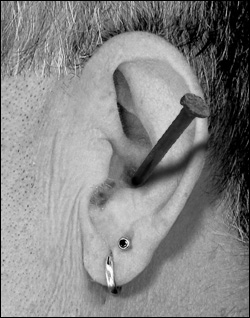
When the maker of some web app or another doesn’t know how to make money out of a popular idea, the go-to concept is of course to somehow shoe-horn advertising into the user experience. Those of you who have a Facebook account will be familiar with the little panel of ads that runs down the side of the page – a little panel that seems to increase in length every time you log on. Personally, I think it’s completely daft way for an advertiser to spend their bucks – I must have ‘seen’ several thousand of those damn things displayed on my Facebook page and I hardly even notice them. Someone has convinced advertisers otherwise, though, or they wouldn’t be paying for them.
If I do notice one, though, it’s usually because it has an overly-high annoying factor. An offering that popped up this morning was a shining example. Ladeez and Gentlemen, I bring to you today…
Ah yes. Your flim-flam detectors just went ping, right. If they didn’t, get off my blog!
Now, I must confess that until this morning I didn’t really have a great deal of insight into tinnitus. Well, not of a scientific kind, anyway. I know what it is, of course, being a professional sound person & all, and I’ve even experienced it myself in my youth when I was much less careful of my hearing, but I’ve never known much about it physiologically. After reading the Tinnitus Miracle™ website, though, one thing of which I was entirely certain is that you need absolutely no knowledge of tinnitus to get the feeling that this site is designed to fleece easily-deceived and desperate folks of their money by convincing them that it has the absolute, failure-proof, 100% guaranteed cure for their affliction.
And, as a prospect for a scam – for a scam it surely is – it makes sense. Tinnitus is a medical condition with all the requirements that make it ripe for the pickings of those who would greedily make money from exploiting others: it’s a poorly understood, highly subjective condition with diffuse symptoms, and it can have dozens of causes. It’s distressing, persistent and can even be painful, but it’s not life-threatening. Best of all for the woo merchants, it’s a sad fact that science-based medicine doesn’t offer much in the way of relief for many sufferers of tinnitus. ((Something that people who advocate ‘alternative medicine’ seem not to understand this situation too well, and you’ll often hear it put forward as a criticism. Science-based medicine never pretends that it has all the answers, because sometimes it doesn’t. There are some things science doesn’t understand very well. That doesn’t make science faulty – it just means that a complex world is not easily understood all at once. It’s a process. And the fact that science doesn’t have an answer to a complex problem doesn’t lead logically to the proposition that ‘alternative’ medicine does. Having no solution to a problem sometimes means, quite harshly unfortunately, that we don’t have a solution to the problem. We simply don’t know everything, and there is no imperative says we should. That’s not an easy thing to tell someone who is in pain, or who has a chronic debilitating condition. Unfortunately, as much as we don’t like that reality, reality really doesn’t care what we like.))
Even though I did go on to spend a little time reading about the condition, you really don’t need a lot in the way actual knowledge to get a strong sense that the Tinnitus Miracle™ ‘phenomenon’ ((Because that’s the way it’s promoted WIDELY across the interwebs.)) is decidedly fishy.
Skimming down the MASSIVE landing page starts the alarm bells ringing fast. ((Of course, if you have severe tinnitus, maybe the noise in your head might drown out said alarm bells. Perhaps this is what the makers of the Amazing Tinnitus Miracle are counting on…)) The amazing Tinnitus Miracle™ is an eBook that you can buy for the handy dandy price of $39, and which unequivocally offers to ‘give you the secrets to eliminate virtually all types of Tinnitus within 8 weeks.’ It’s the enterprise of one Thomas Coleman, ((Coleman may or may not be a real person. For the purposes of this post, I will accept that he is, although I did discover a number of things that made me suspect that he may be a fictional concoction.)) who purports to have suffered from tinnitus for 14 years and to ‘have tried every tinnitus treatment known to science and natural health’, including, but not limited to, ‘herbal remedies, Cellfood Oxygen, tonics, habituation, detox diets, vitamin therapy, hydrotherapy, aromatherapy, macrobiotics, reflexology, Chinese Medicine, vegetarianism, the Wai diet, magnetic therapy, the mucus-less diet, the blood type diet, psychiatric treatments and whatnot.’
The outcome is that none of these (not even ‘whatnot’) were effective. Even surgery didn’t help the poor chap, nor did ‘dietary’ advice nor white noise CDs. Eventually we learn that the unflappable Mr Coleman was cured after discovering ‘a simple holistic system [that] opened the door to my new and much brighter Tinnitus free life.’ The site spares no effort to attempt to impress upon us exactly what a MIRACLE this discovery was. There’s the familiar liberal use of exclamation marks, copious underscoring, oodles of hyperbolic claims, excitable slashes of yellow highlighter and then… THE SCIENCE. Well, no, I lied. There’s no science. None. Nada. Nuttin’. What we have is that ol’ reliable science substitute though: testimonials! Everyone KNOWS a testimonial is MUCH better than science. Let me show you how it works:
♥Tetherd Cow Ahead is the best blog in the universe, bar none. I read it once and it completely cured my cancer! ~ Landon from Illinois
♥I used to have trouble keeping it up, but thanks to Tetherd Cow Ahead I can now go all night! Tetherd Cow rocks! ~ Raymundo
♥I purchased the Tetherd Cow Virtual Glass of Water and I’ve never had a computer virus since! Awesome work TCA! ~ Kofi Anan
Now brace yourselves, Acowlytes: those are not real endorsements, and they hold no credibility whatsoever! I just made them up! I know it seems shocking that someone should do such a thing, and I know you wouldn’t, dear friends, but the internet is, alas, not completely populated by good honest folks such as yourselves.
The point is of course that a fistful of internet testimonials is worth about as much as the paper they are printed on. Unfortunately there still exist out there a substantial number of people who seem to think that if something is written down in words, why, it must be true! Or something. It doesn’t seem to occur to them that the endorsements could easily be as phoney as the names attached to them. ((I’ve long pondered why this should be so. I mean, I totally understand how you might buy a product that was recommended to you by a close friend. I can even stretch to understanding how you might buy a product endorsed by someone who you don’t know personally, but whose opinion you respect for some reason. But I can’t for the life of me even remotely comprehend why you would trust the opinion of some anonymous (and probably fictitious) name from woop-woop!)) What’s more, it seems that such people of limited perspicacity are unable to infer that fifty fake testimonials are no more persuasive than one. I could’ve written dozens above had I been so inclined – it’s not exactly difficult to make that shit up. ((It is vaguely possible that the testimonials are written by actual people, but this doesn’t necessarily mean they are genuine. Lots of people are willing to lend their name and photo out for a fiver. And, being extremely generous, even if the people are real, and the testimonials unsolicited, it still doesn’t mean that the information in them is necessarily accurate, nor representative of most tinnitus sufferers. Tinnitus does, in many cases, clear itself up spontaneously. If you have a few thousand people reading your book, it is quite likely that a small few will have spontaneous natural remission of the symptoms, and attribute it in some way to your magical cure. You only need a handful of those kinds of ‘miracles’ to make something look impressive…))
But it’s not until you try to find some more information about Tinnitus Miracle™ that you begin to see the real depth of this racket. Performing a Search™ on the term returns a veritable truckload of spew. Hundreds, maybe thousands of links that duck and dive through the tinnitus world, inevitably making their way back to a site selling Tinnitus Miracle™.
And not even the merest hint of proper science on a single one of them.
Searching for tinnitus+miracle+scam is an even more enlightening experience. Now we see dozens of hits in the vein of this site, returning search abstracts like ‘There is no basis for the tinnitus miracle scam’ and Is Thomas Coleman’s Tinnitus Miracle Book A Scam? My Opinion … – all couched in such a manner as to appear to be a critical appraisal of the product. If you click through, though, they all go on without exception to overwhelmingly promote Tinnitus Miracle™ in some way or another, often with direct links to the main TM™ site. There are pages of these duplicitous offerings – I clicked through a few dozen and I couldn’t find one that wasn’t some kind of endorsement of Tinnitus Miracle. ((This in itself is an intriguing indictment of the Tinnitus Miracle™ It shows clearly that the people behind it are completely aware that what they are promoting has every indicator of being a scam to those searching for tinnitus relief, and have shaped their marketing strategy accordingly. They are, in essence, predicting that they will be called on their scam, and then flooding possible criticism with noise.)) In fact, try as I might, I couldn’t find any negative critique of the Tinnitus Miracle at all. Lest you think that might be because the thing actually works, let me add that I also couldn’t find a single site that looked like it was a genuine unsolicited recommendation of the product either. To my eye, these sites all look like part of the Tinnitus Miracle empire – a vast and comprehensive attempt to stake a presence wherever anyone with tinnitus might search for some help. Now, there are two reasons I can think of that negative (or even mildly critical) reviews aren’t returned high-up in the search results. The first is that Coleman’s strategy is simply to super-saturate the SEO so that other links are just pushed way down, and you won’t easily come across adverse criticism, and the second rather more sinister one is that Mr Coleman is actively litigious and has aggressively quashed any unflattering press. ((I’d like to think this is not the case, but I guess we will see if that speculation has any substance if he finds this post.))
Another frustration I had was in attempting to find out exactly what might comprise the substance of the Tinnitus Miracle. After reading pages of mind-numbing verbiage, I was concluding that the book offering the wondrous Tinnitus Miracle was probably just a mish-mash of anything and everything that might pertain to tinnitus, with not much ‘miracle’ content at all. This site (another TM™ promotion, despite its efforts to appear to be something else), supposedly penned by one ‘Britni Dorman’ gives some support to that conclusion:
Here are some things you can learn from Tinnitus Miracle:
• Eight food items that are best for you in this condition
• Ten foods you must learn to avoid like the plague since they can worsen your condition
• The name of a powerful herb used in homeopathy that can reverse the condition quickly
• The 100% natural secret vitamin supplement that can impact your condition dramatically in just a few days
• Medications that can worsen the condition
• How you can diagnose your condition with the help of a multi-dimensional approach
• Effective breathing techniques and strategies that allows your body to begin the process of healing
Ah, right. Good foods, bad foods, vitamins, homeopathy and Evil Big Pharma drugs that you can blame. Uh-huh. And some yoga & meditation thrown in for good measure (‘cos it certainly can’t hurt, right?) As miracles go, this is looking about as impressive as producing a coin from behind a kid’s ear.
There’s lots more of the same on this site, which purports to be a tinnitus ‘treatment advice’ hub, but which is revealed by even a cursory exploration to be crammed to the gills with links to the main Tinnitus Miracle site. Perhaps the most hilarious part is the the ‘Pros & Cons’ section. Breathless raving about the pros, but the cons, well:
• Cons – When it comes to the cons, I have to admit that Tinnitus Miracle barely has any.
Mr Coleman may as well have appended his signature to that one.
I did turn up one comment on a tinnitus relief discussion group from someone who seems to know what the book entails. The main thrust of this thread is another tinnitus scam called Quietus, ((Another sure marker for scams of this kind is the appearance of other players on the field. You can bet that where there’s an opportunity to bilk vulenerable people, there’ll be more than one opportunist with his finger in the pie.)) but several sufferers ask if anyone has tried the Tinnitus Miracle. Well, someone called MissionCMD has done so, and had this to say:
I have purchased the book and read it twice. I have tried numerous things in it, but there is no ‘miracle’. There are numerous sections in the book that are duplicated (copy and paste) from one chapter to another… not to mention numerous spelling mistakes. Perhaps the ‘e-book only’ option was because the author could not get a publisher to edit? Overall, there were a few good suggestions, but there was no ‘miracle cure’ if that was what you were trying to ask. Essentailly just ways to try to manage the noise. I did a detailed search for almost three hours to try to find a reputable review before I purchased anything, and could find none. I could find many websites that had supposed reviews, however it looked much like the similar advertisement off of the original site. Suprisingly (or not) none of those sites were accepting comments anymore due to spam… hmmm. I did purchase the book anyway. You do have to keep in mind it does state ‘holestic’ in the sub-title. So the book did what it said… mentioned everything under the sun you can try to manage the tinnitus. That means recommendations ranging from therapy sessions, to extreme detoxification, to accupuncture. I personally did not find anything close to a ‘miracle’ though.
And that’s about as succinct a wrap-up as you could ever expect; the Tinnitus Miracle™ eBook appears to be nothing more than a diffuse hodge-podge of vague suggestions and both conventional and speculative treatments offered as options to address an affliction with multiple possible causes and a wide range of diverse symptoms. It seems to me, in fact, that Thomas Coleman is offering the very same solutions in his book that he says he tried in vain to cure his own tinnitus, just re-heated and served with a sprig of parsley.
A miracle, not so much.
I guess some of you are saying at this stage ‘It’s not really selling anything bogus – what’s the harm here?’
Well, this is the kind of scam that irks me for numerous reasons. First and foremost, it’s targeting vulnerable miserable people and offering them a ‘miracle’, when by any reasonable reckoning that’s not what they’re going to get when they fork out their money. ‘Eliminate Your Tinnitus Within 2 Months!’ the site declares, a promise that, as far as my reading indicates, is unlikely to be fulfilled for the majority of tinnitus sufferers. Tinnitus Miracle ‘…gives you the power to Cure Tinnitus permanently’, we hear: weasel language that deftly transfers any failure to deliver a result from the product itself to a responsibility for the sufferer to be capable of harnessing the supposed ‘power’. The site is full of such duplicity.
Another tactic that I find highly questionable is Tinnitus Miracle’s liberal us of scare tactics, another staple of scamdom:
WARNING: TINNITUS CAN BE VERY DANGEROUS IF LEFT UNTREATED
Well, no, for most sufferers that’s unlikely, despite the blood red fright caps. It is completely true that tinnitus can sometimes herald other more serious problems, but one thing is for sure – buying this book is not the way you’d want to handle that particular circumstance. As with most medical problems, if the symptoms persist, the most sensible thing you can do is to promptly see your doctor (and that information I’m providing totally free of charge).
Elsewhere:
One should only consider surgery for tinnitus if you were diagnosed with a tumor, osclerosis, or fistula . Even so the success of the surgery is 50%, with the inevitable consequence of irreversible deafness.
…which is a piece of negligent generalization bordering on criminality. The success of tinnitus surgery depends entirely on the circumstances of any individual, and the reasons for their problem. To scare all people who may be facing tinnitus surgery with the spectre of the ‘inevitable consequence of irreversible deafness’ is highly irresponsible, and demonstrates clearly that Thomas Coleman cares not one whit about your wellbeing – he just wants your $39.
My reading about tinnitus over these last few days has shown me that for an unfortunate few of those afflicted, the condition is utterly debilitating, and for the greater number it is, at the very least, distressing and uncomfortable. What these people really need to be doing is consulting knowledgable health care providers and getting the best help available. What they don’t need is a whole lot of baloney about the ‘wrong’ food and homeopathy. Even if some of what the Tinnitus Miracle book offers might be helpful (there are indications that meditation, for instance, may be of some benefit to some sufferers, depending on the cause of their tinnitus) it looks like it’s wound up with a lot of crap that’s irrelevant, of arguable efficacy or just plain hogwash.
Aside from that, the marketing campaign for Tinnitus Miracle™ is plainly full of misdirection and flimflam. As a ‘Small Sample Of What You’ll Learn When You Download Your Copy Of The Tinnitus Miracleâ„¢ System Today’, the site reels off dozens of specious claims, lame observations and tips such as these:
• Discover EVERYTHING you need to know about tinnitus, EXACTLY what causes the noise in your head. [Caps are theirs]
No-one knows EXACTLY what causes tinnitus. It can be the result of several different pathologies – physical hearing damage, biochemical interaction, neurological damage or problems, or the effects of other illness. In some cases it has a psychological component. Thomas Coleman is promising to give sufferers something that no doctor on the planet can. Why on earth should anyone believe him?
• What Personality characteristics do tinnitus sufferers share?
Oh, I dunno? The same star signs? A morbid fear of hummus? This is a stupid and irrelevant question, and is so wide in its scope that you could factor just about anything in here.
• The most powerful homeopathic herb (that can quickly reverse most tinnitus conditions) that the Tinnitus and drug industries hope you will never find out!
Of course!! The ‘drug industries’ WANT you to have tinnitus because they are EVIL. Mwahahahaha!
Please. Even the dimmest of the dim can see that this is complete rubbish. If such a ‘homeopathic herb’ even existed, only one altruistic tinnitus sufferer would need to publish its name on the net and the whole world would know. BAM! Take that Evil Big Pharma Mad Scientists. But guess what? No-one has. They obviously all feel so indebted to Thomas Coleman for revealing it to them that they don’t want to see him lose any of the money he would otherwise make on his eBook!
• The cardinal sin of every tinnitus treatment almost every tinnitus sufferer is guilty of, which instead of curing your tinnitus, weakens and destroys your body’s natural ability to defend itself, thus putting your health in serious risk and making your Tinnitus worse in the long run (and more than 92% of tinnitus sufferers are doing it!)
And you thought that masturbation just made you blind!
It’s all smoke & mirrors designed to deflect anyone from asking the question: ‘But what, exactly, am I getting for my $39?’
Which is, by all indications, nothing that’s likely to help you much, and certainly nothing that can compare to the advice that you will get from a good medical practitioner. If you have tinnitus, you have my immense sympathy. Having only experienced it as a fleeting annoyance brought on by my own carelessness, I can only imagine how awful it must be as a chronic condition. I hope that this post has helped you avoid spending money on something that would probably offer you little in the way of relief.
Sat 28 Jan 2012
Posted by anaglyph under Signs, Simple Graphics Man
Comments Off on SGM Extravaganza
Yesterday saw the unprecedented simultaneous arrival in my inbox of not one but three new adventures of Simple Graphics Man.
In this first, sent to me by Atlas, SGM is really up against it. I mean really up against it. Between a rock and a hard place, it would seem. Or perhaps between a brick and a hard place. Whatever, his internal organs are certainly never going to be the same after this unfortunate altercation.

The next one, also from Atlas, apparently chronicles SGM’s employment as a ‘top man’ in the filing department of a certain government organization.
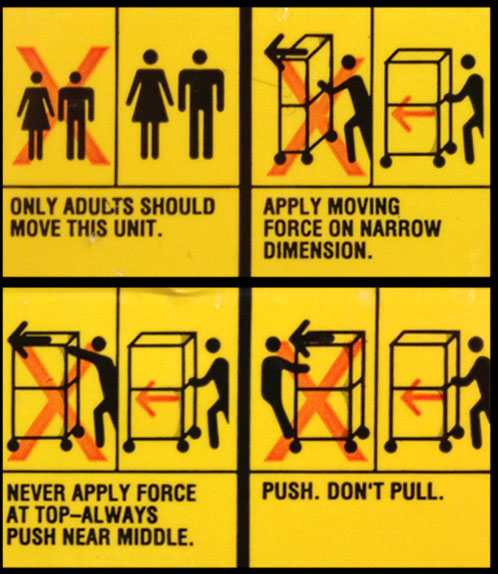
I hope he pushed from the middle! He’s not allowed to talk about that little incident, for obvious reasons. He doesn’t talk about the following little incident (sent in by Cissy Strutt) much either, for other obvious reasons.

Well, it could happen to anyone, right?




 Tetherd Cow RSS
Tetherd Cow Ahead
is powered by WordPress 6.2.9
and delivered to you in 0.123 seconds using 28 queries.
Theme: A highly modified version of Connections Reloaded