Rampage

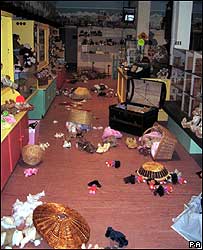
This is the scene of carnage after a guard dog named Barney went berserk at a Somerset Teddy Bear exhibition. Barney was meant to be guarding the bears but seems to have completely lost it when he realized what the cost to his reputation might be. One of the bears that was chomped was worth £40,000 and once belonged to Elvis Presley.

The general manager of the Wookey Hole* Caves, where the bears were on show, said:

“About 100 bears were caught up in this frenzied attack, some were merely little chews, whereas some of them had some quite devastating injuries.”

All together now:

“I just wanna eat,
Your teddy bear…”

Full story of the Wookey Hole Massacre at the BBC News online.

Thanks Pil!
___________________________________________________________________________

*I couldn’t do better if I tried to make it up…

Rain


Shameless Self Promotion

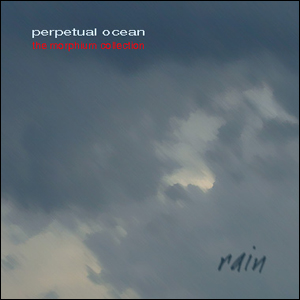
I’ve just released a new recording, the first in my Morphium Collection. It’s called ‘Rain’ and is a careful montage of recordings of rain on an iron roof. It’s minimalism at its most profound.

I originally made this recording to help me sleep, and for that purpose I can vouch that it’s very effective. Coming up in the series are ‘Ocean’ and ‘Pine’. I like to think of each as a kind of aural perfume.

Read more about ‘Rain’ on the Perpetual Ocean site.

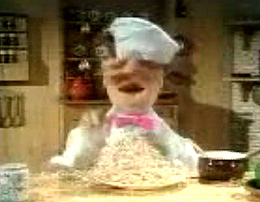
Swedish Chef

Discussion over at Joey’s place reminded me I hadn’t seen the Swedish Chef in an awfully long time.

Why is something this stupid so funny? Or is it just me?

Light Me Up!

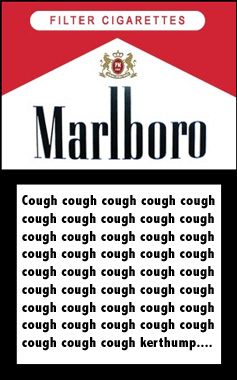
The most recent effort in Australia to turn people off the idea of smoking has involved a confronting television campaign, and the printing on the cigarette packets of very graphic images of the effects of the habit; pictures of mouth cancers, rotting teeth, limbs with gangrene and so forth. Here’s a link (not for the squeamish).

Up until now, the packets have carried simple printed warnings, but the new ones are starting to appear on the shelf.

Last night a young woman beside me in the supermarket asked for a pack of Benson & Hedges:

“I don’t mean to be difficult, but can I get a packet without the scary photo? You know, just one with the warning that says ‘Smoking Kills You’?”

Even though that last story was told as an amusing anecdote, it points, as some of you quickly realized, to some fundamental and important ideas about sound and the way we perceive it.

The question “What if we could have the sound of nothing, rather than silence?” is not a question about sound. It is a question about psychology. Many questions about sound are.

My director continued:

“What I mean is that sound, you know, when you’re out in the middle of nowhere and there’s nothing there… You know, not silence, but an absence of sound.”

And, although there’s a complete logical stump-jump here, I do in fact know exactly what he means.

Of course there is no such thing in the natural world as ‘an absence of sound’.

The quietest natural environment in which I’ve ever been was a cave in Jenolan in Eastern Australia. I was helping some friends complete a geographical survey. They were also divers, and needed to survey a section of the cave that was underwater. I couldn’t help much with that part of the exercise so I sat in the cavern as they disappeared into the inky black water and listened as their scuba bubbles trailed off into… silence.

There was no sound. No water lap, no dripping, no wind, no airconditioner, no next-door tv, no conversation down the hall, no computer drives, no distant traffic. Nothing. After a while, if I moved, any little noise I made sounded unnaturally loud. It was dead, dead quiet. Silence. Well, no actually. Not silence. I could hear my breathing. I could hear my blood moving. I could hear my heart beating. Wow, after a while it was actually noisy. I knew at that moment that human beings never, ever know true silence.

But we nearly all have some experience of that deep contemplative quietness of nature, or the dark black hush of the early morning hours, or the unbearable silent weight of gaps between speech at a funeral.

The question my director is really asking, then, is a different one: “Is it possible for us to have our audience feel that kind of mental silence within the bounds of what we are doing?”

And the answer, in my educated opinion, is that in this particular excercise we will achieve that effect. Because it’s not about the sound we put there, in that place where silence is, but rather, how we get there and what we have encouraged people to be thinking at that time.

Listening is only partially about hearing.
Black...

OK. I’m working (for free) on a small but very tasteful commercial for a major world charity. The sound is subtle but significant. At the very end of the ad, the pictures fade to black, and a simple piece of explanatory text appears.

This morning I’m playing what I’ve done to the director, an awfully nice but very intense chap.

“So, what do you think for the end when we fade out, then?” he asks.

“Oh, I dunno. Silence I guess. I thought that worked pretty well. Unless you want some other kind of thing there…”

He looks deeply thoughtful, and runs his hands through his hair.

“I was thinking, rather than silence, maybe we could just have, you know, the sound of nothing.”

“Uh-huh,” says I. “And that would be different to silence in exactly what way?”

« Previous PageNext Page »