Silly


When I’m at home in my normal life, I don’t watch much tv, but living in LA without my family commitments I do end up with the odd spare half hour at the end of my day that needs to be filled with a little mindless distraction. And if mindless distraction is what you’re after, American television excels. For some reason ((I think it’s some vestige of a long-dashed hope that someday, somewhere, someone might actually make a decent science fiction movie – you know, one that is actually intelligent… Maybe that’s just too much to hope for.)) my brain is drawn to what used to be known as the Sci Fi Channel, but has recently been idiotically re-branded as SyFy. Judging by what SyFy dishes up, I can only assume this naff baby-speak appellation has been applied as an opening gambit in a profit-inspired move to drift the channel away from science fiction programming into a domain that consists of, well, anything that can be loosely assembled under the heading of ‘Crap’.

It’s a category which is headlined by one of SyFy’s own creations, Fact or Faked. Paranormal Files. ((It REALLY annoys me that there is no question mark after the ‘Faked’. If it’s not a question and is just a statement, why do we need a tv show, you morons?)) The premise of the show is this: a bunch of ‘experts’ review a selection of videos sent in each week by viewers, and then pick their favourites to ‘investigate’. The opening credit sequence, weighty with overblown seriousness, introduces us to the members of the intrepid Fact or Faked team:

Ben: Former FBI Agent

Bill: Lead Scientist

Jael: Journalist

Larry: Special Effects Expert

Chi Lan: Photography Expert

Austin: Stunt Expert

Call me shallow, but the very first time I watched the program I took an instant dislike to both Chi Lan and Jael – the former because she’s an opinionated airhead and the latter because I hate her name. Larry is basically an overly-serious nerd, Austin is a gullible prat and Ben looks like he was roped into the whole debacle against his wishes ((No doubt so the producers could flaunt his FBI credentials…)) and is constantly planning his escape from the show.

But you will have sensed that I have saved my vitriol for Bill, the ‘scientist’. Simply put, Bill is an idiot. He is certainly not a scientist in any meaningful sense of the word.

In an effort of forbearance I will refrain from further description of the dumbness of the show itself, and instead just concentrate on a story that was on last night and one that I think demonstrates the full credentials of this team, who must surely all be card-carrying alumni of Scooby Doo University.

The story in question concerns a phenomenon called the Paulding Light Mystery. A video from YouTube shows a tree-lined hill with a bright light waxing and waning in a dusk sky. A ten second long grab (which Fact or Faked repeats over and over) features a mysteriously appealing visual effect as the light is refracted by atmospheric conditions or possibly some kind of lens aberration.

The Facts: If you go to a certain spot just outside the town of Paulding, Michigan, and look toward the south after dusk, you may see, depending on the weather conditions, a bright light just on the top of the tree line. The light may vary in brightness and duration and even sometimes in colour. It is an unusual phenomenon in the annals of the paranormal, in that the light appears quite reliably, with a frequency that has allowed a bit of a tourist industry to have risen around it. In other words, if you visit Paulding, there’s a pretty good chance that you too can see the light.

The Myth: The Paulding Light is said to be the spirit of a dead railway signalman who was crushed to death while trying to warn an oncoming train about another train stalled on the tracks ahead.

So there you have the setup. Let me try and give you some idea of how the Fact or Faked crew typically proceed when investigating something like the Paulding Light.

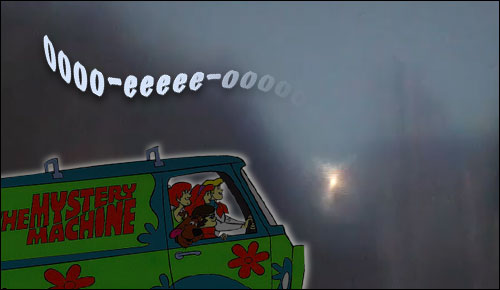
Dusk approaches. Jael, Austin and Bill have been assigned to this story. They arrive in their Scooby Doo Mystery Machine with a fully decked-out Paranormal Investigation Kit: gas sensors, Geiger counter, FLIR camera system, walkie talkies and a two-person mini all-terrain vehicle. People are already milling about in anticipation of being on television an appearance of the mysterious light.

To fill in some time the team does a couple of vox pops. First of all they badger some poor old lady into saying that she thinks that, yes, the Light is the spirit of the dead signalman. Her demeanour is less ‘genuine conviction’ than ‘How much are you going to pay me?’ Next, a rotund geeky chap steps up to the camera and says that, in his opinion, the Paulding Light might simply be car headlights. Uh-oh. A sensible person! Quick! Cut away to Austin leaping into the ATV – the Light has appeared!

This is as close as Fact or Faked ever comes to presenting anything like a balanced point of view.

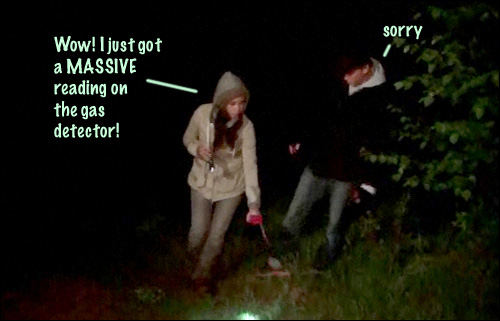
The members of the Fact or Faked team then set about deploying their peculiar notion of what constitutes ‘science’ in an attempt to find an explanation for the phenomenon. In this show, Jael and Austin head off to the place where they assume the Light ‘must be’ and traipse around in the dark with the Geiger counter and the gas detector arriving at the conclusion that the Light isn’t produced by radioactivity or swamp gas. Around now I start throwing things at the television. Of course it isn’t, you pillocks – even the most obtuse of dunderheads could make a quick assessment of that theory and throw it out the window. It is obvious that you’d need a mighty outpouring of gas or nuclear energy to generate something as bright as the video shows – that’s not the kind of thing that goes undetected for 40 years. ((These people plainly haven’t got a clue about how nuclear fission works. The amount of radioactivity generated by something that could create a light as bright as the Paulding Light would have contaminated everything within several hundred miles. The lame Ghostbusters-style traipsing-around-in-the-dark-with-a-Geiger counter is nonsense of the highest order.))

Nitwits.
Austin then heads off to a local airport and, with an ultra bright electric torch, ((Now THIS is impressive – 25 million candlepower, according to Austin. Mind you, since ForF plays loose and fast with the facts everywhere else, I’m not sure we can take his word for it. This of course is one of the problems with a show like this – if there are actually any facts present, they get swamped under the tide of make-believe, rendering everything questionable…)) attempts to duplicate the phenomenon by getting a pilot in a light plane to fly low over the area in question. Well, it does make a bright light in the sky, but it’s plainly not the ground-level geographically fixed light that everyone is seeing. How is it that I don’t need to fly around in a plane to figure out that this is also not a plausible contender?

Then the team (grudgingly it seems to me) get down to the most frequently offered explanation for the Paulding Light – that it’s caused by car headlights from either US Highway 45, or the old Highway 45. They choose a segment of the highway that they have deemed the likely place for car headlights to be the culprit and Austin and Jael use their television credentials to get the cops to block off the road. They then drive back and forwards while communicating with Bill back at Sighting Central. Not a sausage. Bill can’t see them.

Instead of even contemplating that the spot they’ve chosen might actually be the wrong stretch of the road, the team hastily dismisses the car headlight explanation. Then, conveniently, before anyone can raise a finger in objection, the Paulding Light has reappeared. Now, with no explanation that satisfies the Fact or Faked ‘professionals’, it falls to Bill to suggest the next course of action.

I want to pause here for a moment and remind you that Bill is featured as the ‘lead scientist’ of this show. Are you containing that concept in your minds? Right then, lets forge on.

So, what is the best scientific strategy that Bill, lead scientist of Fact or Faked, can come up with at this juncture? I hope you don’t snort whisky out your nose like I did, when you learn that Bill’s suggestion is that they try EVP. ((You may remember that I discussed EVP at length on The Cow some time ago, including my personal experiences with it.)) Yes, that’s right, having ‘thoroughly exhausted all possibilities’, Bill, the scientist, determines that they should attempt to contact the Spirit World to find out more about the restless wraith of the phantom signalman. The next few minutes of the show, with Austin, Jael and Bill wandering around the Ottawa State Forest attempting to coax the spirit of a dead railway worker to leave a message on their audio recorders must rank as one of the most risible things I’ve ever witnessed on television. The Scooby Doo-ers seemed genuinely deflated when their recordings turned up nothing.

Jesus H Christ. What kind of dimwitted, brainless lunacy are these people peddling?

And that was where the show ended. With every single scientific explanation exhausted and without any spirit communications from the Ghostly Signalman to set the record straight, as far as Fact or Faked. Paranormal Files is concerned, the Paulding Light remains a total and unfathomable mystery…

The End.

So utterly unconvinced was I by the team’s findings that I immediately leapt from the couch and did what any sensible modern person would do – I searched for the full YouTube clip of the Paulding Light from which Fact or Faked clipped the brief segment that they used on the show.

I’ve embedded it below for your viewing pleasure. Just listen to the credulous amazement of the onlookers as they gaze upon the perplexing riddle of the Paulding Light! Ponder on why Fact or Faked chose to present to their audience the very small snippet at the head of the clip, rather than a bit at, oh, around about the 1 minute mark. Indeed – listen to someone on the audio track at around 3:15, tell you EXACTLY WHAT THE PAULDING LIGHT IS (as if you need to be told by that point because to any normal rational person it’s as obvious as a pig at a christening).

But heck – view the clip and make up your own mind about what the ‘mysterious’ Paulding Light might be: the spectre of a dismembered signalman? A nuclear explosion? Too much gas? I’m pretty sure you’re not going to come to the same conclusion as the insightful investigators from Fact or Faked.

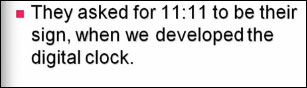
How often have you noticed the numbers 11:11, 12:12, 10:10, 22:22, 12:34, 2:22, 3:33, 4:44 or 5:55 popping up all over the place? These number sequences are not necessarily only time prompts. They can also be number sequences, like 333, 1111 etc. To your mind, is this a coincidence, or are they too frequent to be random? Perhaps you are puzzled or amused by this phenomenon? Possibly even a little bit nervous?

The question everyone is asking is “What does 11:11 mean?” and “Is there a reason for this?”


That’s actually two questions, as it happens, and I have, in fact, asked each of them exactly NO times in my life in relation to any of the ideas advanced on 1111 Spirit Guardians, the website from which this information comes.

1111 Spirit Guardians is a spectacular outpouring of mindless claptrap, which sounds almost like it could have been put together by the same people who brought you Special One Drop Liquid.

The basic gist of the site is that celestial beings called Midwayers are communicating with humans by arranging numbers in such a way as to send ‘signals’ to chosen recipients via digital clocks. Apparently (according to the site) this is happening to a lot of people.

11:11 signals are driving me nuts!

This is a very typical comment from folks who reach this site.

I should think a more typical kind of comment is “Wow, what a load of gobbledygook”, or “Do you also sell Space Diamonds?”

So how is it that these strange supernatural entities have become fixated on the numbers 11.11?


O-k-a-y… So they asked the digital chip makers to reserve them a few numbers…? I guess that does demonstrate some forward thinking. It seems like a kind of a roundabout way of communicating though – why the rigmarole?


Hey – they started it! I would have simply suggested conversation in the first place. It’s extremely tedious trying to get your ideas across in clock language.

What do I have to do?

Acknowledge it out loud. Say – OK guys I hear you, tell me what you want. This speaking out loud is to get around the problem that Midwayers do not automatically have access to our thoughts.

Our clocks, yes, our thoughts, not so much.

What proof have you got?

Well it’s getting so that this is now pretty much proven, simply because by following our instructions, so many other people have found these guys, and talked with them.

Yeah, now see, that’s not actually proof. That’s just you telling us something that may or may not have any truth in it. Proof is independent of personal opinions. You might like to see if you can dig up any of that.

The 1111 Guardians site is, apparently, the handiwork of one George Barnard, a self-styled ‘psychic’ and writer. Barnard claims to be able to ‘channel’ the Midwayers and has transcribed a mind-boggling amount of material from them.

George has been dealing with these guys for over 60 years. He sees them, and talks to them. Mostly he sees with his spiritual eyes, but there have been cases of physical manifestation as well. You could not expect a psych (George) to believe in the voices in his head if they did not turn up physically, could you?

The last sentence seems somehow metaphysically tautological. I don’t think anyone would be surprised if George has, aside from seeing the Midwayers with his ‘spiritual’ eyes, ((I idly find myself wondering if you need to wear ‘spiritual spectacles’ if you’re shortsighted?)) talked to them, shaken hands with them or stayed up late playing poker with them.

What I find intensely (and fascinatingly) strange about people like George, is that they are somehow completely unable to understand the process whereby our brains naturally knit together unrelated incidents in an attempt to find some kind of cohesion for them. We all do this, but most of us realise that it’s just a curious ability that evolution has bestowed upon us – some vestige of our pattern-matching skills honed way back in our time on the veldt, that has now gone into idle mode and leaps to the fore when our brains aren’t productively engaged. Sure you notice the clock is on 11:11. It’s a pattern. As is 12:12 or 10:10 or 12:34 or a wide variety of other numerical combinations. Our brains like patterns. We notice patterns because they are pretty. If the number on the clock is 10:52 or 09:48 it doesn’t ‘stick’ as much and therefore goes completely unnoticed, like nearly every other set of numbers on a digital clock that denote the time. ((Unless of course the numbers 1052 or 948 have particular meanings for you, in which case, you might remember them.)) People like George are completely unable to see that this process is totally normal. It’s as if their world filters are somehow broken and they are obliged to find meaning in the vast drifts of meaningless trivia that the rest of us are able to tune out.

Sometimes I feel a little guilty making fun of people like George. It is quite probable that he has come to completely and profoundly believe his fantasy about Midwayers and meaningful communications via clocks. How is he different, for instance, from the millions upon millions who believe they have meaningful dialogue with a discarnate entity called ‘God’ who lives in a place called ‘Heaven’ and has an adversary called ‘Satan’? How is George’s communication with his Midwayers any different from praying to God, or taking Communion or giving Confession?

Yes, sometimes I feel a little guilty, but then I glance at my digital clock and see it flip over to 4:44. And then I realise that it’s the Midwayers telling me to make fun of him. And everything is alright again.

Some entertaining links from the 1111 Guardians Site:

•A conversation between George Barnard and what appears to be a veritable cavalcade of Midwayers, in which we find out that parrots like to chat with the spirits.

•A conversation with a Midwayer named Sharmon in which we see biblical links with this mythology (the Christian links are profuse throughout Mr Barnards’ channelling).

•A conversation with a Midwayer named Mathew that sounds rather a lot like stuff I’ve read from the Unarius Society.

•Some Midwayer humour (oh, my belly still aches from the laughing!)

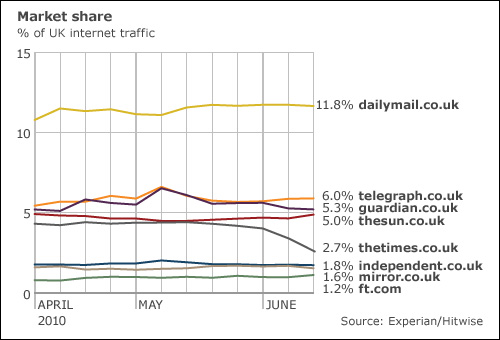
You will remember that a little while back we learned that Rupert Murdoch, using his needle-sharp insight into how people use the internet, stumbled on the notion that it would be a good idea to start charging visitors to read the online version of his flagship newspaper The Times. Consequently, the last month has seen The Times subscription gateway come into operation and readers have been asked to sign up (without paying) before they can get access to stories on The Times site. Here’s a graph that reflects the status of readership figures for various online UK newspapers since April.

Notice anything? And need I point out that this graph reflects only the sign-up process – no money has so far changed hands. Now, to my eye that looks like The Times online has lost nearly half its readers in a month. And the curve doesn’t look like it’s intending to taper off anytime soon, and that’s before we get to the point of actual money being forked out. ((Quite interestingly, the curve visibly trends downwards well before the subscription requirement kicked in. I surmise that this indicates people started abandoning the Times pretty much as soon as they heard that it was going to start charging money. If I was head honcho, I would have taken this as an extremely worrying omen.))

Rory Cellan-Jones, on his blog at the BBC, has speculated that The Times really only has to hang on to about 5% of its former readership ‘to have the champagne corks popping in Wapping’. I predict that the readership will fall right through that number and bottom out at nearly zero. Rory puts his finger right on it in his post:

My suspicion is that the main problem with this experiment is what I’d call friction. Web users have got used to clicking simply from one page to another without hindrance. Any element of friction – the aggravation of having to pay or just log in – acts as an incentive to head elsewhere in a hurry. I tried an experiment this morning, posting a link on Twitter to an article by the very funny Times columnist Caitlin Moran. Plenty of people clicked on the link – but when they were taken directly to the Times pay-station, they all appear to have left without paying.

To anyone who’s been looking at web media for any length of time, this is truly a no-brainer. Why would you bother? Rupert is pinning all his hopes on one single idea: that people care enough about the quality of the journalism (and whatever else The Times has to offer) to pay for it. ((It also breaks one of the most important pieces of functionality of the web, and very few of the Old Guard understand this because it is such an alien concept to them: the ability to cross-link. Anyone who writes a blog (or anything written specifically for online diffusion) understands automatically how powerful a utility this is. The web is a ‘web’ because it builds itself on connectivity. If I want to write something on Tetherd Cow I can easily bolster my story with examples, references and asides that anyone can check instantly. But there’s NO WAY I can do that with the Times any longer. If I cross-linked to an article in the Times, my readers would simply behave as those in Cellan_Jones experiment, above. Murdoch’s idea is fundamentally destructive to the very foundations of the internet. Where we see the awesome power of the building up of information structures, he wants to create cloistered communities that he can control. This, in my opinion, is what will ruin him. He does not grok the net.))

Rupert, I’m sorry to say that the 21st Century is going to give you a bigger ass-walloping than you ever thought possible.

Let me explain it in a way that even Mr Murdoch might understand. Are you sitting comfortably? Very well, let’s begin.

Once upon a time, when horses and buggies were the fastest forms of transport and people cleaned chimneys by crawling up them with big brooms, accounts of what was happening in ‘the world’ started to get circulated via a system called ‘the newspaper‘. The newspaper gathered up a collection of what its publishers deemed the most relevant and interesting bits of news and gossip of the moment, and then distributed them to the community. The newspaper was a marvellous idea for its time, but, for all its charm and utility it did have some limitations: it was largely a local phenomenon, it cost money to make and deliver to the people who wanted it, and it had a kind of inbuilt time delay (if news happened, you had to wait till the next newspaper was made in order to know about it). But because it was a physical object, and it was a convenient way of learning about the latest goings-on in the world, people were prepared to pay some small amount of money to take possession of their daily newspaper. Plus, you could wrap fish & chips in it when you’d finished reading it. (It also had another limitation, but one that few people were aware of at the time: it was a one way street. That is, the newspaper could tell you things, but you could not reply to those things, nor enquire after their veracity.)

Eventually, after a few decades of news distribution of this form, a few cunning people realised that if they could gain control of the newspaper business on a large enough scale, they could earn themselves quite a bit of money. And so newspaper tycoons came into existence. The object of being a newspaper tycoon was to gather up as many small local newspapers as you could find, and either put them out of business, or amalgamate them into your empire. This concept made a small number of crafty men (for they were ALL men) very wealthy indeed. It had the added bonus, for those men, of giving them extraordinary political power, because after all, they controlled what people knew about the world. This state of affairs existed for the better part of a century, with the newspapers becoming more and more ubiquitous and the newspaper men more and more wealthy and more and more powerful.

But then, late in the 20th century, a completely unexpected thing happened – a wonderful piece of technology called ‘the internet‘ came along. The internet was really nothing more than a way in which everyone on the planet could easily and instantly talk to everybody else, no matter how geographically separated they were. It was a simple but powerful idea. And the more people who understood this idea, the more powerful it became. Before anybody really even knew what was happening the internet became connected to all kinds of places across the whole world, and people happily discovered that news and gossip and all kinds of other information could now be exchanged rapidly and for free. People liked that! And the internet was unlike the newspaper in one very important way: nobody ‘owned’ it and nobody could own it. ((You can bet your humidified Havana cigar that there are those who, if they’d known how it was going to turn out, would have moved heaven and earth to have gained control of it…))

So who do you think were the most unhappy about this state of affairs? That’s right – the newspaper tycoons. They were VERY VERY upset, indeed. People were talking to each other and learning about their world for free! What a terrible, terrible thing!

Thanks to their innate carnivorous business instincts, though, the tycoons became aware very rapidly that this ‘internet’ was something quite big and important, and they could see that people had taken to it like ducks to water. Unfortunately they could only see this through spectacles that had little dollar signs embossed all across the lenses, and so their vision was not very clear. The first thing they did was to nab themselves some real estate on this internet thingy. After all, it was FREE, what did they have to lose? Of course, the people who were already on the internet were happy to see their old friends from the newspaper business there and started visiting these new sites from the old guard – but they didn’t just hang out at one newspaper… oh no! They were now reading six or seven or maybe even ten newspapers, and not just newspapers from their home town either! And not only that, they were getting news from sites that weren’t actually newspaper sites but had news anyway, like blogs and ezines and social networks and all manner of other strange ideas! All for free!

The newspaper tycoons weren’t used to the concept of ‘free’. It was not something that was in their world view. When they said the word ‘free’, as they sometimes did, they meant ‘we’re giving you a nice little morsel but it has a hook hidden inside it’. The concept of ‘free’ as in ‘you can get it with no strings attached’ was as alien to the newspaper tycoons as was the idea of travelling economy class, so they looked upon what was happening on the Internet with a great deal of bewilderment and frustration. All these people were here doing stuff and hanging around but the tycoons couldn’t figure out a way to make money from it! How they hated that! How dare people amuse themselves!

So instead of making some kind of effort to understand what was going on with the Internet, as some of their cleverer and less mercenary colleagues did, the tycoons contrived to do the least effective thing possible: they attempted to make the Internet play by their Old Rules. Unfortunately, the people using the internet could see immediately that the Old Rules really suited no-one except the tycoons. The only option open to the tycoons now was to try and make their Old Way look more enticing than all the New Things the Internet was offering. They did this mostly by telling everyone how TERRIBLE the New Way was and how much BETTER the Old Way was. They said this loudly and often.

‘If you continue to get your news for free,’ they cried ‘You’ll only get TERRIBLE quality news. WE are the keepers of GOOD quality news!’

Unfortunately, the people using the internet already knew that this was a stupid and desperate tactic. They knew that not only was the news from the New internet way just as good (and sometimes even better) than the Old newspaper way, but that the Old newspaper way gave them TERRIBLE quality news as often as not too!

In spite of this obvious failing, the tycoons quite idiotically convinced themselves their argument was good enough to charge money for their Old News, just like they used to do when the world was all nice and simple, before smoking tobacco caused cancer and when it was perfectly acceptable to feast on endangered species of quail and unsustainable caviar stocks. And so they said to the Internet people:

‘Now we want you to PAY for our Old Ideas, even though we have made exactly NO CONTRIBUTION to this new way of doing things…’

Well, we’ll have to leave our story there for the moment, because the last words have not quite been written. I suggest that ‘Happily ever after’ is not on the cards for those old newspaper tycoons, though. They are facing the end of their dynasty and they stand, as emperors have often done, bewildered in the empty halls of their palaces while the revolutionaries hammer at the gates.

Will Rupert get his 5% faithful? Will the champagne corks be popping in Wapping? Will the line on that graph level out before it hits sea level? Six months is about what I think it will take to give us the ending to this story.

Cowpokes! The End is Nigh! Run for the hills! What with the threats of terrorism, biological warfare, solar flares, tsunamis, the flipping of the magnetic poles, an atheist woman as head of the Australian government and a black man as the head of the US government, it will be a MIRACLE if we last even another week! But, dear feiends, have no fear! Should one (or more!) of the aforementioned catastrophes overtake us, the folks over at Vivos have anticipated every eventuality for the approaching apocalypse and are offering the ultimate ‘life assurance’ and ‘the greatest chance of future restoration of the world as we know it, regardless of the catastrophe’.

Here – let them tell you about it in their own words:

Millions of people believe that we are living in the “end times”. Many are looking for a viable solution to survive potential future Earth devastating events. Eventually, our planet will realize another devastating catastrophe, whether manmade, or a cyclical force of nature. Disasters are rare and unexpected, but on any sort of long timeline, they’re inevitable. It’s time to prepare!

Vivos is a privately funded venture, with no religious affiliations, building a global network of underground shelters, to accommodate thousands of people. Vivos will provide a life assurance solution for those that wish to be prepared to survive these potential events, whether they occur now, in 2012, or in decades to come

Yes, by purchasing a share in a Vivos community bunker, or getting them to build your own bespoke shelter, you can survive the End Times and walk out refreshed into a world full of bracing post-catastrophe horror! To see what you’ll get for your money, you can take a tour around a typical Vivos facility, furnished with all the comforts of home, including attractive paintings of idyllic landscapes that you’ll never see again:

Geez guys, could you have found a more gloomy and depressing piece of music for that? Are you selling a shelter or a tomb here?

Seriously, no matter how hard I try, I can’t think of any calamity listed on the Vivos site that seems worse than ending up in some underground IKEA nightmare with a bunch of people who are inclined to believe that the world is going to end in 2012 ‘because the Mayan calendar says so’. ((You can watch a video on the Vivos site about how the ‘incredibly precise’ Mayan calendar (‘… a calendar more accurate even than our own’) predicts the world will end in 2012.)) Let me see: Electromagnetic Pulse? Nope. Killer comet? Nope. Planet X? Nope. Super volcano? Nope. ((I’m a little surprised to see that Zombie Attack and Alien Invasion aren’t featured, to be honest. If nothing else, they’d make for some really cool additional icons.)) I’d rather take my chances with any of those.

What are these people thinking? Have they never seen a post-apocalyptic movie? Have they never played Fallout? Do they really want to climb out of their bunkers after a year of mind-numbing boredom to find themselves wandering around a planet full of shotgun-wielding mutant vigilantes with no morals and bad personal hygiene? Or worse, Fundamental Islamic militia?

There are so many things wrong with this unhinged doom-laden vision that it’s hard to know where to start. From the hysterical countdown to annihilation (905 days, 06 hours, 31 minutes, 24 seconds remaining) to the hyper-paranoid ‘scenarios’ videos (Nuclear Terrorism! Surviving Anarchy! Secret Government Shelters!) the website plays out like some bad Hollywood projection of the Apocalypse. It takes mere seconds to find places where this plan will start splitting at the seams.

Take a quick tour around the Vivos Knowledge Base and see how many opportunities for failure you can find. The spectacular promises (hydroponic gardens to support 200 people for more than a year, 24 hour power generation with supplemental wind and solar, hotel-style amenities, impregnable defences to resist volcanic eruption, seismic disturbance and biological contamination) fairly reek of hyperbole. ((For a start – where are they getting their air from? Filtered air from outside will be useless in a case of chemical attack, and it’s not like they can stockpile a year’s worth of oxygen for 200 people…)) Half these things are all but impossible to achieve. And if Vivos doesn’t deliver, what are you going to do when the anarchist Muslim terrorist bio-freaks come pouring through your Vivos shelter airlock? Ask for your money back?

Tetherd Cow Advice: If you’re worried about the Apocalypse arriving in 2012, ((You can bet your Nigerian fortune that I’ll be revisiting all these predictions in 2013!)) stock up on single malt whisky and plan to be somewhere with a good view. In the meantime, send me your bank account details. After all, you can’t take it with you.

___________________________________________________________________________

Big thanks to Atlas for bringing Vivos to my attention.


Yes, I know I’ve talked about it several times already, but this time it’s serious.

‘Cyber sickness’ warning ahead of 3D revolution’ screams the headline. Again, you will not be at all surprised to learn that it’s from the Melbourne Age.

Up to 10 per cent of people who watch 3D images on television, at the movies or while gaming suffer ”cyber sickness” symptoms such as blurred vision, nausea and dizziness, health experts have warned.

Those experts! If it wasn’t for them, the world would be a much cheerier place. But wait! It’s WORSE THAN YOU THINK:

But they say the number of people affected by cyber sickness could rise to unknown proportions with the advent of the 3D TV era…

Did you hear that? UNKNOWN PROPORTIONS! It could be a veritable cyber-sickness pandemic. Forget getting immunised for swine flu – if these experts are right we’ll all be taking major doses of stereoids to fend off the 3DTs.

The article gushes breathlessly onward:

Virtual reality pioneer Mark Pesce, an honorary lecturer at the University of Sydney, said the majority of occasional 3D viewers would love the experience, but he warned that the health effects of heavy use of 3D media – which trick the eye by changing the depth perception of a person’s vision – had not been tested.

Um… actually, that’s not how 3D works at all – there is no ‘tricking the eye by changing depth perception’ Mr… who wrote this damned thing… let’s just scroll back up to the by-line… oh, WHAT a surprise. It’s Stephen Cauchi, King of the the Non-News at the wheel again. Geez. Have they hired this guy specifically to reduce the Age’s credibility or something? ((I swear I’m not witch-hunting this guy. I literally did what I just wrote – I was reading the article and thought ‘Man this is terrible!’, looked at the byline…)) Anyway, to continue, 3D works by exploiting the effect of stereopsis which is the natural way we achieve depth perception. What Mr Cauchi just said is word fluff. It is completely free of actual meaning.

Like last post’s Government Weather Control article that we saw from Mr Cauchi, as the story continues the sensible people start to appear, and we find Victorian Eye and Ear Hospital ophthalmologist Lionel Kowal saying that the number of people who reported problems with 3D is ‘probably closer to 5 per cent than 10 per cent.’ Then, we hear from Kathryn Rose, an associate professor in orthoptics at the University of Sydney, who thinks that ‘about 3 per cent of the population would not be able to watch 3D TV’.

3 percent? 3 percent? Do I hear 2 percent? 2 percent over in the back? 1.5 percent? Can I get a 1?

The article ends with a quote from Newcastle University neurobiologis Alan Brichta:

‘Right now we don’t have all the information but my gut feeling says [cyber sickness] is not going to be a major issue.’

Are you with me here in this insanity, dear Acowlytes? We’ve gone from an epidemic of ‘cyber sickness’ of UNKNOWN PROPORTIONS to ‘er.. actually, not a major issue…’ in the space of one information-free waffle fest.

Like the Government Weather Control story, I propose this whole air-headed notion could have been summed up in one short sentence:

A tiny minority of people might find 3D media a little unsettling but most people won’t.

Again, short on pizazz, but it’s exactly the same content and it would have saved precious digital bits for something that was actually worth calling NEWS.


Y’know, as much as I’m critical of the woo-mongers mixing it up with what they perceive to be ‘science’, I’m afraid that sometimes it’s the scientists themselves that need a good fresh mackerel to the side of the head.

Take this article Chaos Makes a Scream Sound Real, from ScienceNews.

To be fair, it’s not just the scientists. There’s a combination of factors that contribute to the diffuse, nutty quality of this piece, and it’s one that you find frequently in science journalism: a scientific concept that doesn’t immediately appear to be anything remotely worth reporting to a general audience, and a journalist’s desire (or job requirement) to try and spice it up into something that does.

I’ll try and paraphrase the whole idea for you, since I can’t be entirely sure what this is exactly about from reading either the Science News article or the abstract of the paper at Biology Letters, where it was published under the title Do film soundtracks contain nonlinear analogues to influence emotion? ((And I’m not about to fork out for the full article – people still aren’t getting this stuff. Listen to me Biology Letters editors: religious fundamentalists of all persuasions make their stuff available to all and sundry for nothing. THEY ARE YOUR COMPETITION! Get with the 21st Century already!))

Some scientists studying vertebrate communication observed that:

A variety of vertebrates produce nonlinear vocalizations when they are under duress. By their very nature, vocalizations containing nonlinearities may sound harsh and are somewhat unpredictable; observations that are consistent with them being particularly evocative to those hearing them.

What they’re basically saying is that jarring, loud or sudden sounds have a noticeable impression on an animal hearing them.

Yup.

They go on to hypothesize that maybe this is the case for humans too, and that filmmakers use that trick in films.

Yup.

To this end, they analyzed a bunch of films and found that there are more jarring and sudden sounds in horror films, although some appear in action films and a few appear in drama. ((Without even doing an experiment I can tell you that there would be close to none in comedies and romances.))

Yup.

Then they sum up their hypothesis with:

Together, our results suggest that film-makers manipulate sounds to create nonlinear analogues in order to manipulate our emotional responses.

(Translate that to: ‘Film-makers use different kinds of changing sounds for emotional effect’)

Er… Yup.

Now, I don’t suppose that this was likely to be an experiment that cost oodles of money, but whatever they spent on it was WAY too much, because they could simply have emailed me and I would have told them all that for free.

The Science News reporter makes a futile attempt to spin this up into something more than what I just told you, by stirring in some references to Chaos Theory (wtf?) and getting a quote about ‘crying babies’ from a cognitive biologist who was not even involved in the study (‘Screams are basically chaos!‘). She then tags the piece with an entirely irrelevant factoid about how Hitchcock’s The Birds contains sounds that were electronically generated ((I’m not even sure I understand what the point of including it is – that electronic sounds are more jarring/chaotic/annoying than natural sounds? Again, wtf? It’s not true, and it’s immaterial in this context anyway!)) and signs off with the following knowledgeable-sounding quip:

…capturing a realistic, blood-curdling cry is so difficult that filmmakers have used the very same one, now found on many websites, in more than 200 movies. Known as the Wilhelm scream it is named for the character who first unleashed it in the 1953 western The Charge at Feather River.

Well, someone has been pwned here and I’m not sure who. Either the reporter hasn’t done her homework, or she thinks that no-one will notice this risible flub. The Wilhelm scream is used in a lot of movies, not because of its terrifying blood-curdling quality, but because it’s so utterly lame that it has become a game among sound editors to see if they can sneak it in skillfully enough to let the director keep it in the final sound mix.

What’s more, it’s even extremely well known for that reason as even a very cursory search will reveal. Here’s a (VERY old) YouTube compilation of appearances of the Wilhelm scream.

You’ll have noticed that many of the above clips are from the George Lucas/Steven Spielberg stable, and that’s because sound design guru Ben Burtt is responsible for ‘resurrecting’ the Wilhelm scream in Star Wars and the fun challenge of trying to get it into mixes arose among sound editors who worked with Burtt (and with some of whom I’ve worked myself, so I know of what I speak).

I’m all for the concept of popularizing science, but this kind of writing doesn’t really help anyone. It’s painting a hazy and inaccurate picture for a lay audience, can easily be demonstrated to be factually sloppy and, worst of all in my book, because of the two preceding transgressions, casts a sickly glow over the effectiveness of all other science reporting. Science can’t, and shouldn’t be, reported in the same way as entertainment. Science is interesting for what it is, and if you’re a science reporter and can’t find an appropriately absorbing way of working with the actual facts at hand for a story, you should leave it alone and go on to something else. ((Another disappointing consequence of this phenomenon is that the bad story gets picked up, often completely uncritically, by other popular science outlets. In this case I note that it appears in Wired Science who should totally know better.))


« Previous PageNext Page »