Science


Sometimes the minds of really bright people can think really dumb thoughts.

Francisco J. Ayala is an evolutionary biologist of quite some expertise, a critic of creationism and intelligent design, and an active petitioner for the advancement of stem cell research in the US and throughout the world. And yet, as he reveals in his post on the Guardian blog this week, ‘Religion has nothing to do with science – and vice versa’ his accomplishments as a scientist don’t stop him from having bewildering thought processes.

The basic thrust of his piece is that science has no business occupying itself with the domain supposedly reserved for religion (and vice versa, but as we shall see in a bit, that’s nothing more than a sop to the unthinking). That is, science should butt out of matters of good and evil, right and wrong, purpose or none. It takes him about three paragraphs to reveal that he’s playing with a marked deck.

The scope of science is the world of nature: the reality that is observed, directly or indirectly, by our senses. Science advances explanations about the natural world, explanations that are accepted or rejected by observation and experiment.

Outside the world of nature, however, science has no authority, no statements to make, no business whatsoever taking one position or another. Science has nothing decisive to say about values, whether economic, aesthetic or moral; nothing to say about the meaning of life or its purpose.

Did you see the card go up his sleeve? He has simultaneously put religion outside our natural world and forbidden science from that domain. In other words, science can’t know the Mind of God, because.

It’s such a breathtaking piece of religious bias that I almost stopped reading right there.

What he’s advancing is in fact the very foundation of the concept of religion: give up (for reasons that cannot be expressed in any rational manner) everything you know and can demonstrate to be true, in preference to concepts that you (or other people, usually) suppose might be. That’s called ‘Faith’ and it goes by another name too: ‘Magic’. Ayala simply cannot make a claim like that and retain any level of credibility. If you allow that as a piece of valid reasoning, you allow ANYTHING to be possible. And I’m willing to wager a large amount of cash that Ayala doesn’t believe that huge numbers of Americans are being abducted by aliens, or that Xenu is going to come to Earth and smite us all, or that a little green man lives in the peyote plant or any number of other equally preposterous ideas. Yet, by his argument he has no choice but to believe them all because they are ALL outside his allowance for the realm of science!

The above quote also carries with it the implicit endorsement that religion does have something decisive to say about economic, aesthetic or moral values, and about the meaning of life and its purpose. That’s plainly hogwash. Which religion? Says what? For every one thing that a religion says, a contradiction can be found in another. Religions can’t even make up their minds internally about what they think about many things. Religions say stuff about all these things that’s for sure, but whether what they say is valuable, or ‘decisive’, or even worth paying attention to, is a highly questionable conjecture.

Further on he takes the words of Richard Dawkins and bends them to his already-decided will:

The biologist Richard Dawkins explicitly denies design, purpose and values.

In River out of Eden, he writes:

“The universe that we observe has precisely the properties we should expect if there is, at bottom, no design, no purpose, no evil and no good, nothing but blind, pitiless indifference.”

Dammit – did you see that? He palmed another ace!

Firstly, Dawkins is talking here about the mechanics of the Universe, as Ayala must surely understand. Dawkins does not say that we should expect to find no purpose or evil or good or blind pitiless indifference in humans. Dawkins is saying that there is no reason to suppose that those things are inherent in the Universe, and that this is in fact exactly what we see. ((Why isn’t Ayala arguing that point? Because as an evolutionary biologist, he knows he can’t win. ‘God’ – at least no kind of God that cares a hoot about us – is not apparent in the natural workings of the Universe.)) Ayala’s argument is based on a religious misrepresentation of scientific thinking, and, as a scientist, he should jolly-well know better.

Let’s see if Ayala is dealing anything else from the bottom of the deck. He goes on to conjure the spirit of William Provine, noted evolutionist and atheist:

William Provine, a historian of science, asserts that there are no absolute principles of any sort. He believes modern science directly implies that there are no inherent moral or ethical laws, no absolute guiding principles for human society.

There is a monumental contradiction in these assertions. If its commitment to naturalism does not allow science to derive values, meaning or purposes from scientific knowledge, it surely does not allow it, either, to deny their existence.

Zip! Now that’s a hand that’d get you shot in a saloon game of poker!

Let’s just clarify things a little. Ayala is making an explicit statement here that there are two kinds of worlds in which we live: the natural world (which is defined by science) and the supernatural ((I’m using the word in its most literal sense here: ‘of, pertaining to, or being above or beyond what is natural’)) world which is out of the reach of science. Because science can make observations about the natural world such that there appears to be no inherent meaning, morality or purpose, it has, therefore, no right to deny the existence of such things.

What total corn syrup! Science has every right in the world to put up a case for the non-existence of these things! Let me re-write that sentence slightly to make it clear why it’s so incongruous:

‘Because science can make observations about the natural world such that there appear to be no inherent reasons to believe in pixies or unicorns or fairies, it has, therefore, no right to deny the existence of such things.’

This idea of putting such abstract concepts as ‘meaning’, ‘purpose’ or ‘morality’ outside of nature is just religious sleight of hand. Who says that should be so, and by what criteria? Ayala begins by drawing up rules that suit his argument and then criticizes science for not playing by them!

It’s a bit of a straw man, in any case. He’s attempting to distract us from a much more pertinent point: the fact that science finds no ‘natural’ morality does not imply that a social morality is not possible (it clearly is) and most importantly, it certainly does not automatically stamp an imprimatur on religion to take that role. In fact, I would argue that a great deal of our current social morality is held in place not by religion, but by the social constructs we’ve developed under cultures that hold largely scientific world-views. We don’t, for example, find mobs of atheists going around behaving amorally (as much as I’m sure a lot of religious people think that is what happens), primarily because people like me who don’t hold with religion can actually maintain good moral lives without it, believe it or not.

Religious thinkers just love to believe that it is religion that holds our morality in check and stops the world from spinning into unmitigated and wanton chaos, but if they buy into that notion they must necessarily buy into a paradoxical uber-belief: it doesn’t matter what kind of religious belief you hold, as long as it’s a religious belief. ((Or, perhaps more accurately: ‘It doesn’t matter what kind of religious belief you hold, as long as it’s MY religious belief’.)) This is plainly a ridiculous and indefensible stance. For a start, there are plenty of religions that adhere to questionable morals. ((The majority of them, I would contest.))

I’ve attacked the versa part of Ayala’s essay first because I think by doing so it casts illumination on another piece of his prestidigitation. Let’s look at the ‘Religion has nothing to do with science’ part. Here, Ayala invokes Augustine, the emperor who rearranged Christian religion because it didn’t really suit his taste:

As he [Augustine] writes in his commentary on Genesis:

“If it happens that the authority of sacred Scripture is set in opposition to clear and certain reasoning, this must mean that the person who interprets Scripture does not understand it correctly.”

Is anyone else rolling on the floor laughing?

Again, let me clarify: If anything that makes sense appears to be in conflict with the Scripture, then that’s because the Scripture isn’t being properly interpreted. It can’t possibly be that the Scripture is nonsense! ((There are so many things wrong with this reasoning that I can’t begin to enumerate them all. The Bible, for example, makes explicit statements about the natural world. By Augustine’s reasoning, if any of these statements are thrown up against convincing scientific refutation, then there must be some interpretive error – it’s NOT an error of Scripture. What an astonishing ‘get-out-of-jail-free-card’ that is! In this way, the Bible can be eternally revised to fit with the way the natural world is shown indisputably to be and always remain correct! How can the rigorous process of science even begin to compete with such absurdity?))

It baffles me that a smart person can even indulge in such poppycock. From the start, it makes a ridiculous presupposition that the Scripture, like Ayala’s conditions for religion itself, lies outside nature – particularly outside human nature. How can a person with scientific training possibly believe that?

Ayala now throws a bone to the wolves in allowing that religion has nothing definitive ((Anyone else notice that card go to the bottom of the deck? ‘Definitive’ is a slippery term, especially in the light of Ayala’s other slipperiness. ‘Definitive’ allows that religion can have all kinds of things to say about the realm of science if it likes – just not ‘definitive’ things.)) to say about the ‘precincts of science’:

Religion has nothing definitive to say about these natural processes: nothing about the causes of tsunamis or earthquakes or why volcanic eruptions occur, or why there are droughts that ruin farmers’ crops. The explanation of these processes belongs to science. It is a categorical mistake to seek their explanation in religious beliefs or sacred texts.

It’s a banal dismissal of superstitious thinking of the gross kind. Of course we know that God can’t be blamed for earthquakes and eclipses and droughts and plagues of locusts. The only people who believe that kind of thing are the same ones who believe that God sits outside the realm of nature and can accomplish miracles!

Ow.

No matter how he might frame his argument, Ayala does not care about balance. He is concerned only with propaganda. Like all religious people he is scared that the truth is frightening and ugly and something he doesn’t want to hear, and that if science turns its sights on ‘matters of Scripture’ it might reveal, not that the Scripture is being interpreted incorrectly, but, as it has done time and time again, that the Scripture is wrong.

Ayala is only paying lip service to science, and to justify his already formed beliefs (Ayala is a former Dominican Priest) he seems compelled to attempt to somehow shoehorn science into the religious framework of a worldview that was formed half a millennium ago. His version of science is, for an evolutionary biologist, a puzzlingly simplistic mechanical one. It’s a science that doesn’t ask hard questions. It’s a science that obligingly looks the other way when religion walks into the room. It’s a convenient kind of science.

As we all know, though, science doesn’t care about convenience. Science doesn’t care how we think the world should be, or how we wish it was. It just shows us how it is. The way I see it is that we have two choices – we either side with science, look bravely on the Universe and be awed and humbled by our ignorance, or we cower behind our fingers with religion and make pretend everything will be OK. Either way, the world itself does not change.

Y’know, as much as I’m critical of the woo-mongers mixing it up with what they perceive to be ‘science’, I’m afraid that sometimes it’s the scientists themselves that need a good fresh mackerel to the side of the head.

Take this article Chaos Makes a Scream Sound Real, from ScienceNews.

To be fair, it’s not just the scientists. There’s a combination of factors that contribute to the diffuse, nutty quality of this piece, and it’s one that you find frequently in science journalism: a scientific concept that doesn’t immediately appear to be anything remotely worth reporting to a general audience, and a journalist’s desire (or job requirement) to try and spice it up into something that does.

I’ll try and paraphrase the whole idea for you, since I can’t be entirely sure what this is exactly about from reading either the Science News article or the abstract of the paper at Biology Letters, where it was published under the title Do film soundtracks contain nonlinear analogues to influence emotion? ((And I’m not about to fork out for the full article – people still aren’t getting this stuff. Listen to me Biology Letters editors: religious fundamentalists of all persuasions make their stuff available to all and sundry for nothing. THEY ARE YOUR COMPETITION! Get with the 21st Century already!))

Some scientists studying vertebrate communication observed that:

A variety of vertebrates produce nonlinear vocalizations when they are under duress. By their very nature, vocalizations containing nonlinearities may sound harsh and are somewhat unpredictable; observations that are consistent with them being particularly evocative to those hearing them.

What they’re basically saying is that jarring, loud or sudden sounds have a noticeable impression on an animal hearing them.

Yup.

They go on to hypothesize that maybe this is the case for humans too, and that filmmakers use that trick in films.

Yup.

To this end, they analyzed a bunch of films and found that there are more jarring and sudden sounds in horror films, although some appear in action films and a few appear in drama. ((Without even doing an experiment I can tell you that there would be close to none in comedies and romances.))

Yup.

Then they sum up their hypothesis with:

Together, our results suggest that film-makers manipulate sounds to create nonlinear analogues in order to manipulate our emotional responses.

(Translate that to: ‘Film-makers use different kinds of changing sounds for emotional effect’)

Er… Yup.

Now, I don’t suppose that this was likely to be an experiment that cost oodles of money, but whatever they spent on it was WAY too much, because they could simply have emailed me and I would have told them all that for free.

The Science News reporter makes a futile attempt to spin this up into something more than what I just told you, by stirring in some references to Chaos Theory (wtf?) and getting a quote about ‘crying babies’ from a cognitive biologist who was not even involved in the study (‘Screams are basically chaos!‘). She then tags the piece with an entirely irrelevant factoid about how Hitchcock’s The Birds contains sounds that were electronically generated ((I’m not even sure I understand what the point of including it is – that electronic sounds are more jarring/chaotic/annoying than natural sounds? Again, wtf? It’s not true, and it’s immaterial in this context anyway!)) and signs off with the following knowledgeable-sounding quip:

…capturing a realistic, blood-curdling cry is so difficult that filmmakers have used the very same one, now found on many websites, in more than 200 movies. Known as the Wilhelm scream it is named for the character who first unleashed it in the 1953 western The Charge at Feather River.

Well, someone has been pwned here and I’m not sure who. Either the reporter hasn’t done her homework, or she thinks that no-one will notice this risible flub. The Wilhelm scream is used in a lot of movies, not because of its terrifying blood-curdling quality, but because it’s so utterly lame that it has become a game among sound editors to see if they can sneak it in skillfully enough to let the director keep it in the final sound mix.

What’s more, it’s even extremely well known for that reason as even a very cursory search will reveal. Here’s a (VERY old) YouTube compilation of appearances of the Wilhelm scream.

You’ll have noticed that many of the above clips are from the George Lucas/Steven Spielberg stable, and that’s because sound design guru Ben Burtt is responsible for ‘resurrecting’ the Wilhelm scream in Star Wars and the fun challenge of trying to get it into mixes arose among sound editors who worked with Burtt (and with some of whom I’ve worked myself, so I know of what I speak).

I’m all for the concept of popularizing science, but this kind of writing doesn’t really help anyone. It’s painting a hazy and inaccurate picture for a lay audience, can easily be demonstrated to be factually sloppy and, worst of all in my book, because of the two preceding transgressions, casts a sickly glow over the effectiveness of all other science reporting. Science can’t, and shouldn’t be, reported in the same way as entertainment. Science is interesting for what it is, and if you’re a science reporter and can’t find an appropriately absorbing way of working with the actual facts at hand for a story, you should leave it alone and go on to something else. ((Another disappointing consequence of this phenomenon is that the bad story gets picked up, often completely uncritically, by other popular science outlets. In this case I note that it appears in Wired Science who should totally know better.))


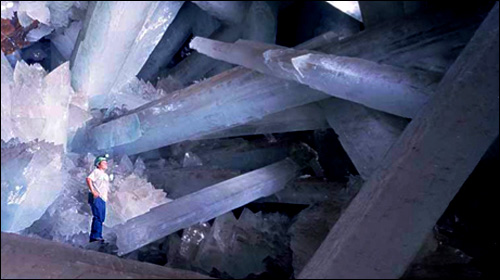
Deep below the surface of the Earth in Mexico, in the Naica mine near a town called Delicia, lies the astonishing Cueva de los Cristales.

In 2000, two miners were excavating a tunnel for their employer Industrias Peñoles when they discovered this cavern crammed with naturally occurring crystals of selenite gypsum, some of which reach lengths of up to 11 metres (36 feet).

I’ve known about these caves for years, but was reminded of them yesterday when I stumbled upon the piece of video I’m embedding below. The temperature and humidity in the caves (which are critical conditions that allow the crystals to reach such an enormous size) are both extremely high. As you will see, this creates a few problems for a photographer.

Those crazy cavers! The reason that you can hear people calling out the elapsed time in the video, is that it is extremely dangerous for these guys to remain in the cave without breathing apparatus for more than about ten minutes. The temperature and humidity are so overwhelming that not only does condensation form on their camera lens, but also on the inside of their lungs. That doesn’t lead to a good outcome.

Selenite gypsum crystals are formed when calcium and sulphate molecules precipitate out of a solution of dissolved anhydrite. To create crystals of this immense size, the caves need to have stayed at very stable temperatures of around 58°C (136°F) for many hundreds of thousands of years.

The caverns remind me of one of my favourite childhood movies, The First Men in the Moon, based on a novel by H.G. Wells. The wonderful premise of this film (which was made 5 years before the first US moon landing) has a multinational mission landing on the moon in 1964 to find a British flag already planted there. This comes as something as a shock, needless to say. ((Perhaps not as much of a delicious shock as it might have been had the mission just been a NASA one!)) The astronauts go on to discover that the moon has already been visited more than half a century earlier by an eccentric English inventor and his companions.

Leaving contemporary events behind, the film flashes back to that first journey in 1899. Joseph Cavor and his associates, propelled to the moon in a fantastic capsule coated in an antigravity substance called ‘Cavorite’, discover an insect-like race living in great crystal-filled caverns under the surface. These creatures (called ‘Selenites’ coincidentally) become concerned that Earthlings, whom they discern to be warlike and aggressive, will follow Cavor to the Moon and destroy their world, and so they conspire to prevent the travellers from returning home…

The First Men in the Moon has to be one of the best proto-steampunk movies ever made. Here’s a (not very good quality) trailer off YouTube (the crystals appear mostly at the end of this clip):

I really would love for someone to remake this movie and keep it true to its original Victorian origins.

___________________________________________________________________________

Photograph of Cueva de los Cristales from National Geographic.

___________________________________________________________________________

Just over a year ago (April 1, 2009, as it happens) I made my first post in what was to become a bit of an ongoing series – the ShooTag saga. Had Melissa Rogers, one of the CEOs of ShooTag, refrained from calling me ignorant at that time, and had not attempted to air her preposterous faux scientific notions on my blog, my interest in the dubious ShooTag might have blown away in the wind like so many other tumbleweeds of pseudoscience that have rolled my way. That wrong step by the ShooTaggers was just the first of many that has kept them in the focus of my attention and led us to this moment, which I think you will agree when you get to the end of this post, is a defining one for the credibility of this product and its makers.

When I first visited the ShooTag site, my main attention was, of course, on the science that was claimed to be behind this remarkable gadget, and, to that end, one of my first stops was the ShooTag Science page. It was immediately obvious that the scientific sounding language that was used there was utter waffle. ((This is the ‘scientific explanation’ originally offered on the ShooTag Science page:

All things are composed of atoms that are mostly electrons and protons. In between the electrons and protons and in between the atoms is mostly empty space, filled with magnetic static, quantum and gravitational fields. The science of voltammetry tells us of the electrical principles of all biological entities. Our research has shown that subtle inductance/capacitance fields (magnetic and static) can have dramatic effects on biology.


The only true measurement in electricity is the voltage and amperage, everything else is a mathematical variation of the two. These calculations are referred to as virtual or mathematical measures. Variations in flow of amperage and voltage give us a way to measure capacitance, inductance and frequency. These measurements reflect the static and magnetic effects of bio-electricity.

This is straight out of the textbook of Professor William Nelson, without a shadow of a doubt.))

This pseudoscientific rambling was quickly removed from the ShooTag site after I wrote my article, leaving only some lines of vague noncommittal nonsense.

The page also featured a link to a report called ‘Subtle Magnetic Repulsion of Insect Pests’ by someone called Professor William Nelson, which allegedly appeared in a periodical called The Quantum Agriculture Journal. It took me a scant second to establish that The Quantum Agriculture Journal didn’t exist [Note: See update at the bottom of this post]. The linked paper was an incoherent ramble through Chaos Theory Lite, MRI mechanics, the electro-sensitivity of sharks and the effects of magnetism on cell cultures – much of it inaccurate, most of it contextually adrift and the sum of it an addled mess of gee-whiz pop-science ideas that would be at home in a bad science fiction movie. [See more about this, also, below.]

Unsurprisingly, this link was also rapidly removed from the ShooTag site after my post, along with all references to the Quantum Agriculture Journal and Professor William Nelson. You can still see the original full text here though, complete with reference ((This reference has also been removed since I wrote this post. Only problem for them is that this time I anticipated that there was a very high likelihood of that happening, so I archived the site as it appeared on April 24, 2010. Compare that with the site as it appears today (January 27, 2011). Is there any more damning proof that the ShooTaggers are desperate to distance themselves from Professor William Nelson? Is this the behaviour of honest people who truly believe in what they sell?)) to ‘The Quantum Agriculture Journal’ edited by Prof. William Nelson for IMUNE. ((A search for IMUNE shows it to be another of William Nelson’s projects; it features references to a course in ‘Quantum BioFeedback’ featuring instruction in EPFX, SCIO and QXCI devices. So this ‘reference’ is to a an article in a non-existent journal attached to a website belonging to the person who supposedly wrote the article. Do I need to point out the fraudulent nature of that circuitous process?))

At the time I thought that the reason for these excisions was simply that the ShooTaggers didn’t like being sprung for their silly science. Fair enough – it does make them look pretty incoherent. However. Our recent investigations into the magnetic strips on the ShooTags prompted me to re-examine some of the scientific claims made for the gadgets, in particular, the notion of the ‘trivector electromagnetic signature’ that seems to be of such importance in the ShooTag promotional literature.

So I plugged that phrase into Google. The very first result throws up a link to a pdf of a document called ‘QUANTUM ELECTRO DYNAMICS and The VOLT-AMMETRIC TRIVECTOR SIGNATURE For DUMMIES’ by William Nelson MD Prof of Medicine IMUNE.

The pdf is a disjointed mish-mash of misunderstood science and erroneous analogies all whirled up into ball of unfathomable conclusions. It sounds, in fact, not unlike the incomprehensible babblings of a certain Dr Werner.

And there he is again. That Professor William Nelson guy.

Now, we’ve had cause to mention him before here on The Cow, but only in passing reference to the ShooTag scam. I think it’s time we turned the magnifying glass onto Professor William Nelson himself.

Here is a clip of him ‘explaining the trivector’:

Whoa. That was even more incomprehensible than the pdf we just looked at. ((I could really rip this apart if I could be bothered, but honestly, it’s just one dumb concept warped into another dumb concept mashed into another dumb concept for its entire length. There’s no point even trying to attack all the daft pieces of it because the whole thing is just utter nonsense.))

Researching Dr Nelson isn’t hard. There are literally thousands of references to him across the net. These are just some of the things that have been claimed of him (mostly by himself): ((http://www.theqxci.com/qxci_nelson.html)) ((http://www.stockscio.anolecms.com/the-inventor-dr-william-nelson/content/view/3/43/)) ((http://www.energetic-medicine.net/bill-nelson.html)) ((http://qxcinrg.com/inventor.html))

•He was childhood genius and accepted into Mensa at age 16 ((This really means nothing at all, even if it’s true – the Mensa tests don’t screen for lack of rational or logical thinking. You can still solve puzzles and be dissociated from a rational thought process))

•He is an accomplished golf, tennis and basketball player and was selected to compete in gymnastics in the 1968 Olympics in Mexico City.

•He worked at NASA and was involved in the Apollo program, notably in the trajectory mathematics of the first moon landing ((He would have been only 18, had that been the truth.)) and the rescue mission of the astronauts on the aborted Apollo 13 flight.

•He is an accredited quantum physicist, medical doctor, mathematician, computer expert, naturopath, acupuncturist, and homeopath.

•He has been nominated for the Nobel Prize in Medicine on numerous occasions.

•He has directed over 20 motion pictures ((‘Motion picture’ is a very floppy term, and could simply indicated the huge number of YouTube videos attributed to Professor Nelson/Desiré Dubounet.))

As well as the comprehensive reference links I’ve added above, you can read Professor William Nelson’s personal Curriculum Vitae here, courtesy of the Seattle Times. (Note that he tones down the more egregious exaggerations when writing in his own hand, and adds the caveat that ‘Whatever Dr Nelson says about himself can be relied on as true. Information that is not direct from Dr Nelson may be distorted’. O-k-a-y. Very convenient. And not that he bothers to correct any of this ‘distorted’ information anywhere, as far as I’m able to determine. To the contrary, as we shall see, he has a ‘friend’ who is very happy to take it one step further still…)

Depending how far you want to trawl and how much time you want to waste, you can find all kinds of other accomplishments for Dr/Prof Nelson. Needless to say, most of them can be established pretty quickly to be false. He (or anybody else) simply can’t know if he has ever been nominated for a Nobel Prize because Nobel Prize nominees aren’t advised they’ve been nominated and all nominations are kept secret for 50 years. So unless his Nobel Prize nomination was made when he was 10 or younger, that’s just plain rubbish. ((Thanks Dewi!)) NASA explicitly denies ((http://seattletimes.nwsource.com/html/localnews/2004020583_miracle18m2.html)) having any involvement with a Professor William Nelson and it is possible that he is hoping to dupe people into mistaking him for Clarence William ‘Bill’ Nelson – a NASA mission payload specialist of some achievement. ((Digging deeper we can find evidence that maybe William Nelson worked in a minor capacity for a company that worked for NASA. That’s not the same as ‘working for NASA’ and certainly not the same as ‘saving the lives of the Apollo 13 crew’.)) And, investigation into ‘Professor’ Nelson’s degrees reveals that they all come from dubious unaccredited institutions and mail-order or online courses. He is certainly not a quantum physicist.

There is no shadow of a doubt that Professor William Nelson is not the man he paints himself to be. Indeed, sometimes the man Professor William Nelson paints himself to be is actually a woman. A woman who goes by the name of Desiré Dubounet. It turns out that William Nelson is a gender switcher.

Now, I want to say right off the bat that when it comes to gender identification and sexual preferences and fantasies, I’m fairly open-minded. There’s a pretty big sliding scale with sexuality as far as I’m concerned, and as long people don’t do it in the streets and frighten the horses, I really don’t care. William Nelson’s right to be Desiré Dubounet is unassailable in my book, but his right to cheat, lie and swindle people out of good medical care is what I have in my sights here. To that end, I present a clip of Desiré Dubounet that is as frightening for its dreadful taste as it is for its demonstration of William Nelson’s mental state (WARNING – this is NSFW. It contains torrents of venomous bad language and it is quite surprising that it is still up on YouTube):

That’s a deeply troubled person by any reckoning. And Desiré Dubounet is not at all shy about promoting her ‘accomplishments’, either, be it for herself or for William Nelson. This from the Desiré Dubounet website:

Desiré is by far the most colourful, interesting, intelligent and courageous person in the world today… Nobody has changed the world as much as Desiré. Desiré as a super intelligent child was the first to max several intelligence tests, she was able to save the Apollo 13 astronauts, and has developed several patents that have revolutionized life. ((Consider this symptom of Narcissistic Personality Disorder:

Omniscience – The narcissist often pretends to know everything, in every field of human knowledge and endeavour. He lies and prevaricates to avoid the exposure of his ignorance. He resorts to numerous subterfuges to support his God-like omniscience. Where his knowledge fails him – he feigns authority, fakes superiority, quotes from non-existent sources, embeds threads of truth in a canvass of falsehoods. He transforms himself into an artist of intellectual prestidigitation. Many narcissists are avowed autodidacts, unwilling to subject their knowledge and insights to peer scrutiny, or, for that matter, to any scrutiny. The narcissist keeps re-inventing himself, adding new fields of knowledge as he goes. This creeping intellectual annexation is a round about way of reverting to his erstwhile image as the erudite ‘Renaissance man’.

))

As we’ve seen in the video above, like a good many of the peddlers of pseudoscience, William Nelson/Desiré Dubounet portrays herself as being ‘persecuted’ for her beliefs. Claiming to have switched gender to ‘prevent the powers-that-be’ from killing her’ she makes her pseudoscience cause corporeal by dressing it up in a gender issue; that way, if her ideas are criticized she can make the accusation that it is her person that is being persecuted and that she is being witch-hunted by those who are intolerant of her human rights. ((And she does do this, there is no question about that. There are numerous instances of this tactic in her writings and in the many online videos.))

The truth of the matter is that in 1996 ((Or 1998 – like everything about William Nelson, the actual facts seem variable)) William Nelson fled his home in the USA to take up residence in Budapest because he has been indicted by the U.S. Food and Drug Administration on nine counts of felony fraud charges in relation to various ‘bioenergetic’ healing devices sold through his companies. These expensive (and needless to say completely bogus) devices, which are claimed to be effective for the treatment of all manner of ailments including debilitating diseases such as AIDS and cancer, have been implicated in the deaths of several severely ill people in the United States, and are responsible for the lengthening of the illnesses of numerous others. This is a monstrously repellent scam and William Nelson has made millions of dollars out of it. Consequently he lives extravagantly in a restored five story building in Budapest with his personal staff of about a dozen, including a cook, hairdresser, nanny, security guards and chauffeurs. He uses his money to make terrible movies, ((Hollywood is not interested in his movies because they have been ‘pressured by the drug companies’ to avoid dealing with him. It has nothing to do with them being so bad as to be laughable.)) even worse music, and run his nightclub Bohemian Alibi, among other things. ((Just an aside: if you thought the trolling by the various ShooTag supporters was bad, you should see how the supporters of William Nelson behave. It is very interesting to me that the tone of the commentary that I’ve read across various sites that have criticized Nelson is eerily similar to the way the ShooTaggers express themselves. I fully expect we’ll get trolled by both camps for this post.))

William Nelson’s network for the sale of his machines (which go variously under the names EPFX, SCIO and QXCI) is widespread. He uses chiropractors, homeopaths, physicians, nurses and volunteers to sell the machines worldwide and there is no question that he knows that they do nothing at all (the disclaimer on the QXCI site says, in part ‘No claims are made of the system or of its results.’ which, in anybody’s language, is the ultimate ‘Get Out of Jail Free’ card).

And the ‘scientific’ basis for these completely fraudulent, dangerous ((Dangerous because they are completely ineffective.)) devices is the ‘trivector electromagnetic’ principle that Nelson promotes.

Which brings us, I believe, right back to ShooTag. As we have seen, Melissa Rogers and Kathy Heiney were at first very happy to invoke Professor William Nelson’s name when it suited their purpose ((And ditch it mighty fast when it didn’t, I might point out.)) and are still flaunting the ‘trivector electromagnetic’ principles behind their device. It seems to me very likely that Kathy Heiney, in her ‘training’ as a ‘Quantum Biofeedback Technician and Stress Management Specialist‘ could have come across the work of William Nelson. So, no real coincidence there. But now an obvious question arises: Is there any really tangible link between Professor William Nelson and ShooTag, Melissa Rogers and Kathy Heiney? Let’s see what a quick search brings up…

The link is protected with a login, but Google can see it, so it should be there… somewhere… Aha! Some further detective work from Dewi (who you will recall was our chief decoder of the data on the ShooTags a few posts back) reveals the complete schedule for the QX World Conference in Budapest, part of which features:

QX World Conference 2009. 8-11 October 2009. Budapest, Hungary.
Sunday, Oct. 11.
09.00, Prof. William C. Nelson/Desiré Dubounet. Introduce ShooTag – Melissa Rogers and Kathy Heiney.
09.15, Dr. Amanda Velloen. AIDS research.
12.00, Coffee Break. ((Dewi was able to reconstruct the entire schedule for the conference, even though none of it was directly available. He’s a good man to have on your side!))

And the pieces of the puzzle all fall resoundingly into place. The QX World Conference is an event that has, over the last few years, been held annually in Budapest by William Nelson/Desiré Dubounet. At this conference, Nelson assembles the faithful from his Quantum Bioenergetic flock, and here they presumably shore up each others’ belief systems, trade war stories and have an opportunity to touch the hem of the Master’s (Mistresses?) garment. From this snippet of information we can deduce that Melissa Rogers and Kathy Heiney were there, were sheduled to be there, or at the very least were represented there in some way. ((For their literal 15 minutes of fame in bioenergetic circles, it seems.)) However you cut it, a visceral, and certainly not insubstantial link with the fraudulent, criminally culpable William Nelson is established.

Now, I will quickly add that the act of associating with a criminal does not make you yourself a criminal. It can in no way be construed that the Shoo!TAG sisters are involved with the felony fraud committed by William Nelson. But the inference is written plain – William Nelson is wanted for fraud by the FDA because the ideas behind his gadgets have no scientific substance and are, through their complete lack of efficacy, misleading and liable to cause harm. Melissa Rogers and Kathy Heiney, by all the available evidence, advocate those exact same pseudoscientific ideas for their Shoo!TAG products.

No wonder they were so quick to divest themselves of any relationship to Nelson. Once they realised that they simply didn’t need to have the endorsement of a nutty ‘professor’ like Nelson to get their product to sell, they ditched all reference to him quick smart.

The credentials of Shoo!TAG can no longer be in any doubt. With absolutely no scientific evidence to back up their claims, a product that is revealed to be nothing more than a stock-standard magnetic swipe card, some third party testing that demonstrates clearly the complete ineffectiveness of the tags, and an indisputable link to the unsubstantiated irrational beliefs of a person who is a fraud and a swindler wanted by the FDA, it is more than clear that Melissa Rogers and Kathy Heiney are ripping off pet owners wherever they have managed to get their silly product into a retail outlet. Worse, by encouraging the use of their product for humans, they are putting the lives of people at risk.

I consider that what we have here, then, on the matter of the Shoo!TAG’s bona fides, is an emphatic QED.

And I’m not talking quantum electrodynamics.

___________________________________________________________________________

[UPDATE]Dewi points out that something calling itself the Quantum Agriculture Journal does indeed exist as a one-off document in exe format. I want to make it very clear that the Quantum Agriculture Journal did not have any web presence at the time I searched for it originally – and I was extremely thorough. All available references to it at the time pointed back to the ShooTag site. I did some further searching and turned up another online version of the ‘scientific’ paper (attributed to Professor William Nelson) that was purportedly carried by the QAJ (and originally linked to the ShooTag site). You can read the complete paper here. (This, also, has been removed from the web as of April 2010).

This is what I said of it in my original ShooTag post:

The ’scientific’ document itself (if you can be bothered) is a hare-brained ramble through a whole mess of abracadabra, beginning with some descriptions of chaotic attractors, jumping through magnetic resonance imaging and the electrical sensitivity of sharks, and ending up with the conductivity of chemicals in cells. It’s the most meaningless agglomeration of waffle that I’ve attempted to read in a very long while. If you’ve ever even seen a scientific paper, you know this ain’t one of those.

In light of recent comments by the ShooTaggers, though, it does have some interesting points. The ‘paper’ says that:

‘This three dimensional or trivector signature has been imprinted onto the magnetic field of a three-field magnetic memory card. This card is then hung around the neck of an animal and the magnetic field can stimulate the biology of the animal to build up defense to invaders.This is completely safe and proficient. In our preliminary farm tests the researchers found 75% less infestation of the insect pests when using the pests than in control populations. Further testing is presently being done in Europe.’

These words have been spoken in larger or smaller part by promoters of ShooTag at various times over the last year. It establishes quite clearly that they are using the exact same pseudoscience which underpins William Nelson’s fraudulent medical devices.


Recently on Tetherd Cow Ahead we did a simple science experiment that allowed us to reveal a visual representation of the magnetic data on the stripe of a standard swipe card. You will remember that one of the magnetic cards I examined in that post was the dubious Shoo!TAG, which according to its inventors, is a miraculous device that repels fleas and ticks (and other ‘targeted’ pests!) from you or your pets by using ‘the power of the bio-energetic field which surrounds all living thing to create a frequency barrier’.

It turns out that some pretty smart people read the Science Experiment post, including commenters MomentumV and the inimitable Dewi Morgan. To my great surprise, both MomentumV and Dewi were actually able to look at my images and read the card’s encoded data directly off them – something I had never anticipated as possible – and make some great initial headway in decoding the mysterious power of the Shoo!TAG.

The results were cryptic at first. Surprisingly, all of us missed the significance of the letters A E L F, which appeared on the card, along with a string of numbers. I threw up an image of the second ‘Cat’ tag I had (this one supposed to ward off ticks) and Dewi came up with a clever little javascript to auto-decode ShooTags. A number of things then dropped swiftly into focus. We were looking at the data backwards. You can experience the discovery as it happened in the Comments on that post – it makes for a wonderful scientific ‘Aha!’ moment.

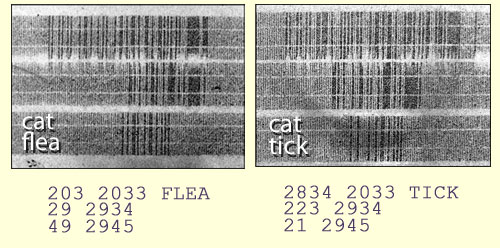
This is what Dewi found when he ran the data through his script (all the technical details of how it was achieved are explained in detail on Dewi’s journal): ((It’s probably the best description of how mag stripes work anywhere on the net – trust me, before Dewi came along, I looked!))

I’ve arranged the characters to correspond with their equivalent position on the cards. Note that the words ‘FLEA’ and ‘TICK’ are actually encoded as letters in the magnetic data.

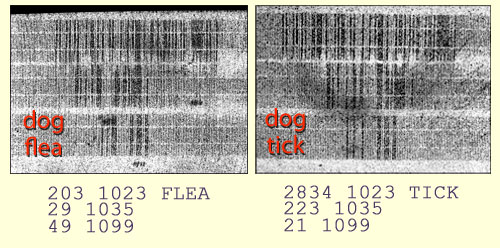
In the interests of science I decided to expand our dataset, and to this end I acquired a pair of the ‘Dog’ ShooTags from a nearby pet supply shop. ((‘Do you know how they work?’, the sales assistant asked. ‘No-one knows how they work. It’s bunk’, said I. She seemed nonplussed.)) Dewi was kind enough to decode them also:

There is some numerical symmetry and repetition apparent here, and the obvious conclusion is that the various numbers simply signify ‘Dog’ or ‘Cat’ and ‘Flea’ or ‘Tick’. ((There are a number of ways the digits can be paired with the actual words in the code or with the animal on which the tag is supposed to be worn.)) Melissa Rogers, one of the CEOs of ShooTag claims, however, that the tags are ‘encoded with earth friendly frequencies’ in the form of a ‘three dimensional or tri-vector signature imprinted onto the magnetic field of the card’ and the ShooTag FAQ says that ‘we are only using the energy field that is already emitted from an animal and adding a few frequencies that we know that specific insects do not like’. The implication is, therefore, that the data on the cards is some kind of numerical representation of these supposedly effective frequencies. I think you will agree with me that it beggars belief to think that anyone would base a serious 21st century product on this concept. It makes wearing a ShooTag the modern equivalent of the old superstitious practice of warding off evil spirits by carrying around a piece of paper with numbers written on it.

Whatever the characters signify, there is no known scientific mechanism that would explain how a few lines of magnetic data in a common encoding format, written to a card that is designed to be swiped through a checkout terminal, could have any effect at all on fleas, ticks, mosquitoes or any other insect.

[NOTE: I think there is still probably some kind of screwy logic to the numbers on the cards – if there’s anyone out there with some expertise in cryptography, or who feels like going on a treasure hunt, any extra information is welcomed. Places to start: Rife Frequencies, Quantum BioEnergetics and Quantum Energy Wellness (where you will see the term ‘tri-vector’ bandied about some more). Who knows whether any of these are relevant in the case of ShooTags, but it would be hugely satisfying to find out…]

Some years ago a tree in our backyard was cut down, and the stump cleared. Now, all through the year we have this weird fungus that keeps on growing up where the roots were. Violet Towne likes to ruthlessly lay into it with the mattock, but despite her best efforts, a little bit of rain and up it comes again.

It’s really quite an unsettling organism. It has a kind of a dead fleshy texture and colour… If you look very closely, it’s sort of brain-like. And recently it’s started to ooze something that looks awfully like blood…

If anyone actually knows what’s going on here, I’d love some more information. What is the red stuff? It seems very slightly oily… not particularly sticky. It washes off in the rain and you can quite clearly see little pits where it was – so it’s something that the fungus has evolved to do. It doesn’t seem to attract insects and I can’t for the life of me think of what it might be for (other than to conjure images to disturb my sleep).

« Previous PageNext Page »