Book Review: The Secret of Scent: Adventures in Perfume and the Science of Smell by Luca Turin.
Hey! What’s this? A book review on The Cow? I thought you didn’t do that kind of thing. It must be a very special book…
Oh yes, it truly is.
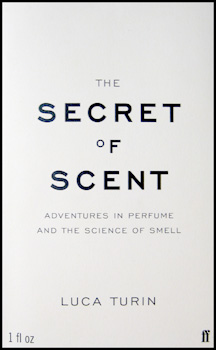
Those of you who have been long-time readers of The Cow (or who have browsed the Perfume category) know already about my interest in the field of perfume and scent. You might even remember that I have mentioned previously the name of Luca Turin in reference to Chandler Burr’s The Emperor of Scent, a book that elevated Turin from esoteria into the relative mainstream of that very successful contemporary publishing niche ‘Popular Science’.
In that book, Burr went some way towards illuminating a radical idea by Turin that challenges the conventional scientific wisdom behind the perplexing mystery of how we smell things.
Now, Turin turns his hand at telling his story in his own words. And what beautiful words he has at his command. I think it would be almost impossible for any reader of this book not to be infected by Turin’s obvious passion for scent. Here, let me just snip out a bit at random* (he’s talking about his first experience with Shiseido’s Nombre Noir):
The fragrance itself was, and still is, a radical surprise. A perfume, like the timbre of a voice, can say something quite independent of the words actually spoken. What Nombre Noir said was ‘flower’. But the way it said it was an epiphany. The flower at the core of Nombre Noir was halfway between a rose and a violet, but without a trace of the sweetness of either, set instead against an austere, almost saintly background of cigar-box cedar notes. At the same time it wasn’t dry, and seemed to be glistening with a liquid freshness that made its deep colours glow like a stained-glass window.
I don’t know about you, but I really want to smell this right now. Turin’s words swirl and bound and cavort on the page. He can barely conceal his verve and great enthusiasm for perfume and his need to make your nose plead to just have one tiny hint of that scent. More than once the visual and even aural images are so strong that I found myself wondering if Turin isn’t at least a little synaesthetic.
And Turin spins his tale in the manner in which you could infer he might design a beguiling perfume, beginning with an immediate and alluring top note that entrances the reader with a flitting precis of perfumes and perfumery, drawing you deeper into the secondary notes of how individual fragrance families are related to one another and then finally settling into the real substance of the drydown – his controversial hypothesis about how scent is detected by our olfactory organs.
It has to be said that when the story gets to this stage it doesn’t exactly make for light reading, as eloquent and illuminating as Turin is. You do need some science to get through. Refreshingly (as far as I’m concerned anyway) Turin doesn’t talk down to his (presumably) lay audience. He makes the science as easy to understand as I suspect anyone could, and rapidly moves on through his ideas. But you need to keep in mind that this is a big concept; he’s challenging an entire branch of science, and accordingly, the rationale for investments of billions of dollars by the huge perfume companies. If pictures of molecular structure and the big broad brushstrokes of grand thinking scare you, he’ll leave you behind.
Behind is not where you want to be though; this is the kind of thinking that needs to be wholeheartedly embraced. Turin thinks, in my opinion, how scientists ought to think, but often don’t. He collates information from obscure sources, re-examines decades-old research with new computer tools, reads what other scientists have speculated, riffing and elaborating on their ideas, and jumps to and fro across his subject with breathtaking flashes of insight. And, most of all, he quite literally follows his nose. When he says that boranes – big molecule chemicals used mostly in rocket fuels (and which are famously so olfactorily debilitating that scientists keep them in complicated corrales of glass tubing and sealed beakers) – smell like sulphur†, you know that he didn’t just take someone’s word for it.‡
It might be of some advantage, if you’re not already familiar with Turin’s work and his theory, to read Burr’s earlier account before you embark on this book. It probably does help make some of the more esoteric stuff (Do we have some kind of spectroscope in our noses?) a little easier to fathom, and also gives a good basis for understanding where Turin fits in the scheme of things. Even so, Turin’s journey is not too difficult to follow, and his sheer delight in his subject certainly makes you want to try.
Turin’s ideas, purely theoretical at the time of Burr’s writing of The Emperor of Scent, are currently much more substantial – he is now one of the key players in the scent creation company Flexitral, and has designed for them a number of new and novel scent molecules using his concepts. If ever anything speaks for the success of new science these days, it’s commercial endorsement.
Ultimately though, commerce is the farthest thing from Turin’s mind. In the most profound sense of the word, he is an artist. An artist whose medium – mysterious, evocative, sensual, sexual, nostalgic and joyful – is perfume.
Buy this book. Read it at least twice. And then keep it on your shelf so that you can say, in decades to come, I was there when they discovered how our sense of smell works.
___________________________________________________________________________
*Dear Mr Turin’s Copyright Lawyer: I’m not sure about the legality of quoting stuff from a book in a review, but I plead dedication to Turin’s vision, and I intend to forever and a day commit myself to urging anyone who will listen to spend their money on his book, if that helps at all.
†This single fact is a major key to Turin’s argument. It’s too complicated to go into, but it’s really a sweet piece of reasoning.
‡He has also, at some stage or other, whiffed hydrogen cyanide, a fact that he drops as a careless aside. HCN is the kind of gas that you don’t go around casually sniffing, since it can cause you to sort of DIE.