In The News


I hate computers. I hate them in the same way as I hate audio equipment. For me, gadgets have always been a means to an end. My idea of the perfect audio system is one with no wires, no speakers, no knobs and no disks. All that stuff is ugly and distracting. I would be happy if I could just go into my favourite room and hear the music without any need for the accompanying paraphernalia.

And my idea of a perfect computer is one with no hard drives, no interfaces, no file systems, no processors. I don’t really care that something has 3 terabytes of RAM or a 16GHz processor. And the big humming boxes that house such things are ugly, distracting and hot. My idea of a perfect computing environment is one with nothing more than a screen, a sketchpad, and a keyboard ((I still like typing over writing, and for the short term at least I don’t see any alternative to a keyboard. When voice recognition becomes MUCH better, maybe it will be nice to speak things to your computer, but as long as we read, I think there will be writing of some kind. Perhaps that will change when direct neural interaction becomes possible…)) and where I can do stuff and get results without having to think about file management or disk fragmentation or syntax or communications protocols.

The last few days have seen a lot of discussion about the sad passing of Steve Jobs and the legacy he has left the world. There can be little doubt, even among the detractors, that his vision did change our modern lives in a most profound way. To deny it is to be trivially contrarian. For me, the greatest thing for which Steve ((It’s funny how I feel quite comfortable calling him Steve. In my circles it’s always been the way. I think he has been such a big influence in our daily lives that I feel, like a lot of people I guess, that I kinda knew him personally.)) is responsible is not the Mac, nor the iPod, the iPad or the iPhone, ((I’ve always detested that pretentious and irksome ‘i’ prefix…)) but the wondrous behind-the-scenes tech of the operating systems in all those gadgets.

Some of you are probably old enough to remember the kinds of computing devices that existed before the Apple Macintosh came along and changed the computing world forever. I had two of them: a Commodore 64 and an Atari ST. You communicated with the Commodore via BASIC ((The C64 had no operating system as such, hard as that is to comprehend these days. When you booted it, it was just a dumb blank brain until you loaded something into its RAM.)) and with the Atari via Atari DOS, neither of which were what you could remotely consider ‘intuitive’. Each of these devices required a significant amount of figurin’ if you wanted to get something useful done with them. There certainly wasn’t much need to own one unless you intended to do something that was, in those days, fairly obscure, like music sequencing or database building.

I believe that Steve Jobs greatest gift to us was to make the ‘computeriness’ of computers go away (well, at least to start making it go away – it’s still not as invisible yet as I would like personally). I think that Jobs understood in his bones that most people don’t have the remotest desire to want to tangle with computers. They just want to do stuff. They just want to have their whole music collection to choose from when they’re taking a walk. They just want a little game to play while they’re waiting for the train. They just want to snap pictures and send them to a friend – or make them into a photo album. They just want to be able to lie in bed and browse the web.

And, when they work, they just want to be able to write a letter, prepare a report, record a song, edit a movie or hold a video conference without having to understand what C+ or printer drivers or ROM or RAM or SCSI or serial ports are. Mr Jobs took us a long way along the path to never having to think about this kind of ephemera and to just getting on with doing the things we needed (and wanted) to do.

I admit, quite proudly, to being what is derogatorily known these days as an Apple fanboy. I bought my first Apple product, a Mac Plus, in 1988, and not long that after switched up to an SE. After the Atari it was like upgrading from a badly-tuned 2 cylinder motor scooter to a Rolls Royce. I was initially only interested in having a computer solely as a music tool, but with the Macintosh, suddenly I could do all this other stuff as well. It was truly an enlightening experience. The thing that captured my imagination most of all with those early Macs was that for my mind, at least, they just felt right. It was like there was someone sensible in the design process who was thinking more about me and how I might want to use the machine, than whether it had the latest chipset or the fastest clock speed. That someone was Steve Jobs. In short, I felt an immediate affinity with the Macintosh because it didn’t get in the way of what I wanted to do with it.

Advocates of PCs and the Microsoft Windows way of doing things (and to a lesser extent aficionados of worthy alternatives like Linux), can’t understand why we Apple disciples love our Apple environments so much. They look on the Apple culture as something like a fashion trend, believing us to have all been sucked in by the slick design and the tinker-toy simplicity of the computers themselves. They frequently proclaim that we have ‘drunk the Cool Aid’. What they fail to understand is that people like me simply don’t care that there are faster, cheaper, more efficient, cleverer ways to do computer things out there; ((Consider these two options: 1. An ugly car that has a theoretical speed of 300 mph, has a super-efficient engine, an optimized drive-train and is technically superior to every other car on the road – as long as you fully understood the complicated procedure for driving it; 2. A nicely designed car that reliably gets you to the shops and back without any thought on your part about how that’s achieved. Some people will undoubtedly choose the first option. People whose main concern is just getting the shopping done will be the same people who buy a Mac.)) to us, computers are necessary annoyances, and the simpler it is to get something done with them, and the less they force you to think ‘like a computer’, the better. ((In this respect, Apple’s ‘Think Different’ campaign is not so much about how people think about the world, but about how the world was thinking about computers. Apple was truly thinking different(ly).)) This was the critical insight of Steve Jobs – an insight that went on to inform the Apple music players, the phones, the tablets and the online stores. We love Apple, and we loved Steve, because he made our lives richer by giving us the power of computers without needing to be part of the arcane secret societies that had previously been the sole interlocutors for the mysterious digital magicks. This, I believe, is what the PC (and IT) crowd hate most about Apple – that it has given the peasants the keys to the church.

One of the criticisms you hear most from Apple critics is that Jobs pushed ‘style-over-substance’. This is mostly a cry of ‘How come we can’t make OUR things so neat?’, because if you think about it, how can anyone celebrate a lack of style? The real implication of this complaint is, of course, that if there is style there must necessarily be little substance. Such a deprecation indicates the profound absence of acumen of the prosaic mind. As any thinking person should realise, style is not just an outer layer in which something is cloaked, but is an integral part of its very being. To quote Jean-Luc Godard:

To me style is just the outside of content, and content the inside of style, like the outside and the inside of the human body. Both go together, they can’t be separated.

The style with which Jobs imbued Apple products is not surface deep, but reaches down into the core of the Apple brand. It is his personal philosophy that we engage with every day when we use our iPods and iPhones, our iPads and iMacs. We believe that Steve understood exactly how to allow us to engage with the world in a way that felt stylish and empowering and fun and, well, yes, insanely great.

It is for this reason, I believe, that even though we didn’t know him personally, many of us long-time and dedicated Apple users feel very deeply that with his untimely death we’ve lost a dear friend. And we fear that the people who are now taking over the reins at Apple might not truly understand what Steve Jobs seemed to embody intuitively as a driving force. Certainly, there is currently no-one else in the tech world who does, even including the very closely philosophically aligned Sergey Brin and Larry Page.

Perhaps that’s the way it happens. I guess that’s for history to judge. For now, Steve Jobs has planted the seeds of great ideas. We can only hope that they continue to grow into beautiful trees without him to tend them.

Rest in peace Steve. I, for one, am richer for having had my life illuminated by the tools and creative philosophies which you brought us.
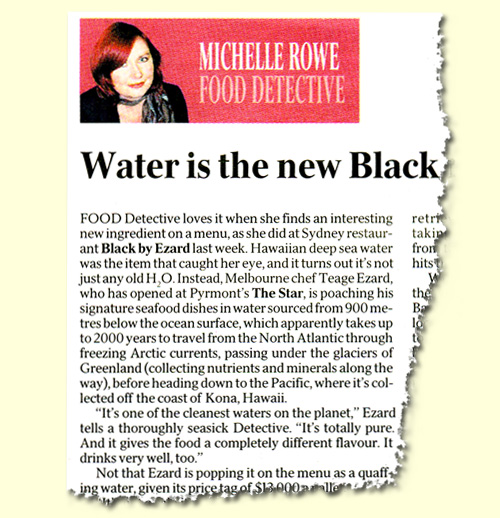
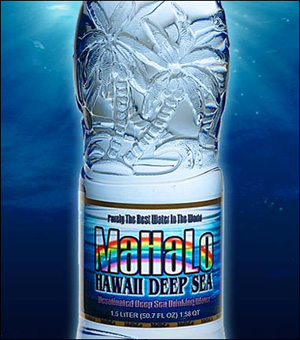
Ah, dear Cowpokes. If there’s one thing that remains completely reliable in the World of Woo, it’s that people will relentlessly find ways to re-invent, repackage and re-market good ol’ H20 as some kind of miracle product. For your delectation this morning, I present to you the following newspaper snippet that comes to you courtesy of the Weekend Australian and my fellow tweeps ((You see how I’m actually warming to Twitter, don’t you now?)) @johncarneyau & @DrRachie.

It is to laugh. Now, I have not dined in chef Teage Ezard’s restaurant ((I have food allergy: I’m allergic to anything that contains hogwash. It causes me to launch into long raves about how stupid people can be. Ask Violet Towne. She’ll tell you.)) but when I read something like this:

It’s one of the cleanest waters on the planet. It’s totally pure. And it gives the food a completely different flavour.

…I already know, without the need to do any further research, that the person saying it is a nitwit. Understand this, Mr Ezard: it’s not hard to make ‘totally pure’ or ‘clean’ water. Millions and millions of litres of it are created every day for one use or another. It’s done very simply: you boil it and condense it, or you filter it. THAT. IS. ALL.

But of course for block-headed pretentious chefs-de-cuisine and air-headed credulous journalist gourmands, that’s WAY too prosaic. They don’t want ‘pure’ water, they want magic water – ‘2000 year old’ magic water from the bottom of the ocean, in this case.

Whoa, hang on there Faithful Acowlytes – no need to bang the tin cups on the bars. Yes, water from the ocean IS salty, even if it is old. So how can it be ‘pure’? Well, to answer that question we must visit the source of Chef Ezard’s mystical water, ‘the island paradise of Hawaii’ and consult the makers of the product in question: MaHaLo Hawaii Deep Sea Water.

[Cue Hawaiian guitars and hula dancers]

MaHaLo Hawaii Deep Sea drinking water comes to you from the island paradise of Hawaii, 3,000 feet below the ocean’s surface, where the water is naturally clean, pure, cold and filled with healthy minerals and nutrients.

Aha! Naturally clean, pure, cold and filled with healthy minerals! Righty-ho, that’s easy – nothing left to do but bung it in some bottles and ship it to the customers!

Koyo USA Corp. pumps the water into its ultra-modern processing facility, where it removes the excess sea salt and tests it for purity and content.

Wha? They have a processing facility? And they need to remove stuff? And then do tests? So when they told us before that their water is naturally clean and pure, they meant, ‘kinda sorta’, it seems.

Deep Sea Water contains abundant amounts of essential minerals like potassium, calcium and selenium, plus minute amounts of many of the trace elements such as iron, copper, zinc, manganese and chromium, which are missing from common surface water.

Maybe that’s so, but that’s not what’s getting into the bottle, is it? ((And what’s with the ‘common’ surface water?)) What MaHaLo is asking us to believe here is that they treat water in such a way that they can remove the sea salt, make the water ‘pure’ and still maintain its supposed magical balance of minerals. I’m highly skeptical of this. What I reckon happens in the MaHaLo plant is that they desalinate the water, measure its characteristics, and then add stuff back to it. This is not rocket science, nor is it particularly special – it happens in water bottling plants all over the planet.

These trace minerals help humans absorb the vitamins in food and pass these directly into the system.

Actually (and I’m prepared to stand corrected on this matter) I was under the impression that it’s vitamins that help the body absorb metals and minerals and not the other way around. Whatever the case, it’s plain bunk that you need to get necessary trace minerals from drinking water; whatever you need you can get from a healthy diet.

In some cases, bottled water marketed as “natural spring water” with pictures of mountain streams and lakes on the bottles’ labels is nothing more than filtered tap water.

That’s right. And in some other cases, bottled water marketed as “natural deep sea water”, with pictures of palm trees and rainbows on the bottles’ label is nothing more than filtered sea water.

We at Koyo USA take these deceptive claims very seriously and strive to meet and exceed EPA and FDA standards for our water.

The implication here is that there is something rare or special about meeting or exceeding EPA and FDA water quality requirements – this is a wondrous use of weasel language. ALL bottled water and even normal tap water is required to meet those standards. MaHaLo should be doing more than striving – they should be guaranteeing!

There is no healthier way to obtain all the nutrition your body requires from water than MaHaLo Hawaii Deep Sea® Water.

Nutrition? Really? Er… actually, your body doesn’t require any nutrition at all from water. I think they’re getting confused with food. What your body requires from water is water. Counting on water to provide nutrition is almost as dumb as counting on air to provide nutrition.

But perhaps I have this whole affair arse-about. Maybe that’s what Teage Ezard is getting at with his fancy boil-in-a-bag haute cuisine: there’s no nutrition in the food itself, so he’s hoping you’ll get it out of the water! It’s at least as plausible as claiming that it makes the food taste any different. I guess Chef Ezard feels compelled to do something flamboyant with MaHaLo Deep Sea Water: for the $13,000 per pallet that they apparently charge for it, you’d certainly not be wanting to piss the stuff away. ((MaHaLo is certainly not spending any of their profits on their advertising. The commercial on their home page is one of the lamest, crummiest, least-persuasive ads I’ve ever seen. And I’ve seen some.))

[More silly water stories here, here, here (bonus material in Comments), here and here.]


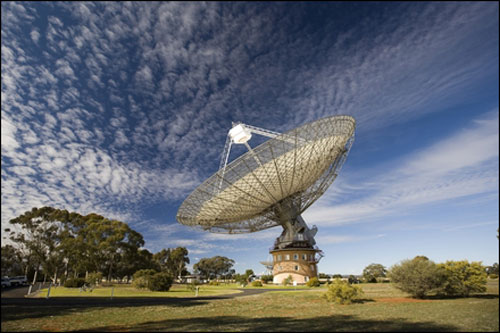
Image CSIRO

The Conversation is carrying an enormously insightful article by Dr Matthew Bailes, the Pro-Vice Chancellor of Research at Swinburne University of Technology in Melbourne.

Dr Bailes was one of the discoverers of the ‘diamond planet’ that you can’t fail to have heard about recently if you follow any kind of science news. It even made a sizeable appearance in the mainstream media all across the world.

…the diamond planet has been hugely successful in igniting public curiosity about the universe in which we live… Our host institutions were thrilled with the publicity and most of us enjoyed our 15 minutes of fame. The attention we received was 100% positive, but how different that could have been.

How so? Well, we could have been climate scientists.

As Dr Bailes goes on to point out, the scientific process involved in discovering a diamond planet is exactly the same scientific process involved in gathering data on climate change. And yet, the media and the general public is happy to accept the scientific community’s assessment of one and not the other.

I highly recommend you read this article and Tweet it, Like it and otherwise recommend it to your friends.

(Oh, and seriosuly, make sure you subscribe – for free – to The Conversation. Real news, real journalism, no agenda. As it should be.)

Researchers at the Cornell Creative Machine Lab came up with the brilliant idea of getting Cleverbot, their ‘intelligent’ chat program, to engage with its own doppelganger.

Clever Clogs: meet Clever Clogs.

Awesome.

By way of explanation for the non-Australians: earlier this year the northern parts of the east coast of Australia were devastated by rain and floods, significantly damaging the large banana crops that are grown there. As a consequence, the price of bananas has more than tripled throughout the land, and they have become something of a luxury item in recent months. Pic comes courtesy of Cissy Strutt who snapped this in her ‘hood.

One of the big topics in the skeptical community at the moment (like everywhere else I guess) is the climate change issue. It’s a subject that is as fraught with debate as that of Evolution vs Creationism, and indeed, has many of the hallmarks of that particular tussle. What makes it particularly volatile in this setting, though, is that many of the people who claim that there is no need to worry about global warming paint themselves as climate change skeptics, and take the position that they offer a rational approach to the debate. What they are in fact doing is voicing opinions that are in contradiction to MOST of the world’s knowledgeable climate scientists. Though they like to think of themselves as skeptics, this stubborn entrenchment in a belief system has earnt them, instead, the badge of climate change deniers.

I pretty much stay out of the climate change argument, just as I stay out of the Creationism debate. It’s not that I don’t have a strong view on global warming. I think the scientific evidence is conclusive that we have a looming disaster on our hands, and that it’s a disaster of our own making. Bothering to argue with the deniers though is the mental equivalent of jabbing a sharp pencil repeatedly into the back of your hand – a sensible person stops doing it pretty quickly.

The main problem is that, as with evolution, climate science deals with concepts that don’t come easily to the natural human way of thinking. With evolution it has to do with vast amounts of time (which we’re not good at comprehending) and the complexity of the vectors that come to bear on natural selection. With climate science, it’s all in the maths. I’m going to attempt in this post to show you why, even if you haven’t kept up with all the marginalia of the climate discussion, you should be afraid of what we’re doing to the planet.

At the outset I will state that my essay takes one idea as a given: that global warming is a human-instigated phenomenon. You should understand that a cornerstone of the denier’s ‘argument’ is that it isn’t, but I will stand behind the overwhelming scientific viewpoint on this matter. ((If the deniers are right on this and global warming is an inevitable natural process, then we’re in a handcart to hell anyway, and it doesn’t matter what we do. So we may as well make efforts to ameliorate the situation as not. An argument of financial imperative (‘it will ruin our economy’) is quite irrelevant because in a hundred years there won’t be an economy.))

OK. We’re going to talk about math in this, but you don’t need to understand numbers. And I promise you, it won’t be dull. This is a very scary story. I’m going to divide it into three chapters.

Chapter 1: Boiling the Frog

There is an old fable – it’s probably apocryphal but for our purposes it doesn’t matter – that says that if you take a frog and put it in a bowl of water over a burner and slowly raise the heat, the frog, unable to feel the very slow rise in temperature will make no effort to leave the water and happily sit there until it is boiled to death. In other words, it either doesn’t realise there is a problem, or, by the time it does, it’s too late.

The story illustrates a psychological phenomenon called ‘creeping normalcy’ (or in science, the ‘shifting baseline’ problem). Put simply, it says that if you have changing reference points, you can only judge what is ‘normal’ by what you’re familiar with at any given time. In this way, familiarity changes the baseline of ‘normal’ to whatever you get used to, and if things change slowly enough, ‘normal’ can wander an awfully long way from ‘acceptable’.

The first step towards understanding why the climate issue is so deadly is to understand that humans think like this as a default. Our brains don’t work well on timescales in excess of a few years. Our horizons are small. I’m not the first to mention the Boiling Frog concept in relation to the climate change situation, so its appearance here is no big revelation. But you need to keep it in mind as we head off to chapters 2 & 3:

Chapter 2: The Big Clock

I recently saw a comment on an article in The Conversation from one John Dodds, a ‘retired engineer’:

First a philosophical point: Climate Change is claimed to be complex. I claim it is NOT. It is simple physics – add more energy and the world warms up.

Mr Dodds’ opinion typifies the way in which most people believe that the planet’s climate system behaves – something like a Big Clock. A wheel here, a cog there, a spring yonder – all ticking away in a simple predictable manner that can be completely described if you do the right calculations. Most people think, therefore, that if we’ve caused some kind of problem with the climate, then all we need to do is to ‘oil the gears’ on the clock and everything will go back to the way it was. They believe that the problem is proportionate to the actions we take to correct it.

This is a massive and perilous failure of understanding. It’s a mechanical Newtonian notion of the way things work that is fine for pipes and balls and clocks, but breaks down catastrophically when applied to something like climate behaviour. To grasp why, we have to venture into the frightening, mind-bending and completely unintuitive world of complex systems.

clock

First, let’s consider the pendulum in our Big Clock. As physical systems go, this is about as unadorned as you can get. A swinging pendulum exhibits what is known as simple harmonic motion ((For small angles of swing. As the angular acceleration increases things become a little more complicated, but for our purposes we can assume true simple harmonic motion.)) and it is a very reliable behaviour that allows us to build a clock that will behave predictably and dependably. A simple pendulum is mathematically very straightforward. Its properties can be described completely in terms of the length of the ‘rod’ of the pendulum, gravity, the mass of the ‘bob’ on the end of the pendulum and the angle of swing. If you know these things, you can predict exactly how this pendulum will behave. This uncomplicated mechanism works great for a clock, and it’s fairly tolerant of perturbations in the system: if you push the pendulum a little hard, it will dampen down to its normal swing pretty quickly. You need to be pretty violent to cause the clock to have problems big enough to effect its function.

This is the kind of path we could expect the bob on the simple pendulum in our clock to trace. Every time:

Unfortunately for us, the climate system isn’t driven by a simple pendulum.

Let’s consider a physical system only a tiny step away from our Big Clock’s single pendulum: the double pendulum. A double pendulum makes one small alteration to the simple pendulum model – instead of a simple bob at the end of the pendulum, you add another pendulum. This very unassuming variation has sudden and profound effects.

Here’s a computer simulation of the path traced by the tip of a double pendulum:

If that looks weird and science fictiony to you, let me assure you that double pendulums behave exactly like that in reality. There are dozens of YouTube videos that show them in action.

You can see how this one small change to our pendulum quickly throws a simple harmonic oscillation into a volatile and complex motion. The double pendulum system can be very easily described, ((We still know the lengths of the rods, the mass of the bobs and the gravity coefficient.)) but its ultimate behaviour cannot. Each time you set it swinging its bob will trace a completely different path in space because, crucially, a double pendulum is very sensitive to initial conditions. Unlike our clock’s pendulum, we can’t accidentally give it a bit too much of a shove and have it simply settle back into its predictable ol’ groove.

Imagine, now, that you have a pendulum with n arms, each with a bob with a mass that is a variable coefficient ofn, n points of articulation on each arm, and variable gravity. It doesn’t take much of a leap of imagination to understand how wildly such a device will behave. In fact (and this is where most people fall off the bike), for surprisingly small values of n, no amount of computing power in the universe can ever predict the path of motion it will describe!

Well, the Earth’s climate is exactly such a system.

Unfortunately one thing that tends to be a little confusing with this is that climate scientists often speak of ‘climate modelling’ and to many people this sounds again like they’re talking about some kind of Big Clock: you stick in all the variables into your computer and ‘ping’ – out comes the behaviour that the Big Clock will exhibit. If it were only that easy.

When you look up a weather report on your i-Device of choice, you’re seeing climate modelling at work. One thing I probably don’t have to tell you, is that you shouldn’t rely on the information more than a few days ahead. That’s the state of the art in climate modelling. We’re just not very good at predicting the behaviour of complex systems (like weather) even a few days in advance. Here’s the kicker: it’s not our fault! These systems are inherently unpredictable. Even if we had super-super-super computers, we couldn’t do it. Even if we had a computer that could take ALL the variables – and that’s a HUGE amount of variables – and then run the simulation in real time to see what it did, it would do us no good – we would get a different outcome every time we ran the program. Just like its very simple distant relative, the double pendulum, a complete detailed model of a complex system like the climate is critically dependent on initial conditions. (We actually do have such a computer – it’s called ‘Reality’. The only accurate simulation of what the climate will do is the climate itself).

So, when you hear scientists talk about modelling the climate, you should not understand that to mean they are trying different kinds of wood for the clock case, or a new type of oil to make the gears run smoother. They mean they are making their best educated guess at the Big Picture of what might happen if they picked enough of the right factors to plug into their equations. Just like you understand the weather man to be doing when he tells you that in a week’s time it looks like rain (are you starting to get nervous yet? No? Then you’re not following me).

So what’s the problem, right? We don’t know what the weather will do – why is that different from any other period in our history? Why are we suddenly worrying now? Well, one of the things that modelling can predict pretty confidently is trends. Just as we can say that a double pendulum pushed gently is unlikely to do the crazy loop-the-loops that we see in the same system dropped from a higher angle, models can tell us that when we change something in the climate system too much, we’re likely to see unpredictable behaviour. In recent times (the last few million years or so) the climate has been ticking along like a gently-pushed double pendulum; little flurries here, little irregularities there, but for the most part, predictable enough for life-forms to have evolved strategies to cope. Things do change, but they change slowly. The system keeps itself in check through millions of years of self-modification that has allowed it to reach a relatively stable, though delicately balanced, equilibrium. The evidence is clear, though, that over the last few hundred years (a VERY short period by geological standards) humans are swinging the pendulum’s arc wider and wider by the simple act of burning things. We’re taking carbon that has been for eons locked up in the biosphere and chucking it into the atmosphere where it has started to imprison the Earth’s heat. We can, therefore, state with a high degree of confidence (based on an enormous amount of accumulated data) that the planet is heating up monumentally faster than it ever has before, and that that heating-up is concomitant with the technological period of humans. ((We’re excluding events that happened in geological times of many hundreds of millions of years ago, where lots of weird climate events happened. They are not relevant to our argument because we weren’t involved. If we had been, we’d be dead, which is of course the issue at hand.))

But when climate modelling scientists make a ‘prediction’ that the temperatures will rise 3 or 4 degrees by the end of the century, you should not think of that as a jolly nice warming of the winter months, and the odd extra scorcher in July (or January, depending in which hemisphere you live). You should instead interpret it to mean ‘We figure the whole system is going to heat up, but how it delivers that heat, and to whom, depends on the swing of the double pendulum…’ What you should expect is periods when the weather seems just as it always has, interspersed with occasional outbursts of extreme behaviour. For a while this will seem normal, and you will be as happy as a frog in a warm pond. But this extreme behaviour itself will start to interfere with the system – it’s another phenomenon of mathematics which those in the know approach with respect: feedback. And that feedback will almost certainly affect the system in ways which we can’t even imagine. ((We don’t really have much of an idea of the way the climate system is held in such delicate check anyway – global atmospheric behaviour is without doubt one of the most complex systems we know. All we can say for certain is that that if it changes much, we are in trouble.))

This coupling of complex behaviour and feedback is the thing which frightens the scientists, because it’s something with which the world of science has become very familiar in the last fifty or sixty years. We know that a complex system exhibiting instability and feedback can suddenly and capriciously become chaotic. That is, the system is likely to reach a point where even modelling is completely useless – it just goes completely berserk.

Trust me when I say that we really don’t want to see our climate system go chaotic. If we hit that point, it is likely that the great majority of the human race will suffer. ((It should be understood here – because I often think that it’s not – that the planet is indifferent to this problem. You hear climate deniers putting forward ideas like ‘Well there have always been periods of global warming’ or that ‘Sea levels have changed many times though the Earth’s history’. Well, sure. But mostly, there were no, or few, humans around, and other creatures were affected by these events, often in the form of species-wide extinctions. The Earth was once a giant greenhouse, covered with plants. But WE could never have lived in it. The planet would probably survive quite extreme results of our global warming efforts – it’s just that we wouldn’t.))

Chapter 3: Jenga

clock

The kind of critical instability that I’ve just described is a lot like the game of Jenga. The Jenga tower will remain upright as long as the system is stable around its centre of gravity. If you lived on top of the Jenga tower, you would probably be aware of nothing at all as pieces are removed. Maybe the tower might wobble a bit, but, hey, things look pretty normal. Every removal of a Jenga tile is exactly the same kind of small effort, but each one of these small efforts moves the system closer and closer to critical instability. When the Jenga system reaches this point, the collapse into chaos happens rapidly and catastrophically, with little warning.

Well, that’s where we are right now. The tower is wobbling a bit, but everyone is saying ‘Hey, the tower has wobbled before and we were OK – what’s the problem? Worse, we continue to slide out the pieces, because that’s what we’ve been doing for years and it’s been just fine.

Unfortunately, this kind of situation is the very worst sort of thing to try to get resolved by a ‘popular vote’. When you combine the Boiling Frog situation with the Big Clock scenario and stir in a whole lot of poorly educated ((I say ‘poorly educated’ because I think that even the great majority of people who are literate do not have a good grasp on science, nor on rational ways of thinking. Any of you who have been reading TCA for a significant period of time will understand exactly what I mean here.)) points of view, you just get lots of personal assessments of the problem – or debates about even whether or not there IS a problem – and a bucketload of total inaction. The grim truth is that it’s a state of affairs that seriously needs everyone on the planet to be in complete agreement, or we will, without doubt, plod our way into extinction.

The way it stands at the moment is that the vast majority of people are either uninterested or confused, a small minority is in denial and beset by superstition and petty agendas, and another small minority is informed but frightened, frustrated and powerless. I think that what we are seeing here are the ramifications of a massive failure as a species to improve ourselves by putting emphasis on the capacity to understand our world through observing it properly. That is, through science. It is of no use to put an appropriate course of action to a popular vote in this instance, because the holders of a popular vote aren’t equipped to understand what it is they’re voting on. And frankly, I think we’ve run out of time to get them up to speed. Added to that is the negative influence that whatever we need to do will, most likely, cause great inconvenience to a large number of people, and will include increased poverty, loss of jobs, deprivation of luxuries (and maybe even necessities for many) and a general willingness to just suck it up and take a beating. It doesn’t take much insight to see that we’re never going to get people to volunteer for that, unless they become very afraid indeed (by which time – I emphasize once more – it will be way too late).

If ever there was a time for the leaders of our nations to listen to the science, and act decisively and quickly for the good of human race, this is it.

___________________________________________________________________________

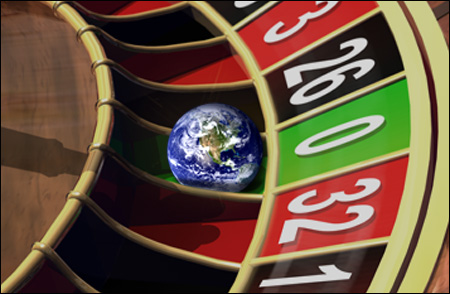
Image of the Earth courtesy NASA and the Visible Earth project.

« Previous PageNext Page »