OK, as I said a couple of days back, in this post, and possibly the next, I’m going to take a critical look at the Transforming Melbourne document entitled ‘The Vital Role of the Church and Christian Faith in Our Society’ by Rob Isaachsen. The pdf is long and rambling, so I’m just going to lift out the more egregious and offensive portions for examination. Just so you know that I’m not taking anything out of context, though, I urge you to read it for yourself.
I’ll start with the soft stuff:
Our City and Nation depend on the Church
The contribution of Christian faith to every level of our society, its history, laws, institutions, culture, values, community support, welfare services and overseas aid is far in excess of any other movement.
It may indeed be true that there is dependency on the Church for some things. But in my view, that’s exactly the kind of situation we should be addressing. To claim that the contribution of the Christian faith to our society is ‘far in excess of any other movement’ is an exaggeration and a straw man. The assertion conveniently excludes the greater umbrella of secular contribution to society, which is not a ‘movement’ as such, but is just the way we live. Indeed, it is an enhancement of this secular contribution that Humanists and atheists seek.
Church, Government and Society are largely ignorant of the vital place of the Church
It is only because society is ignorant of this, that society contemplates restricting Christian influence.
No, our society contemplates restriction of Christian influence because Christian ideals are in conflict with the ideals of our society. It is only Christians who think that the medieval morality of their Church is ‘vital’. Other people, like me, think it has an agenda that is overly influential. We are not in any way ignorant of what’s going on here – we know, and we object.
Correlation between Christian heritage and strong nationhood
“Christianity, and nothing else, is the ultimate foundation of liberty, conscience, human rights, and democracy, the benchmarks of Western civilisation. To this day we have no other options [to Christianityâ€.
Oh for Pete’s sake. Now the rhetoric starts. This, of course, is complete and utter bullshit. First of all it makes the conceited assumption that ‘Western civilization’ is better than any other way of living. What utter racist gall. ((Rather shabby argument too, considering that as we will see in a bit, Christians pride themselves on their tolerance and lack of racism.)) This statement is demeaning to every culture on the planet that does not have a Christian heritage. As usual, Christians are putting themselves on the top of the pile, and somehow don’t find it hypocritical that they target atheists and others as ‘arrogant’.
In addition, I don’t think I need to point out to anyone with even a little bit of history and philosophy that Christians can hardly take the credit for ‘liberty, conscience, human rights, and democracy’. They seem to have forgotten that the Ancient Greeks and Romans were doing pretty well on that score before Jesus came along. Not to mention that they conveniently ignore some of the appalling subjugation of those ideals by Christianity through the ages (God, according to his own Word, is certainly not too fussy about ANY of those things).
Individual Influence of Christian Faith
“If you are a church-goer you are more likely to take the opinions of other people seriously, more determined to make a contribution to society, more inclined to think that life is meaningful, less likely to violate property rights or to harm other people, cheat on your taxes, avoid paying train fares or to take sickies. (“The Religious Factor in Australian Life†by Melbourne sociologists, Beverly Dixon and Gary Bouma 1983)
I’d be inclined to laugh at this if I wasn’t so angry. The Dixon and Bouma conclusions (which I don’t even really need to point out are 30 years old) are taken from information accumulated by the 1983 Australian Values Study, a self-reported survey carried out by the Roy Morgan Research Centre.
What’s happening here is something with which you should be very familiar if you’re a regular reader of The Cow. It’s a common tactic of a people who are being dishonest about what they are telling you: opinions are being touted as facts. The Australian Values Study shows us data about what people say they do. This is manifestly not the same as what people actually do. Being ‘more determined’ to make a contribution to society is not the same as actually making a contribution. Just because Christians say that they are less likely to violate property rights, harm other people, cheat on their taxes or evade train fares is not evidence that they act that way. In fact, an equally valid explanation for the statistical over-representation of Christians as being ‘morally superior’ is that they lied more about these things than other people on the survey. Unless some kind of evidence is put forward, the Dixon/Bouma statement – presented quite clearly here as ‘fact’ – is merely conjecture based on biased opinion.
I’m going to skip a few paragraphs here ((I can deflate most of the intervening rubbish as easily as I have done above, but it’s kind of tedious.)) and go on to something that really peeves me, before, in the next post, we look at the really offensive material.
Christian Schools
44% of secondary and 34% of all primary students in Victoria attend Catholic or independent (mainly Christian or Church-run) schools in Greater Melbourne (2006 Census). The percentage of students enrolling at state schools is falling and to independent (Christian) schools is rising – generally because parents see these schools give priority to Christian values or the style of education provided by them.
Wow – a fact! Yes, the enrollment rate in religious schools in Victoria is rising (indeed, VT & I send our own kids to a Christian school). ((It is the least doctrinal of all the Melbourne religious schools, as far as I can tell.)) But it’s not because ‘parents see these schools give priority to Christian values or the style of education provided by them’. It’s because the religious schools have better teachers. Why do they have better teachers? Because they are attracted by better wages than they can earn at a government school. Why can religious schools afford to pay teachers better? Because they have the triple benefit of their historically deep pockets, an ability to attract wealthier parents who will pay substantial fees, ((This happens through a kind of bootstrapping effect – a little bit more operating money than governments schools -> better teachers -> better education -> parents wanting the best for their kids -> higher fees -> a little bit more operating money -> better teachers… Not hard to see how it works. I don’t like participating in that scheme, but I also want my kids to have the best chance they can. And it has to be said, their school is very good. But it has NOTHING to do with religion.)) AND government support in the form of stipends and tax breaks! Why are there no atheist or Humanist private schools? Because they would not be eligible for any kind of government assistance! ((It is a sad state of affairs that government schooling in Australia does not get the kind of priority that it should. But it is a fact that private religious schools – which are money-making enterprises – have an effect on the budget that is allocated to government schools. Private religious schools, in my opinion, should be independent of government subsidy. The Christian church – for nearly all private schools in Australia are Christian – are REALLY afraid of this happening, because then they would need to survive on their assertion that ‘parents give priority to Christian values’ and would thus be prepared to pay an even greater premium for that privilege. Any sensible person knows how that scenario would play out. Indeed, if government schools could afford to pay better teachers – which might be possible if they had money that was being siphoned off by private schools – I think we could confidently predict a rapid decline in the enrollment numbers of private religious schools.))
And why, Faithful Acowlytes, would they not be eligible for government assistance? Because they are not RELIGIONS. Keep that thought in mind, because in a little bit you will see how Mr Isaachsen’s rhetoric causes him to be hoist with his own petard…
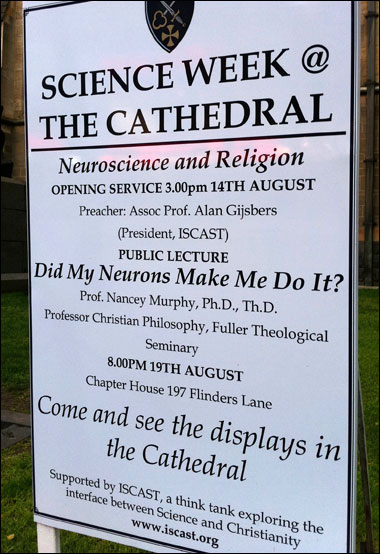
I snapped this sign in front of St Paul’s Cathedral, in inner city Melbourne last week.
The duplicity of the intent here is only eclipsed by its inanity. Professor Nancey Murphy is the author of ‘Did My Neurons Make Me Do It?: Philosophical and Neurobiological Perspectives on Moral Responsibility and Free Will’. She is also an ordained minister of The Church of the Brethren, a Christian sect so confused that it has split into numerous splinter groups that are, apparently, able to interpret the Word of God to be whatever suits their personal agenda. ((It should be said that The Brethren are not alone in this pursuit. Christianity itself is really just one big collection of groups that have decided that what God meant is dependent on your point of view.)) If Prof Murphy is a hard core member of The Brethren, though, she believes that the Bible is the inerrant word of God (with all that entails).
My brain finds it hard to contain the idea that someone can take that stance and still call themselves a scientist. Her interpretation of what science is, seems, apparently, to be as flexible as the interpretation of God’s Word among members of her belief system.
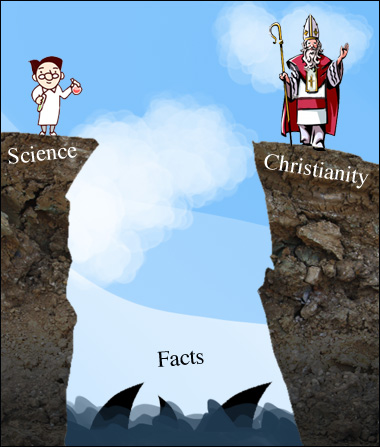
As for ISCAST, ‘a think tank exploring the interface between science and Christianity’, I have prepared a little diagram illustrating what I see as the principal difficulty in exploring that interface:
You see, when you accept the idea that a magical being created us and everything we see for inscrutable purposes of its own, you have abandoned all notions of science. Now, personally speaking, I don’t care one whit if Professor Murphy or anyone else cares to invent such fanciful stories, but it pisses me off when:
1: They think they have the right to push those ideas down my throat, and,
2: They think their ideas are better than everyone else’s ideas because their magical being told them so, and,
3: They attempt to conflate those ideas with science.
But I said ‘duplicity’ didn’t I?
I was intending to make this post a humorous jab at a daft sign, but in looking up St Paul’s Cathedral I inadvertently stumbled upon one of the most worrying, irrational, fearful and misleading documents I’ve seen in a long time. St Paul’s, it appears, is affiliated with an organization called Transforming Melbourne, a group that defines itself as ‘a Movement of Christians praying and acting together with the vision that God will renew His Church and not only bring new life to the people of our city, but transform its culture and society.’
Praying? Not a lot of science there, that’s for sure.
OUR SOCIETY DEPENDS ON CHRISTIAN FAITH AND THE CHURCH
It then lists some ‘statistics’ that are supposed to convince us of how terrific the Christian Church is, before concluding:
The highly intentional atheist and secular humanist movements are seeking to influence governments to remove the freedom of the Church and Christian agencies to provide their community support, and Christian education programmes and Chaplaincy in schools which foster Christian values in society.
If they succeed in restricting Christian care and education the result will be the undermining of society itself.
This kind of addled fear-mongering makes my skin crawl and my blood boil. Yes folks, what it comes down to is that the people behind Transforming Melbourne believe that the EVIL ATHEISTS are attempting to get rid of the WONDERFUL CHRISTIANS because, for some reason, the EVIL ATHEIST agenda is to ‘undermine society itself’. Do these people really think like that? Are they really that simple-minded? Because if that’s the case it’s pretty damn clear why I don’t want Christian chaplains giving moral advice to my kids.
So it turns out that the real reason that the Cathedral is having Science Week is nothing at all to do with science (surprise) but is in fact a sleight-of-hand designed to give the appearance of open-mindedness and acceptance. There is no intent to explore an ‘interface’ between science and religion here. Make no mistake: these people do NOT care about science. If it was up to them, they’d as soon see their God wipe this troublesome ‘science’ thing from the planet.
What’s happening here is that they are afraid. Scientific thought represents the biggest real threat that religion will ever face. And now, with atheists and humanists asserting their human rights to create communities that are not built on superstition and fear, but instead on critical thinking, scientific inquiry and rationally considered ethics and morals, the Christian Church is resorting to one of its favourite techniques: instead of facing their challengers bravely, ((For surely, if their God is actually right as they claim, they have NOTHING to fear…)) they are attempting to subsume them. To make them feel at home. To feign charity. To pretend they’re on their side. But all they are really concerned with is promoting their agenda.
It has worked many times in the past when their competition was also fearful and held irrational beliefs, but this time it won’t.
(I’m going to examine some of the Transforming Melbourne document in the next post. It’s full of such egregious and erroneous claims that it simply can’t go unconfronted.)
Today I’m going to try something new. I’m going to INVENT some kind of crazy new pseudoscientific idea and try and get people to believe it. First of all, I’m going to pick a field of interest that has some high levels of subjectivity. OK, um… – oh I know, wine tasting! There’s all sorts of hocus pocus goes on with that. Now let’s see… I’ve got it! You know when people swish the wine around in the glass? Could it be that swishing it clockwise makes it taste different to swishing it anticlockwise? You know: clockwise swirling brings out the spicy notes and anti-clockwise makes it taste more of the fruit. Genius! I’ll call it ‘wine swirling’ and…
Sorry? What’s that you say? It already exists? People actually already believe it? Come ON! That’s ridiculous! No-one could seriously come up with such a patently silly notion…!
Yes, my dear Acowlytes, it is true. Faithful Cowpoke JR points me to this article from the owner of a tour company in the Napa Valley in California, that espouses the fine art of wine swirling. This is what Mr Ralph de Amicis, of Amicis Tours has to say:
This idea starting circulating around Napa via Twitter and here it is in a nutshell. When you swirl your wine to the left (counter clockwise) the scent you pick up is from the barrels over the grapes, what we call the spice shelf. When you swirl the wines to the right (clockwise) you pick up more flavors from the fruit.
O-k-a-a-a-y…. The idea started on Twitter, that completely reliable repository of fact and commonsense. That speaks volumes. Mr de Amicis goes on:
I’ve shown this to clients in the tasting room and experimented with it myself and found it to be true, and especially noticeable with wines that have spent significant time in newer oak barrels. The question comes up, why is that?
Well, Mr de Amicis, the answer comes back pretty smartly: you’re deluding yourself. But don’t, for God’s sake, attempt any kind of explanation because you’ll only…
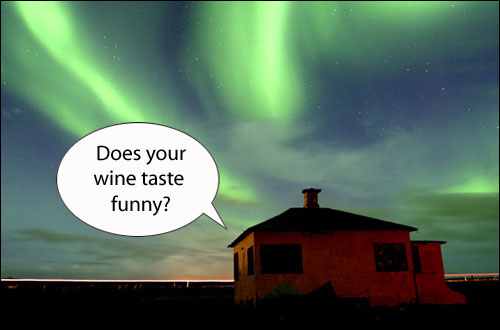
Like all living things wine cells have a magnetic polarity, just like humans and the Earth. The positive pole is more highly charged, just like the North Pole of the Earth, which is why there are Northern Lights in the Arctic Circle, but not Southern Lights in the Antarctic. This polarity tends to keep wine cells generally upright, spinning on their axis when they are being swirled…
Awww…dagnabbit!! I was feeling like cutting you a little slack but then you went and did some pretendy science on me. Sigh.
When you swirl the wine counter-clockwise you are pushing against the molecules nap, just like stroking the fur of a cat the wrong way, this dislodges anything on the surface. Since the flavor from the barrel is introduced fairly late in the wine’s development it tends to concentrate in the outer layers. When you swirl the wine counter-clockwise it dislodges that flavor, while at the same, pushing liquid into the pores, inhibiting the fruit flavors that are inside the cell from coming out.
Molecules have nap? ‘Flavor’ is on the ‘surface’ of the molecules and can be ‘dislodged? Molecules have pores? ‘Liquid’ goes into the ‘pores’ of the cells? Molecules? What? Ping! Now let’s be honest Mr de Amicis. You just made all that crap up, didn’t you? Like you made up the non-existence of the Southern Lights. You haven’t the foggiest clue how taste and smell work, have you? (You don’t hold shares in Special One Drop Liquid, by any chance? Or study under Dr Werner?)
Evidently I wasn’t the only one who found Mr de Amicis’s ‘science’ risible, as he was quick to post a justification of his views on his site. In this, he makes much of his scientific qualifications:
I’ve written eight books on wine country, three books on natural health, I’m a Master Herbalist with forty years of experience working with plants and people, a Naturopathic Physician, and I’ve lectured extensively on anatomy and physiology.
Right, so no actual science accreditation, then? ((Lecturing on something does not count as academic endorsement. I could ‘lecture’ on brain surgery, but it doesn’t mean I know anything at all about it.)) And nothing there about geomagnetic science, molecular chemistry or physics, which does explain rather a lot. Not content with just riding the faux pas out, though, our knowledgeable tour guide just keeps on digging…
Everything has a polarity right down to the atomic level, and when put into suspension in a liquid it rotates in relation to that pole. Because we are on a planet that has both a polar system and a consistent rotation, everything forms with a pole and a circular patterning. Wind it one way and it tightens and wind it the other and it unwinds.
Uh. That’s what you learnt in herbal school, is it? Or in naturopathy college? Because they sure as hell don’t teach it in any science class I’ve ever been in. ((Mr de Amicis’s view of the planet is, evidently, that it functions like it’s powered by a giant rubber band.))
Honestly this is just basic physics related to molecular science and plant chemistry, something which herbalists and herbal researchers deal with all the time.
Honestly! Basic physics! Like the non-existence of the Aurora Australis due to the polarity of the Earth! ((Anyone with even an ounce of geophysical knowledge knows that the auroras don’t have anything at all to do with the positive or negative polarity of the the planet, but appear at the poles due to the shape of the Earth’s magnetic field and its focussing effect.))
By the way, I’ve done an informal study of this and my hyper-sensitive clients all notice the difference in the swirl directions and the nature of the scents. I would love to hear other people’s theories about this,
And I would love to oblige!
What’s going on here, Mr Amicis, is that your brain is tricking you. Because you have sold yourself on this daft idea, and because wine tasting is full of subjective assessments, you (and your ‘hyper-sensitive clients’) merely think that you’re detecting an effect. In proper science (that is, the kind that they don’t teach in naturopathy school) we have a way of eliminating this problem of self-delusion. It’s called ‘double blinding’ and I’m fairly sure ((When I say ‘fairly sure’ I am just being linguistically coy. I am in fact 100% certain.)) that if you had an unbiased third party set up a double blind testing of your idea you’d find that the ‘swirling factor’ mysteriously vanishes. I’m not going to explain double blinding here on the Cow for the millionth time, but I really do suggest you look it up on Wikipedia and familiarize yourself with the concept before you go making a further fool of yourself. You should probably read up on the auroras and the magnetosphere as well. Just saying.
The moral to this story, if it’s not obvious, is that if you want to promote something as science, make sure you understand what science is. Especially if you decide to write about it on your web site where the whole world can see it.
Some ways back, I dipped my toe briefly into the sludgy pool of grandiose claims and unsupported hogwash that makes up the field of ‘ultrasonic’ or ‘electronic’ pest eradication. A few days ago Faithful Acowlyte Matthew reminded me that I’ve been meaning to revisit this daft corner of Wooville when he sent me this recent offering from Pest Control Peddlers Pestrol.
As if they’re still living in the ’60s, Pestrol seems to think that it’s impressive to point out that their product, Pestrol Rodent Free is ‘seen on TV’. In their FAQ they are equally eager to boast that it’s ‘advertised on talkback radio Australia wide’ which I gather is intended to imply something other than ‘we paid some irritating radio personality to advertise it’. Are people so stupid that these kinds of vapid endorsements get them reaching for their wallets? But silly me – I guess that anyone with a brain is not the main market for this product, as we shall see.
This ‘latest technology’ that the Pestrol seems so overjoyed to introduce is that of ultrasonics. Since ultrasonic devices have been round for decades, this seems rather a lot less impressive than if they’d said it used, oh, quantum tunneling or carbon nanotubes, two other technologies that would be just as effective at repelling rodents as ultrasonics (ie, not at all, if you haven’t guessed) and are a lot more current and cool sounding. I might even be tempted to buy a rodent repelling device that claimed to use quantum tunneling. At least it wouldn’t be quite as easy to completely ridicule as one using ultrasonics.
The Pestrol Rodent Free technique emits a disorienting pulse that startles and frightens away insects and rodents from your home or office.
O-k-a-a-a-y… and the science to support the idea that that rodents and insects don’t like those ‘disorienting’ ultrasonics pulses comes from… where… exactly? What’s that you say? You heard it from a friend of a friend?
The fact is, evidence for ultrasound being an effective deterrent against rodents is slim. It is vaguely possible that the noise irritates them somewhat, but since rats will repeatedly endure full electric shocks to get at human food, it is unlikely that a slightly bothersome noise is going to have much of an effect.
The Pestrol Rodent Free will need to be plugged into a power point approximately 0.2 metres from floor level in order for the ultrasonic to run along the ground, living rooms and hall ways.
Now, are you forming a picture in your minds, dear Acowlytes, of ultrasonics ‘running along the ground’ through your house? I know I am. Because everyone knows that sound (ultrasonics are nothing more than high frequency sound waves) behaves just like that – seeping along at floor level. Even if ultrasound did work, it would not matter one whit where in the room you put the device as long as it was relatively unobstructed.
Pestrol Rodent Free combines electromagnetic, ultrasonic and ionic technologies to help free your home of rats, mice and aids with the control of cockroaches.
Yes friends, Pestrol Rodent Free deploys a veritable Holy Trinity of implausible techniques to keep your home pest-free. There’s our old friend ‘electromagnetism’ that well-known bane of pests of all kinds, and a new player in the game: ionic technology.
Animals are naturally sensitive to negative ions. ((Who says so? And in what way? This claim means absolutely NOTHING in this context.)) Long before a lightning storm, insects and rodents sense a change in the environment and look for protection away from the storm.
So let’s see – the negative ions are supposed to simulate a thunderstorm so the rodents go looking for shelter… in your house. Good one Pestrol!
This is a shining example of what I call ‘selective woo’. Elsewhere you will find gadgets being peddled under the claim that ‘negative ions’ are actually beneficial for the very reason that rats and cockroaches don’t like them. In other words, the arbitrary decision by humans to decide something is a pest is all it takes to turn the power of ions from desirable to repulsive. Amazing!
Selective woo comes into play with other aspects of the Pestrol Rodent Free, too. The makers claim that it is effective against rodents and insects and even possums (which in this country are marsupials), and yet will not effect your pets. How can this possibly be? Well:
Pestrol Rodent Free has been used for many years by thousands of satisfied customers in Australia and NZ. Will not affect dogs, cats, birds, or fish as they have a different genetic structure to rodents and cockroaches
Ah. It’s the genetic structure. Of course! Rodents, as any student of biology surely knows, are much more closely related to cockroaches than they are to cats and dogs or other mammals. Or marsupials. Or birds or fish.
This is, I’m sure I don’t need to tell you, complete and utter claptrap. Elsewhere you will find that these kinds of devices are supposedly effective against deer, rabbits, skunks, squirrels, bats, foxes, raccoons, chipmunks and armadillos. And, paradoxically it would seem, cats and dogs as well, should you find them vexatious rather than cute and fluffy. In fact, the chief benefit of Pestrol Rodent Free-style devices seems to be that they will repel anything that you decide you don’t want hanging around, and won’t affect anything else! I wonder if it is effective against people selling pseudoscientific crap?
‘But Reverend,’ I hear you interrupting ‘there’s a 30 Day Money Back Guarantee! It says there in BIG WRITING. How could they possibly offer that if there wasn’t anything to it?!’
Aha, young Acowlyte, that’s another trick to get you to part with your hard-earned cash (All $119.00 frigging dollars of it in this case). You sure can get your money back if you return your Pestrol Rodent Free within the 30 days specified… but what’s this in the FAQ?
How do I know if my Pestrol Rodent Free is working?
You may see increased activity as rodents and cockroaches are forced from their hiding places. Often it can take up to 3 weeks to remove rodents. Cockroaches may take longer as eggs can lay dormant for many months before they hatch.
Right. So you may not see the desired effect from the device for 21 whole days. ((Indeed, you may see INCREASED rodent activity – the exact opposite of the desired outcome – in the first 3 weeks of use!)) Factor in a week or so for postage and there goes your money back guarantee. You’ll certainly have blown your cash if you wait around ‘for many months’ to see if the Pestrol works on cockroaches.
Lest there is any lingering hesitation in your minds, dear Cowmrades, that the Pestrol Rodent Free might still have some slim remaining shred of credibility, let me quote from a US Federal Trade Commission finding on similar devices:
Between 1985 and 1997, the FTC brought law enforcement actions against six companies that allegedly made false and unsubstantiated claims about the effectiveness of ultrasonic devices in controlling rodent and insect infestations. Each of those cases was resolved by consent order. In those prior actions, the FTC challenged the following types of claims:
• Eliminates rodent infestations;
• Repels insects;
• Serves as an effective alternative to conventional pest-control products;
• Increases or assists the effectiveness of other pest-control methods;
• Eliminates fleas on dogs or cats; and
• Scientific tests prove product effectiveness.
Prior FTC complaints alleged that any reaction by rodents to ultrasound would be temporary at best because rodents become accustomed to ultrasound and will return to their nesting or feeding areas even in the presence of an ultrasonic device. Furthermore, previous FTC complaints alleged that ultrasound devices do not control insects.
These findings were handed down over a decade ago and yet, performing a Searchâ„¢ for ‘ultrasonic pest repeller’ returns literally hundreds of thousands of hits, the first few umpteen thousand pages apparently for people selling the damned things.
One of the big topics in the skeptical community at the moment (like everywhere else I guess) is the climate change issue. It’s a subject that is as fraught with debate as that of Evolution vs Creationism, and indeed, has many of the hallmarks of that particular tussle. What makes it particularly volatile in this setting, though, is that many of the people who claim that there is no need to worry about global warming paint themselves as climate change skeptics, and take the position that they offer a rational approach to the debate. What they are in fact doing is voicing opinions that are in contradiction to MOST of the world’s knowledgeable climate scientists. Though they like to think of themselves as skeptics, this stubborn entrenchment in a belief system has earnt them, instead, the badge of climate change deniers.
I pretty much stay out of the climate change argument, just as I stay out of the Creationism debate. It’s not that I don’t have a strong view on global warming. I think the scientific evidence is conclusive that we have a looming disaster on our hands, and that it’s a disaster of our own making. Bothering to argue with the deniers though is the mental equivalent of jabbing a sharp pencil repeatedly into the back of your hand – a sensible person stops doing it pretty quickly.
The main problem is that, as with evolution, climate science deals with concepts that don’t come easily to the natural human way of thinking. With evolution it has to do with vast amounts of time (which we’re not good at comprehending) and the complexity of the vectors that come to bear on natural selection. With climate science, it’s all in the maths. I’m going to attempt in this post to show you why, even if you haven’t kept up with all the marginalia of the climate discussion, you should be afraid of what we’re doing to the planet.
At the outset I will state that my essay takes one idea as a given: that global warming is a human-instigated phenomenon. You should understand that a cornerstone of the denier’s ‘argument’ is that it isn’t, but I will stand behind the overwhelming scientific viewpoint on this matter. ((If the deniers are right on this and global warming is an inevitable natural process, then we’re in a handcart to hell anyway, and it doesn’t matter what we do. So we may as well make efforts to ameliorate the situation as not. An argument of financial imperative (‘it will ruin our economy’) is quite irrelevant because in a hundred years there won’t be an economy.))
OK. We’re going to talk about math in this, but you don’t need to understand numbers. And I promise you, it won’t be dull. This is a very scary story. I’m going to divide it into three chapters.
Chapter 1: Boiling the Frog
There is an old fable – it’s probably apocryphal but for our purposes it doesn’t matter – that says that if you take a frog and put it in a bowl of water over a burner and slowly raise the heat, the frog, unable to feel the very slow rise in temperature will make no effort to leave the water and happily sit there until it is boiled to death. In other words, it either doesn’t realise there is a problem, or, by the time it does, it’s too late.
The story illustrates a psychological phenomenon called ‘creeping normalcy’ (or in science, the ‘shifting baseline’ problem). Put simply, it says that if you have changing reference points, you can only judge what is ‘normal’ by what you’re familiar with at any given time. In this way, familiarity changes the baseline of ‘normal’ to whatever you get used to, and if things change slowly enough, ‘normal’ can wander an awfully long way from ‘acceptable’.
The first step towards understanding why the climate issue is so deadly is to understand that humans think like this as a default. Our brains don’t work well on timescales in excess of a few years. Our horizons are small. I’m not the first to mention the Boiling Frog concept in relation to the climate change situation, so its appearance here is no big revelation. But you need to keep it in mind as we head off to chapters 2 & 3:
First a philosophical point: Climate Change is claimed to be complex. I claim it is NOT. It is simple physics – add more energy and the world warms up.
Mr Dodds’ opinion typifies the way in which most people believe that the planet’s climate system behaves – something like a Big Clock. A wheel here, a cog there, a spring yonder – all ticking away in a simple predictable manner that can be completely described if you do the right calculations. Most people think, therefore, that if we’ve caused some kind of problem with the climate, then all we need to do is to ‘oil the gears’ on the clock and everything will go back to the way it was. They believe that the problem is proportionate to the actions we take to correct it.
This is a massive and perilous failure of understanding. It’s a mechanical Newtonian notion of the way things work that is fine for pipes and balls and clocks, but breaks down catastrophically when applied to something like climate behaviour. To grasp why, we have to venture into the frightening, mind-bending and completely unintuitive world of complex systems.
First, let’s consider the pendulum in our Big Clock. As physical systems go, this is about as unadorned as you can get. A swinging pendulum exhibits what is known as simple harmonic motion ((For small angles of swing. As the angular acceleration increases things become a little more complicated, but for our purposes we can assume true simple harmonic motion.)) and it is a very reliable behaviour that allows us to build a clock that will behave predictably and dependably. A simple pendulum is mathematically very straightforward. Its properties can be described completely in terms of the length of the ‘rod’ of the pendulum, gravity, the mass of the ‘bob’ on the end of the pendulum and the angle of swing. If you know these things, you can predict exactly how this pendulum will behave. This uncomplicated mechanism works great for a clock, and it’s fairly tolerant of perturbations in the system: if you push the pendulum a little hard, it will dampen down to its normal swing pretty quickly. You need to be pretty violent to cause the clock to have problems big enough to effect its function.
This is the kind of path we could expect the bob on the simple pendulum in our clock to trace. Every time:
Unfortunately for us, the climate system isn’t driven by a simple pendulum.
Let’s consider a physical system only a tiny step away from our Big Clock’s single pendulum: the double pendulum. A double pendulum makes one small alteration to the simple pendulum model – instead of a simple bob at the end of the pendulum, you add another pendulum. This very unassuming variation has sudden and profound effects.
Here’s a computer simulation of the path traced by the tip of a double pendulum:
If that looks weird and science fictiony to you, let me assure you that double pendulums behave exactly like that in reality. There are dozens of YouTube videos that show them in action.
You can see how this one small change to our pendulum quickly throws a simple harmonic oscillation into a volatile and complex motion. The double pendulum system can be very easily described, ((We still know the lengths of the rods, the mass of the bobs and the gravity coefficient.)) but its ultimate behaviour cannot. Each time you set it swinging its bob will trace a completely different path in space because, crucially, a double pendulum is very sensitive to initial conditions. Unlike our clock’s pendulum, we can’t accidentally give it a bit too much of a shove and have it simply settle back into its predictable ol’ groove.
Imagine, now, that you have a pendulum with n arms, each with a bob with a mass that is a variable coefficient ofn, n points of articulation on each arm, and variable gravity. It doesn’t take much of a leap of imagination to understand how wildly such a device will behave. In fact (and this is where most people fall off the bike), for surprisingly small values of n, no amount of computing power in the universe can ever predict the path of motion it will describe!
Well, the Earth’s climate is exactly such a system.
Unfortunately one thing that tends to be a little confusing with this is that climate scientists often speak of ‘climate modelling’ and to many people this sounds again like they’re talking about some kind of Big Clock: you stick in all the variables into your computer and ‘ping’ – out comes the behaviour that the Big Clock will exhibit. If it were only that easy.
When you look up a weather report on your i-Device of choice, you’re seeing climate modelling at work. One thing I probably don’t have to tell you, is that you shouldn’t rely on the information more than a few days ahead. That’s the state of the art in climate modelling. We’re just not very good at predicting the behaviour of complex systems (like weather) even a few days in advance. Here’s the kicker: it’s not our fault! These systems are inherently unpredictable. Even if we had super-super-super computers, we couldn’t do it. Even if we had a computer that could take ALL the variables – and that’s a HUGE amount of variables – and then run the simulation in real time to see what it did, it would do us no good – we would get a different outcome every time we ran the program. Just like its very simple distant relative, the double pendulum, a complete detailed model of a complex system like the climate is critically dependent on initial conditions. (We actually do have such a computer – it’s called ‘Reality’. The only accurate simulation of what the climate will do is the climate itself).
So, when you hear scientists talk about modelling the climate, you should not understand that to mean they are trying different kinds of wood for the clock case, or a new type of oil to make the gears run smoother. They mean they are making their best educated guess at the Big Picture of what might happen if they picked enough of the right factors to plug into their equations. Just like you understand the weather man to be doing when he tells you that in a week’s time it looks like rain (are you starting to get nervous yet? No? Then you’re not following me).
So what’s the problem, right? We don’t know what the weather will do – why is that different from any other period in our history? Why are we suddenly worrying now? Well, one of the things that modelling can predict pretty confidently is trends. Just as we can say that a double pendulum pushed gently is unlikely to do the crazy loop-the-loops that we see in the same system dropped from a higher angle, models can tell us that when we change something in the climate system too much, we’re likely to see unpredictable behaviour. In recent times (the last few million years or so) the climate has been ticking along like a gently-pushed double pendulum; little flurries here, little irregularities there, but for the most part, predictable enough for life-forms to have evolved strategies to cope. Things do change, but they change slowly. The system keeps itself in check through millions of years of self-modification that has allowed it to reach a relatively stable, though delicately balanced, equilibrium. The evidence is clear, though, that over the last few hundred years (a VERY short period by geological standards) humans are swinging the pendulum’s arc wider and wider by the simple act of burning things. We’re taking carbon that has been for eons locked up in the biosphere and chucking it into the atmosphere where it has started to imprison the Earth’s heat. We can, therefore, state with a high degree of confidence (based on an enormous amount of accumulated data) that the planet is heating up monumentally faster than it ever has before, and that that heating-up is concomitant with the technological period of humans. ((We’re excluding events that happened in geological times of many hundreds of millions of years ago, where lots of weird climate events happened. They are not relevant to our argument because we weren’t involved. If we had been, we’d be dead, which is of course the issue at hand.))
But when climate modelling scientists make a ‘prediction’ that the temperatures will rise 3 or 4 degrees by the end of the century, you should not think of that as a jolly nice warming of the winter months, and the odd extra scorcher in July (or January, depending in which hemisphere you live). You should instead interpret it to mean ‘We figure the whole system is going to heat up, but how it delivers that heat, and to whom, depends on the swing of the double pendulum…’ What you should expect is periods when the weather seems just as it always has, interspersed with occasional outbursts of extreme behaviour. For a while this will seem normal, and you will be as happy as a frog in a warm pond. But this extreme behaviour itself will start to interfere with the system – it’s another phenomenon of mathematics which those in the know approach with respect: feedback. And that feedback will almost certainly affect the system in ways which we can’t even imagine. ((We don’t really have much of an idea of the way the climate system is held in such delicate check anyway – global atmospheric behaviour is without doubt one of the most complex systems we know. All we can say for certain is that that if it changes much, we are in trouble.))
This coupling of complex behaviour and feedback is the thing which frightens the scientists, because it’s something with which the world of science has become very familiar in the last fifty or sixty years. We know that a complex system exhibiting instability and feedback can suddenly and capriciously become chaotic. That is, the system is likely to reach a point where even modelling is completely useless – it just goes completely berserk.
Trust me when I say that we really don’t want to see our climate system go chaotic. If we hit that point, it is likely that the great majority of the human race will suffer. ((It should be understood here – because I often think that it’s not – that the planet is indifferent to this problem. You hear climate deniers putting forward ideas like ‘Well there have always been periods of global warming’ or that ‘Sea levels have changed many times though the Earth’s history’. Well, sure. But mostly, there were no, or few, humans around, and other creatures were affected by these events, often in the form of species-wide extinctions. The Earth was once a giant greenhouse, covered with plants. But WE could never have lived in it. The planet would probably survive quite extreme results of our global warming efforts – it’s just that we wouldn’t.))
Chapter 3: Jenga
The kind of critical instability that I’ve just described is a lot like the game of Jenga. The Jenga tower will remain upright as long as the system is stable around its centre of gravity. If you lived on top of the Jenga tower, you would probably be aware of nothing at all as pieces are removed. Maybe the tower might wobble a bit, but, hey, things look pretty normal. Every removal of a Jenga tile is exactly the same kind of small effort, but each one of these small efforts moves the system closer and closer to critical instability. When the Jenga system reaches this point, the collapse into chaos happens rapidly and catastrophically, with little warning.
Well, that’s where we are right now. The tower is wobbling a bit, but everyone is saying ‘Hey, the tower has wobbled before and we were OK – what’s the problem? Worse, we continue to slide out the pieces, because that’s what we’ve been doing for years and it’s been just fine.
Unfortunately, this kind of situation is the very worst sort of thing to try to get resolved by a ‘popular vote’. When you combine the Boiling Frog situation with the Big Clock scenario and stir in a whole lot of poorly educated ((I say ‘poorly educated’ because I think that even the great majority of people who are literate do not have a good grasp on science, nor on rational ways of thinking. Any of you who have been reading TCA for a significant period of time will understand exactly what I mean here.)) points of view, you just get lots of personal assessments of the problem – or debates about even whether or not there IS a problem – and a bucketload of total inaction. The grim truth is that it’s a state of affairs that seriously needs everyone on the planet to be in complete agreement, or we will, without doubt, plod our way into extinction.
The way it stands at the moment is that the vast majority of people are either uninterested or confused, a small minority is in denial and beset by superstition and petty agendas, and another small minority is informed but frightened, frustrated and powerless. I think that what we are seeing here are the ramifications of a massive failure as a species to improve ourselves by putting emphasis on the capacity to understand our world through observing it properly. That is, through science. It is of no use to put an appropriate course of action to a popular vote in this instance, because the holders of a popular vote aren’t equipped to understand what it is they’re voting on. And frankly, I think we’ve run out of time to get them up to speed. Added to that is the negative influence that whatever we need to do will, most likely, cause great inconvenience to a large number of people, and will include increased poverty, loss of jobs, deprivation of luxuries (and maybe even necessities for many) and a general willingness to just suck it up and take a beating. It doesn’t take much insight to see that we’re never going to get people to volunteer for that, unless they become very afraid indeed (by which time – I emphasize once more – it will be way too late).
If ever there was a time for the leaders of our nations to listen to the science, and act decisively and quickly for the good of human race, this is it.