Technology


Seeing red? Feeling blue? Got aches and pains that just won’t go away? Tried whisky and aspirin and bonox and nothing seems to work anymore? Why not shed some light on the problem: the iPhone Pocket Pain Doctor is here!

Yes, dear Acowlytes, no matter what your problem, it can be solved by an iPhone app. And if your problem is a kinda sorta non-specific-type general one, then the right kind of app will obviously feature as its main operating principle – all together now – woowoo!!!


(The YouTube video has been removed for some reason. You have to imagine a long spiel from an unappealingly pushy man who shows you how you can make the iPhone shine coloured light on your skin. It’s far from persuasive).

That’s right Cowmrades – just by shining red or blue light on yourself using your phone, Pocket Pain Doctor will relieve all kinds of pain, make you more alert and cure your acne! Or, on the other hand, it might not. The bottom of the Pocket Pain Doctor site features this disclaimer:

BluWave and RedWave are not intended to treat or cure any disease. None of the statements on this website have been evaluated by the FDA.

(The Pocket Pain Doctor site has now been pulled, sadly. But unsurprisingly).

See, that’s the REALLY GREAT THING about woowoo! You can have your cake and eat it too! Your product may or may not work but people still pay you money for it. Marvellous!

Oh. But what’s this? There’s some references to ‘Clinical Studies‘ on the site! Hooray! This is bound to be enlightening… let’s see what we have. First a link to PubMed. OK, that’s impressive. It’s a draft of a paper (supposedly) called Seasonal Disorder & Body Effects Of Blue Light. ((It’s actually called “Action spectrum for melatonin regulation in humans: evidence for a novel circadian photoreceptor.” Do these people think that potential Pocket Pain Doctor customers are stupid? Oh.)) Hey waiddaminute! That’s got nothing to do with ‘Seasonal Disorder’ or blue light! It’s about the effect of light on melatonin suppression. OK – here’s another one from Modern Medicine: Blue Light Kills Acne Bacteria. Wow… so it appears. That is, if it’s catalyzing a chemical called 5-aminolevulinic acid! I wonder if the iPhone squirts some of that out too?

How about red light then? Here’s a link to a NASA article: Red Light Therapy Relieves Pain Naturally. Oh looky! It’s actually about how infrared light helps cell regrowth in a certain type of cancer, minimising the pain as a result. What about Red Light Relieves Arthritis Pain & Muscle Injuries? Well, that’s a link ((On a site called Healing Light Seminars – now that really looks reputable.)) to a pdf that appears to be a list of double blind clinical trials – but not including the findings of those trials! And anyway, they are trials of an entirely unrelated kind – various methods of infrared laser treatment. Just in case anyone isn’t clear on this – your iPhone does not emit infrared laser light. I’m astonished that anyone can get away with this kind of complete fakery.

In a comment on the home page of the Pocket Pain Doctor site, the person who created the app complains that over on Engadget they gave his toy a bit of an unfair bashing. From his tone, one might even come to the conclusion that this guy believes in what he’s pushing. But that’s a little hard to accept when you see the duplicity involved in those links to ‘scientific evidence’ that he has provided. At best he misunderstands what he’s reading and actually thinks his sources offer some kind of substantiation of his idea. At worst, his ‘corroboration’ is deceitful.

In any case, it’s all about to become academic. Down in the Tetherd Cow Ahead labs, the boffins have been hard at work on this very concept, and I’m sure it will not surprise you at all to hear that they have perfected a new technology which we call ChromaCow™. Incorporating the technology behind the TCA Virtual Glass of Water™, ChromaCow™ offers you everything that you get with Pocket Pain Doctor, only IT’S ABSOLUTELY FREE! Best of all, TCA Labs is introducing a third, even better alternative to RedWave™ and BluWave™ – YelloWave™! With TCA YelloWave™ active on your computer, we UNRESERVEDLY GUARANTEE ((Guarantee may not be guaranteed.)) that the true nature of your innermost self will be revealed to you!!! Simply click on the icons below for the complete ChromaCow™ experience! (Make sure you do them all in order or your spectral chakras may become misaligned, resulting in mood swings, sour milk or even anal haunting).

Red CowBlue CowYellow Cow

So off you go Faithful Cowpokes – tell all your friends that they need no longer waste their money on woowoo in the iPhone app shop when they can get it here at Tetherd Cow Ahead FOR NOTHING!

___________________________________________________________________________

(Thanks once more to Atlas for putting me on the trail. I suppose that now I really am going to have to give him a prize for the Pickled Herring Poetry Contest.)

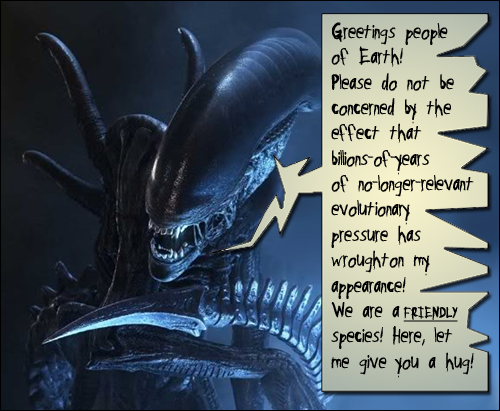
Seriously.

The robot creators seem hell bent on proving my point. Today, Atlas points me to the next chapter in the ‘humanizing’ of the machines: The First Robot Kiss.

Here – take a moment to watch it with all its unbridled passion on Engadget.

I can only imagine the conversation afterward:

Oh, Gail 34z Beta! I felt a seismic disturbance of 6.5 on the Richter Scale! It seemed to me that ignition of carbon and suphur compounds caused colourful inflorescences of magnesium, iron and titanium to stimulate the phosphors in my CCDs!

OK robots. Today’s homework:


Cuddly!

Now, as I mentioned at the end of that last post, before I got distracted by the whole V debacle I had set out to jot down a few thoughts on something a little more serious. A related topic, to be sure, but seriouser. And much more deeper. You’ll understand the detour I think – just keep in the back of your mind that it might involve lizards and you should keep up.

In a recent issue of New Scientist magazine, Dr Susan Blackmore (a scientist we quite like because she dyes her hair rainbow colours) made some interesting speculations about what she calls the ‘third replicator’ of our species. I’m not going to go into detail about her article (you can read it here if you like) but to precis, her idea is that there have been two important shapers of human evolution on this planet – genes and memes – and that we may now be looking at the emergence of a third replicator which will change us beyond what we can ever anticipate and probably do so even before we are likely to be fully aware of it. This third replicator (for which she invites us to invent a name) is something, she speculates, that is arising already out of our rather recently acquired human interconnectedness. I like the notion and I even think she may well be onto something, but that’s by-the-by; let’s push on a bit.

Toward the end of her item she brings up the subject of the perennial modern human quest to find life elsewhere in the universe. It is a pursuit close to my heart – I, too, would love to know if there is life out there. Really, who wouldn’t? Like about a zillion other people, I was happy to jump on the SETI@Home bandwagon when that started up, and for a while there I was pretty damn eager to help find the next Wow! signal. But then I started to reflect… The idea of making actual contact with aliens has always freaked me out a bit. While it would be nice to know if those lizard people are out there I’m not so sure I like the idea that they may consequently know we’re out here. Just think about it for a second: any civilization with whom we might make contact must necessarily be at least as technologically advanced as we are, and, more likely, somewhat further advanced. Can a situation like this turn out to be to our advantage? Given the only example to which we can refer – the history of the civilization of own planet – I think we can make an almost unassailable rule-of-thumb. I will call it the Reverend’s Law of Beads & Mirrors:

• If, by fate or design, two previously separated cultures are drawn together, the one with the least sophisticated technology always ends up with the worst part of the bargain.

I don’t think I can think of a single exception to this Law in the entire span of human history (although I would be completely delighted to be pointed to any counter-examples).

Further, I propose that this Law is exponential – the greater the difference between the two technological entities, the worse the outcome for the less sophisticated one. Again, my examination of human transactions shows no contradiction to this addendum.

And so I ask: is it really such a good idea to buddy up with the lizard-folk? Won’t it just turn out badly for us? Call me xenophobic, but if an alien is offering his claw in friendship, I’m keeping my brain way out of reach of his telescoping mandibles.

“But Reverend,” I hear you exclaim, “If Professor Einstein was correct, even if the lizard people are super-intelligent, then the laws of physics won’t allow them to ever get here! So our hamsters are completely safe!”

Ah yes, but this is where we turn back to Dr Blackmore’s hypothesis, and the scary implication she has entirely missed (or perhaps glossed over, if she is, as I am beginning to suspect, a lizard person herself…)

After making a case for our human originated Replicator 3 (R3) somehow acquiring a gestalt ‘imprint’ of the sum of human experience that none of us individually may even fully comprehend, she says in her New Scientist article:

Perhaps intelligence and civilisation are not what we should be concentrating on […in our search to find extraterrestrial life…]. My analysis based on Universal Darwinism suggests that instead we should be looking for R3 planets

Hey! Whoa there Starbuck! Throttle back on the thrusters and pull up planet-side for a bit!

Can you see the full implication of what she’s proposing, Acowlytes? Not that we should be looking for life on other worlds, but that we should be looking for third level replicators on other worlds. Or, to fill in the step that she seemed to have… missed… (yeah, right, Ms Lizard Scientist): that we should be setting ourselves up so that our third replicators (you remember – they’re the ones over which we may not have any actual control) can get in touch with their third replicators. In other words – our souped-up way-brainier-than-a-hundred-Einsteins Hive Mind confabbing (behind our backs) with their souped-up way-brainier-than-a-million-reptilian-Einsteins Hive Mind…

The lizards are probably in parking orbit already.

Well, alrighty then! I’ve sure got a name for this R3 thingy: let’s call it a neme, after the word nemesis – something it will surely become. From the Greek nemein for ‘retribution’, personified as the goddess of divine punishment.

I’ve got a b-a-a-a-d feeling about this…

___________________________________________________________________________

Oh, and while we’re on the subject – I see from the poll that we now have two lizard people among the Cownoscenti! Praise Mangar-kunjer-kunja! I pray that he sends you a plentiful supply of flies and hamsters!

___________________________________________________________________________

Computers have become so powerful now that it is possible to do things that are quite mind boggling. I have no doubt that you’re all aware of what’s going on in the realm of digital image, but us sound dudes can do some pretty cool stuff too.

Let me tell you about convolution reverb.

It is a truth universally acknowledged that no matter what your level of vocal talent, you will always sound better singing in the shower. The technical reason for this is that bathrooms have nice shiny reflective tile surfaces, and the reverberation off those surfaces allows you to hear your voice more clearly. ((It’s pretty hard to ‘hear’ your own voice in your head. When you sing, you are using reflections off the space in which you happen to be to judge your pitch – this is the reason that people often sing out of tune when they’re listening to music in headphones.))

It follows logically, then, that if you sound good in the shower, you’ll sound really good on stage at, say, the Sydney Opera House, with all its great reverberant reflections and acoustic properties. Of course, it’s not possible for you or me just to whip up an a capella version of Copacabana on the Sydney Opera House stage on a whim… or, at least it hasn’t been possible until now! Yes folks, not only can you now hear how your best Barry Manilow impersonation would sound onstage at the Sydney Opera House, but we can precisely simulate your performance in any acoustic space – caverns at Carlsbad… Wembley Stadium… Abbey Road studios… in a glass jar, a metal bucket or even a broom cupboard (where Barry Manilow would, arguably, sound most appropriate).

All this thanks to fast computer processing and ‘convolution’ mapping of acoustic spaces (stick with me folks, it’s pretty damn cool…)

As I’ve already mentioned, we gauge the details of the sound of a room by the reflections off surfaces in that room. Our ears are able to hear very small variations in frequency, and our brains, by comparing the information from one ear with the other, determine the exact aural characteristics of the environment we’re in. Quite obviously, every acoustic space is completely unique – it has an acoustic ‘fingerprint’ if you like – and we are able to very accurately judge aspects such as size, shape, harmonic frequencies and surface qualities of our surroundings. All this happens completely automatically of course – you don’t think ‘Ooh, I’m in a room thirty metres long with a fundamental harmonic frequency of 160Hz and plasterboard walls!’, but rather ‘This is a big hollow space!’ or ‘This is a cupboard!’

So, how does that become useful? When we record instruments of voices in a studio, we mostly strive to get the ‘cleanest’ most unaffected-by-the-environment recording we can, so that we may add acoustic effects such as reverberation and delay at some later date. This is done for two reasons – one is that any reverberant characteristics originally recorded with an instrument are ‘stuck’ to it – you cannot remove them. A flute recorded in a big church will always sound full and awash with reverb – nine times out of ten, that’s not desirable. The second reason that we prefer a ‘clean’ recording, is that we can apply reverb and other effects judiciously as we need, to make for a better and more pleasing balance in the audio mix.

When it comes to music recording and film sound, then, you can understand that being able to call up particular audio characteristics on demand has significant value. Up until now we’ve relied on artificially created approximations of real environments – good enough to fool your ear, but nothing like the real thing. Now, we can get so close to the real thing that even experts have trouble picking the difference. In other words, we can now use on our recordings the beautiful, real, rich ambiences that have been created in performance spaces and studios around the world. Or, if we need to, the sound spaces of interior cars, hallways, schoolrooms, water towers, aircraft hangars or jam jars – you can see how we film people might like that kind of thing.

So how is this impressive audio magic done? Well, if I don’t go into too much technical detail, it’s actually quite simple. We take a sound – optimally a tone sweep ((This is basically a sound that starts off really low in pitch and ‘sweeps’ to really high over a few seconds. A sharp transient sound like a pistol shot, or an electrical spark or a balloon pop can also be used – hence the term impulse response that you’ve heard me use.)) – and play it in the environment we want to model, re-recording it in high quality within the acoustics of that place. Then, using some fancy software, we compare that with a ‘pure’ version of the tone sweep. The software calculates the difference between the two sounds and uses that to build a map of the frequency responses and delays of the actual space. It takes my computer about a second to process the file – incredible. From this I get a ‘convolution map’ that I can then use in my audio software to apply to any other sound.

As I mentioned in my most recent post about Masthead Island, the Pisonia forest in the middle of the island had some very nice acoustic characteristics. I wasn’t able to take up equipment for making tone sweeps, but I recorded some ‘make-do’ resonses with sharp hand claps.

So, after such an exhausting technical lesson, I know you’ll want to hear some demonstrations of what I’ve been yammering about, and, lucky for you, I have prepared some earlier! So first of all, we need to start with our source sound, and I’m sure you’re way ahead of me with what that might be…

1. Here we have a duck’s quack as you might hear it in a field, with no acoustic reflections:

Download Raw Duck

2. Now, a duck as you might have heard it in the Pisonia forest on Masthead Island:

Download Forest Duck

3. Next, a duck on stage at the Sydney Opera House (as you might hear it from the stalls):

Download What’s Opera Duck?

4. And finally, a duck recorded in a washing machine just before you throw the spin cycle switch:

Download Washed Duck

There were, alas, no actual ducks on Masthead Island, but I can assure you, if there were, they would sound much like #2 above.

So, faifthful Acowlytes, that’s the TCA Crash Course in convolution spatial mapping. Your task for this week is to listen. That’s it: simply listen. As you walk about your daily lives, listen to the way your voice sounds in different rooms. Listen to the ambience on the street as sirens sweep by. Listen to yourself singing in the shower. Listen to how the sound of your voice changes as you walk from one room to another.

And marvel with me that we can now reproduce the acoustics of all those experiences exactly.

Along with the prestigious Cow Medals I hand out very sparingly here on The Cow, I think I’m going to have to invent some kind of trophy for the opposite end of the spectrum; an award for those who say the stupidest things on teh webs.

I’d kick off the ceremony with the CEO of Sony, Michael Lynton, who last week opined “I haven’t seen any good come out of the internet”. Translating that into something that makes sense to people who aren’t the buck-stops-here-guy for multinational companies: “I don’t get why this thing is bigger than television and getting bigger by the attosecond and we can’t figure out a way to make as much money out of it as we used to make out of all that old technology we have”.[tippy title=”*”]Or: “God in Heaven – just look at all that MONEY that we’re NOT making!”[/tippy]

Mr Lynton got a good old walloping immediately on the nets of course, and tried to backpedal in an article on the Huffington Post, managing only to dig himself an even deeper hole by revealing the real extent of his failure to grok the magnitude of the thing he’s trying to get his brain around.

I cannot subscribe to the views of those online critics who insist that I “just don’t get it,”

…he protests, and then goes on to comprehensively demonstrate his inability to get it.

His Huffington Post whinge is so clubfooted, and so embarrassingly naive, that it is staggering to believe that this guy has managed to get to be the guy in charge of one of the largest corporations in the world.

He laughingly attempts to equate the ‘Information Superhighway'[tippy title=”†”]Surely one of the daftest most empty-headed and inappropriate expressions ever uttered…[/tippy] with an actual ‘highway’…

In the 1950’s, the Eisenhower Administration undertook one of the most massive infrastructure projects in our nation’s history — the creation of the Interstate Highway System… Guard rails went along dangerous sections of the road. Speed and weight limits saved lives and maintenance costs. And officers of the law made sure that these rules were obeyed.

…and then suggests that unless we do something, our kids are going to grow up inside some kind of artistic vacuum, without anything at all decent to ‘enliven their culture’.

As I go into my sixth decade, I listen to people like Mr Lynton and realise that… I actually feel young again. While he stamps his foot and pouts and sulkingly packs up his marbles into his little string bag, folks all around the planet who do understand what’s going on in the 21st Century are just getting on with their business and doing very well thanks all the same.

Mr Lynton wants the world to be the way it was when his company was making packets of money and everything was nicely settled into a paradigm he could understand. By drawing stupid analogies and playing the Fear card he wants people to think the world will be a whole lot worse off without companies like Sony providing the entertainment they think we should see. The implication being, of course, that without them the alternatives couldn’t possibly be anything but inferior, and we would all be engulfed by some kind of cultural Dark Ages.

I’m getting to be an old guy now (relatively speaking, you understand), but never have I been as optimistic as I am now about the future of art. Would I be disappointed if mega budget movies like The Da Vinci Code and Spiderman disappeared off the face of the earth? Not one whit. Would I care if Mariah Carey or Avril Lavigne or Kings of Leon were taken up in the Rapture tomorrow? Not even remotely.

My Lynton – for all your wailings about the End Times, let me put this to you: an artist doesn’t need much these days to make something worth watching or listening to. And an audience doesn’t need much to experience that effort. To translate: We. Don’t. Need.You.

If you didn’t exist, music and painting and poetry and literature and film wouldn’t cease to exist. As much as you desperately might like to think you have some important part to play in the great cultural sweep of the human species, you are just an accessory. You are unimportant.

Do you get it?

No, I didn’t think so.

___________________________________________________________________________

*Or: “God in Heaven – just look at all that MONEY that we’re NOT making!”

†Surely one of the daftest most empty-headed and inappropriate expressions ever uttered…

___________________________________________________________________________

They'll Be Back!


Acowlytes! The END IS NIGH! Run for the hills!!! TERMINATORS ARE ALMOST HERE! SkyNet has become self aware and before you can say ‘Hasta la vista baby’, we’ll all be vassals of the Machines!

Yes, this is front page news in this morning’s Melbourne Age. The above breathless gush was headlined as an op ed piece from military futurist Peter W. Singer who speculates that if computers continue to become powerful at the rate that Moore’s Law hypothesizes, by 2030 we will have military robots that carry computing power a billion times their current capabilities.

Of course, a newspaper can’t let it go at that[tippy title=”†”]Because that story is basically: Computer power expands exponentially, so everything that uses computers, including weaponry, will get more powerful. Yawn…[/tippy] Oh, no, no, no! In Newspaper Land science is boring so you have to jazz it up a bit to get the idiots readers interested – that means TERMINATORS! This is what I call ‘Brain-In-a-Jar’ science fiction – the kind of thing that, twenty years from now, will look as goofy as Flash Gordon and 50s images of robots stealing earth women look to us today.

In the article Peter Singer is critical of the Australian Defense Department’s lack of foresight in mentioning robots in a recently released ‘white paper’ outlining Australia’s military strategies for the next couple of decades. You all know how I feel about robots. If they do as well in warfare as they seem to be doing in other areas of deployment, then seriously, we’re well better off without them. Those of you whose skulls aren’t crushed under the treads of the machines in the imminent Northern Hemisphere robot wars can come live here when it’s all over.

Crap


___________________________________________________________________________

†Because that story is basically: Computer power expands exponentially, so everything that uses computers, including weaponry, will get more powerful. Yawn…

___________________________________________________________________________

« Previous PageNext Page »