You will recall that a couple of weeks back I had a personal letter from Melissa Rogers, CEO of Shoo!TAG, in which she took me to task for ‘defaming’ her product, and asking why I believed there was no scientific support for it. I clearly outlined my position to her in a manner that I thought didn’t leave much room for interpretation. After receiving her reply this morning, though, I get the distinct impression that she didn’t actually read my letter, so much as skim through it in the way that I assume she approaches scientific literature. This is the sum of what she wrote:
Although I respect the right to your opinion, we obviously do not agree. My question is: What would you do, if you discovered you were wrong?
Dear Ms Rogers,
The entire problem here is that we’re not talking about an issue of opinion. You have made claims that challenge fundamental precepts of science as we currently know it, and you have said quite plainly on your web site that your product uses these novel scientific discoveries to repel insects. By doing so you are not putting forward an opinion that I am merely countering with some contrasting opinion. What you are doing is quite deliberately declaring that you have scientific substantiation of the principles by which you say Shoo!TAG operates. Scientific evidence and opinion are two very different things. Indeed, the scientific process is specifically designed to weed out the influence of opinion.
I believe that you understand very clearly that you need more than just opinions to make Shoo!TAG sound credible to your customers. You want to make it appear that you have science behind your claims, because you know, as we all do, that science works. The trouble is that, although you know lots of scientific buzzwords like ‘quantum’ and ‘electromagnetism’ and ‘fractals’, you don’t really understand much about these things, nor indeed, about the scientific process itself.
On your website, you use every opportunity to attempt to give Shoo!TAG scientific validity, even if it means distorting the truth. You use lots of scientific sounding language, you have a ‘Technology’ page (formerly called ‘Science’) where you talk about your ‘lab’ and ‘experiments’. You have implied repeatedly that you have endorsements by legitimate scientific institutions (which is demonstrably not true), and you publish scientific-looking documents with lots of tables and statistics. Your patent application has pages of technical-sounding language which is plainly contrived to give the impression that there is something scientific going on (when really it makes very little sense to anyone who does understand science).
The primary difference between opinion and science is that an opinion is, by its nature, a subjective stance. Science tries very hard to iron out all subjectivity and make an assessment of facts that can be agreed upon by anyone who cares to observe that assessment.
Let me try to explain this difference with some simple analogies:
In the 18th century, a mathematician named Daniel Bernoulli outlined a principle that showed that in a fluid flowing over an object with differing surface areas, a pressure differential is created on one side. This quite simple observation went on to have profound effects for our modern lives, perhaps the most well-known being the invention of the airplane. The Bernoulli Principle is what keeps aircraft in the air. Now it doesn’t matter what your opinion of Bernoulli’s discovery is; it will work for everyone in exactly the same way. Even if you hold an opinion that Bernoulli ‘just made it all up’, it will still work anyway. Bernoulli’s Principle is a sound scientific idea to which millions of people entrust their lives every day. And it is independent of opinion or belief.
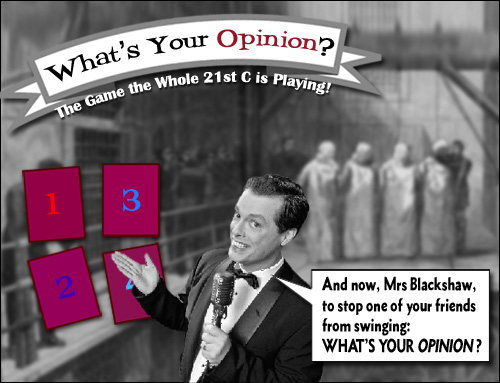
Now let’s consider some colours: twenty shades of some dark red colour, say. We can show those colours to a hundred people and probably get a hundred different opinions on which of those shades might be called ‘purple’ or ‘crimson’ or ‘red’. And we could show them to people in China and Spain and Canada and get more opinions still. But if it came down to whether you would stake your life on the opinion of Gladys Blackshaw of Manchester, England, of whether the card she had in her hand was red, crimson or purple, you simply wouldn’t do it. Why? Because opinion is highly subjective and we don’t trust it for important decisions.
This is why humans came up with the idea of science in the first place: it is the most reliable way we know of assessing the world. What this means is that your opinion or my opinion or anyone else’s opinion is entirely irrelevant when it comes to your claims for how Shoo!TAG is supposed to work, because the only correct way of establishing the validity of your claimed results is with science.
You ask me what I would do if I discovered I was wrong? ((Asking a question like this is a technique much beloved of those who are unable to argue with evidence on their side. By throwing an open-ended query back at the interrogator the argument is deflected away from the issue at hand, which, in this case, is: What kind kind of evidence can they provide that they are right? What I would do if I am wrong is hypothetical and irrelevant to the usefulness of the discussion unless they can demonstrate that they are actually right. They are making the unverified claims, not me.)) Well, the only way that I’m going to ‘discover’ that I’m wrong is if you can demonstrate some good science behind your product. The onus is not on me to prove that I’m right – I’m not the one seeking to sell a product based on remarkable new scientific principles. It’s YOU who are obliged to show the world that you’re right – YOU are the one making money out of this scheme. You have a responsibility to back up your claims. As I have said repeatedly, you can easily bring real science to bear on Shoo!TAG, should you have the courage to do it. It’s not even particularly hard science, as these things go. If you genuinely believe in your product, I simply don’t understand why you wouldn’t seek this kind of widely accepted corroboration. The really impressive thing about proper science is that if you really can scientifically demonstrate the astonishing results you say you can get, I (and everyone else on the planet) will have no choice but to accept your evidence, because the science will bear you out.
It won’t come down to a matter of opinion.
Sincerely
Peter Miller