Science


Is your computer behaving erratically? Do you suffer from Hangs, Crashes or Freezes? Did you ‘accidentally’ open that ‘hotnakedwives’ jpeg or click on the ‘Nude Kim Possible!’ link that was ‘mysteriously’ sent to your email address last week? Have you comprehensively failed to practice safe text?

Well, Intrepid Internet Adventurer fear no more!!!

TCA Enterprisesâ„¢ in association with Hello From Hell Inc. offers to you here, for the very first time on the internet, The Virtual Homeopathic Cure.

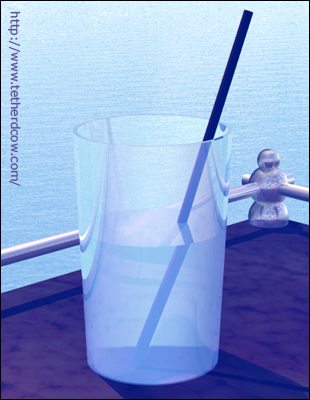
Yes this Cure, acting in much the same way as a conventional Homeopathic Cure works in the Real World, is presented in the form of the neutral-tasting, and almost completely transparent Virtual Glass of Water (VGW)â„¢! The VGWâ„¢ has been created ENTIRELY DIGITALLY from the very same bits that Evil Computer Hackers use to make their Dreaded Viruses! Here at TCA, our scientists have taken those bits and distilled them down to just 1 billion billionths of their former strength and used them to create a remedy that will protect you FOREVER from the scourges of Worms, RATs, Trojans and bugs.

How Does it Work?

Just view the picture above on the screen of any computer you believe might be infected! Yes, that’s ALL YOU HAVE TO DO!! By activating the Homeopathic Law of Digital Similars the VGWâ„¢ goes to work immediately on your computer without you even being aware of anything happening! INCREDIBLE! Behind the scenes, the VGWâ„¢ is cleansing every single bit in your RAM, on your hard drive, and in your cables using Atto-Magnetic Rotation (AMR)â„¢ and Double Spin Holographic Resonance (DSHR)â„¢. As long as you keep the VGWâ„¢ somewhere on your hard drive, and view it from time to time (our Researchers suggest weekly), we give you our 100% MONEY BACK GUARANTEE that your computer will BEHAVE BETTER and FEEL MORE FRIENDLY than it has ever been! Not only that, your screen will appear SHARPER and and all websites and emails will be CLEARER and MORE DEFINED. In addition, your keyboard will feel MORE RESPONSIVE, typing errors will DRAMATICALLY DECREASE and unwanted spam will be REDUCED BY HALF!!

How Much Does it Cost?

Well, as a Special Introductory Offer, we are making the VGWâ„¢ available to readers of Tetherd Cow Ahead ABSOLUTELY FREE! Yes, you heard me right, ABSOLUTELY FREE! Best of all the VGWâ„¢ is already working on your computer!!! The Virtual Homeopathic Technology we have used is SO POWERFUL that just by viewing the image in this post, viruses have been cleansed from your system.

There’s No Such Thing as a Free Lunch. What’s the Catch?

Faithful Readers. I know you will be SO IMPRESSED by the VGWâ„¢ and SO GRATEFUL to have been given the chance to be the first to experience this revolution in Computer Health that you will be wanting to share the VGWâ„¢ with ALL your friends. That’s right Folks, I want you to be my Watery Army and start The New Flood! Send the VGWâ„¢ to all your friends! Send them a link to this post! And make sure they send the Word on to their friends, and to their friends’ friends!†

Why Are You Using So Many Capital Letters and Exclamation Marks?

I DON’T KNOW! I just started writing this post and I COULDN’T HELP MYSELF!!!

So, all you Aquifying Acolytes, off you go to Splash the word around! I want to see my web counter clock fifty thousand hits by the end of the week! Onward towards a Healthier, Happier and Wetter Internet!!!

†And while you’re at it, how about some product endorsements in the Comments?

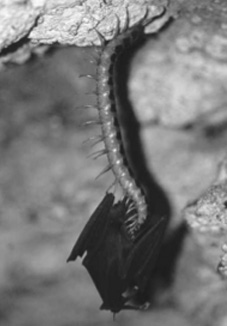
If you read boingboing you probably caught this article about a guy who found a Venezuelan centipede in his London home. Well that’s all disgusting enough.

But I’m watching David Attenborough’s ‘Life in the Undergrowth’ just now and he told me the real dirt on these foot-long beasts.

They catch bats in flight and eat them. Bats. Seriously. They climb up a cave wall, and hang there to catch a passing bat. And they’re poisonous.

It makes cockroaches look kinda cute.

This is a leaf from a small plant in a pot in my backyard. It’s a tree. An apple tree in fact, and not just any apple tree. It’s an identical copy of perhaps the most famous apple tree in the history of humankind (I exclude mythical apple trees).

Let me tell you its story.

My friend Rod is a cider maker. In Australia it’s pretty hard to make good cider unless you grow your own apples, because cider is not just made from your average garden-variety apple tree. As a consequence, Rod has become fairly knowedgeable about apple trees, and especially interested in apple trees that might have a little bit of heritage.

Some years ago, Rod’s partner Michelle was in Parkes, in western NSW, on holiday with their children. Parkes is the home of one of Australia’s most famous scientific landmarks, the Parkes Radio Telescope,* which was a stop on their itinerary. While they were there, Michelle noticed an old apple tree in the grounds. A small plaque on the neglected tree told visitors that it was a descendant of the tree under which Isaac Newton sat while formulating his hypotheses on the nature of the force of gravity. Rod travelled to Parkes and asked the management at the telescope if he might take some cuttings. It worked out well – the old tree got a much-needed prune, and Rod got a number of cuttings, or scions.

Rod tells me that his research has uncovered the information that the variety of the tree is called ‘Flower of Kent’ and the original tree was growing in Newton’s mother’s garden at Woolsthorpe Manor, near Grantham in Lincolnshire. Newton had gone there to escape the plague which was rife in London at the time, and stayed there from 1665-1666 while he was consolidating his ideas on gravitation.

Apple trees are usually propagated clonally, that is, cuttings from one tree are grafted onto a sturdy rootstock to grow into maturity. This means that the descendants of the Newton tree are genetically identical to their parent tree. Clones of the Newton tree have been circulated to various scientific institutions across the globe. Parkes Radio Telescope was one of the destinations to which a Newton apple made its way. Rod made several new clones from the parent, one of which went back to the telescope grounds to be re-established in a suitable place at the visitor centre.

Rod also very kindly gave me one of the new little trees. I am not really sure he knew exactly how much it meant to me, but it is one of the most wonderful gifts I have ever received. I really wish I had a garden in which I could plant it. My tiny inner city house has nowhere at all for me to put it as it starts to grow. I’m now on the lookout for its new home. My intention is to plant it this winter with the ashes of my beloved Kate. I know she would like that.

*The Parkes Radio Telescope played an important part in the Apollo 11 moon landing.

After my post Clipping an Angel’s Wings, I received a comment from still amazed, which follows.

I welcome such comments about these big topics, and rather than let these thoughts disappear into the ephemeral distance of Blogger Comments, I hope still amazed will not mind that I have brought it back into a main post.

still amazed said…

Sorry to be so late in the day on this one, but would it really make no difference at all if there were a creator? Wouldn’t an objective scientific mind be the least be curious about how it all got started and from whence it all came — if it came from whence at all? Isn’t the Big Bang Theory an attempt to explain how and where it all started? Why would anyone have come up with such a theory except out of scientific curiousity? Has anyone ever calculated the probability that all that science describes in the universe (or is it a multiverse that we live in?) could have resulted from random interaction matter and energy?

Here’s a probability argument, only in relation to the probability that a single living cell could result at random. (The argument is not mine mind you; I am obviously not smart enough to advance this one): The probability of the chance formation of a hypothetical functional ‘simple’ cell, given all the ingredients, is acknowledged to be worse than 1 in 10 raised to the 57800th power. This is a chance of 1 in a number with 57,800 zeros. It would take 11 full pages of magazine type to print this number. To try to put this in perspective, there are about 10 raised to the 80th power (a number with 80 zeros) electrons in the universe. Even if every electron in our universe were another universe the same size as ours that would ‘only’ amount to 10 raised to 160th power electrons. (Read that last sentence carefully.) That makes 10 raised to the 57800th power a very big number.

still amazed: Thank you for your considered response. There’s a good question there, and some bad science.

Would it make a difference if there was a creator? That’s a reasonable question. We should ask that question. As a question.

But there are many problems associated with just supposing there is a creator and trying to make your world view fit in with that. For one thing, there are hundreds of different creation stories from all over the world and from all periods of history. Even Scientology has a creation story. So which creator is the real creator? From where do we derive the tools to make that decision? (It doesn’t count to say your creator told you so; everyone can say that).

Science, if practiced properly, doesn’t negate a creator; scientific reasoning just says there’s no evidence to suggest that it is necessary to make that assumption. Mystery is just not enough. There are a lot of mysterious things that we don’t feel the need to attribute to supernatural beings. And many things that were once considered mysterious, we now understand better because we’ve thought rationally and carefully about them. (That reason alone should make you wary of attributing mystery to God.*).

Another problem with just supposing there is a creator has to do with where you stick that creator on a timeline. Once upon a time people believed that the world was created pretty much ‘as is’ a few thousand years ago. We can now easily demonstrate that that just isn’t so. So the creator has moved back through the mists of time, to keep in step with scientific observation. The latest incarnation of this is the rather erroneously-named Intelligent Design, which accepts that, yes, there is such a thing as evolution (an admission that would have once been heretical) but claims that it only works to a point. The perceived ‘slack’ is taken up by the creator. All this re-arranging of the goal-posts just completely smacks of human-ness.

Now, your bad science: the statistical example you use is flawed on many levels, not the least of which is a smoke-and-mirrors trick with the big numbers. Yes, it sounds impressive, but you’re using a very faulty piece of post hoc, ergo propter hoc reasoning. It is often offered up to impress people.

Where does your logic fail? With the assumption that because this is the way things are, that this is therefore the only outcome. Calculating the odds of one exact outcome of a series of events is very explicitly not the same as calculating the possible outcomes of a series of events. This is an example of how people get easily confused by probability, and why slot-machine manufacturers and lottery companies make so much money.

To use numbers to say “Wow, look at what a whole lot of random events produced! Us!” is wrong in at least two ways.

In the first case, lots of evolutionary experiments, over a time period unimaginable to our human way of experiencing time, have produced literally billions of outcomes, and those are only the ones we know of. Evolution has enabled everything from slime-moulds, through trilobytes, allosaurs, water beetles, termites, coral reefs and wildebeest, to humpback whales. Your single cell example is meaningless – there have been, through the millennia, countless numbers of different kinds of cells, and cell-like adaptations. Not just one. And that doesn’t even include the probably billions of billions of failures. Evolution is an imperfect tinkerer. Your example is like pointing at a person on a bicycle and saying “Wow, what are the odds of seeing that particular guy, wearing that exact red scarf, on that exact model of bicycle riding down this exact street in London on a Tuesday in December?” Of course, they are ENORMOUS odds. You would not put a wager on such an event happening. Nevertheless, when you see that guy on his bicycle zip past, you don’t scream “It’s a miracle!” Why? Because it isn’t a miracle unless you consider it out of context and after the fact.

Another way in which your example is imperfect is subtle and needs some knowledge of mathematics and chemistry to grasp well. It is also a fairly cutting edge idea but evidence is accumulating rapidly which speaks in its favour.

It is this: evolution (both physical and biological) has a high degree of randomness inherent in it, but it is not entirely random. Very clever people like Ian Stewart, Stephen Wolfram and Paul Davies have suggested that evolution (and indeed, many other kinds of natural processes) is expedient and exploits certain kinds of physical properties inherent in the mathematical structure of the universe. In other words, evolution conserves effort by making use of atomic properties and simple rules, and for reasons we are only just now starting to understand, complexity arises from these simple states.

To relate it to your example, a cell forms because, over a long period of time, certain kinds of inherent physical tendencies (like surface tension, molecular lattice structure and forces inside atoms) are exploited by random processes. Complexity builds rapidly from these simple conditions in a perplexing way. But it’s only perplexing because the calculation capability of our brains is not able to comprehend it, in much the same way as you or I can’t really imagine ten million years of time, or three hundred light-years of distance. Crucially, though, we are slowly beginning to understand more of the mechanism by which life evolves by careful observation and study. Where there was once ‘God’, there is now more understanding. And this pattern gets repeated through the ages. No wonder gets removed by this understanding, nor amazement. Just superstition.

Now, the really Big Question. Why should the universe be striving toward life? That’s a mystery. A big mystery. Science doesn’t know. Science doesn’t pretend to know either. Science says “Let’s find out! It’s a great adventure!” And we move forward and find out more.

You can, if you wish, stick God in right back there and say – God made all those laws and that’s why it’s so. But it’s a barren thought. Why not say, instead, that God made everything yesterday including all your memories up until that time? It’s just as valid a speculation. There is no way that we can usefully process either of those things. If it makes you comfortable to believe that the mathematics of the universe was written in stardust-peppered ink on a coal black nothingness in the very beginning of time, then that’s OK. It’s just that there is no reason to suppose that it’s so.

still amazed: May I suggest you read some of the writing of Paul Davies, a scientist who has won the Templeton Prize for Progress in Religious Thought. Professor Davies is a thoughtful, erudite and deeply philosophical scientist. A proper scientist. He is a scientist who is asking the questions you want scientists to ask. And coming up with some answers. That might be the hard part for some people.

*Some things that were once considered mysterious and in the realm of gods: the Sun’s movement across the sky; epilepsy; the regular flooding of the Nile Delta; dinosaurs; sneezing.


Do not all charms fly
At the touch of cold philosophy?
Philosophy will clip an Angel’s wings,
Conquer all mysteries by rule and line,
Empty the haunted air, and gnomed mine –
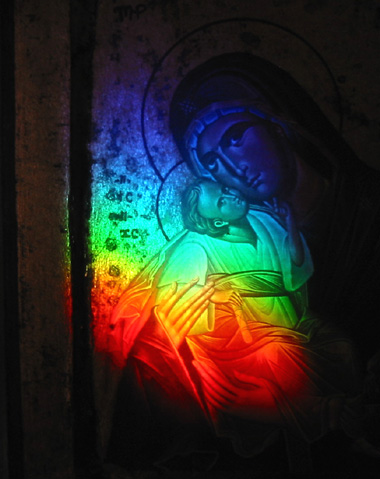
Unweave a rainbow…

So wrote John Keats. As many idealists and romanticists have done ever since, Keats was putting on his Smock of True Art, levelling his pistol at the ‘cold unfeeling heart’ of science and plugging away.

Once upon a time, many years back, I probably would have leant to the side of Keats. In fact, to this day I sympathise with Keats, and I understand, as only someone who has been on both sides of the fence can, his fear and from whence it comes.

But these days I disagree in a most profound way with his assessment that philosophy (by which he means science in keeping with the manner of his time), “empties the haunted air” by “unweaving the rainbow”.

See, the mistake that Keats makes, and one that I very nearly made in a desire not to lose a sense of mystery from my life, is to think that the intent of science is to explain everything, and by inference, trivilalise it; to pit the marvels of the universe against the measure of man. This is a view of science that is fundamentally and seriously wrong.

Science, as practiced by real scientists, is a tool with which we can examine the universe and make assessments that are not based on the way we would like it to be but on the way that it tells us it is. This is one of the most rigorous intellectual and philosophical challenges that any human can undertake. Religion can’t do it, art doesn’t feel the need to do it, and capital ‘P’ Philosophy sits on the fence. Only science seeks to look squarely at the truth and endure its harsh blows.

In a private email about my recent post on homeopathy, a correspondent suggested that I was ‘narrow-minded’ in my view. I explained that to the contrary, my open-mindedness about homeopathy was what convinced me it was bogus; I once used to think that it should be considered as a complementary medicine (and yes, I even used it myself), but my wide reading about it, my willingness to entertain both sides of the argument, was what led me to doubt its efficacy. I still read about research into homeopathic claims. If someone can give me some substantiation that homeopathy works in the manner in which it is suggested that it does, I promise I will change my mind. But you see, so far no-one has been able to do this. The support for homeopathy is anecdotal and diffuse and minimal at best.

On the other hand, if I want to demonstrate that clonal science effectively keeps millions of people healthy every day, it is a trivial exercise.

Is this any less marvellous, just because we understand exactly why it works?

Keats, like many artists, was afraid that science would strip our world and our lives of mystery. If he had been willing to spend a little bit of his time with science, he might have discovered, as so many scientists have, that the deeper you look into the universe, the more mysterious it becomes.

This does not mean that we need to invoke supernatural beings like gods and demons to explain it. It just puts us in mind of the one thing of which we should always be aware: we are tiny parts of an extraordinarily complex machine of which we know so very little. Only hubris in the form of bad science or bad religion even attempts to suggest that we can understand it all.

And if you want mysteries, try these:

★Why does the number phi (1.61803399…) appear in so many seemingly unrelated places, from plant structure to the event horizons of black holes?

★Where is your conscious self? Where does it go when you fall asleep?

★Why do we dream?

★Would the universe exist if we weren’t here to see it?

★Why do alcoholic drinks retain their aroma longer than non-alcoholic drinks?

★Is the string of numbers in pi completely random forever?

★Will the internet ever become sentient? Would we even know if it did?

★How does memory work?

★Why do normal body cells go berserk and multiply out of control in cancers?

★Why is it that some people can be hypnotized not to feel pain, and some people can’t?

No-one knows the answers to these questions. It is possible that someday, we might know something of some of them. But then again, we might not. The crucial thing to understand is that by asking questions about these things, we don’t diminish ourselves, or our dreams. Of one thing you can be sure: for every question we answer, another two will arise.

Imagine this:

You are on a luxurious cruise liner in the South Pacific (not one of those tacky floating pubs full of bloated tourists in loud Hawaiian shirts – I’m talking 1920s-chandeliers-and-monogrammed-crockery type affairs. Only A1 class analogies here at TCA). A waiter pours you a shot of vodka, but before you even get to take a sip, a careless socialite waltzing across the deck with her dashing lover bumps you, and you drop the shotglass into the ocean. The ship sails on. When you reach port two weeks later, you tell your amusing lost-vodka story to an acquaintance and they say: “Don’t worry, just take a shot glass, go down to the ocean and scoop up some sea water. If you drink it, it will still have the same effect!”

Are you with me? Are you thinking what I’m thinking? You would say to them: “You are a CRAZY FUCKING LUNATIC. No way will it have the same effect!”

If they insisted that it would, then you know that they are into homeopathy, one of the daftest belief systems to have originated this side of Scientology.

(Actually, the analogy I gave above is exaggerated. The usual homeopathic ‘remedy’ has even less ‘active’ material than the amount of your spilt vodka in the entire volume of water of all the oceans on the planet. Seriously.)

It’s hard to know where to start in picking on homeopathy. It’s like shooting a very fat fish in a very small barrel.

A brief lesson in how it is supposed to work (for anyone who’s been on a Pacific island for the last seventy years and thinks the war is still on):

1: You acquire a substance that is meant to have some kind of prophylactic effect.

2: You then dilute it with distilled water so much that there is, in many cases, literally none of the original substance in the remaining liquid.

3: You then swallow it according to a variety of regimes, none of which need concern us here because the preceding two steps have enough nonsense to sink a ship (just riffing on the original Luxury Liner analogy).

In recent times, homeopaths have had to agree (mainly because it is unarguable) that a typical homeopathic remedy contains none of the supposed active original substance. But lately, because they really need to defend a couple of centuries of investment in an increasingly shaky belief system, advocates of homeopathy have come up with a new idea; that even though the original ingredients have been diluted out of existence, the water somehow remembers what was dissolved in it. This concept has come to have been rather surprisingly called ‘Water Memory’. Let me give you a potted explanation of this (stick with me – there’s a lot of willing suspension of disbelief involved): You take a small amount of a substance. You dissolve it in purified water, say, at a ratio of 100:1. Now you do this again, with your 100:1 solution, and you do it again and again and again. Many times. Many, many times. So many times that there is possibly, even probably, no molecule of the original substance left in the water (I’m not making this up). In fact, homeopaths assert that the more times you dilute it, the more effective it is. You simply can’t dilute it too much*. But this is totally OK, because even though there is no remnant of the original substance in the water, it somehow† leaves some kind of ‘imprint’ on the water. This final solution (you may as well call it water, because it is), is the thing that is meant to cure your ills.

I don’t know about you but I when I hear stuff like this I get the urge to do something like staple my hand to a table just to make sure I’m awake.

Thing is, the concept caught the fancy of a few scientists who have a bit more tolerance for loonies than I have, and who quite scientifically thought “Why not test this assertion? It should be easily verifiable in a controlled experiment!” Consequently, lots of non-conclusive experiments have been performed over the last few years. The jury is still out on ‘water memory’ largely because no-one has managed to do a proper double blind experiment on it, but if I was a gambling man, I know where I’d place my life savings.‡

The real mistake these diligent scientists made, though, was that they didn’t consider the whole question. They tried for “Does water have a memory?” but completely missed “What are the original substances that homeopaths choose to dissolve in water, why are they deemed to be effective, and who decided that?”. The scientists fell for a classic magician’s smoke-and-mirrors distraction: they tackled the part of the theory that was mysterious and missed the bit that was just plain deception. But by giving credence at all to a small part of the idea, they lent weight to the entire spurious argument that is homeopathy.

To answer those last three important questions (and I emphasise, these are the things you should really consider if you are even contemplating using a homeopathic treatment): Homeopathy was invented in 1796 by a physician named Samuel Hahnemann and uses an archaic belief system traceable back to the original alchemists, called The Law of Similars. The Law of Similars is basically medieval superstitious thinking that says if you have, say, a stomach pain, then it should be treated by, maybe a pig’s intestine because pigs have a good constitution and hardly ever get sick (!) Or something like that. Truly, it’s that nutty. There is pretty much no rational reasoning, let alone science, involved. Hardly anyone I know who uses homeopathic medicines seems to realise this.‡‡

Let me leave you with one last thought: If homeopathy is a valid concept, then you should beware every glass of water you ever drink. Because, according to the laws of homeopathic ultradilution, every cure and every cause for every illness ever known to humankind has over the millennia passed through, and is ‘remembered’ by, that glass of water. Feel a bit queasy?

Me? I stick with single malt whisky. And I believe in Santa Claus because he’s comparatively plausible.

*There are further aberrant behaviours involved, such as ‘striking’ or ‘tapping’ the container with the final dilution ten times to ‘potentize’ (ugh, even the language is ugly) it to ‘make it more effective’, but I’ve left these out because, well, it’s hard enough to believe this shit even without including them.

†No one has even mooted a mechanism for how this might work. Unsurprisingly.

‡Even generously allowing the benefit of the doubt in favour of homeopathy that there is some kind of effect it must be staggeringly small. In the order of success of about one in a million treatments. This is hardly something you’d want to stake your health on.

‡‡A great thing about The Law of Similars is that in some cases, the ‘cure’ is the disease itself, such as a rabid dog’s saliva being used to cure rabies. But that’s OK, because it’s diluted so much, it isn’t there. Oh, I just can’t go on. Even writing about it is just absurd.

« Previous PageNext Page »