Tue 12 Sep 2006
What I Believe But Cannot Prove
Posted by anaglyph under Art, Philosophy, Religion, Science
[23] Comments
I’ve just finished reading a very interesting book called What We Believe But Cannot Prove, in which prominent scientists and scientific thinkers speculate around their disciplines on things that they feel are true but for which there is as yet no scientific substantiation. I really recommend this book as an insight into the way scientists think, but also as an insight into the way in which they explore their intuition.
It should be made clear that the speculations in this book are distinctly different from just ‘wishes’ or irrational beliefs, but are hunches that scientific thinkers have based on their work, or on deep and methodical thought about their particular subjects.
Reading the book prompted me to think about what kinds of things I believe, but can’t prove. The speculations that follow are also based on some sensible science, I hope, particularly on my work with mathematics and image generation.
So, for your perusal:
What I believe to be true, but cannot prove, is that all life is the result of complexity that emerges from the interaction of very simple rules. In other words, I believe that, although we may never fully understand how it happens (indeed, it may just be unfathomable to our brains), sets of simple descriptions linked together by circumstance, chemistry and time contain all the information necessary to describe all the lifeforms we see today and that we will ever see.
This is not to belittle the majesty which is life. It is a truly remarkable outcome from humble beginnings, and is so extraordinary that many people feel the need to evoke a Creator to explain it. But I don’t, and I’ll try to give you some idea of why that is.
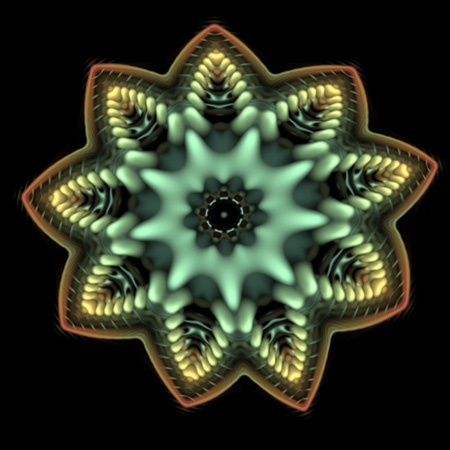
Some of you know that one of my many interests is the creation of images from mathematical constructs. Almost unfailingly, when uninformed people see my work they leap to the conclusion that it is something to do with fractals, even though mostly they will not have a clue what that actually entails. But my work has little to do with fractals strictly speaking.
The software I use* allows me to take algorithms that make simple descriptions of Cartesian (or flat geometrical) space and chain them together in such a way that aspects of one simple description contribute to the outcomes of all the other simple descriptions. In other words, each simple description speaks to every other simple description so that altering the aspects of one has effects on all the others. It is, to give a considered analogy, the genome of my artwork.
It really is a breathtakingly uncomplicated idea; I might have one algorithm that describes a circle, and another that describes a modulated distortion of that circle. Yet another describes colour, another describes how many times that circle is drawn. Another balances the shading applied to the image. As I start with these very easily comprehended descriptions, everything seems pretty basic. I can predict, in systems with three or four algorithms, pretty much what tweaking any of the variables in the equations will do to the final image. The results of this rendered in image form are pretty much what you would expect – fairly prosaic geometric figures and bright colours. But then, after about seven or eight algorithms have been connected together a very eerie and profound thing takes place: the outcome of changing any one of the thirty or so variables that have now been introduced is simply not predictable. And the images start to take on very special unspecified qualities. The system has become so interdependent on all its many changeable pieces that a level of extraordinary complexity has been reached. For the works that I am now creating, my systems typically contain between fifty and eighty algorithms, encompassing something like 240 individual interconnected parameters and feedback loops.
This is for all practical purposes an entirely unnavigable artistic space. Even if I had a billion lifetimes I could only explore a small fraction of the possible results. It would be a mind-numbingly daunting prospect, were it not for some other tools at my disposal, notably a way of applying rule-based mutation to the equations and observing generations of outcomes.
When mutations are applied, many of the outcomes, in fact most of them, deliver uninteresting or even ugly results. But every now and then something truly surprising and beautiful springs forth, and I can, using other tools, refine my image in countless ways. (I must emphasize that this is not a random process†; there are strict rules in play here. It is just an unfathomably complex process that can seem random without inside information). Using a combination of mathematical knowledge, the mutation tools, and artistic intuition, I now have a workable method for usefully exploring these vast numerically-defined landscapes.‡
Of course, some will argue that in the process I’ve described above I am playing God by making decisions and crafting the direction my creations take. It is my will alone that decides what is valuable and what is not. Why is it different in the real world? That’s a fair point.
If we extrapolate my dalliances in mathematical invention into the real world, is there some persuasive natural force that obviates a need for a Divine Hand and would guide the best choices of the available descriptive options in such a way to provide the kinds of outcomes we see in life all around us? I believe so, and I think that force is Natural Selection.
In other words, what I believe is that Natural Selection and the fundamental mathematical rules of the material world work in concert to efficiently, explosively and inexorably produce the kinds of life that we know. Mysteries that exist in current evolutionary theory, such as the incredible rapidity in which life has evolved on our planet, the extreme flourishing of diversity to which the fossil record gives witness, and the sheer determination of life to arise anywhere it can, have puzzled scientists for many years. If, however, we factor in an ability for some kind of information coding system (like DNA) to exploit mathematical physical laws that already govern basic matter (things like surface tension, viscosity, crystallization), stir in some (I believe inevitable) emergent complexity, and add some time and some kind of filter process (Natural Selection), I think answers to these mysteries present themselves readily.
I can’t prove I’m right about any of this. But my artistic intuition, combined with the small amount of science and mathematics that I have informally picked up over the years makes this feel right to me. I’m trained as an artist rather than a scientist, so I get a bit of license to lean more heavily on intuition than your average diligent scientist. As far as the science goes, though, there is recent thought from scientists much cleverer than I am that tends toward support for my hunches, though I’ve not heard anyone voice these exact ideas. Mathematician Stephen Wolfram in his extraordinary work A New Kind of Science suggests that cellular automata, or simple generative rule systems, are the basis for the structure of living organisms (amongst other things), and author and mathematician Ian Stewart in his book Life’s Other Secret advances an hypothesis that proposes that DNA might exploit natural physical properties. I have riffed heavily on their ideas. I have also taken inspiration from Philip Ball’s The Self-Made Tapestry and Paul Davies’ The Fifth Miracle.
If I’m even close to being in the right ballpark with any of this I believe I can make a few predictions stemming from the ramifications of my hunch. The thing about the net is that this is here for posterity now, so I will look damn stupid if I’m proved wrong. Nevertheless, I have the courage of my convictions. Here we go:
1: I predict that when we finally examine the genome comprehensively we will not necessarily be able to make direct correlations between particular genes and what those genes ‘do’. Indeed, Information Theory already hints at this outcome.** In other words, we won’t be able to point at a particular gene and say “#4123 specifically codes for eye colour”. I believe it will turn out to be far more complex than that. That is to say, #4123 may indeed have an effect on eye colour, but I’m going to speculate that if you tinker with that gene to get brown eyes rather than blue, you will also alter the balance of many other aspects of the organism in complex and unpredictable ways. I think we will discover that all the genetic therapies we are currently undertaking will in time prove to be clumsy and indirect and possibly even detrimental in some cases. Of course, if past behaviour is anything to go by, the pharmaceutical companies and Big Business behind gene research will go some way toward obfuscating any results that point to this, because the implication is that there is no direct cause/effect correlation, and business hates that kind of thing.
2: As a result, I predict that knowing how to effectively mold the results of genetic manipulation will become a matter of intuition and inspiration; the domain of artists rather than businessmen. Therefore, I predict that the design of new drugs, prostheses and even life-forms will become an artistic endeavour rather than a technical one.
3: I predict that the principles at work in emergence will also be shown to exist at the core of other complex systems such as societal behaviour, economic systems and neurological processes. I think we will learn that ‘consciousness’ is an emergent effect from mechanical brain function.
4: I predict that the internet will start to exhibit this emergence in an overt manner (I think there is already a level of emergence in the net, but that as yet it is merely phenomenological; I am speaking about something deeper, and probably to us, spookier, than this).
5. I predict that when we do find life elsewhere in the universe (because I am very sure we will, maybe even in our solar system), we will find it abundantly and in spectacular variety. I don’t believe we will just find a little microbe hiding under a rock, but entire complex ecosystems. And I think that we will find them anywhere that they are technically possible.
I apologize for this lengthy, serious and technical post. I know this is not good blogging practice. Regrettably, you will be obliged to put up with this kind of thing from time to time. Normal programming will resume presently.
___________________________________________________________________________
*The application is called ArtMatic, developed by Eric Wenger and Edward Spiegel of U&I Software, designers of unique creative enabler tools. I’ve been priveleged to have been in on the development of the ArtMatic project from the ground floor nearly eight years ago. It is no secret that I am not fond of the name of the application, it being rather too redolent of ideas of ‘art’ being produced ‘automatically’ which is about as far from the truth as you could get. C’est la vie.
†Although Randomness is another tool that I can bring to bear if I wish. It’s also a tool that nature has at her disposal.
‡One of the most astonishing things is that the beautiful results I am able to generate are often evocative of things that we see in the natural real world. I don’t explicitly make them like that, I just set up the right conditions – the forms themselves are emergent from the maths. I can control them comprehensively for sure, but ultimately they exist somewhere in the numbers. Occasionally this really spooks me out… I don’t believe this echoing of natural forms in pure maths is at all coincidental, but that’s material for another post, perhaps.
**Simply put, it is possible to show theoretically that DNA does not contain enough explicit descriptive information to detail the complex outcome of, say, a jellyfish. Consider: there are something like 20,000 genes in the human genome (the exact number is still unknown). It’s really not that many. If you allocate tasks directly to parts of the gene it’s just not enough ‘bits’ to describe all the complexity of a human being (even taking into account contributing factors from ‘junk’ DNA or Regulatory Sequences and other gene ‘enhancers’ that seem to be in play ‘controlling’ gene expression). If you don’t do that, you have to come up with an alternative information-carrying concept, which is tricky (not to say messy). Some contemporary Christian thinkers have leapt on all this to say “Aha! There’s God at work”, but of course they would.
___________________________________________________________________________
Click here to vote for this post in The Philosophy Blog War!
___________________________________________________________________________