Science


Uncanny!

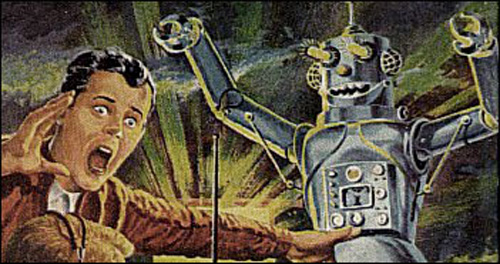
You may remember that in my post about the Coming of the Robots a little while back I talked about Hiroshi Ishiguro’s actroids and the inventor’s attempt to give his automatons a realistic human appearance. I penned the words:

…the closer these things come to having the semblance of humanness, the greater is my desire to punch them.

As I wrote in that post, my feeling is that there is something more disconcerting about the almost human appearance of these robots than there would be about having a clumsy metal quite obviously artificial ‘Robbie’ as a manservant.

Well I discovered today that there is in fact some interesting thinking devoted to exactly this idea, and even better, a cool term.

It is called The Uncanny Valley.

The Uncanny Valley hypothesis was advanced by Japanese roboticist Masahiro Mori and basically states that, as robots develop and become increasingly ‘human’ in appearance, humans start to find it easier to accept and interact with them. However, there comes a certain point beyond which acceptance gives way, quite abruptly, to revulsion. Then (Mori’s hypothesis asserts) as the facsimile approaches even greater realism (that is, the ‘ideal’ human form) acceptance increases once more to ‘human’ level tolerance.

If you viewed the videos of Ishiguro’s actroids you’ll understand exactly what the Uncanny Valley idea encompasses – these robots are creepy and disturbing and there’s no way I’d want one lurking in my house after dark. Or before dark for that matter. So much so that I’m even wary of Mori’s use of the term ‘Valley’ in his hypothesis – from where I stand it looks more like an Uncanny Grand Canyon.

Mori has been criticised on this very point – there is of course no evidence so far that robots will become sufficiently lifelike to make the Uncanny Valley anything more than an Uncanny Precipice.

In fact Mori’s whole concept has been called into question by commentators such as US roboticist and sculptor David Hanson and Swiss artificial intelligence scientist Dario Floreano* who go so far to say that it is pseudoscience. Well, it may be true that there is little actual science behind the idea of the Uncanny Valley as yet, but to my mind at least it makes good common sense that we instinctively don’t lend our trust to something that could be human but also might not be. It’s not a new concept to humans in any way – it has been the subject of paranoid science fiction for decades, and before that an idea that surfaces in folk tales and myths as far back as we have records.

As I said in We Are the Robots, when we used to have the old electronic ‘cut-up’ voices on telephone answering services, it was clear that we were dealing with machines. In my opinion, as superficial semblance to machines decreases (in these ‘voice robots’ at least) then we expect, quite correctly I think, that their behaviour should increase in realism at the same rate or better. And as much as I respect the obviously informed opinions of people such as Hanson and Floreano I think that the Uncanny Valley will persist until such times as robots are indistinguishable from humans.

In other words, when the androids get as convincingly lifelike as Rachel in Blade Runner, then maybe The Uncanny Valley might start to look more like a Grassy Meadow.

___________________________________________________________________________

*Floreano has an MA in Visual Psychophysics. Oh, how much do I want one of those!

___________________________________________________________________________

A Boring Image

Now that pretty much everything you can imagine has been turned into a movie monster, from the recombined pieces of corpses through cars, atmospheric moisture, dolls, dogs and dinosaurs, writer/director M. Night Shyamalan, director of such memorable moving pictures as, well, OK, only The Sixth Sense, has turned, for his latest effort, to that ultimate Creature of the Night: the larch. Yes folks, I’m giving away the plot. In his new film, The Happening, the trees did it.

You will recall that some time ago I wrote that I wasn’t going to get into the habit of reviewing movies here on The Cow unless they were very very special movies…? Well, this is a very very special movie. Oh yes – ‘special’ in the way we used to be told to refer to the kids with learning disabilities in school.

Like Danny Boyle’s execrable Sunshine, Shyamalan’s The Happening commits the Number 1 Crime of science fiction; it is dumb. And, as if it’s trying to get one up on Sunshine, it also commits the Number 1 Crime of movies-in-general: it is boring. This film is dumb and boring. And annoying.† About twenty minutes into The Happening I contemplated emulating one of the film’s pheromone-addled humans and seeing if I could stuff enough popcorn up my nostrils to kill myself.

The story begins with a relatively intriguing stage-setting sequence in Philadelphia’s Fairmount Park where a young woman begins babbling incoherently to a friend and then meticulously removes a chopstick-sized hairpin from her hair and inexplicably plunges it into her jugular. Other people around the park seem bewildered and disoriented, and screams echo from somewhere in the distance. Elsewhere in the city, Elliot Moore (Mark Wahlburg) a science teacher in a local high school, is enquiring of his class if they’ve ever heard of Bee Colony Collapse Disorder (a mysterious catastrophe that is, in actual fact, devastating honey bee colonies in the USA) and asking the students to put forth some explanations for this baffling phenomenon. The first kid to come up with a suggestion – “Some kind of disease?” – is in all probability right on the money, but this does not deter M. Night, via Marky Mark, from plunging headlong into the ridiculous.* Nope, Colony Collapse Disorder is nothing we could ever imagine: “It is,” pontificates Elliot weightily, “An Unexplained Act of Nature!™”

This scene, so very early in the piece, is an alarm bell that presages a series of inane pop-science clichés and baseless myths that will form the framework of the film. As Elliot strides around his classroom, attempting lamely to be Cool Mr Science Geek, all I could think was “Well, if American science teachers are anything like this, I now completely understand the success of the Intelligent Design movement in US schools”. It is true that Colony Collapse Disorder is perplexing and unexplained, but SO WHAT? Lots of things are perplexing and unexplained. Shyamalan quite obviously wants us to think that in this case it means that science is, somehow, inadequate for the job of providing any interpretation of CCD, and that is w-o-o-o-o-o-o-o-o-o… SPOOKY!!!. Spare me.

It’s a real shame, because the premise of the film – that plants might evolve to react to humans as a threat, and consequently take measures to eliminate them – is actually reasonably original, The Day of the Triffids notwithstanding. It even has some slight basis in the natural world. It’s the kind of thing that a writer with more skill might have made into a decent yarn.

Meanwhile, in the picture’s only truly unsettling sequence, across town a bunch of construction workers start throwing themselves off the top of a building. It appears that the city is suffering some kind of mysterious pandemic (which in the paranoid US lexicon automatically means ‘an attack by terrorists’). It’s about here that the film turns rapidly brainless. And never recovers. News reports inform us that some kind of airborne agent is causing people in the city area to kill themselves. Early warning signs of contamination are confused behaviour and incoherent speech. The teachers in Elliot’s school are told to send their kids home and lay low. Elliot and his teacher pal Julian (John Leguizamo) decide to grab their families and head out of town.

We are next introduced to Elliot’s wife Alma (Zooey Deschanel) who appears from the very start to have been affected by the terrorist mind chemical, but as it turns out, that’s just her acting style and/or the witless script. Elliot calls by to collect her and they head off by train with Julian and his daughter Jess (Ashlyn Sanchez) in tow.

The train gets stopped in Nowhereseville USA, and after what seems like an interminable series of explanatory scenes, Elliot & Co manage to hitch a lift with a goofy guy and his wife who are some sort of horticulturalists. Goofy Guy is the first to offer the idea that maybe the source of the mysterious toxin which is affecting the humans comes from trees. On the way to a place that the group has perceived as ‘safe’ (Wha? Did anyone else understand how these fruitcakes decided this?) they stop by Goofy Guy’s greenhouse where we discover that he has a penchant for hotdogs (what the crap was that about?) and that he talks to his plants (and plays music to them).

“They respond to human voices!” he exclaims, rolling his buggy eyes around, “It’s a scientific fact!” And suddenly I see what he’s getting at – by now it is plain that the performances from the plants in this film are considerably less wooden than those of the actors, and this could be readily explained if you care to speculate that maybe M. Night Shyamalan spent more time on the set talking to the trees than to the people. Seriously. The dialogue and the acting in this picture must conspire to be some of the worst to hit the screen since Robot Monster or Plan Nine From Outer Space. Let me give you an example:

Elliot (talking about Goofy Guy’s theory that the trees are responsible): Maybe that guy was right…
Alma: What do you mean?
Elliot: I don’t know.

That’s the only one I can remember verbatim, but there are dozens of these kinds of clunkers. Mark Wahlburg, who is usually quite capable of turning in a reasonable performance, seems to spend most of the picture barely keeping the effect of the mind-altering plant toxins at bay. He stumbles around the countryside (and the film in general), as the ad hoc ‘leader’ of his little group, like a clueless boy scout about to fail his orienteering badge. In one memorable and quite absurd sequence he shouts over and over “Give me a second! Just give me a second! Why don’t you give me a second to think?! Just give me a second!!!”

All of which takes up more than a few seconds of his thinking time, but gives the audience plenty of time to think that they should have gone next door to see Kung Fu Panda. What Marky Mark comes up with in his thinking time is the brilliant strategy that the group should try and outrun the wind. I’m not kidding. This guy teaches science.

I won’t bore you with a blow-by-blow of the rest of the story.‡ And it truly is boring. Just imagine a confused road movie with panicked groups of people driving around the bucolic Pennsylvania landscape stumbling alternately across corpses and unhinged-people-who-will-eventually-become-corpses. When one victim throws himself under an industrial lawn-mower I was right there with him.

It’s hard to believe that a film can be quite this awful. With the vacuous substitution of scene changes and spectacle (in the form of shock-tactic suicides) for plot, and mawkish sentimentality for emotion, the movie plays to the dimmest of the dim. It mixes up scientific fact and the truth about natural events with hokum and nonsense in a mad mélange of glib throwaway hippie philosophy and post Cold War paranoid hysteria. It’s like Walt Whitman rewrote The Day of the Triffids after watching What the Bleep Do We Know? On crack. And, inexcusably these days for a science fiction film, it perpetuates the idea that scientists are either mad or bumbling, and that science itself is clueless and ineffectual. Or evil. These things are bad enough, but unbelievably, it’s even worse than just that. At times during the film Shyamalan seems not to know whether he is making a sci-fi thriller or a comedy. A bizarre scene with Elliot talking to a house plant is played, confusingly, first for tension then for laughs. In the cinema where I saw The Happening, the audience was laughing at, not with. Portmanteaus of people committing suicide in bizarre ways (a guy offering his limbs to lions in the zoo; the man lying in front of the lawn mower) are so blackly humourous that it’s hard to believe Shyamalan was oblivious to the effect they might have on the audience. If he was aware of this, one is forced to ask the question: “Why? What the heck is he getting at?” Sequences which I presume are intended to be symbolic and ‘meaningful’ (the Exhibition home with its fake sushi plates and prop wine glasses; the solitary ‘Earth Mother’ in her isolated homestead; the lame horror feint involving a rope-swing on a creaky branch) are flat and stupid and go nowhere.††

And the obligatory Shyamalan ‘twist’ ending, so obvious and soporific that it would have been rejected from the lamest episode of The Twilight Zone, is made even worse by ringing loud with a cinematic “Tsk tsk tsk: you humans don’t know nuthin’!”

As I said at the outset, M.Night Shyamalan’s The Happening is a movie with learning disabilities; it is to the science fiction oeuvre what Basil Fawlty is to the hospitality industry: an uncoordinated, unlikeable, nonsensical caricature that is a peerless example of what not to do if you at all concerned about pleasing your customers.

Did I mention it was dumb?

Right.

___________________________________________________________________________

*”Good theory Timmy,” says Marky Mark, metaphorically tousling the kid’s hair, “But it doesn’t explain why it’s happening everywhere at once!” No it doesn’t. That’s because, in all likelihood, Colony Collapse Disorder had already spread widely before it was noticed. It’s distinctly probable that it’s happening ‘everywhere at once’ in the same way as, say, AIDS is happening everywhere at once if you examine it right now. It does not mean that it didn’t start somewhere. Read about CCD here and get some understanding of how science is actually approaching this problem. (One is forced to conjecture that for a person writing about a phenomenon of nature and science and offering it up dressed in the robes of plausibility, M. Night Shyamalan was actually not terribly concerned with those pesky things like facts…)

†The film is peppered with scenes of people committing suicide in graphic and novel ways. It is the filmic equivalent of someone poking you every time you’re just about to doze off to a nice comfy sleep.

‡And there are SO many risible scenes to choose from: such as when Elliot confronts the train guards about why they’ve stopped in some remote town:

Train Guard: “Because we can’t go any further.”
Elliot: “But what are we supposed to do?”
Train Guard: “You’ll have to make your own way from here…”
Elliot (apoplectic): “Why are you giving me information one bit at a time!!”
Me (mentally screaming silently at the screen): “Because you only asked two things and besides are quite clearly mentally retarded”

Or the sequence when Elliot’s group hears gunshots from over the hill; the party they’ve just split from (after they’ve been told to stick together, I might add) has been affected by the toxins:

Alma (wincing as gunshots ring out, and we realise the people are shooting themselves): We can’t just stand here. We have to DO something!
Elliot stands dumbstruck, like a deer in the headlights.
Alma (hysterical): We have to DO something. We can’t just stand here like those people who watch an accident and do nothing!
Me (screaming silently at the screen): No you dumb bitch, you can’t! But you could act like people who’d made a rational appraisal of the situation and haul your asses out of there as fast as possible before the plant pheromones get to you too!!!

††If you want to see a movie about what an inexplicable event like this would be really like if it happened, try Michael Haneke’s Wolfzeit (The Time of the Wolf). I guarantee you won’t leave that film laughing.

___________________________________________________________________________
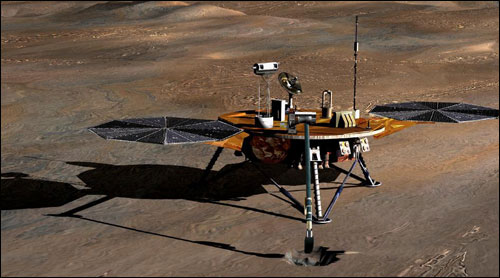
NASA Phoneix - Artist Impression

Just for fun, blogging the NASA Phoenix Mars touchdown as it happens.

The NASA TV Stream is here. Phoenix has just successfully separated from its cruise stage and commenced its automatic landing sequence – that is, NASA is about to turn over the complicated descent process to the spacecraft’s onboard computers. Phoenix must complete dozens of tricky manoeuvres to get to the Mars surface in one piece – this is the part of the process that has seen disaster in many previous Mars missions.

The Odyssey Orbiter and the Mars Reconnaissance Orbiter are both relaying Phoenix mission data back to Earth, the mission having been planned to take advantage of the positions of each of these craft.

• Phoenix is just about to enter Mars atmosphere.

• Heat shield has been deployed.

• Phoenix altitude information is being successfully relayed… 1600 metres….

• Phoenix has touched down successfully!

• Jesus H. Christ, Windows Media Viewer is a shitty piece of crap – NASA! Have you people never used Quicktime? Please let Apple handle the media broadcast next time!

• There is some short delay while Phoenix prepares to begin its own independent transmissions back to Earth. The mood in Mission Control is jubilant though, so all has gone exactly to plan. I wish I could have seen them at the moment of touchdown, but the piece of rubbish that is WMV dropped all the image out and I had to reboot Firefox to get it back.

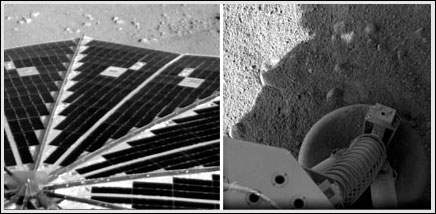
• Waiting for Phoenix telemetry to come online. Phoenix is tilted at a mere quarter of one degree from the vertical, and the next part of the process involves the unfolding of the solar array which of course is Phoenix’s power plant.

First Pix from Phoenix

• Phoenix is functional and sending back images.

For the first time in 32 years, and only the third time in history, a JPL team has carried out a soft landing on Mars. I couldn’t be happier to be here to witness this incredible achievement. ~ NASA Administrator Michael Griffin

Some points of interest:

• After the touchdown, the Phoenix team waited for over 15 minutes before deploying the solar panels, one of their concerns being that dust kicked up by the engines might cover the solar cells and reduce their effectiveness. In the event, there was no discernible trace of dust at all.

• Phoenix is at Mars’ North Pole and is looking for proof of extant water (most likely in the form of ice) on the planet. The Phoenix team agrees that a white object that has been seen in one of the first surface images is probably not a polar bear.

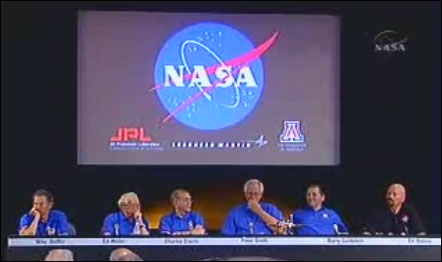
The First Phoenix Press Conference

Mission Earth Day 2:

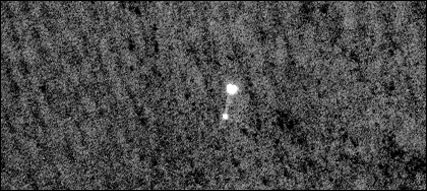
The Mars Reconnaissance Orbiter snapped this astonishing image of the Phoenix descending to the surface of Mars on its guidance ‘chute:

The Phoenix Descending to Mars Surface

Monty Loses

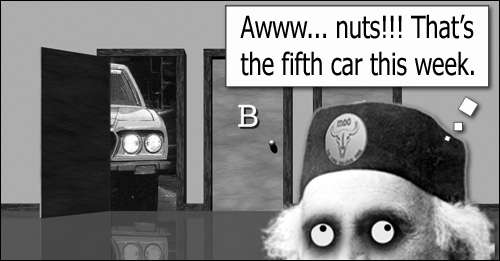
The correct answer to The Monty Hall Problem is: Yes, you should definitely change your choice when Monty gives you the opportunity. You will improve your odds of walking away with the car from your initial 33.3% to an impressive 66.6%.

Those of you who said that your chances remain the same as they were to start with, or improve to an even 50/50, are in error. I know, it seems bizarre on the face of it: if you change your mind, your chances of winning the car are not just better, but substantially better. But how can that possibly be?

I think the best way to approach the Monty Hall Problem is like this:

First of all, remember that Monty knows what’s behind every door. This is critical.

When you make your initial random choice from Doors A,B & C, there is a 2-in-3 chance that you will pick a goat. That is, two times out of every three your first random choice would give you a goat. Are we agreed on that point? Good. Therefore, on those two times out of every three, after Monty knows your choice, he will have no option but to open the door where the other goat is (presuming, of course, that he doesn’t want to show you the door with the car). Logically, therefore, Monty Hall allows you to know two thirds of the time where the car is† (that is, behind the door you didn’t choose). So you should always change your choice when he gives you the opportunity to do so.

It’s infuriatingly counter-intuitive. When I was first presented with the Monty Hall Problem I was convinced the choice was a mere 1/2 and therefore it made no difference if I changed or not. But the maths don’t lie. If the Word of the Cow isn’t good enough for you, go to the maths department at the University of California & San Diego and conduct yourself some practical trials. If you always change your choice when given the opportunity you will walk away with the car more often than not. You can also see the accumulated trials of everyone who has done the experiment before you: it’s inarguable – the best strategy is to swap doors when Monty gives you the choice!

Why do we have such difficulty with the Monty Hall Problem? I think the answer is twofold – firstly our brains are not naturally great at interpreting statistics, and secondly, The Monty Hall Problem is not strictly a problem of maths.

Statistically we can all see quite clearly that the chance of choosing the car initially is 1-in-3. We then tend to think that by being shown an ‘irrelevant’ door and given two remaining options there is an equal chance that either may hide the prize. This is in fact true; in a strict statistical sense, taken in isolation, the prize may indeed be behind either remaining door. But Monty (unwittingly, we must suppose) is not giving you that kind of choice. He is instead giving you the opportunity to change your mind about your first choice which is an entirely different thing altogether. And that opportunity is informed by the fact that Monty knows something about what’s behind the doors that you don’t.

In other words, a purely statistical experiment is muddied up by the fact that the experimenter knows something about the outcome and stirs that into the experiment, irrevocably removing the random element.

Or, put another way, if Monty doesn’t know what’s behind each of the doors (or, alternately, if you don’t tell Monty which door you’ve initially chosen) then the Monty Hall Show plays out exactly as your intuition might suggest. (Of course, if Monty doesn’t know what’s behind the doors, in all possibility he may reveal the car when he opens a (necessarily) random door to show you what’s behind it, immediately increasing your odds of walking away with the prize to 100%).

The Monty Hall Problem is a good reminder of how easily it is for the human brain to be lead astray, and why our intuitive grasp of things is not a reliable indicator of the way they really are…

___________________________________________________________________________
†Of course, on the one-in-three times you choose the car on your first go, Monty can show you either of two doors with a goat, in which case your chance of getting the car if you swap doors is merely 50/50. But that’s only for one out of every three times you randomly choose correctly on the first pick!

Correction courtesy of din.

___________________________________________________________________________
Monty & the Doors

A couple of days back I was reading an article about statistical method in experiments in primate behaviour and the writer mentioned The Monty Hall Problem as a possible source of unintentional introduced error or experimenter bias.

Now The Monty Hall Problem is a fascinating mathematical conundrum, and since I know those kinds of things are always of interest to Cow Readers, I thought those of you who are not familiar with this puzzle might like to exercise your mental muscles on it.

The Monty Hall Problem goes like this:

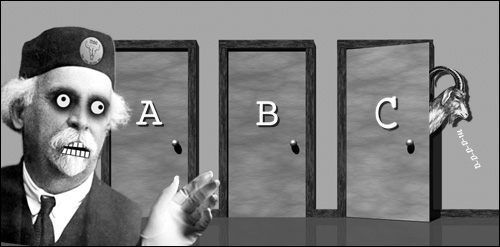
You are on a game show with your host Monty Hall who is offering you the chance to walk away with the Car of Your Dreams. He shows you three doors, A, B & C.

“The Car of Your Dreams is behind one of these doors,” he says, “The other two doors each conceal a goat. As your Games Master, only I know which door conceals which object. Now, please choose a door to claim your prize!’

You choose your door. You tell Monty “I have chosen Door B!”

“Well done!” he says. “I knew you were a contestant of superior ability! But before we open your door, I’m going to open one of the other doors and show you what’s behind it.” He opens Door C to reveal a goat. “Now that you’ve seen what’s behind Door C,” he says, “I’m going to give you a special opportunity to stick with your chosen door, Door B, or change your choice to the other remaining door, Door A. I’ll give you ten seconds to have a think about it!”

Here’s the question: To win the car, is there any advantage in changing your mind and swapping from your initial choice of Door B to Door A?

Answers on my desk by end of class.

This from the most recent issue of New Scientist:

Matteo Caleo of Italy’s Institute of Neuroscience in Pisa has found that botulinum toxin – which is used as a cosmetic anti-wrinkle treatment – can travel down nerve fibres and into the brain within days.

To which I can only say that explains a lot.

A Scary Person

« Previous PageNext Page »