In The News


Residents of Lenoir County, North Carolina, have got it into their heads that this kudzu vine covering a utility pole about a mile south of the town of Kinston ‘bears a striking resemblance to Jesus’ crucifixion’.

A local citizen, Kent Hardison, almost took to the weed with pesticide until (we can only presume) God stayed his hand.

‘You can’t spray Jesus with Roundup’, he is quoted as saying in the Kinston Free Press.

I’m not entirely sure about that. I couldn’t find anything in the Bible actually prohibiting such an action. There’s definitely no Commandment that says ‘Thou Shalt Not Spray the Son of God with an Herbicide’.

In any case, how can the good folk of Lenoir know that God intends this obvious manifestation of His awesome power to be Jesus anyway? Maybe He had something else in mind and they are completely failing to understand the significance of His message?


Suggestions as to what God is actually trying to say to the people of Kinston are very welcome.

One of my favourite places on teh intertubes is the massive US Patent Database. You really could, if you were so inclined, spend an entire rainy afternoon traipsing down its digital corridors and uncovering all manner of bizarre, and sometimes clever ideas. Along with hundreds of thousands of approved patents, you can also find in these dim dark recesses, an enormous slush pile of hopeful patent applications – the wannabees and the has-beens of the entrepreneurial universe.

It has to be said, though, that whoever is in charge of the USPTO doesn’t make the traipsing easy. If you’re looking for something in particular the system seems to do its very best to evade any kind of sensible search procedure. If it was my job to sort it out, I’d approach the people who do the database programming for, oh, Amazon, for instance, and get them to look into a better system for the filing, archiving and retrieving of patents and applications. Because the USPTO sure needs one.

On the other hand, maybe the impenetrable and unfriendly process suits aspiring entrepreneurs quite well, if, let’s say, a punter like myself is in search of a… certain item of interest. It’s quite possible that secretive inventor types hope that the labyrinthine process will cause potential patent sleuths to give up before they can steal any precious ideas, or, as is my particular intention today, before they can bring them out of the musty digital recesses of patent database anonymity and into the bright light of rational public scrutiny. ((I want to point out that there is absolutely nothing illegal about doing this – US Patent Applications are publicly available to anyone who wants to see them.))

The item of interest I have in mind is this one: US Patent Application #20100243745 for an APPARATUS AND METHOD FOR REPELLING AN UNDESIRED SPECIES FROM A SUBJECT SPECIES. Its inventors are listed as: Heiney; Kathryn M.; (Wimberley, TX) ; Dubounet; Desire; (Budapest, HU); Rogers Melissa M.; (Austin, TX). The document was published on September 30, 2010.

Yes, that’s right. You have surely recognized it as the patent application for ShooTag. ((ShooTag is also now being promoted as ‘ShooBug‘. New name, same old woo.)) And just in case I need to draw a line under the name, the patent application for ShooTag is jointly owned by Melissa Rogers, Kathy Heiney, and Desiré Dubounet, aka ‘Professor’ William Nelson.

As you will recall, I have previously demonstrated indisputable links between Nelson and ShooTag, in my post ShooTag; Waterloo, despite Melissa Rogers’ & Kathy Heiney’s apparent efforts to erase any associations between themselves and Nelson and his crackpot notions. ((Nelson is nowhere mentioned on the ShooTag site at the time of this writing, although he featured very prominently on their ‘Science’ page when ShooTag first came to my attention. In addition, Google links to Heiney and Rogers’ attendance at one of Nelson’s QXCI conferences in Budapest have been rendered invalid and are only retrievable via Google’s cache.))

To recap, William Nelson was indicted in 1996 by the U.S. Food and Drug Administration on nine counts of felony fraud charges in relation to various ‘bioenergetic’ healing devices sold through his companies (these machines go variously under the names ‘QXCI’, ‘SCIO’, ‘EPFX’ and others, but they are all basically similar flavours of the same woo. They are implicated in the deaths of several people and the prolonged illnesses of many more). To evade prosecution, Nelson abandoned his home in the USA to take up residence in Budapest, Hungary, where he currently resides in the persona of Desiré Dubounet, and is still actively promoting his/her odd beliefs and his dangerous ‘medical’ machines. ((Where he claims, in the manner of so many charlatans of medical pseudoscience, to have fled because of persecution by ‘Big Pharma’. The reasoning presumably goes that his wonderful machines have solved all the medical problems known to humankind and if the word got out, the pharmaceutical companies would go bust, and they won’t let that happen by hook or by crook. Of course, when it comes down to concrete results, Nelson’s machines don’t deliver. They are at their most ‘effective’ on those maladies that have vague symptoms and subjective outcomes – just like all pseudoscientific medicine. The deaths attributed to these dangerous gadgets are mostly the result of critically ill people being hoodwinked into using them rather than seeking proper medical care. And, folks, in some cases you get so sick that you will die, no matter what anyone does. Modern medicine can’t cure everything, but it has a damn better chance than a silly box fuelled by ‘trivector frequencies’.))

The reason that Heiney & Rogers and their company, Energetic Solutions, don’t want any public association with him/her is, to most observers, pretty obvious I think. Nelson/Dubounet is a wanted criminal and an out-and-out fruitcake, and Energetic Solutions finds him/her and his flaky ideas a liability to the sales of its product. ((It’s probable that Heiney and Rogers aren’t able to determine that Nelson’s ideas are flaky, but I think that they, or perhaps their PR people, are keenly aware that a cross-dressing woo-spouting mad ‘scientist’ does tend to come across as a complete lunatic to most people. One has to assume that originally, in their addled ‘quantum-fractal-Schumann-Wave-bioenergetic-magnetic’ enthusiasm, Heiney and Rogers were all for Nelson’s mad ideas, but somewhere along the line they realised that maybe it was better that they just gave him his cut of the profits and kept him in the closet.))

Now I will emphasize strongly, as I have done before, that merely associating with a criminal does not make a person themselves a criminal. It is not William Nelson’s crimes that concern us here. We can, however, legitimately ask whether there is any link between Nelson/Dubounet’s pseudoscientific beliefs – beliefs that underpin her machines and the practices which have been found fraudulent by the FDA and the law – and the supposed basis for the working mechanism of ShooTag.

With that thought in mind, let’s take a look at some of the ShooTag patent application.

The first thing that probably doesn’t have to be said is that there is an encyclopaedic volume of utter crap in this document. It leaps, like a frog on LSD, from one crazy lilypad of gibberish to another. It is, in fact, a version of the ‘science’ that was originally expounded on the ShooTag website, and which has been subsequently removed (presumably because it made no sense to anyone who knew anything about science).

And we see immediately some of the trademark ideas of William Nelson: ‘cyclic voltammetry‘ and ‘trivector signatures‘. Nelson/Dubounet has expounded upon these ideas all over the web, and the ‘trivector’ concept is focal in the machines he sells. The patent application offers up a flow chart of how the inventors propose that ShooTag would work:
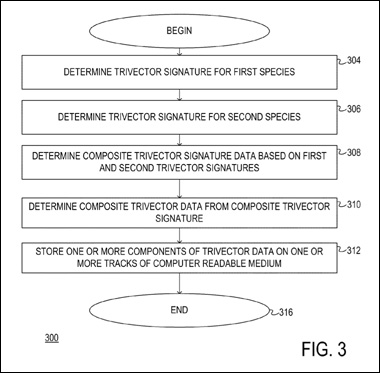
Already we are in pixie land. ‘Determine’ the trivector signature for the species concerned? Now how, exactly, should one go about doing that? Well, Fig. 4 throws some light on that question:
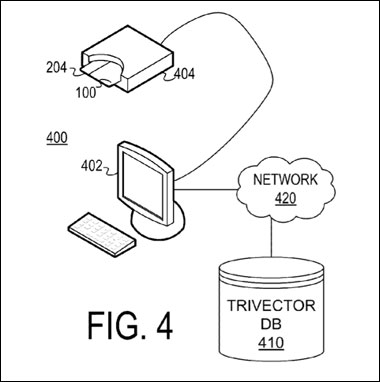
Aha! A network connection to a ‘trivector database‘. Now, I wonder where someone might find such a database? Plugging the term ‘william nelson trivector database‘ into a search engine returns hundreds of results related to Nelson’s QXCI/SCIO/EPFX machines just like this one:


What is the EPFX (Electro Physiological Feedback Xrroid) Quantum Biofeedback Device ?

It is the most accurate and sensitive technology of its kind for identifying stress reactions to over 10,000 trivector voltametric algorithmic signatures stored in it’s ((Ah yes, unsurprisingly, these sites are a tour de force of bad grammar, spelling and punctuation.)) database, such as those taken from nutritional items, emotional imponderable formulas, allersodes, toxins and more.

And elsewhere, on William Nelson’s very own ‘Imune’ website:

•Every substance has its own unique trivector (voltammetric) field signature, and it seems that when a substance with a voltammetric field signature is introduced to the body, it can provoke a change in the field of the body.

•This voltammetric field has a virtual photon effect, which also influences the body and changes its electrical readings. Thus, the trivector signature of an organism will change when the trivector of a stimulus is introduced electrically via device. With this, Nelson realizes an innovation in electrophysiological reactivity (EPR) testing.

• A system is developed for recording thousands of 3-Dimensional trivector “shapes” of individual substances, such as organs, toxins, allergens, nutrients, and others

I think we can very reasonably infer that the ‘trivector database’ specified in the ShooTag patent application is the very same ‘trivector database’ referred to in connection with Nelson/Dubounet’s fraudulent machines. How that database is determined is impossible to know. We can be quite certain there is no published science that explains what these ‘trivector substance signatures’ are. In my opinion, the patent should be refused on that basis alone; even nonsensical homeopathy ‘treatments’ are at least available for public perusal.

My assessment is that the QXCI/EPFX/SCSI/ShooTag ‘trivector database’ is nothing more than a big heap of spurious numbers that have no real meaning whatsoever. Of course, I can be proved entirely wrong about that with the offering up of some properly presented scientific evidence. I have no fear, however, that any such evidence will ever come my way.

The patent application goes rambling on over four dense pages of ‘explanation’, often repeating much of the same daft silliness in different wording. It comes from the school of ‘If-you-don’t-have-facts-throw-in-lots-of-baffling-sounding-terms’ thesis writing. The whole lot could be simply summed up in one brief paragraph:

‘We have a card with a magnetic strip upon which is encoded some numbers. Via some completely unspecified mechanism, some of those numbers refer to insects, and some of those numbers refer to pets. Via some other completely unspecified mechanism, the numbers working together cause the insects to avoid the pets.’ ((You can make it even shorter, in fact: ‘It’s a magic card that keeps bugs away.’))

That’s it.

Of course, the ShooTaggers know full well that they’d never have even the remotest chance of getting a patent if they said it like that, hence the mind-numbing verbage and circumlocutious gobbledygook. One hopes that the patent examiners are so used to seeing this kind of thing that the red pen comes out well before the end of the first paragraph.

Elsewhere on the patent application, we find other enlightening information. To set the scene: you will remember that a little while back we comprehensively decoded the ShooTag data and exposed the silly magical thinking inherent in the information encoded on the card. Not long after that, ShooTag added a question to the FAQ on their site in an obvious (if risible) attempt to deflect this exposure: ((Presumably their thought process was that people would search for ShooTag, find our deconstruction of the data, and then be mollified by the pat explanation in the FAQ. Nice try, folks.))

How do I know if my tag is still working?

This is a fun one. We encode shoo!TAG® tags with a frequency embedded in the magstripe located on the back of the tag. Customers can take their shoo!TAG® to any retailer that carries a magstripe (credit card) reader and swipe it through. The type of tag (i.e. fly, mosquito, tick) will show up when scanned. If there is no name, then the shoo!TAG® tag has lost its efficacy.

Yeah, that really is a fun one because we’ve caught you with your trousers down again. Let me quote you from your very own patent application (and it’s said not once, but three times, in different places):

…the trivector data stored on the three tracks is not readable by a conventional credit card reader.

Indeed. That statement tallies perfectly with my own experience: swiping a brand new ‘Tick’ card in a conventional card reader at my local shopping centre merely resulted in a ‘Card Read Error’. Maybe the ShooTaggers will want to amend that FAQ again, to erase this little untruth as well. Of course, this circumstance suits them down to the ground – if any ShooTag card is swiped, it will always come up as non-functioning (as it always literally is, I might point out). This is a ruse quite plainly intended to persuade unsuspecting customers to buy another one. Make no mistake, these people never miss a trick when money is involved.

So, what are we to make of this attempt by Energetic Solutions to obtain a patent? It’s not like they need it for any particular legitimate reason. The patent process exists in order to invest the intellectual property rights ownership of an invention with legal protection, so that someone else can’t take a good idea and just steal it. But here’s the thing – how do you protect an ‘invention’ that has no rational basis for doing what is claimed? ShooTag says their invention uses ‘trivector frequencies’ to achieve its stated purpose, so even if they had a proper patent, there would be nothing at all to stop me from creating a similar pet tag that uses a different method of operation to repel fleas, such as, oh, ‘overmodulated photonic recursion’ or something. When you just make shit up, holding a patent for it has no meaning.

But.

If your aim is to try and get authentic sounding endorsement for a product that can’t get any legitimacy via the path of factual evidence, then holding a patent is certainly a good PR tool. In other words, if you haven’t got any science to back up your claims, hoodwinking an official body into giving you an official seal of approval will undoubtedly buy you some mileage. ((It strikes me also that these people are prepared to put in a huge amount of time, effort, and, one assumes, money to try and establish their patent. Is it not a telling indication of how they view their product that they aren’t prepared to put the same kind of commitment into proper scientific trials? And wouldn’t you think you’d do the scientific investigation first? All legitimate product development happens that way round…))

I think most people trust that an organization such as the US Patent Office scrutinizes a document like the ShooTag application and files it where it belongs – under ‘N’ for ‘Nonsense’. Sadly, that trust would be misplaced. The USPTO rubber stamps some pretty stupid stuff. Take Patent #5,603,915Process for manufacturing homeopathic medicines’. Its inventors are listed as Carmel Kiely and a certain William Nelson. This ‘invention’ basically calls for the application of an electric current to a homeopathic medicine solution to ‘increase its efficacy’. Its rationale goes on for seven pages of ridiculous garbage.

And folks, the US Patent Office saw fit to award it a patent in 1997.

This enables William Nelson to boast, as he does whenever given the opportunity, about the many patents he holds. For people who don’t know better, it will undoubtedly sound impressive. This, I propose, is the sole reason that Energetic Solutions desires their patent for ShooTag. Not to protect its ‘clever technology’, but simply so they can use it as another advertisement. It’s exactly the same ploy that they’ve used with the ‘scientific experiment‘ that they tout on their website.

When you don’t have actual facts on your side, all you’ve got to play with is smoke and mirrors, and man, do these people know ALL the tricks.

Still, if they do get their patent approved, we will have something to look forward to. Melissa Rogers promised us that:

When we go from patent pending to full patent protection, then all of our sceince (all three applications) will be disclosed.

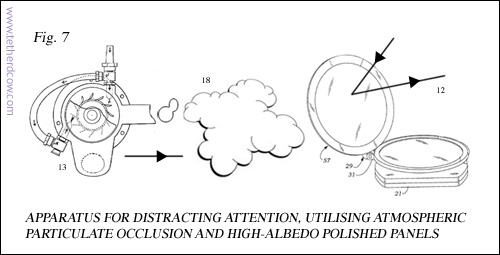
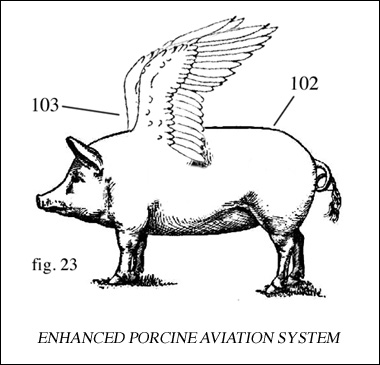
Well, Ms Rogers, such is my confidence of that ever happening that I’m applying for a patent to cover the event:
As much as I’m disparaging of journalists, I do encounter, very occasionally, some smart ones. Annabel Crabb, from the Australian Broadcasting Corporation is such a writer. You may remember my very long post about modern artistic endeavour The King is Dead! Long Live the King! in which I discussed how we’ve come to value art (in a monetary sense) and speculated on its true worth. I did speak briefly about the status quo of journalism in that post, but mostly concerned myself with my own field of music.

It’s encouraging for me to see Annabel asking, in her article Finding a coin for the journalistic juke box, some of the same questions I did. When you propose an heretical idea, it’s nice to know that you’re not actually mad.


According to Family Radio, the world begins to end today, May 21st at 6pm in each Earth time zone…

Blogging it live:

•6pm: Auckland, New Zealand. TCA Status report: Still standing. (Cloudy, light wind)

•6pm: Honiara, Solomon Islands. TCA Status report: Still standing. (Drizzle)

•6pm: Melbourne, Australia. TCA Status report: Still standing. (Mostly clear, prominent cricket chirping)

•6pm: Tokyo, Japan. TCA Status report: Still standing. (Fair, light breeze. Hmmm, I could do with some sake)

•6pm: Beijing, China. TCA Status report: Still standing. (Fair. Some air pollution)

•6pm: Hanoi, Vietnam. TCA Status report: Still standing. (Business as usual)

Yawn. I’m going to bed. I’ll continue in the morning. If we’re all here. I guess. See you then.

•6pm: Dubai, United Arab Emirates. TCA Status report: Still standing. (Not even a rumble)

•6pm: Moscow, Russia. TCA Status report: Still standing. (Happy-go-lucky)

•6pm: Jerusalem, Israel. TCA Status report: Still standing. (Quiet as a manger)

•6pm: Zurich, Switzerland. TCA Status report: Still standing. (Your money is safe)

•6pm: London, United Kindom. TCA Status report: Still standing. (Buses running)

•6pm: Reyjavik, Iceland. TCA Status report: Still standing. (Wow, this is a really empty time zone… hey what’s this… volcanic activity? That looks promising.)

•6pm: Fernando de Norhona, Brazil. TCA Status report: Still standing. (Even emptier!) ((This is the only major city in the world with this time zone, apparently.))

•6pm: Nuuk, Denmark. TCA Status report: Still standing. (Whistling wind)

•6pm: New York, USA. TCA Status report: Still standing. (Zzzzzzz.)

•6pm: Kansas City, USA. TCA Status report: Still standing. (Slight breeze. Well, OK, tornadoes… but it’s not like that’s unusual or anything for Kansas…)

•6pm: Salt Lake City, USA. TCA Status report: Still standing. (Looks like the Mormons are OK.)

•6pm: Las Vegas, USA. TCA Status report: Still standing. (If ever there was a city that God had his eye on…)

OK, Acowlytes. I think we can call it. The Rapture and the End of Civilization hasn’t happened. Family Radio and Harold Camping have proven themselves (once again) to be completely deluded by their irrational beliefs. Chalk up another one to rationalism.


I’m not one for patriotism. In this rapidly shrinking world I feel that the idea of ‘belonging’ to one country or another is as silly as forever waving a flag for the town where you were born ((Goulburn, NSW.)) But sometimes, sometimes, along comes an event that makes me truly proud to be Australian.

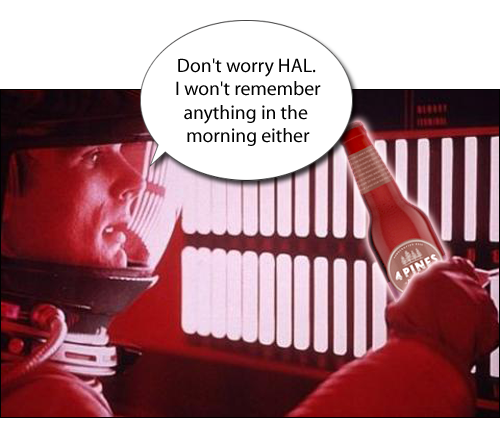
This morning I read in the Guardian of one such event. Ladies and gentlemen, allow me to announce to you, direct from Australia … Space Beer.

That’s right friends, the 4 Pines Brewing Company in Sydney, Australia, is proposing to go where no brewery has gone before by concocting a malty beverage fit for astronauts.

Humanity loves beer. We always have and always will. The Space tourism market is emerging and will take off in less than 2-years, with thousands of screaming, happy space fans booked on suborbital flights. Guaranteed some of them will want the option to enjoy a brew while looking at our big Blue Globe. Why deny them the chance?

Why indeed?! To this end, Jaron Mitchell and Jason Held from 4 Pines have developed their Vostok 4 Pines Stout, which, like good scientists, they have tested under the conditions in which it will be consumed.

A microgravity expert from the non-profit organization Astronauts4Hire (A4H) provided the test subject. The tester, who also works part-time as an in-flight coach for ZERO-G, had over 300 parabolas in microgravity. The tester consumed nearly 1-litre of the beer during weightless portions of the flight, while recording basic biometric data to track effects of the experiment.

This obviously gives the ‘vomit comet’ a whole new level of potential.

Making a brew suitable for consumption in zero gravity is not all beer & skittles though. There are a few obstacles to be overcome:

Beer aficionados will notice two differences when drinking in space. First, the sense of taste is reduced due to mild swelling of the tongue. Second, drinking beers can be uncomfortable—bubbles do not rise to the top, because there is no “top” in space. Gasses and liquids don’t like to separate. So if you have to burp, you will burp both beer and bubbles.

Hmmm. Beer-bubble-burps. Not something you might like to inflict on that groovy zero-g chick you have your eye on.

Undaunted, 4 Pines has pushed on to address these problems by re-engineering one of their previous award-winning beers to create the new highly-flavoured space stout.

This is not a “novelty beer” with the same bland taste as your normal stuff. This is a craft beer. It is meant first for people who love beer so it MUST TASTE SUPERB on Earth.

Of course you don’t need wait for your Virgin Galactic flight to sample Vostok 4 Pines – it’s already available Earthside. But only for Australians. Sorry foreign folks: that’s one of the perks you get for living in a country of innovation! ((I may have to acquire a few bottles and report back…))

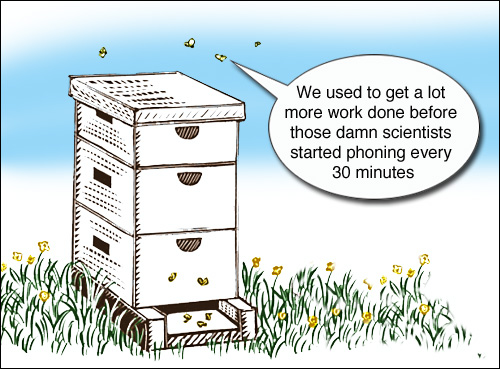
OMG! ACOWLYTES!! Mobile phones are KILLING OUR BEES! The FOOD CHAIN is going to COLLAPSE and we’re ALL GOING TO DIEEEEEEEE!!!!!!

What’s that you say? That’s not news? You already heard it ages ago? Ah, yes, Faithful Acowlytes, the hoary old idea that bee Colony Collapse Disorder is caused by radiation from the cellphone network has, of course, been reported, sensationalized and thoroughly found to be wanting years ago, but that doesn’t stop it from rising once more like a zombie hopped up on homeopathy to chew on the brains of the stupid. Twice today I came upon this story, once in my local newspaper and once via a Facebook posting. Both times, the ‘accredited’ source was this credulous gaping by Inhabitat reporter Lori Zimmer.:

More Scientific Studies Indicate That Cell Phones are Harming Bees

Scientists may have found the cause of the world’s sudden dwindling population of bees – and cell phones may be to blame. Research conducted in Lausanne, Switzerland has shown that the signal from cell phones not only confuses bees, but also may lead to their death

The original title of this article was It’s Official – Cell Phones are Killing Our Bees (as you can still see in the story’s URL) but the editors have evidently been kicked soundly in the bollocks and told that it’s not actually official at all, at least unless your interpretation of the word ‘official’ is ‘I pulled it out of my ass’.

The Daily Mail carried the story as Mobile Phones ARE to Blame for Killing off the World’s Bee Populations as is nicely preserved in the digital amber that is the remnant Google search link: ((Ah, don’t we LOVE teh intertubes, where stupidity and duplicitousness is forever preserved!))

Presumably someone gave them a good swift kick in the testicles as well, since they have now amended it to: Why a mobile phone ring may make bees buzz off: Insects infuriated by handset signals.

So, what does the ‘research conducted in Lausanne, Switzerland’ actually show? Well, you can read the full text of researcher Daniel Favre’s findings here, if you’re so inclined, but, as is my wont, I have done the legwork for you.

M. Favre and colleagues have conducted an experiment that suggests that bees don’t really like active cell phones being close to them. That is THE SUM TOTAL of what they have found. To synopsize, M. Favre showed that when mobile phones were place directly underneath bee hives (that is, within mere centimeters of the bees living environment), and the phones were dialled, the bees acted strangely. Now, while this is very interesting, it is hardly surprising. It has been demonstrated that honeybees are at least aware of magnetic fields ((Daniel Favre says in his report: ‘It is known that honeybees possess magnetite crystals in their fat body cells and that they present magnetic remanence. These magnetite structures are active parts of the magnetoreception system in honey- bees. Importantly, it has been shown that honeybees can be trained to respond to very small changes in the constant local geomagnetic field intensity.’)) so there is a likelihood that they are also affected to some extent by electromagnetic radiation. We already know that cell phones emit electromagnetic radiation ((including microwave heat to some extent)) (that’s why almost all cell phone manufacturers advise you not to hold them close to your ears for long periods of time), so an educated speculation says that having a strong EM field radiating at them from centimeters away may well annoy them at least a little. M. Favre’s experiment tends to confirm this. THAT’S ALL.

What Daniel Favre’s trials explicitly don’t show is that the cell phone network in general (including its broadcast towers) has any effect on bees, or that, even if it did, that such an effect has anything at all to do with bee Colony Collapse Disorder. Journalists just made that shit up because their brains go like this: ‘Bees… oooh… cell phones… ooooh… sciency stuff… ooooh… COLONY COLLAPSE DISORDER IS OFFICIAL!!!

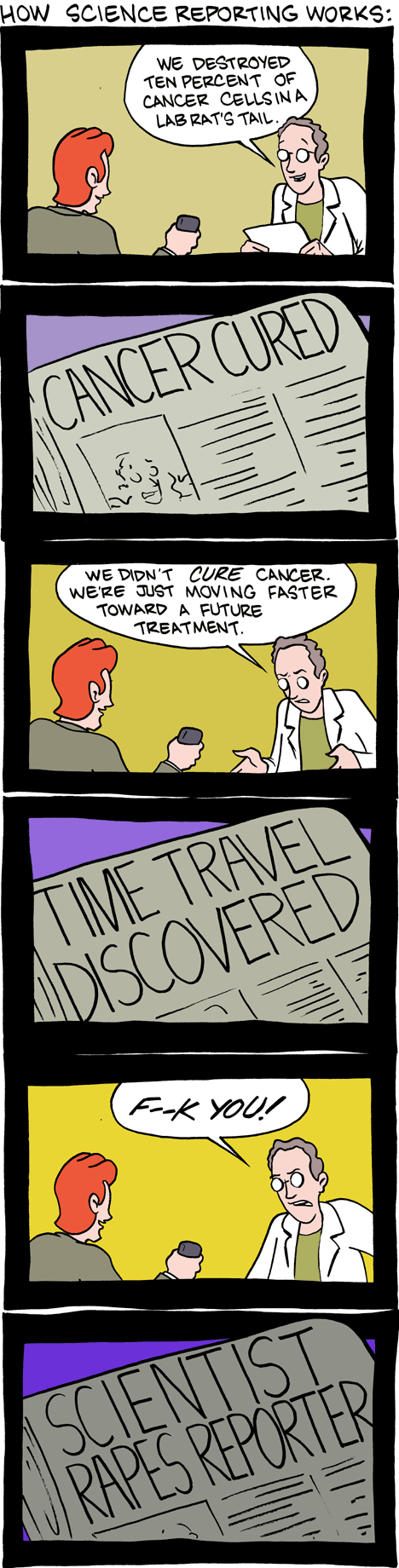
I don’t know who teaches journalists to think like this, but it is plain that it must be part of their training because so many of them do it. Here is a very funny cartoon from Zach Weiner’s Saturday Morning Breakfast Cereal that illustrates in pictures, a typical journalist-meets-science scenario: ((With thanks to Zach for generously allowing it to be linkable.))


But I digress. Back to the science…

Daniel Favre’s experiment is reasonably sound as far as I can tell – if the aim is to find out what bees do if you put a phone in their hive. His protocol seems reasonable, and his results appear to be methodically tabulated. Where he wanders a bit off track is his further hypothesizing, prompted, one has to speculate, by an already-formed agenda. In his own words (my emphasis):

“We should ask ourselves, whether the plethora of mobile phone masts also have an impact on the behaviour of the honeybees”

To which I reply: Sure, let’s ask away, and while we’re at it, let’s also ask whether they have an impact on kangaroos, pigeons and water buffalo. Questions don’t cost anything. But for the question to have any meaning at all in relation to the experiment at hand, M. Favre has first to show that what mobile phones do when they receive and transmit calls is in some way relevant to the kind of behaviour that cell phone transmitter masts exhibit. ((Speaking personally, I don’t have a clue. For all I know, cell phone towers work in an entirely different manner to the way my iPhone does when they send and receive signals. Daniel Favre cannot just make an assumption that the two things are equivalent. Furthermore, as a scientist it is irresponsible of him to allow that assumption to colour the experiment in question, especially when he is presenting it to untrained minds. If he intends to make a case for cell phone towers having an effect on bees, he must show that cell phone towers are having an effect on bees, not simply demonstrate that an affiliated piece of technology has an effect on bees. Science is like that – it has strict and unforgiving expectations of thoroughness.)) This being established, he would then need to demonstrate that the signals are actually strong enough to affect bees. ((It’s kind of curious that it seems that, given his expressed concerns, M. Favre has conducted his phone experiments in an environment that was not actually isolated from the cell phone towers (‘Beehives were located either in the beekeeping and apiary school of the city of Lausanne (altitude, 749 m) or in a second site used by beekeepers north of the city of Morges (altitude, 510 m; both locations in Switzerland’). If the nominal ground state for ‘normal’ bee activity is taken to be one in which cell towers are present, then, ipso facto, the cell towers are not having any significant effect…)) Having done that, his next step would be to show how such an effect is related to bee Colony Collapse Disorder, if at all.

Do you see how that works, Acowlytes? There is no reason at all to suspect that cell phone networks play any part in CCD. It is a speculation that was raised years ago as one of dozens of possibilities and has, for some reason, fired up the paranoid fantasies of the media and the brainless. For it to gain any ground at all, numerous pieces of a a puzzle must be locked together in such a way that they make sense. To put it another way, why cell phone radiation in particular? Why not rising C02 levels, increasing UV levels, increasing ambient noise, decreasing night-time sky visibility or any of a thousand other things?

Daniel Favre knows this. In his own words, again:

“Among other factors such as the varroa mite and pesticides, signals from mobile phones and masts could be contributing to the decline of honeybees around the world ; I am calling the international scientific community for more research in this field. ”

Once more, I’ve emphasized the points that you should attend. I think it’s pretty clear that M. Favre is in no way putting his conclusions forward as ‘official’. And what he doesn’t say, but should know if he’s doing research in this field, is, that among apiarists and scientists, pretty much every other speculated reason for CCD is considered more likely than cell phone signal radiation. In fact, it is beginning to appear that the number one contender for Colony Collapse Disorder is our love for convenience and the satisfaction of our cravings at a cheap price. In other words, the thing that is most likely killing off the bees is our creation of a vast honeybee monoculture. Hives are weakened by expedient farming practices and a lack of genetic diversity and so become highly susceptible to environmental stressors such as pathogens, pesticides and parasites. A recent USDA report says:

…based on an initial analysis of collected bee samples (CCD- and non-CCD affected), reports have noted the high number of viruses and other pathogens, pesticides, and parasites present in CCD colonies, and lower levels in non-CCD colonies. This work suggests that a combination of environmental stressors may set off a cascade of events and contribute to a colony where weakened worker bees are more susceptible to pests and pathogens.

So, while we may well be responsible for the collapse of the honeybee population (a population that we made unnaturally big in the first place) it’s not because we’re making phone calls. It’s just because we want something sweet and cheap for our toast at breakfast.

That, however, does not make for a much of a paranoia-inducing headline for the idiotic news media. And selling papers, is, after all, MUCH more important than giving people the facts.

« Previous PageNext Page »