In The News


Copyright Image Tetherd Cow Ahead

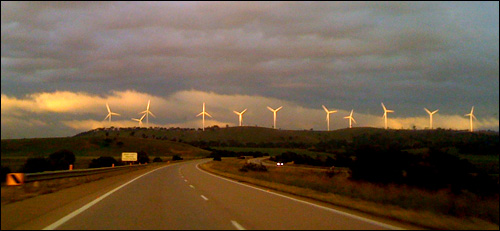
Acowlytes! Do you suffer from quivering? Nervousness? Fear? A compulsion to flee? Visual blurring? Panic? Nausea? Can you rule out having glimpsed Tony Abbott in budgie smugglers as the cause of these ailments? Then it is possible, dear friends, that you may have Wind Turbine Syndrome, or WTS. A more fitting acronym for this affliction would probably be WTF? but I digress.

Wind Turbine Syndrome is aligned with other forms of paranoia-induced woo such as EHS (electrical hypersensitivity) which evince a plethora of diffuse and non-specific symptoms ((Symptoms of electromagnetic radiation sickness are for example sleep disturbances, dizziness, heart palpitations, headache, blurry sight, swelling, nausea, a burning skin, vibrations, electrical currents in the body, pressure on the breast, cramps, high blood pressure and general unwell-being.”)) attributed to technology of which the sufferers (and their doctors) are afraid and/or ignorant (or just plain don’t like).

WTS is rather more irritating than EHS, though, because of its implementation in a political agenda. The story generally goes like this:

A land owner makes a deal with a power company to host (usually for a reasonably healthy figure) a bunch of wind turbines on a nice windy ridge on his/her property. Other people who are within visual distance of the turbines (and sometimes not even that) who are not making any money out of them, claim to have developed WTS. There is not one single case of WTS being developed by the franchisee of a wind farm operator. ((As far as my research has been able to determine, anyway. If anyone has heard of one I’d love to get a link.))

For reasons that are not at all clear to me, many country people seem to have taken against wind turbines with an amount of vitriol that is perplexing. Personally speaking, I think the lazy rotating blades are quite elegant and attractive, and the airy whooshing sound they make fairly inoffensive.

But WTS is not, of course, about common sense. It’s about political agendas, ignorance and NIMBYism.

You will recall that the first push by objectors to wind farms took the form of ‘Oh noes!! The horrible mincing blades are killing all the birds!’ This, from people who up till then had pretty much never even noticed the green speckled parrot or the golden-throated lark. ((Fictional birds because there are so many that are supposedly affected by wind turbines that you may as well say ‘any bird’)) Well, it turns out that on the list of things-that-birds-need-to-worry-about, wind farms are pretty damn far down, so, with these newly-adopted eco concerns of the anti-wind lobby not getting much traction, another bogeyman was needed to put the scare into folks. They found one with WTS. Deciding without evidence that something is, a priori, bad, and then finding multiple, disparate reasons to attempt to support your supposition, is, as you will all know by now, a glittering trademark of irrational thinking.

I was going to tell you next about exactly what it is that’s supposed to be the cause of WTS, but after reading pages of print about it, I’m finding that difficult. Mostly, though, the Big Bad is infrasound: sound frequencies that are so low they are literally inaudible to humans. Other sources claim that it’s ultrasound – high frequencies that are above the range of human hearing.

Dr Nina Pierpont, a New York paediatrician and self-styled expert on Wind Turbine Syndrome (she lays claim to coining the term) says:

…infrasonic to ultrasonic noise and vibrations emitted by wind turbines cause the symptoms

To be clear, she is saying that the problem is all the sound they make, from the highest part of the audio spectrum to the lowest. This kind of catch-all generalizing should immediately ring your woo-woo alarm bells.

In The Independent where the above quote originates, Dr Pierpont goes on to say that:

…the wind turbine companies constantly argue that the health problems are “imaginary, psychosomatic or malingering”. But she said their claims are “rubbish” and that medical evidence supports that the reported symptoms are real.

‘Rubbish’? That would be an effective scientific rebuttal if ever there was one. Professor Gary Wittert, the head of Medicine at the University of Adelaide, would be one person who would take exception to to Dr Pierpont’s claims that medical evidence supports WTS. Using data from the Australian Pharmaceutical Benefits Scheme, Professor Wittert has demonstrated that a sampled population of around 10,000 people living in the vicinity of wind farms in Victoria and South Australia shows no variation in quantities of usage of sleeping pills or cardiovascular medications from that which can be seen in the overall general population. Either people who live near wind farms aren’t seeking treatment for their WTS, or it doesn’t exist. This kind of data is, of course, exactly what would expect to see if WTS was a psychosomatic condition experienced by a small number of impressionable people rather than a discrete medical phenomenon in the community at large. Prof Wittert’s figures have still to be published and peer-reviewed, but we know that even when they are found to be solid (as they will be) the anti-wind farm campaigners will simply start crying that he’s a wind farm shill.
Copyright Image Tetherd Cow Ahead

Setting aside the statistical science for a moment, and wandering briefly into my own field of expertise, let’s consider that claim that infrasound is the cause of the WTS. First, there is no medical evidence at all to suggest that infrasound itself has detrimental impact on human health unless encountered at enormous levels – levels well in excess of what you’d find even directly underneath a wind turbine. When you know that low frequency sound can be detected in your bones, it’s the sort of thing that seems like it might be possible, but that’s about it – no-one has collected data on such speculations. ((It’s perfect territory for woo – a vaguely plausible mechanism that is ‘sciency-sounding’ enough to give it a sort of ersatz currency.)) So to prove that wind farms are producing infrasound that affects human health detrimentally, you need to do three separate things: show that wind turbines produce infrasound in the first place, demonstrate that infrasound has adverse effects on humans and then establish that the amount of infrasound coming from the turbines is sufficient to trigger those adverse effects. So far, the data accumulated for each of these scenarios is not at all promising for advocates of WTS.

Without even doing that, though, there is a much more persuasive argument against infrasound being harmful to humans. Let’s take a situation that arises in nature where large volumes of infrasound (and ultrasound and everything in between for that matter) are generated in a constant and repetitive manner, just as wind turbines are supposed to do…

Yes, that’s right – the sea. Crashing ocean waves create at least as much infrasound as a wind turbine, probably more by several orders of magnitude. And yet, living by the ocean has not been demonstrated by any science I’ve ever seen to cause people to exhibit any of the symptoms of WTS. On the contrary, the sound of the surf is considered, by anyone who is lucky enough to have a beach house, to be restful and relaxing. ((But God made the sea, right, so that’s OK.))

Another insidious aspect of the anti-wind farm lobby when it comes to WTS is their habit of attempting to align the wind power industry with the tobacco and asbestos industries. This is, of course, the cynical employment of the logical fallacy of Weak Analogy (mixed with a bit of conspiracy-theory style paranoia). In other words, they’re saying that because the tobacco industry and the asbestos industry claimed their products were causing no human health problems and were found to be engaged in coverups, then it follows that the wind power industry is doing the same. There is no logical equation that you can make between those two things – it’s nothing more than a semantic trick designed to befuddle sloppy thinkers. What will speak here, is the science, as it did in the cases of tobacco and asbestos. So, what’s the state of the science on the side of the WTS advocates? Not very persuasive at all. ((And, like all pushers of pseudoscience, when the science is not on their side they freely wheel out the anecdotal evidence, the testimonials and the conspiracy theories.))

Nina Pierpont, who is a vocal objector to wind farms, bases all her science on one small self-generated study (10 families who were already ‘diagnosed’ as having WTS), that was sloppy in protocol, was based on subjective self-reporting and was not controlled. It’s the kind of experiment that would get you a C- if you handed it in to your science teacher. In the UK, the NHS found that Dr Pierpont’s study:

…provides no conclusive evidence that wind turbines have an effect on health or are causing the set of symptoms described here as “wind turbine syndrome”. The study design was weak, the study was small and there was no comparison group.

In Australia, Sarah Laurie, an unregistered doctor and ‘Medical Director’ of the climate denialist affiliated Waubra Foundation is the chief ‘expert’ campaigner for people who supposedly have WTS. Laurie claims to have conducted research into the causes of WTS, but what she offers up is embarrassingly spare and scientifically awful. This article at Crikey examines Sarah Laurie’s claims and highlights an hysterical ‘Explicit Cautionary Notice’ from the Waubra Foundation that effectively challenges wind farm companies with a series of claims that are highly dubious. It is without doubt designed as a propaganda tool rather than as a document of sincere concern. The notice refers to Nina Pierpont’s study, incorrectly endorsing it as ‘peer reviewed’ which it was not. ((Well, not in the properly understood scientific sense of the term, anyway. Pierpont showed her results to some friends, and then published the positive things any of them said. This is the same kind of peer review that made me Scientist of the Year in 2011.)) It also raises the spectre of ‘Vibroacoustic Disease’, a malady which is contentious in the field of scientific medicine, and is certainly irrelevant when dealing with the sound levels generated by wind turbines. ((Vibroacoustic disease is associated with people who are subjected to extremely loud noise for extensive periods of time. Think military personnel on cargo aircraft, or engine-room workers on ships. Even so, pinning the problem on infrasound is speculative. These kinds of noisy environments are assaulting workers with exceptional levels of sound of all frequencies, and separating out infrasound as the culprit would take a specific kind of research that – to my knowledge – has never been undertaken.))

Now, I want to make it clear that I do believe it is quite likely that most sufferers of so-called WTS are experiencing the symptoms they claim. Based on a rational appraisal of the science we have, though, it’s just not reasonable to conclude that those symptoms have got anything at all to do with any mechanical effects of wind turbine operation. An extremely balanced examination, by commentator Dave Clarke, sets out the state of play in the WTS debate with amazing clarity. Clarke examines every facet of the WTS phenomenon in thoughtful detail. It is effectively distilled down into one simple sentence:

It seems that complaints regarding nearby wind farms, regarding illness or simply annoyance, are often related to negative feelings about the wind farms.

In other words, for reasons that are hard to determine (but are most likely to do with politics or NIMBYism), people who don’t want the wind farms near them get stressed enough about it to make themselves ill. That is all.

At the very least, this explanation must be unequivocally ruled out before the promoters of Wind Turbine Syndrome can even begin to make claims that wind turbine technology is, by some unknown mechanism, causing the illness, and that ‘Big Wind’ is conspiratorially endeavouring to make it look like it’s not.

[Many thanks to Dr Rachael Dunlop for some of the source materials for this post]

___________________________________________________________________________

With many many thanks to Atlas, who spends far too much time making me laugh.

___________________________________________________________________________

This just in:

The Sydney Morning Herald is carrying this story of a bikie ((That is a ‘biker’, to all you Yanks)) who has been charged by police with ‘recklessly dealing with the proceeds of a crime’ after they discovered over $3000 stuffed between his buttocks. It’s bum note for the poor chap who had obviously heard that there was money in crack and was acting on that information. Word on the street is that the 24 year old ‘Rebels’ member, although sitting on a small fortune, only ever paid bottom dollar for goods.

In the opinion of The Cow, this whole affair makes money laundering seem not only an appealing concept, but one that should be made compulsory.

The question that arises from this caper must surely be, however, that if there is a legal charge of ‘recklessly dealing with the proceeds of a crime’, there must logically be an acceptable method of dispersing your filthy lucre. I hereby provide some suggestions for what might be appropriate ways to spend money you’ve hidden up your ass:

• Put it in the plate at church

• Buy a gift for your granny

• Send it to Ugandan children

• Throw a cocaine party for enemy bikie gangs, and provide the dollar bills for snorting

• Do magic tricks for kids (‘Look – nothing up my trousers’)

• Buy goodies from the Tetherd Cow Shoppe (hey, we’re not fussy).

All further suggestions welcome.


I am genuinely curious about how human minds work. I am particularly curious about how religious minds work, because they seem to be able to quite easily hold multiple contradictions simultaneously, and not have a problem with doing so. Religious people frequently attempt to argue using ‘logic’ when they have, by accepting a completely illogical premise (ie, the existence of a supernatural being who cares about the affairs of humans), abandoned all structures of logic. Perplexingly, they seem completely unable to understand the paradox inherent in this pursuit.

Take this opinion piece penned by one Simon Smart for the Sydney Morning Herald over the weekend. You should really read it to get the full flavour of its absurdity, but I will synopsize it for those who don’t have the time.

Mr Smart attempts to hijack the old maxim that ‘The quickest way to a man’s heart is through his stomach’ and use it in the service of a religious argument. He is basically claiming that humans, unlike other animals, ((This, as many biologists will tell you, is not necessarily so. Some animals have acquired simple preparations methods when eating food. Japanese macaques, for instance, like to wash their food before eating it, and have even adopted a preferential habit of doing this in sea water (rather than river water), presumably because they like the seasoning taste.)) have rituals that surround food and this (somehow) means we are chosen by God. Or something. I’m sorry if I sound confused – it’s because I am.

Of course humans have complicated rituals involving food. We have complicated rituals involving everything. We have complicated rituals involving killing one another – is that God’s handiwork too? It’s banal to observe that humans do things that are different to other animals, and to infer that there’s something ‘miraculous’ about this is simply an awkward manifestation of 19th century thinking.

I have to snip a quote from Mr Smart’s daft noodling:

Imagine for a moment a dinner party of old friends. There’s a scientific way of analysing all that transpires at this dinner – plenty that the biochemists, anatomists, physiologists and neuroscientists could describe – regarding chemical processes of the body and brain that are astonishing in their complexity and intricacy.

But such a description wouldn’t even come close to telling us what’s going on. One guest can’t quite manage to lose the acidic feeling in his stomach as he tries and fails to forget the precarious state of his business. Another diner, perennially proud of her successes, feels an even warmer glow of satisfaction than those drinking the bottle of Grange she came armed with. The host, enlivened by the wine, smiles at his wife across the table and thinks how much he still loves her after all these years. Another, at the first mouthful of her favourite dessert, is lost in thought as she nostalgically recalls her childhood family kitchen.

You see what he did there? It’s a familiar piecer of religious prestidigitation – a classic strawman argument. He sets up science as a cartoon bespectacled-people-in-labcoats caricature (the hoary old ‘science is cold and clinical and concerned only with mechanical things’ cliché) and then conjures up a whole lot of things that he says science can’t explain because… well, it just can’t. He divides the world (quite arbitrarily) into things that he considers are the domain of science and things that he considers aren’t, just as we saw biologist Francisco Ayala do a little while back. Also familiar is the call to emotion, which he continues in the next sentence:

Is this interaction of memory and emotion to be thought of as singularly physical and material in nature?

Um, sure, why not? All Mr Smart is doing here is drawing an arbitrary line that removes memory and emotion from the world of the ‘physical and material’ because he’s not comfortable with that idea, and he’s appealing to his reader on the same basis. Scientific examination does not know or care about this kind of discomfort which is precisely why it’s so reliable. We know with absolute certainty that memory and emotion can be altered and controlled by physical processes, and these things can be demonstrated scientifically. Mr Smart is either ignorant of the scientific explorations of these things, or is wilfully ignoring them. Either way it makes his opinion valueless.

Smart goes on to perpetuate another vacuous stereotype, referring to Philosopher Leon Kass’s ‘The Hungry Soul’:

Kass suggests there is a huge gap between the ethically sterile nature as it is studied by science and the morally freighted, passionate life lived by human beings.

It makes me really mad. Examining the world through science is, in Simon Smart’s painting of it, ‘ethically sterile’ and by inference, morally vacant and lacking passion. This, of course, is not an accurate representation of the truth, but instead is a bogeyman that religious thinkers are compelled to raise in order to reserve the domain of morality and ethics for religion. Whenever I encounter this argument these days I almost find it embarrassing for the person promoting it. It is perpetuated solely with the purpose of cementing it in the minds of less rigorous thinkers.

Mr Smart ends his article with a story about his daughter returning from hospital after a burst appendix and three operations:

She was frail and pale, and we immediately set about building her strength. As a family we ate together, cheered her recovery, took photos and gave thanks for doctors, nurses and supportive friends. It was a special moment, a coming back to life. It felt almost sacred. Or was that, as some would have it, just my brain chemistry messing with my head?

How many addled misconceptions are contained in that tale? Who engineered that ‘coming back to life’? Scientists! A process that was once the ‘domain of God’ – the mysterious, ineffable ‘miracle’ of life and death – is now commonly administered by rational thinkers. The fact that Simon Smart and his family even knew how to go about building their daughter’s strength is due to science. If they’d trusted that whole process to God, no matter how much fervent praying they did, I think we could quite reasonably conclude that their daughter would most likely now be dead.

Simon Smart has quite obviously allowed his brain to accept that science can acceptably achieve some ‘miracles’ (no doubt rationalizing the circumstances by allowing that God is in charge anyway) but arbitrarily forbidding it from others.

He resists the idea that brain chemistry ‘messes with his head’ because it simply doesn’t ‘feel’ right to him. He says elsewhere that:

…most of us resist being spoken of in such reductionist terms.

The fact is that the universe doesn’t care how much we ‘resist’ the idea. ((The argument via reductionism is problematic anyway. We already know that complex systems can arise from very simple sets of basic circumstances, so reductionism per se is not the QED that religions like to assert. To invoke particular ‘specialness’ in humans because they exhibit a high level of complexity requires the continual re-drawing of boundaries. As our description of living organisms becomes more detailed, religious appraisal of what constitutes this specialness is forced to make more and more compromises just to preserve God’s input. We see exactly the same thing in cosmology.))This specialness that he thinks he has – a specialness that somehow elevates him above all other living things – is purely an invention of human thought processes (and peculiarly antiquated thought processes at that, as I have said). There is nothing that we see in the natural world that gives credence to this belief other than the human conviction that it is so. Mr Smart doesn’t want to think of himself as a mess of chemical and electrical interactions for the simple reason that he’s already formed the opinion that he isn’t. And that’s all it is: an opinion. The position is certainly not defensible via observation or rational appraisal.

Simon Smart is completely entitled to have an opinion, of course, but I just wish he wouldn’t attempt to pass his superstitious speculations off in the guise of logical argument, while simultaneously denying logic the right to examine those very same speculations. ((Mr Smart needs to spend some time reading (and making an effort to understand) beautifully written and coherent essays such as this one.))

The crazy Christmas holidays can be, well, crazy, and we all know that sometimes the little details can easily get overlooked in the midst of the mad festive rush. On Boxing Day just passed, Australian retailer Myer overlooked a little detail that they undoubtedly really wish they hadn’t, since it got a lot of mirth-mileage in the Twittersphere and the Webiverse.

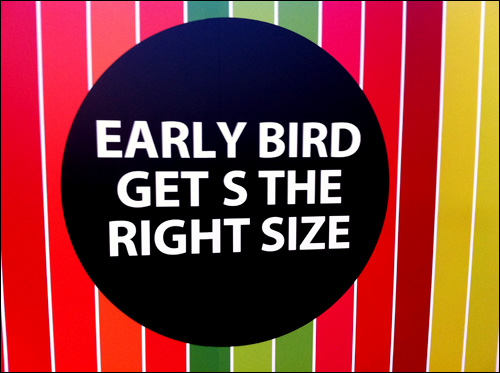
It seems that someone (a someone who is probably beginning their new year queuing for an unemployment cheque) inadvertently thought to add an apostrophe in the wrong place in the Myer New Year Sales’ slogan: ‘The early bird get’s the right size’.

Oh deary me.

Leaving aside for a moment the fact that it’s an atrocious slogan to begin with, and the copywriter probably deserves a place in Hell for that alone, WHAT THE CRAP WERE THEY THINKING? That’s such a random apostrophe that I don’t believe anyone on the planet could be so dumb as to think ‘gets’ needs it. For fuck’s sake WHY??? It’s so bizarre in fact that I’m inclined to think that someone with evil intentions purposely sneaked it in there just to see how far along the production chain it could go before it was noticed. And travel far it did, merrily whistling its way past the ad team creative directors, the designers, the Myer client and the printers, finally declaring its cheeky presence in seven-storey high banners throughout the Myer chain. You can see an example here on the Sydney Morning Herald site.

Em. Barrass. Ing.

The best part is, though, that having printed however many hundreds or thousands of posters and banners with the cringeworthy blunder, Myer were obliged to rectify it or look like even greater dunderheads. The signs now look like this:

Management obviously felt that the mistake didn’t warrant the expense of reprinting, so the band-aid solution was almost literally that – a black swatch of tape on every instance of the pesky punctuation point.

This leads to the almost greater crime of an ungainly kerned word in the slogan. In other words, an offence of grammar is being repealed at the expense of a crime against typography. The signs are still up everywhere and every time I see one it makes me chuckle with schadenfreude.

I was in Myer a few days ago, attempting to exchange a box of drinking glasses which had one piece missing. As I was standing at the counter, waiting to be served, the saleswoman – who was plainly aware of my presence – just wandered away somewhere without so much as a word of explanation and didn’t come back. I waited for five minutes. Another customer queued behind me.

‘Is anyone serving you?’ she asked.

‘Well, there was someone,’ I said, ‘but she disappeared somewhere over there.’

We waited for another few minutes. Finally, the woman dumped her goods on the counter.

‘And they wonder why we shop online,’ she said, leaving.

Right on sister.

I hung around for a bit longer but eventually thought, fuck it, I’ll just go get another box myself. I took the old box out of my bag and put a new, complete box in, and headed off. A security guard was not ten feet away.

The moral to this story is:

Little stroke’s fell great oak’s.

This is Kim Jong-un, the new Political and Military Leader of North Korea.

Here, he is pictured riding a horse which he has just tamed, having roped it in the wild using a lasso which he fashioned from his own hair. Kim Jong-un has been hailed by Korean officials as ‘the genius among the geniuses’ in military strategy, and no wonder after all his accomplishments! At the age of 16, he wrote his first thesis on military matters after studying for months on end with only 3 hours sleep per night. During this time he lived solely on poached pigeon eggs and tepid water in order to ‘sharpen his mind’ and maintain his manly physique. Even now, he rarely strays from a strict diet of pan-fried crickets and Weetbix, attributing his ‘svelte good looks’ to the regime.

Whilst still a teenager, Kim astounded physicists by inventing String Theory (which he says came to him ‘while doing Sudoku on the bus’) and solving the Riemann hypothesis. He turned down the Nobel Prize in Physics of that year due to a lack of shelf space.

‘It’s not like he doesn’t already have a couple of those,’ said a government spokesman.

The next few years saw him dabbling in movie directing, with The Dark Knight, Pirates of the Caribbean and Kung Fu Panda among his biggest successes. Sadly, American prejudice and jealousy saw his name removed from his films, which were attributed to lesser US directors.

Not to be daunted, Kim Jong-un refocussed his efforts on world health, personally developing cures for malaria, tuberculosis and cancer, maladies which, as a result, have been all but eradicated from North Korea. Even though he has now assumed political control of the country, the Great Leader is still often seen walking the countryside in his trademark â‚©50 sandals, administering vaccinations to the needy. He sometimes journeys five hundred miles on foot in a single day on these charitable quests.

Unfortunately the pressures of state mean that Kim will now have to limit his activities as a critical systems analyst and solid propellent expert in the Korean Space Program. It looks also as if his political duties might have some slight impact on his work in advanced neuroscience.

One thing he’s not likely to give up, though, is his martial arts training. His black belts in Tae Kwon Do, Judo, Karate and Jiu-Jitsu are the envy of all Korea, and it is said that his dedication to these pursuits is the only reason he curtailed his ambition to be the first North Korean on the moon.

His reputation as a lady’s man and his accomplishments in international espionage have earned him the nickname ‘The North Korean 007’, and his 3 Michelin Star eatery ‘Cheonsanju’ continues to hold its reputation as the best restaurant in the Universe.

Well, that’s the official version, anyway.


« Previous PageNext Page »