In The News


Good morning Faithful Acowlytes! I hope you got plenty of restful sleep last night because today you’ll need to have your wits about you as we start off with a quiz. This is the kind of quiz where I show you two images and you have to spot the differences between them. I’m sure you’ve done one of those before. OK, are you ready? Here we go then:

No? Look very very carefully. Still nothing? Hahaha! I apologize dear friends – I’ve tricked you with this one because image #1 is a teapot and image #2 is ALSO a teapot! In fact the only tiny difference between them is that the first one is a Royal Doulton, and the second one is a royal dolt.

Generally I try to refrain from picking on Royalty ((Well, except for King Willy of course – but he’s such good sport.)) here on The Cow because, well, it’s a bit too much like shooting fish in a barrel. I mean, it’s not their fault, really, is it? All those centuries of inbreeding does tend to take its toll. Luckily, most Royals are safely out of harm’s way for the most part, but sadly it doesn’t stop them from opening their mouths and gabbing when they have an audience.

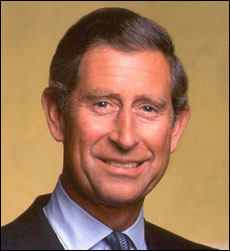
If you know anything about the Prince of Wales you will be aware that he’s not a stranger to elliptical thinking. He has campaigned on behalf of homeopathy, freaked out about GM technology and now, in his latest escapade, blamed Galileo and science for the ills of the modern world.

In a presentation last week to the Oxford Centre for Islamic Studies, Prince Charles places culpability for all our climate problems on ‘mechanistic thinking’ which ‘goes back at least to Galileo’s assertion that there is nothing in nature but quantity and motion’. The prince thinks that the reason for our current environmental difficulties is because the Western world is having a ‘deep, inner crisis of the soul’.

This is a banal piece of reasoning that is as antiquated as the concept of the Royal Family itself. The Prince of Wales pulls one of the classic tricks of the religiously-inclined of equating a quest for knowledge with an abrogation of moral responsibility. In other words, science equals heartless amoral exploitation; religion ((The Prince doesn’t specifically campaign for religion as such, but it’s the same kind of thinking – the mention of ‘souls’ and the faux surprise when he says that he finds it ‘baffling that so many scientists profess a faith in God yet this has little bearing on the ‘damaging’ way science is used to exploit the natural world’ all mixes in to his diffuse religious view of how things work.)) equals warm and fuzzy caring and sharing. Even a schoolkid can see the stupidity inherent in this simplistic notion.

Prince Charles’ view of science as ‘cold and mechanistic’ is one that is beloved of science detractors and shows no understanding at all of scientists or scientific pursuit. Additionally, the Prince is either willful or stupid by ignoring (in favour of its perceived ills) the extraordinary benefits so obviously brought to us by science. How about the science that gave us the cure for smallpox, Your Highness? Or the science that has allowed millions of people access to clean water and nutritious food? How about the good deeds of the scientists who figured out how to clone insulin so that diabetics can have affordable treatment? How about the wonderful achievements of science that let us talk to our friends and family wherever they may be on the planet, at any time of the day or night? Or the science that allows us to make great adventures inwards to our consciousness and outward to the cosmos?

Like many of the purveyors of woo, the Prince of Wales wants it both ways; he eschews science because it is ‘evil’, but is quite happy to enjoy the countless improvements it brings to our lives. He blames science for our creating our ‘materialistic culture’ and for the ‘damaging way it is used to exploit the world’, yet offers no practical alternatives – just notions of vague, superficial, wistful magical thinking.

He advocates a world without science and without individual material aspirations. ((For the peasants, at any rate.))He pines for a world with a folky agrarian culture where superstitious thinking rules.

It’s not surprising in the end. Royalty has always done very well in such climates.


Yes, I know I’ve talked about it several times already, but this time it’s serious.

‘Cyber sickness’ warning ahead of 3D revolution’ screams the headline. Again, you will not be at all surprised to learn that it’s from the Melbourne Age.

Up to 10 per cent of people who watch 3D images on television, at the movies or while gaming suffer ”cyber sickness” symptoms such as blurred vision, nausea and dizziness, health experts have warned.

Those experts! If it wasn’t for them, the world would be a much cheerier place. But wait! It’s WORSE THAN YOU THINK:

But they say the number of people affected by cyber sickness could rise to unknown proportions with the advent of the 3D TV era…

Did you hear that? UNKNOWN PROPORTIONS! It could be a veritable cyber-sickness pandemic. Forget getting immunised for swine flu – if these experts are right we’ll all be taking major doses of stereoids to fend off the 3DTs.

The article gushes breathlessly onward:

Virtual reality pioneer Mark Pesce, an honorary lecturer at the University of Sydney, said the majority of occasional 3D viewers would love the experience, but he warned that the health effects of heavy use of 3D media – which trick the eye by changing the depth perception of a person’s vision – had not been tested.

Um… actually, that’s not how 3D works at all – there is no ‘tricking the eye by changing depth perception’ Mr… who wrote this damned thing… let’s just scroll back up to the by-line… oh, WHAT a surprise. It’s Stephen Cauchi, King of the the Non-News at the wheel again. Geez. Have they hired this guy specifically to reduce the Age’s credibility or something? ((I swear I’m not witch-hunting this guy. I literally did what I just wrote – I was reading the article and thought ‘Man this is terrible!’, looked at the byline…)) Anyway, to continue, 3D works by exploiting the effect of stereopsis which is the natural way we achieve depth perception. What Mr Cauchi just said is word fluff. It is completely free of actual meaning.

Like last post’s Government Weather Control article that we saw from Mr Cauchi, as the story continues the sensible people start to appear, and we find Victorian Eye and Ear Hospital ophthalmologist Lionel Kowal saying that the number of people who reported problems with 3D is ‘probably closer to 5 per cent than 10 per cent.’ Then, we hear from Kathryn Rose, an associate professor in orthoptics at the University of Sydney, who thinks that ‘about 3 per cent of the population would not be able to watch 3D TV’.

3 percent? 3 percent? Do I hear 2 percent? 2 percent over in the back? 1.5 percent? Can I get a 1?

The article ends with a quote from Newcastle University neurobiologis Alan Brichta:

‘Right now we don’t have all the information but my gut feeling says [cyber sickness] is not going to be a major issue.’

Are you with me here in this insanity, dear Acowlytes? We’ve gone from an epidemic of ‘cyber sickness’ of UNKNOWN PROPORTIONS to ‘er.. actually, not a major issue…’ in the space of one information-free waffle fest.

Like the Government Weather Control story, I propose this whole air-headed notion could have been summed up in one short sentence:

A tiny minority of people might find 3D media a little unsettling but most people won’t.

Again, short on pizazz, but it’s exactly the same content and it would have saved precious digital bits for something that was actually worth calling NEWS.


Anomalous Radar Activity Around Melbourne

I just love it when event transpire such that I can bring you two of my favourite subjects in one Tetherd Cow Ahead post. Today’s is such a post and it’s brought to you by the Melbourne Age which is carrying an article that combines the stupidity of the newspaper business with the beliefs of a loony. It runs under the headline ‘Weather has conspiracy theorists strung out’

INEXPLICABLY odd images ((Why, why, why do reporters continue to use this kind of language? The images are ENTIRELY explicable in any number of ways. They are ONLY inexplicable in the mind of Colin Andrews. Stephen Cauchi, you are an IDIOT.)) on Bureau of Meteorology radar. Cyclones off the Australian coast and the most intense storm to hit Melbourne in living memory. A controversial US military facility in Alaska suspected of research into weather control … It sounds like the plot of a sci-fi conspiracy thriller.

Yes, there’s no quibbling there – that’s exactly what that hodge-podge of unrelated factoids sounds like (although I’d be inclined to add the word ‘bad’ just before ‘sci-fi’). So the implication here is that it’s going to turn out to be The Truth, right, as opposed to the fiction of a ‘sci-fi conspiracy thriller’? Well, you’d be totally wrong if you were thinking that.

The story goes on to detail the following points:

•The Bureau of Meteorology radar has been recording ‘a number of very strange patterns – rings, loops, starbursts’ around Melbourne.

•There have been some big storms here.

•The High Frequency Active Auroral Research Program (HAARP) facility in Alaska has powerful transmitters and radars.

From this, the correspondent spins up a vacuous story that says in essence that websites ‘specializing in pseudoscience’ have ‘leapt on the notion’ that the three things above are connected and the ‘government’ is trying to control the weather.

Is anybody else feeling the need to stick their head in a bucket of ammonia?

To simplify: this is a story which is actually just a free plug for the nutty ideas of lunatics, while all the while pretending to ‘news’ by distancing itself from aforementioned lunatics. And, to put the icing on the cake, the story is embellished with an image of the recent SpaceX Falcon 9 launch, which has exactly NO relevance to anything at all.

As I’m reading this, I find myself thinking ‘Who the hell is responsible for this guff and how do they get to be working on a news desk?’ So I scroll up to the byline. It will probably come as no surprise to you at all to find that the literary genius behind this story is none other than reporter Stephen Cauchi, who has provided us with much mirth previously here on The Cow with his non-news style of journalism.

Which brings me to the second of my favourite Tetherd Cow subjects – insane people. Mr Cauchi’s main source for the above-mentioned conspiracy turns out to be someone who is very familiar to anyone who’s spent time around the pseudoscience traps – a fellow who goes by the name of Colin Andrews. Now, just to set you up, Mr Andrews has about ZERO credibility as any kind of authoritative source. In fact, if you were actually trying to find a less credible spokesperson (for anything except nutty ideas I guess) you’d have your work cut out for you.

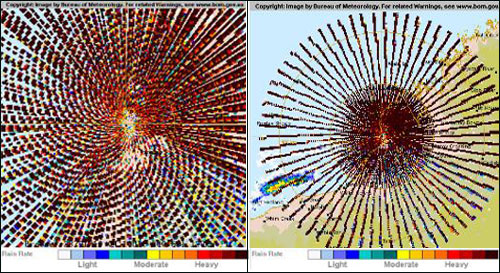
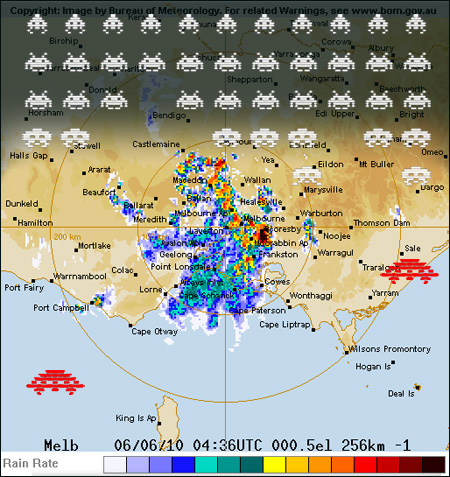
Colin Andrews first came to prominence as an ‘expert’ on crop circles back in the 1980s, and contrary to all common sense, still believes that they are made by ‘aliens’. Since that time, he has advanced all manner of implausible conspiracies across numerous disciplines. In this case, Mr Andrews’ ‘government weather control’ paranoia centers on some ‘anomalous’ radar screen captures from earlier this year when the south coast of Australia suffered some unusually fierce storm activity. This is a couple of them:

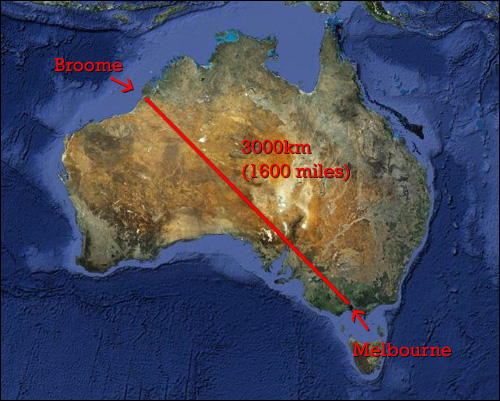
Well, yeah, sure, these ones are from the Bureau of Meteorology radar in Broome in Western Australia, but close enough, right?

These are the ‘inexplicably’ odd radar images to which Mr Cauchi refers in his first paragraph. Rather than conclude (as might any rational person) that the radar images are simply quite explicable as imperfections in the way that a meteorological radar functions, Mr Andrews’ brain oscillates to the most wildly improbably alternative – that the images are some kind of government weather control experiment that has been cunningly contrived to appear like a radar imperfection.

Mr Andrews persists in this belief even when told as much from someone who works for the Bureau of Meteorology:

Re: The round radar prob in WA, it is a BOM Radar unit which has its lower rain level threshold setup too low, ie, too sensitive, which gives the noisy radar reading like that. Nothing to do with HAARP, which, as you know, is in Alaska. I see images like this a lot, as I work for the Bureau of Meteorology in QLD.

And you know what? You too can see images like this on Australian meteorological radars if you feel like clicking on every radar station that the BOM offers. If you think like Mr Andrews, you’re likely to find a LOT of government hanky panky. It’s a wonder the government has any time for actual governing.

After giving plenty of airing to Colin Andrews’ hair-brained ideas, the Age article goes on to seek opinions from authoritative skeptics, who quite reasonably call the idea ‘silly’. We could have started with that conclusion and made the whole story one sentence long, viz:

We asked a sensible person, Mr Tim Mendham (president of the Australian Skeptics), what he thought of noted loony Colin Andrews’ idea that the government is controlling the weather, and he said it was silly.

I guess that doesn’t make for ‘pizazz’ but the content is exactly the same as the story as it stands.

Anyhoo, after a lot of stupid waffle, the article rounds off with:

The Sunday Age tried to contact Mr Andrews, who is based in the US, but there was no reply. That could be because, according to his website, he was in Oregon for last weekend’s 11th annual UFO Festival.

Smirk smirk smirk. Well if that’s your attitude Mr ‘cynical’ Stephen Cauchi, why are you making this nitwit’s ideas out to have any credence at all?

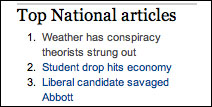
It makes me feel quite nauseous to note that this was No. 1 on the ‘most read’ list of Top National Articles in The Age today.


Well done Melbourne Age! Another pin on the board for the Great De-Braining of the Human Race. ((Or, one optimistically hopes, another nail in the coffin of the old news media.))

UPDATE: At the time I wrote this yesterday, there were no comments on the article. Now there are 19. After reading them I actually feel like walking over to the train line near my house and throwing myself in front of the 10:15 to Flinders St Station. WHY WAS I BORN INTO A WORLD WITH THIS MUCH STUPID?!

The comments are now closed and the one I left was evidently deemed unsuitable for inclusion – evidently it made a little too much sense.


Sometimes the minds of really bright people can think really dumb thoughts.

Francisco J. Ayala is an evolutionary biologist of quite some expertise, a critic of creationism and intelligent design, and an active petitioner for the advancement of stem cell research in the US and throughout the world. And yet, as he reveals in his post on the Guardian blog this week, ‘Religion has nothing to do with science – and vice versa’ his accomplishments as a scientist don’t stop him from having bewildering thought processes.

The basic thrust of his piece is that science has no business occupying itself with the domain supposedly reserved for religion (and vice versa, but as we shall see in a bit, that’s nothing more than a sop to the unthinking). That is, science should butt out of matters of good and evil, right and wrong, purpose or none. It takes him about three paragraphs to reveal that he’s playing with a marked deck.

The scope of science is the world of nature: the reality that is observed, directly or indirectly, by our senses. Science advances explanations about the natural world, explanations that are accepted or rejected by observation and experiment.

Outside the world of nature, however, science has no authority, no statements to make, no business whatsoever taking one position or another. Science has nothing decisive to say about values, whether economic, aesthetic or moral; nothing to say about the meaning of life or its purpose.

Did you see the card go up his sleeve? He has simultaneously put religion outside our natural world and forbidden science from that domain. In other words, science can’t know the Mind of God, because.

It’s such a breathtaking piece of religious bias that I almost stopped reading right there.

What he’s advancing is in fact the very foundation of the concept of religion: give up (for reasons that cannot be expressed in any rational manner) everything you know and can demonstrate to be true, in preference to concepts that you (or other people, usually) suppose might be. That’s called ‘Faith’ and it goes by another name too: ‘Magic’. Ayala simply cannot make a claim like that and retain any level of credibility. If you allow that as a piece of valid reasoning, you allow ANYTHING to be possible. And I’m willing to wager a large amount of cash that Ayala doesn’t believe that huge numbers of Americans are being abducted by aliens, or that Xenu is going to come to Earth and smite us all, or that a little green man lives in the peyote plant or any number of other equally preposterous ideas. Yet, by his argument he has no choice but to believe them all because they are ALL outside his allowance for the realm of science!

The above quote also carries with it the implicit endorsement that religion does have something decisive to say about economic, aesthetic or moral values, and about the meaning of life and its purpose. That’s plainly hogwash. Which religion? Says what? For every one thing that a religion says, a contradiction can be found in another. Religions can’t even make up their minds internally about what they think about many things. Religions say stuff about all these things that’s for sure, but whether what they say is valuable, or ‘decisive’, or even worth paying attention to, is a highly questionable conjecture.

Further on he takes the words of Richard Dawkins and bends them to his already-decided will:

The biologist Richard Dawkins explicitly denies design, purpose and values.

In River out of Eden, he writes:

“The universe that we observe has precisely the properties we should expect if there is, at bottom, no design, no purpose, no evil and no good, nothing but blind, pitiless indifference.”

Dammit – did you see that? He palmed another ace!

Firstly, Dawkins is talking here about the mechanics of the Universe, as Ayala must surely understand. Dawkins does not say that we should expect to find no purpose or evil or good or blind pitiless indifference in humans. Dawkins is saying that there is no reason to suppose that those things are inherent in the Universe, and that this is in fact exactly what we see. ((Why isn’t Ayala arguing that point? Because as an evolutionary biologist, he knows he can’t win. ‘God’ – at least no kind of God that cares a hoot about us – is not apparent in the natural workings of the Universe.)) Ayala’s argument is based on a religious misrepresentation of scientific thinking, and, as a scientist, he should jolly-well know better.

Let’s see if Ayala is dealing anything else from the bottom of the deck. He goes on to conjure the spirit of William Provine, noted evolutionist and atheist:

William Provine, a historian of science, asserts that there are no absolute principles of any sort. He believes modern science directly implies that there are no inherent moral or ethical laws, no absolute guiding principles for human society.

There is a monumental contradiction in these assertions. If its commitment to naturalism does not allow science to derive values, meaning or purposes from scientific knowledge, it surely does not allow it, either, to deny their existence.

Zip! Now that’s a hand that’d get you shot in a saloon game of poker!

Let’s just clarify things a little. Ayala is making an explicit statement here that there are two kinds of worlds in which we live: the natural world (which is defined by science) and the supernatural ((I’m using the word in its most literal sense here: ‘of, pertaining to, or being above or beyond what is natural’)) world which is out of the reach of science. Because science can make observations about the natural world such that there appears to be no inherent meaning, morality or purpose, it has, therefore, no right to deny the existence of such things.

What total corn syrup! Science has every right in the world to put up a case for the non-existence of these things! Let me re-write that sentence slightly to make it clear why it’s so incongruous:

‘Because science can make observations about the natural world such that there appear to be no inherent reasons to believe in pixies or unicorns or fairies, it has, therefore, no right to deny the existence of such things.’

This idea of putting such abstract concepts as ‘meaning’, ‘purpose’ or ‘morality’ outside of nature is just religious sleight of hand. Who says that should be so, and by what criteria? Ayala begins by drawing up rules that suit his argument and then criticizes science for not playing by them!

It’s a bit of a straw man, in any case. He’s attempting to distract us from a much more pertinent point: the fact that science finds no ‘natural’ morality does not imply that a social morality is not possible (it clearly is) and most importantly, it certainly does not automatically stamp an imprimatur on religion to take that role. In fact, I would argue that a great deal of our current social morality is held in place not by religion, but by the social constructs we’ve developed under cultures that hold largely scientific world-views. We don’t, for example, find mobs of atheists going around behaving amorally (as much as I’m sure a lot of religious people think that is what happens), primarily because people like me who don’t hold with religion can actually maintain good moral lives without it, believe it or not.

Religious thinkers just love to believe that it is religion that holds our morality in check and stops the world from spinning into unmitigated and wanton chaos, but if they buy into that notion they must necessarily buy into a paradoxical uber-belief: it doesn’t matter what kind of religious belief you hold, as long as it’s a religious belief. ((Or, perhaps more accurately: ‘It doesn’t matter what kind of religious belief you hold, as long as it’s MY religious belief’.)) This is plainly a ridiculous and indefensible stance. For a start, there are plenty of religions that adhere to questionable morals. ((The majority of them, I would contest.))

I’ve attacked the versa part of Ayala’s essay first because I think by doing so it casts illumination on another piece of his prestidigitation. Let’s look at the ‘Religion has nothing to do with science’ part. Here, Ayala invokes Augustine, the emperor who rearranged Christian religion because it didn’t really suit his taste:

As he [Augustine] writes in his commentary on Genesis:

“If it happens that the authority of sacred Scripture is set in opposition to clear and certain reasoning, this must mean that the person who interprets Scripture does not understand it correctly.”

Is anyone else rolling on the floor laughing?

Again, let me clarify: If anything that makes sense appears to be in conflict with the Scripture, then that’s because the Scripture isn’t being properly interpreted. It can’t possibly be that the Scripture is nonsense! ((There are so many things wrong with this reasoning that I can’t begin to enumerate them all. The Bible, for example, makes explicit statements about the natural world. By Augustine’s reasoning, if any of these statements are thrown up against convincing scientific refutation, then there must be some interpretive error – it’s NOT an error of Scripture. What an astonishing ‘get-out-of-jail-free-card’ that is! In this way, the Bible can be eternally revised to fit with the way the natural world is shown indisputably to be and always remain correct! How can the rigorous process of science even begin to compete with such absurdity?))

It baffles me that a smart person can even indulge in such poppycock. From the start, it makes a ridiculous presupposition that the Scripture, like Ayala’s conditions for religion itself, lies outside nature – particularly outside human nature. How can a person with scientific training possibly believe that?

Ayala now throws a bone to the wolves in allowing that religion has nothing definitive ((Anyone else notice that card go to the bottom of the deck? ‘Definitive’ is a slippery term, especially in the light of Ayala’s other slipperiness. ‘Definitive’ allows that religion can have all kinds of things to say about the realm of science if it likes – just not ‘definitive’ things.)) to say about the ‘precincts of science’:

Religion has nothing definitive to say about these natural processes: nothing about the causes of tsunamis or earthquakes or why volcanic eruptions occur, or why there are droughts that ruin farmers’ crops. The explanation of these processes belongs to science. It is a categorical mistake to seek their explanation in religious beliefs or sacred texts.

It’s a banal dismissal of superstitious thinking of the gross kind. Of course we know that God can’t be blamed for earthquakes and eclipses and droughts and plagues of locusts. The only people who believe that kind of thing are the same ones who believe that God sits outside the realm of nature and can accomplish miracles!

Ow.

No matter how he might frame his argument, Ayala does not care about balance. He is concerned only with propaganda. Like all religious people he is scared that the truth is frightening and ugly and something he doesn’t want to hear, and that if science turns its sights on ‘matters of Scripture’ it might reveal, not that the Scripture is being interpreted incorrectly, but, as it has done time and time again, that the Scripture is wrong.

Ayala is only paying lip service to science, and to justify his already formed beliefs (Ayala is a former Dominican Priest) he seems compelled to attempt to somehow shoehorn science into the religious framework of a worldview that was formed half a millennium ago. His version of science is, for an evolutionary biologist, a puzzlingly simplistic mechanical one. It’s a science that doesn’t ask hard questions. It’s a science that obligingly looks the other way when religion walks into the room. It’s a convenient kind of science.

As we all know, though, science doesn’t care about convenience. Science doesn’t care how we think the world should be, or how we wish it was. It just shows us how it is. The way I see it is that we have two choices – we either side with science, look bravely on the Universe and be awed and humbled by our ignorance, or we cower behind our fingers with religion and make pretend everything will be OK. Either way, the world itself does not change.

Y’know, as much as I’m critical of the woo-mongers mixing it up with what they perceive to be ‘science’, I’m afraid that sometimes it’s the scientists themselves that need a good fresh mackerel to the side of the head.

Take this article Chaos Makes a Scream Sound Real, from ScienceNews.

To be fair, it’s not just the scientists. There’s a combination of factors that contribute to the diffuse, nutty quality of this piece, and it’s one that you find frequently in science journalism: a scientific concept that doesn’t immediately appear to be anything remotely worth reporting to a general audience, and a journalist’s desire (or job requirement) to try and spice it up into something that does.

I’ll try and paraphrase the whole idea for you, since I can’t be entirely sure what this is exactly about from reading either the Science News article or the abstract of the paper at Biology Letters, where it was published under the title Do film soundtracks contain nonlinear analogues to influence emotion? ((And I’m not about to fork out for the full article – people still aren’t getting this stuff. Listen to me Biology Letters editors: religious fundamentalists of all persuasions make their stuff available to all and sundry for nothing. THEY ARE YOUR COMPETITION! Get with the 21st Century already!))

Some scientists studying vertebrate communication observed that:

A variety of vertebrates produce nonlinear vocalizations when they are under duress. By their very nature, vocalizations containing nonlinearities may sound harsh and are somewhat unpredictable; observations that are consistent with them being particularly evocative to those hearing them.

What they’re basically saying is that jarring, loud or sudden sounds have a noticeable impression on an animal hearing them.

Yup.

They go on to hypothesize that maybe this is the case for humans too, and that filmmakers use that trick in films.

Yup.

To this end, they analyzed a bunch of films and found that there are more jarring and sudden sounds in horror films, although some appear in action films and a few appear in drama. ((Without even doing an experiment I can tell you that there would be close to none in comedies and romances.))

Yup.

Then they sum up their hypothesis with:

Together, our results suggest that film-makers manipulate sounds to create nonlinear analogues in order to manipulate our emotional responses.

(Translate that to: ‘Film-makers use different kinds of changing sounds for emotional effect’)

Er… Yup.

Now, I don’t suppose that this was likely to be an experiment that cost oodles of money, but whatever they spent on it was WAY too much, because they could simply have emailed me and I would have told them all that for free.

The Science News reporter makes a futile attempt to spin this up into something more than what I just told you, by stirring in some references to Chaos Theory (wtf?) and getting a quote about ‘crying babies’ from a cognitive biologist who was not even involved in the study (‘Screams are basically chaos!‘). She then tags the piece with an entirely irrelevant factoid about how Hitchcock’s The Birds contains sounds that were electronically generated ((I’m not even sure I understand what the point of including it is – that electronic sounds are more jarring/chaotic/annoying than natural sounds? Again, wtf? It’s not true, and it’s immaterial in this context anyway!)) and signs off with the following knowledgeable-sounding quip:

…capturing a realistic, blood-curdling cry is so difficult that filmmakers have used the very same one, now found on many websites, in more than 200 movies. Known as the Wilhelm scream it is named for the character who first unleashed it in the 1953 western The Charge at Feather River.

Well, someone has been pwned here and I’m not sure who. Either the reporter hasn’t done her homework, or she thinks that no-one will notice this risible flub. The Wilhelm scream is used in a lot of movies, not because of its terrifying blood-curdling quality, but because it’s so utterly lame that it has become a game among sound editors to see if they can sneak it in skillfully enough to let the director keep it in the final sound mix.

What’s more, it’s even extremely well known for that reason as even a very cursory search will reveal. Here’s a (VERY old) YouTube compilation of appearances of the Wilhelm scream.

You’ll have noticed that many of the above clips are from the George Lucas/Steven Spielberg stable, and that’s because sound design guru Ben Burtt is responsible for ‘resurrecting’ the Wilhelm scream in Star Wars and the fun challenge of trying to get it into mixes arose among sound editors who worked with Burtt (and with some of whom I’ve worked myself, so I know of what I speak).

I’m all for the concept of popularizing science, but this kind of writing doesn’t really help anyone. It’s painting a hazy and inaccurate picture for a lay audience, can easily be demonstrated to be factually sloppy and, worst of all in my book, because of the two preceding transgressions, casts a sickly glow over the effectiveness of all other science reporting. Science can’t, and shouldn’t be, reported in the same way as entertainment. Science is interesting for what it is, and if you’re a science reporter and can’t find an appropriately absorbing way of working with the actual facts at hand for a story, you should leave it alone and go on to something else. ((Another disappointing consequence of this phenomenon is that the bad story gets picked up, often completely uncritically, by other popular science outlets. In this case I note that it appears in Wired Science who should totally know better.))


‘Single mum fleeced of $8700 through Nigerian eBay scam.’

So screams the headline in this story from The Melbourne Age this morning, the exclamation mark surely struck off only minutes before it went to press.

When I started reading the article I had sympathy for the ‘single mum’ in question – apparently she’d been attempting to sell a PlayStation on eBay when she fell for a scam involving ‘paying for the shipping costs’ of the Nigerian buyer. Well, sure, to you and me even the very word ‘Nigerian’, when associated with the internet and monetary transactions, starts ringing alarm bells, but hey, not everyone out there in intertubes land is a savvy geek, right?

Those Nigerian bastards picking on our dinkum single mums! Why, I oughta…!

However, reading on, and picking out the threads of actual story from the sob story, I found my sympathy waning somewhat as the details emerged. It turns out that our poor single mum did in fact become suspicious of the transaction at some stage and contacted Consumer Protection, who told her in no uncertain terms to stop dealing with the fraudsters. She made her first major mistake at that point by completely disregarding the Consumer Protection advice and sending the Nigerians a copy of the email containing it.

Upon forwarding this email to the scammers, she then received fake emails back from them featuring WA ScamNet and WA government logos, which advised her to co-operate with Nigerian authorities.

The hoax escalated when the woman received a phony eBay email saying the case had been reported to Nigerian Police who then emailed her to say that the fraudster had been arrested.

Later, the fake police email told her that the courts and president of Nigeria had awarded her compensation amounting to $US250,000 ($278,000).

Aha. Now even the dimmest of us is stuffing cotton balls in his ears to drown out the clanging sound. It doesn’t take much to predict the next step. In order for our poor battling mum to get this $US250,000 she was asked to send the ‘Nigerian Government’ a ‘bank transfer fee’ of $US7000 so that the money could be ‘released’ to her.

I don’t know about you, but I just can’t see myself sending off a cool $7k to someone in Nigeria who I don’t know – someone whom I’ve never even heard of – on a promise, even if they do have a nice Nigerian Government letterhead. ((The matter of the SEVEN THOUSAND DOLLAR bank fee notwithstanding. It’s no wonder the Nigerians need money if their banks are screwing them that bad!)) But that’s exactly what Ms Single Mum went ahead and did. I think it’s reasonable to assume that she didn’t just have a spare $7k lying around the house, so she plainly went to some effort to round up the money. WHAT WAS SHE THINKING?! Well, I guess that was actually a rhetorical question – what she was thinking was ‘Jesus, Mary and Joseph! I’m gonna be RICH on Nigerian money!!!’ ((Even though I don’t want to seem to be endorsing these Nigerian scamsters, you really have to admire how they’re evolving. Now that they realise that everyone is onto their scam they’re turning the scam itself into a scam. ‘The Nigerian government is SO distressed at all the problems caused by these terrible terrible scammers that we really want to give you money to compensate you!’))

Apparently, once the situation became plain she told Consumer Protection staff she felt ‘violated’ by the scam, but I suggest that what she really felt violated by was the realization that her own greed had gotten her into deep shit. People! I’ve said it before, I’ll say it again – if something on the internet (or anywhere) seems too good to be true, it probably is!

The real flub here, though, must fall in the laps of the press (again). What is it with the ‘victim’ story here? Who the fuck cares if the woman in question is a ‘single mum’ and what does it have to do with anything AT ALL? I guess a headline that says ‘Gullible & Greedy Aussie Woman Keeps Nigerian Scammers in Clover’ doesn’t tug the heartstrings quite as poignantly. The lesson for us all is surely not simply caveat emptor but is also writ clear in the wisdom of the great Lao-Tzu:

There is no greater calamity than lavish desire.
There is no greater curse than discontentment.
And there is no greater disaster than greed.

« Previous PageNext Page »