In The News


Acowlyte Ed points me to this late breaking news from India which I just know you all need to know.

It appears that traffic police in Nagpur have decided that the best way to deal with road accident black spots is to install 30 centimeter tall pyramids by the roadside in order to disperse ‘negative energies’. Cos’ everyone knows that’s what causes car accidents right? Bad vibes. ((It could have NOTHING to do with the huge number of untrained Indian drivers, the atrocious roads or the lax law enforcement – factors that contribute to the deaths of more than 114,000 people in India every year…))

The brains behind this scheme is one Sushil Fatehpuria, an ‘expert’ in Vastu, a kind of Indian feng shui. “I will energise the pyramids,” he says,“I will transfer my positive thoughts into the pyramids.” Mr Fatehpuria has (quite surprisingly, considering) offered his services free of charge.


I can see the reasoning behind Mr Fatehpuria’s idea – how many car accidents did the Ancient Egyptians have? Yeah – find fault with that logic if you can!

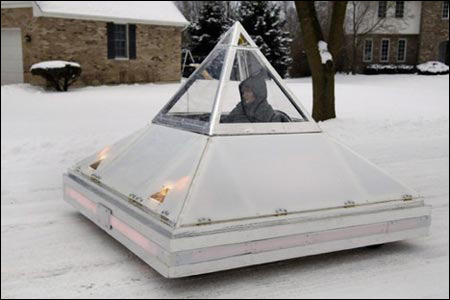
Personally, though, I think that Mr Fatehpuria is not really making a big enough commitment. Why not campaign for the the introduction of pyramid-shaped cars such as the one above featured on Geekologie? ((You should go visit Geekologie – they are cool dudes.)) Surely these cars would be completely accident proof!!!! And why stop at piddly little 30cm pyramids? What about putting in some really big motherfuckers – that’s unquestionably going to have a much greater effect! I’m sure there are some statistics to show the dramatic reduction in car accidents in Cairo and Las Vegas!

Of course it is conceivable that pyramid power works on some kind of homeopathic principle, meaning that the smaller the pyramid is the more effective its powers. In which case, Mr Fatehpuria is wasting his money with those whopping huge 30cm behemoths.

Damn. This new-fangled science is SO confusing!

(Quite coincidentally, while I was writing this, a documentary came on the History channel about pyramids. The basic gist of it was that the Ancient Egyptians couldn’t possibly have built the pyramids with the technology they had to hand, and the purpose of these huge stone monoliths was to generate microwave power via hydrogen ((I didn’t quite follow that bit…)) to communicate with aliens. I have three observations to make:

1. This is not HISTORY.

2. I’m scared that because it’s on the HISTORY channel, some people think it is.

3. There is a lot of stuff on the HISTORY channel that is like this…)

This just in from NASA:

On August 1st, almost the entire Earth-facing side of the sun erupted in a tumult of activity. There was a C3-class solar flare, a solar tsunami, multiple filaments of magnetism lifting off the stellar surface, large-scale shaking of the solar corona, radio bursts, a coronal mass ejection and more.

The solar flare has spawned a coronal mass ejection heading in Earth’s direction due to hit about the time you read this. Everybody duck.


What is is with techy people when they come across robots? It seems that a machine merely has to bat a servo-driven eyelid for normally sane, balanced geeks to completely drop their brains on the floor.

Take this recent article over at the usually-sensible Engadget.

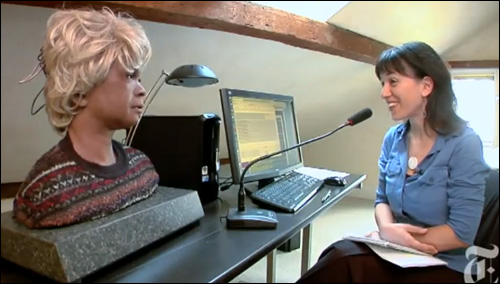
The photo you see above is of Bina48, one of the most advanced humanoid robots around. Bina48 resides at the Terasem Movement Foundation in Bristol, Vermont, and while she doesn’t exactly excel at conversation, she’s far more coherent than many we’ve spied… her existence and nearly constant evolution is pretty impressive and we’re going to keep our eye on her as we move toward the future.

In case you couldn’t figure it out, Bina is the one on the left. I know, I know, the astonishing human likeness makes it tricky to pick the robot from the New York Times reporter, but you’ll have to take my word for it. The spastic wobbling head on a plinth is in fact a machine.

Engadget’s acknowledgement that Bina ‘doesn’t exactly excel at conversation’ is somewhat of an understatement. The New York Times reporter attempted to ‘interview’ Bina and the effect is less of a conversation than something like an attempt to interpret the ravings of a simpleton on peyote.

I encourage you to watch the video of the interview now, to experience the full effect of Bina’s striking humanness.

I fail to see how this is in any way more impressive than the numerous other ‘realistic’ robots we’ve examined previously on The Cow. Engadget really needs to get out more. Perhaps on a date with Aiko or Roxxxy, who, even if not as ‘anatomically correct’ as their makers would have everyone believe, at least have bodies.

The New York Times reporter starts out bravely with Bina, but realises in two sentences that she’s been sent out on one of those stories that has little salvaging.

“Hi Bina,” she says, cheerily.

“Er… so where were we?” asks Bina, like a junkie being roused from an opium dream.

“I’m Amy. I’m a reporter,” says the NYT girl, with the sinking feeling that she’d have been better off doing the kitten-stuck-up-a-tree story.

“There is probably more to you than just that,” interrupts Bina, with a sneer. ((Seriously – we are SO attuned to facial gestures that, in my opinion, it’s way better to just forget them than to take the risk that they will be inappropriate. Watch someone closely next time you have a conversation, and see how much of the intent is carried by facial movement. You may be surprised.))

Poor Amy cuts her losses by having the story go to a voiceover:

I had lofty goals for my interview with the Bina48 robot. I imagined me, the intrepid New York Times correspondent, communing on camera with a new kind of intelligent silicon species.

Yes, dear Amy, and I bet that’s just how your editor sold it to you. Well, you’ve learned your lesson about robots haven’t you? You could have saved yourself a lot of grief if you’d been a constant reader of The Cow. We’ve covered all this in depth on numerous occasions.

Amy persists, to her detriment. She asks Bina several times if she’s ready for a conversation while the robot wobbles its badly-wigged head around, doing an uncanny impression of Parkinson’s patient trying to get out of a straight jacket. It finally decides on the well-worn AI strategy of rephrasing the question, which Amy takes as an affirmation.

“Cool!” says Amy.

“Ambiguous,” replies Bina, in an astonishingly embarrassing 1950s ‘does-not-compute’ kind of way. “Cold weather or cold sickness?”

Oh dear. That’s a big fat ‘F’ for you on the Turing Test, Bina. ((Lesson Number 2: Make sure your robot knows the difference between literalness and colloquialism. My first question to a being who I suspected of masquerading as a human would be something like ‘How’s it hangin’ dawg?’))

After an hour of ‘exhausting’ rapport with Bina, Amy calls it quits. Bina has lolled her head around, ((Maybe if they programmed her to drool? It would complement the overall effect, that’s for sure.)) interrupted the conversation with baffling observations, misinterpreted questions, and advanced her ‘opinions’ on artificial intelligence in a completely unconvincing manner, all the while effectively demonstrating that she is anything BUT intelligent. Eventually, she attempts to explain her poor performance away on ‘having a bad software day’.

“You know how that is,” she pleads. ((The programmers are obviously going for wit here, but succeed only in bathos.)) NO WE DON’T, Bina. We are humans. We don’t have ‘bad software’ days. ((That excuse is going to go down really well when the first robot babysitter to drown someone’s child in the bath tries to blame it on ‘a bad software day’.))

As I see it, every day is a bad software day for Bina. I’m perplexed when things like this get wheeled out time and time again as evidence of how the robotic future is just over the horizon. Bina is really nothing more that a mechanical appendage of software routines that have been around for decades. There are a few ‘physical’ additions (Such as Bina’s attempts to smile which are so creepy that I think makers of horror movies would do well to take notes) but all in all Bina is no more impressive than Fake Captain Kirk or Eliza. Obviously Engadget has a very different idea to me of what the future with robots ought to be like.

___________________________________________________________________________

Thanks to Atlas for providing more robot-spotting fun.

___________________________________________________________________________

In the United States of America, around 30 kilograms (66lb) of beef is eaten per capita every year. ((According to the Guardian article linked here. A search around the web mostly gives numbers higher than that.)) That’s over 9 million metric tons of cow meat. ((Or more than 10 million ‘short’, or US, tons.))

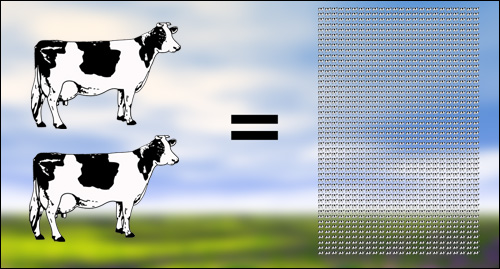
That’s a lot of cows. And a lot of cows take up a lot of space and use up a lot of feed. The Guardian reports this morning that Professor Richard Gradwohl of Washington state has come up with a solution to this problem by spearheading a drive for miniature cattle. Gradwohl’s farm boasts 18 breeds of miniature cows, including ‘microminiature’ varieties that stand just over a meter (one yard) tall. He claims that 10 miniature cows can be raised on the same amount of land as two full size cows, using just one third the feed and producing half the amount of methane. Sheer genius. Not only that, the tinier the cow, the better it tastes, according to the Guardian article.

Of course, here at the Tetherd Cow Ahead laboratories, the boffins were quick to see the potential of this scheme. “Why stop at merely ‘miniature’ cows?” asked the Head Boffin, “Surely if you make the cows even smaller you can make even greater savings and get even tastier beef!”

That’s why he earns the big bucks! To this end, I have set the laboratories to work creating the first nano cows. By my calculations, using the savings in feedstock and land that Gradwhol’s reductions in size have achieved, the shrinking of cows to nanoscale should mean that a million cows could fit on one square centimeter of farmland and would only need a blade of grass per year. On the five acre pasture that Gradwohl uses to raise ten mini cows, TCA Labs can raise trillions of cows, producing a billionth of the methane of conventional cows and yielding enough beef for one thousand billion billion McDonalds’ all-beef patties every month. ((Quoted statistics may or may not be entirely accurate – strange things happen at subatomic levels.))

I also have the labs investigating what happens when the miniaturization process ‘goes homeopathic’ (as we say in the science business). What this means is that once the cattle are shrunk past a certain size, Gilbert Einstein’s famous equation E=M¾ kicks in and the cows become ethereal. The beef yield simultaneously becomes infinite. Needless to say, the taste of flame-grilled steaks also improves immeasurably via this process.

Here in the Land of Shoo!TAG, I don’t see how I can possibly fail to get some investment interest.

This extraordinary creature is a Benthic Holothurian. It was photographed swimming in the waters above the mid-Atlantic Ridge where scientists have discovered ten possible new species of marine life.

See more beautiful pictures by David Shale on The Guardian site, and marvel at the mysteries of our beautiful planet.

___________________________________________________________________________

Photograph: David Shale/University of Aberdeen/PA. Used respectfully without permission in the interests of promoting science.

___________________________________________________________________________

You will remember that a little while back we learned that Rupert Murdoch, using his needle-sharp insight into how people use the internet, stumbled on the notion that it would be a good idea to start charging visitors to read the online version of his flagship newspaper The Times. Consequently, the last month has seen The Times subscription gateway come into operation and readers have been asked to sign up (without paying) before they can get access to stories on The Times site. Here’s a graph that reflects the status of readership figures for various online UK newspapers since April.
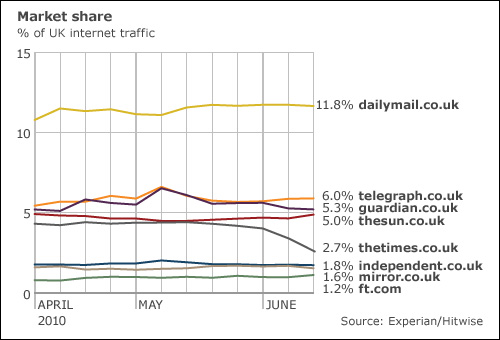
Notice anything? And need I point out that this graph reflects only the sign-up process – no money has so far changed hands. Now, to my eye that looks like The Times online has lost nearly half its readers in a month. And the curve doesn’t look like it’s intending to taper off anytime soon, and that’s before we get to the point of actual money being forked out. ((Quite interestingly, the curve visibly trends downwards well before the subscription requirement kicked in. I surmise that this indicates people started abandoning the Times pretty much as soon as they heard that it was going to start charging money. If I was head honcho, I would have taken this as an extremely worrying omen.))

Rory Cellan-Jones, on his blog at the BBC, has speculated that The Times really only has to hang on to about 5% of its former readership ‘to have the champagne corks popping in Wapping’. I predict that the readership will fall right through that number and bottom out at nearly zero. Rory puts his finger right on it in his post:

My suspicion is that the main problem with this experiment is what I’d call friction. Web users have got used to clicking simply from one page to another without hindrance. Any element of friction – the aggravation of having to pay or just log in – acts as an incentive to head elsewhere in a hurry. I tried an experiment this morning, posting a link on Twitter to an article by the very funny Times columnist Caitlin Moran. Plenty of people clicked on the link – but when they were taken directly to the Times pay-station, they all appear to have left without paying.

To anyone who’s been looking at web media for any length of time, this is truly a no-brainer. Why would you bother? Rupert is pinning all his hopes on one single idea: that people care enough about the quality of the journalism (and whatever else The Times has to offer) to pay for it. ((It also breaks one of the most important pieces of functionality of the web, and very few of the Old Guard understand this because it is such an alien concept to them: the ability to cross-link. Anyone who writes a blog (or anything written specifically for online diffusion) understands automatically how powerful a utility this is. The web is a ‘web’ because it builds itself on connectivity. If I want to write something on Tetherd Cow I can easily bolster my story with examples, references and asides that anyone can check instantly. But there’s NO WAY I can do that with the Times any longer. If I cross-linked to an article in the Times, my readers would simply behave as those in Cellan_Jones experiment, above. Murdoch’s idea is fundamentally destructive to the very foundations of the internet. Where we see the awesome power of the building up of information structures, he wants to create cloistered communities that he can control. This, in my opinion, is what will ruin him. He does not grok the net.))

Rupert, I’m sorry to say that the 21st Century is going to give you a bigger ass-walloping than you ever thought possible.

Let me explain it in a way that even Mr Murdoch might understand. Are you sitting comfortably? Very well, let’s begin.

Once upon a time, when horses and buggies were the fastest forms of transport and people cleaned chimneys by crawling up them with big brooms, accounts of what was happening in ‘the world’ started to get circulated via a system called ‘the newspaper‘. The newspaper gathered up a collection of what its publishers deemed the most relevant and interesting bits of news and gossip of the moment, and then distributed them to the community. The newspaper was a marvellous idea for its time, but, for all its charm and utility it did have some limitations: it was largely a local phenomenon, it cost money to make and deliver to the people who wanted it, and it had a kind of inbuilt time delay (if news happened, you had to wait till the next newspaper was made in order to know about it). But because it was a physical object, and it was a convenient way of learning about the latest goings-on in the world, people were prepared to pay some small amount of money to take possession of their daily newspaper. Plus, you could wrap fish & chips in it when you’d finished reading it. (It also had another limitation, but one that few people were aware of at the time: it was a one way street. That is, the newspaper could tell you things, but you could not reply to those things, nor enquire after their veracity.)

Eventually, after a few decades of news distribution of this form, a few cunning people realised that if they could gain control of the newspaper business on a large enough scale, they could earn themselves quite a bit of money. And so newspaper tycoons came into existence. The object of being a newspaper tycoon was to gather up as many small local newspapers as you could find, and either put them out of business, or amalgamate them into your empire. This concept made a small number of crafty men (for they were ALL men) very wealthy indeed. It had the added bonus, for those men, of giving them extraordinary political power, because after all, they controlled what people knew about the world. This state of affairs existed for the better part of a century, with the newspapers becoming more and more ubiquitous and the newspaper men more and more wealthy and more and more powerful.

But then, late in the 20th century, a completely unexpected thing happened – a wonderful piece of technology called ‘the internet‘ came along. The internet was really nothing more than a way in which everyone on the planet could easily and instantly talk to everybody else, no matter how geographically separated they were. It was a simple but powerful idea. And the more people who understood this idea, the more powerful it became. Before anybody really even knew what was happening the internet became connected to all kinds of places across the whole world, and people happily discovered that news and gossip and all kinds of other information could now be exchanged rapidly and for free. People liked that! And the internet was unlike the newspaper in one very important way: nobody ‘owned’ it and nobody could own it. ((You can bet your humidified Havana cigar that there are those who, if they’d known how it was going to turn out, would have moved heaven and earth to have gained control of it…))

So who do you think were the most unhappy about this state of affairs? That’s right – the newspaper tycoons. They were VERY VERY upset, indeed. People were talking to each other and learning about their world for free! What a terrible, terrible thing!

Thanks to their innate carnivorous business instincts, though, the tycoons became aware very rapidly that this ‘internet’ was something quite big and important, and they could see that people had taken to it like ducks to water. Unfortunately they could only see this through spectacles that had little dollar signs embossed all across the lenses, and so their vision was not very clear. The first thing they did was to nab themselves some real estate on this internet thingy. After all, it was FREE, what did they have to lose? Of course, the people who were already on the internet were happy to see their old friends from the newspaper business there and started visiting these new sites from the old guard – but they didn’t just hang out at one newspaper… oh no! They were now reading six or seven or maybe even ten newspapers, and not just newspapers from their home town either! And not only that, they were getting news from sites that weren’t actually newspaper sites but had news anyway, like blogs and ezines and social networks and all manner of other strange ideas! All for free!

The newspaper tycoons weren’t used to the concept of ‘free’. It was not something that was in their world view. When they said the word ‘free’, as they sometimes did, they meant ‘we’re giving you a nice little morsel but it has a hook hidden inside it’. The concept of ‘free’ as in ‘you can get it with no strings attached’ was as alien to the newspaper tycoons as was the idea of travelling economy class, so they looked upon what was happening on the Internet with a great deal of bewilderment and frustration. All these people were here doing stuff and hanging around but the tycoons couldn’t figure out a way to make money from it! How they hated that! How dare people amuse themselves!

So instead of making some kind of effort to understand what was going on with the Internet, as some of their cleverer and less mercenary colleagues did, the tycoons contrived to do the least effective thing possible: they attempted to make the Internet play by their Old Rules. Unfortunately, the people using the internet could see immediately that the Old Rules really suited no-one except the tycoons. The only option open to the tycoons now was to try and make their Old Way look more enticing than all the New Things the Internet was offering. They did this mostly by telling everyone how TERRIBLE the New Way was and how much BETTER the Old Way was. They said this loudly and often.

‘If you continue to get your news for free,’ they cried ‘You’ll only get TERRIBLE quality news. WE are the keepers of GOOD quality news!’

Unfortunately, the people using the internet already knew that this was a stupid and desperate tactic. They knew that not only was the news from the New internet way just as good (and sometimes even better) than the Old newspaper way, but that the Old newspaper way gave them TERRIBLE quality news as often as not too!

In spite of this obvious failing, the tycoons quite idiotically convinced themselves their argument was good enough to charge money for their Old News, just like they used to do when the world was all nice and simple, before smoking tobacco caused cancer and when it was perfectly acceptable to feast on endangered species of quail and unsustainable caviar stocks. And so they said to the Internet people:

‘Now we want you to PAY for our Old Ideas, even though we have made exactly NO CONTRIBUTION to this new way of doing things…’

Well, we’ll have to leave our story there for the moment, because the last words have not quite been written. I suggest that ‘Happily ever after’ is not on the cards for those old newspaper tycoons, though. They are facing the end of their dynasty and they stand, as emperors have often done, bewildered in the empty halls of their palaces while the revolutionaries hammer at the gates.

Will Rupert get his 5% faithful? Will the champagne corks be popping in Wapping? Will the line on that graph level out before it hits sea level? Six months is about what I think it will take to give us the ending to this story.
« Previous PageNext Page »