Hokum


It's an Omen!

Recently over at Nurse Myra’s Gimcrack Hospital, we had cause to discuss the ‘curse’ on the 1976 movie The Omen, starring Gregory Peck & Lee Remick. Numerous movies are affected by such ‘curses’ (Rosemary’s Baby, The Exorcist, Poltergeist and The Crow to name but a few) and it will come as no surprise to you, dear Acowlytes, that about such matters I am highly skeptical. So, as I promised Nurse Myra, today I’m donning my Tsk Tsk Tsk Hat and taking a look at the Omen Curse through my acid-tinted glasses.

Nurse Myra’s jumping off point was an article that appeared in the Sunday Herald that features the point of view of the designer of The Omen, John Richardson, who paints a grim picture of the bad luck surrounding the making of the film.

You can read the Herald’s picturesque account if you want to get the full flavour, but it would take me pages to go into detail, so I’m just going to bullet point the gist of it:

    •1: John Richardson and his assistant on the film, Liz Moore were in an horrific car accident in Holland, in which Moore was killed.

    •2: Afterwards, Richardson claims that he realised the accident bore uncanny similarities to a death in The Omen, in which actor David Warner is decapitated.

    •3: Richardson also saw a road sign at the site of the accident that indicated it was 66.6 miles from the Dutch city of Ommen.

    •4: Gregory Peck’s son killed himself two months before the film commenced shooting.

    •5: When Peck set off for London to start on his role, his plane was struck by lightning over the Atlantic Ocean.

    •6: A plane carrying Omen Executive Producer Mace Neufeld was struck by lightning a few weeks later.

    •7: The hotel where Neufeld was staying in London was bombed by the IRA, as was a restaurant where the some of the cast and crew were due to dine on November 12.

    •8: Stuntman Alf Joint was injured when a stunt when wrong.

The article goes on to describe how “everyone involved in the production was freaked out to some extent. They all felt that something wasn’t quite right and that included the cast.”

Well, there we have it. The scariest thing in the whole report is the grammar in that last sentence. ((Although I have been on a number of films where we all felt the cast wasn’t quite right, so perhaps that’s what they really meant.))

Even just bullet-pointing the ‘best evidence’ for a curse, rather than using the highly coloured language of the article, throws a sobering light on the collected anecdotes. For the sake of pedantry, though, let’s cast the Cow Eye of Rationality over them and see what we can determine:

    •1: From the get-go we’re on shaky ground. The credit list for The Omen reveals that John Richardson was not a designer, as the Herald writer tells us, but is instead listed on the IMDB under Special Effects – an entirely different department. A small point perhaps, but a very good example of how misinformation propagates in these kinds of urban legends. The car accident in question actually happened almost a year after Richardson finished on The Omen, while he was working on A Bridge Too Far. Since Liz Moore is not credited on either film, we must raise an eyebrow on her actual credentials for being ‘cursed’ at all. Is it enough to merely work with someone who has been involved with a cursed film, to bring the curse down on yourself? That would certainly increase the potential victim pool by a substantial order of magnitude.

    And even if Moore did work on the film, why did the curse indiscriminately pick on an assistant, rather than go for a head of department? Was it afraid of a fight or something? ((Some reports say Moore was Richardson’s girlfriend, but I haven’te been able to substantiate this. It would make sense.))

    •2: Moore’s injuries were identical a to death depicted in the movie, so the legend goes – specifically the untimely end of David Warner’s character, Jennings, who is decapitated by a sliding sheet of glass. Gruesome, for sure, but heck – don’t people know what kind of things happen in car accidents? Vehicle fatalities are one of the most frequent types of non-natural death in the industrial world and decapitation in such situations is certainly not uncommon. And I would be most surprised to find that the victim’s head was severed as cleanly and bloodlessly as that of Jennings in the film (call me skeptical). So what we’re noting is this: while Richardson was working on A Bridge Too Far, a year after he had completed The Omen, an assistant of his, who we can’t actually be sure had even worked on either film, was horribly killed in a car accident, suffering terrible injuries. Um. So how is it that A Bridge Too Far is not cursed? And anyway far from being the victim of a terrible fate, John Richardson is surely lucky to have survived such an awful tragedy!

    •3: Richardson says he noted a road sign that indicated the accident happened 66.6 miles from Ommen. Are you detecting a whiff of over-embroidery here, Astute Acowlytes? Distances in Holland are marked in tenths of a mile? With decimal points on the road signs? I’m prepared to be corrected, but I’d find it highly unusual if this is the case. I suspect that if we drilled down into this factoid we’d find that the accident happened ‘about’ sixty-something miles from Ommen, and the 6.6 has somehow crept into the tale for ‘neatness’.

    •4: Gregory Peck’s son committed suicide before the film commenced shooting. This happened two months prior to the shoot. Is the curse prescient as well as omniscient? How far before the shoot would the suicide have been acceptably not the work of a curse? How far after? Are all relatives and friends of all the cast and crew susceptible to a filmic curse, with a two month window on either side of a probably 18 month production timescale? Crikey – given the numbers of folk who work on a film, does it strike anyone that it would be incredible for an accident or death not to happen to any of several thousand people over a two year period?

    (I’m also prepared to bet that Peck’s son’s suicide didn’t just, like, happen out of the blue. Suicide usually occurs in profoundly unhappy individuals after some deliberation. Indeed, here we learn that:

    He (Jonathan Peck) had serious health problems (most of them heart-related), a recent breakup with a girlfriend, and suffocating work conditions (he was working for a local news station which expected him to come up with a certain amount of footage per day, whether there was any news, or not). On top of all this, he had to live up to being the son of Gregory Peck (and here, his astonishing resemblance might have indeed been a drawback). He left no suicide note, but it’s not hard to speculate that the world just became too much for Jonathan to bear.

    So not only is the curse responsible for Jonathan Peck’s suicide, it presumably must also be held accountable for his unhappy life…)

    •5&6: Planes get struck by lightning. It happens a lot. I’ve been in a plane that was struck by lightning. ((… and it’s totally possible I watched The Omen either two months before or two months afterward… spoooooky!)) It’s generally not a big deal, and rarely results in any problems of any kind. And again, neither of these two events constitutes the outcome of a curse, since both times, exactly nothing happened to all the passengers and crew on the planes concerned.

    •7. The cast and crew were affected by IRA bombings in London in 1975. Duh. 1974 and 1975 represented two of the most active years for the IRA intrusions into England, with 7 serious attacks over that time. Famous and wealthy people stay in expensive hotels and eat in exclusive restaurants. The IRA was consistently targeting expensive hotels and exclusive restaurants. There’s a surprise here?

    Notwithstanding the fact that no bombings occurred on November 12 as it happens, so that’s another complete error. And in any case no-one was actually bombed anyway! They all escaped being bombed! Surely, once more, that’s good luck as opposed to the gruesome execution of a horrible curse.

    And, if we’re going to expand the curse’s powers to include not only bad things happening, but missing out on bad things happening… well, need I elaborate?

    •8: A stuntman was injured on a film! HOLD THE FRONT PAGE!

    Stunts are dangerous. That’s why they have professionally trained people do them, rather than just throw the lead actor onto a row of metal fence spikes (although sometimes that would be more desirable). I know a few stunt people. They’ve all had accidents of some degree or other. Again, on a film with a lot of stunts (and The Omen had its share) it would be more remarkable not to have had a few accidents.

Now, I can hear your objections already Cowpokes: “Yes, yes, yes, Reverend, that’s all very well, all those things taken as individual items, but what about them all happening in confluence? Surely that’s the evil handiwork of a curse!”

Well, as we’ve seen, about half of those incidents can’t really be considered bad luck as such, because the sum result for those involved was no consequence at all. To the contrary, not being in a restaurant that was bombed is surely the best kind of luck you can have! The remaining unhappy events (all cherry-picked out of hundreds of thousands of possibilities after the fact) can be easily assimilated as the normal flux of daily life mixed with some exaggeration and a little bit of coincidence. All entirely within the realms of natural occurrences.

Movie curses (like other famous ‘curses’ such as the one on the tomb of King Tutankhamen) work on one very simple principle – if you allow your criteria to be stretched to the widest possible extent, you can, with hindsight, find all kinds of seemingly ‘related’ phenomena. Because the ‘logic’ is retro-fitted to the circumstances, anything can be interpreted in a manner that befits the curse.

If we examine the ragtag bunch of ‘facts’ from The Omen curse, one thing is immediately evident – there is nothing at all to relate them to one another. How is the Dutch city of Ommen important in any manner aside from having a name that is similar to the name of the film? What has ‘lightning’ got to do with the ideas behind the film, other than in the loosest possible Wrath-of-God way? How come Gregory Peck’s son and Richardson’s partner were bumped off – what did they do to particularly anger The Omen demons that was more egregious than, say, directing the film, or funding it? What have the IRA, or hotels, or restaurants got to do with anything? All these things are just unrelated events tied together by one common thread – over time, disparate people have come to think they constitute a curse!

Seriously, if I was a demon and I wanted some serious curse action, why would I bother with all this maybe-it-is-maybe-it-isn’t vagueness? It doesn’t speak well for promotion in the demonic workplace. Why wouldn’t I bump off all the principal players and the director and the producers of the film… in the manner of each of the deaths portrayed in the story… on the night of the premiere? Now that would be food for thought!

But like all myths and hooey, there is no logic, no method and, when it comes down to it, no substance of any kind behind The Omen curse. It is just a piece of pop culture mythology spun out of a general queasiness about entertainment meddling with religion. And, dare I be so cynical, something that did no harm at all to the marketing of the film.

You may remember that, in the ‘wine horoscope’ post a few days back, I said that ‘hokum flourishes in places where there is a substantial amount of subjectivity and a stratosphere of opinionated ‘experts’’. Wine is not my field, so aside from pointing out the obvious ridiculous claims made by the wine sellers in that particular case, I’m not really qualified to comment on the mechanics of the business with any technical authority.

There is another field, though, that is rife with its own 101 Flavours of Claptrap that I am qualified to take on, and that is the mysterious club of ‘high end home audio’.

It’s hard to know where to start with ‘professional’ hi fi. There is so much misinformation and gobbledegook that pretty much wherever you turn there’s some implausible gadget or other for improving your sound, from gold-plated connectors, through pens that make CDs ‘clearer’ to (quite unbelievably) expensive wooden knobs* for your amplifier. And that’s not even tippy-toeing into the world of serious audio fruitcakes.

But today I’m going to examine the simplest, and perhaps the most exploited of all hi fi components: speaker cables. The hyperbole spouted by the vendors of these products is voluminous. Their ‘oxygen free, polarized di-electric, elevated-off-the-floor, cryogenically chilled’ cables will make your muddy cloth-filtered music sound like it’s been triple-washed in Persil! It’ll come out of the speakers at a fidelity beyond studio quality!

What’s going on here? Can some bits of wire really make that much difference? Well, yes and no. First of all there’s an important point to note about speaker cables – they carry a much higher level signal than anywhere else in the audio chain because it is amplified. In practical terms, what this means is that your actual modulated raw audio signal is at its most powerful going from your amp to your speakers. Why is that important? Because at this time the electrical signal is bumped up way beyond the noise level of all the other components in the system – most of the stuff that can be done to affect the fidelity of the signal itself has already been done.†

That being said, what becomes significant is the best way to get the electrical signal from out of your amp into your speakers with the least impediment possible, and this essentially comes down to one thing: providing the happiest and least reactive conduit for your excitable electrons to travel along. Now there are some mitigating factors involved: no matter how good your path is there is some wear and tear on how well the electrons fare. They are effected by the quality of the conductor, the distance they have to travel and other electrical phenomena such as capacitance and inductance. But here is the critical point: none of these are really much of a problem in ten feet of speaker cable. In addition, even if you were able to demonstrate some non-optimal electrical artifacts over such a short distance, it is unclear what effect, if any, these have in relation to audio fidelity.‡

So. What is the most important factor to consider in getting your electrical signal to your speaker? Just one thing: lots of copper. Copper is a terrific conductor of electricity. It’s very kind to the electrons as they pass though, giving them the easiest path to travel that they could ever want. And when we’re talking about ten feet, all being said, that’s really not that much copper.

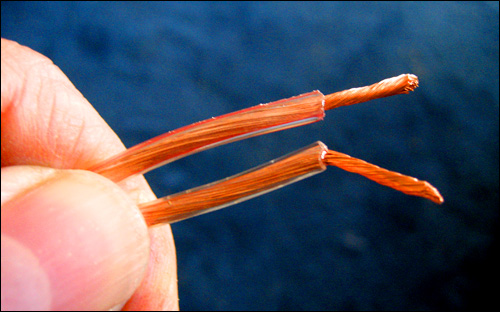
I’m now going to give you a tip that will save you hundreds of dollars and make your hi fi system sound as good as the very nerdiest of your audio-buff friends: for your speaker connections, forget all about the oxygen free, diode rectified, dipped-in-chocolate, used-only-by angels $1000-per-foot Pear cables** and instead just use a good quality twin core electrical cable.

All You Need

That’s it! Use some wire like this and no-one on the planet will be able to tell the difference between it and the most expensive cable you can buy! I found the stuff above for less than $2 a metre and you can do even better than that. Sum total for speaker cable for my studio: $45. And that’s for a full 5.1 sound set up, with 6 speaker sources.

Audio buffs like to pontificate ad nauseum about the how much difference the supposed ‘high end’ speaker cables make but to those of us who work in the business they just look like idiots – we don’t use those kinds of cables! So what these people are claiming is that they can hear better sound in the reproduction of the material than we heard when we made it! That, of course, is an absurdity of the highest order.

I’d like to end with a true story. Many years ago, a hi fi aficionado acquaintance of mine invited me around to hear his new system. He had spent many thousands of dollars on components, and waxed lyrically about his new speaker cables, which, he said, had improved the fidelity of his music by an impressive order of magnitude. Knowing about my skepticality of such claims, he swore that even I would notice! He sat me down and pressed play on one of his favourite jazz recordings. Could I perceive a superior sound quality? Was I astonished at the clarity of his sound? Well, not so much – I spent a more than a few minutes coming to grips with the fact that his speakers had been wired out of phase, a much more egregious degradation of the listening experience than even speaker leads made of string would have inflicted. And something that he had not even noticed.

I’m not suggesting that all hi fi buffs would make such an obvious mistake, but the thing is, my friend had invested so much money and faith in his audio gear that he had little choice but to believe that he was witnessing superior sound reproduction. And I do suggest that this phenomenon, like that which we saw at work in the ‘wine horoscope’ hoodwink, has more than a little part to play in influencing the subjective experience of listening to recorded music…

___________________________________________________________________________

*It seems pretty clear to me that the most significant knobs in this equation are the ones forking out the money. Seriously – read the blurb on the link to the ‘Silver Rock ‘Signature’ knobs and tell me that the manufacturers aren’t having a very good laugh at the silly hi fi twits’ expense. You’d be forgiven for thinking it really was a joke, if this very same company wasn’t selling speaker cables for over a thousand dollars…

†Excluding, of course, what is done by probably the most important component of all – the speakers themselves. But we’re not talking about speakers for the moment – that’s a whole other ballgame.

‡Another sign of the magical thinking involved in high end audio comes in the form of the following dichotomy: hi fi buffs will argue till they’re blue in the face that analogue sound is superior to digital sound. They insist that there is something called ‘warmth’ that comes from analogue that doesn’t make it into the digital world. Why, then, are they so happy to eschew the old, simple twin core speaker cable used on nearly every analogue hi fi system ever made up until about the late 1970s (when the hi fi craze really started to take off)? What if the old cables contributed to that warmth…? Paradoxes such as these are another flag for spotting pseudoscience.

**James Randi put forward his famous Million Dollar Challenge to the makers of Pear cables, to demonstrate in a double blind test that their product would outperform a cheap good quality cable of the same length. Predictably, after first calling the Challenge a hoax, and then (as is so often the way) resorting to ad hominem attacks against Randi, Pear’s CEO Adam Blake refused to participate. This is an unequivocal admission of flim flam. If your product performs as claimed, you can only come out of the Randi Challenge looking absolutely golden (with the added advantage of $1000,000 cash in your pocket). If you back out, then this surely indicates that you are afraid that the results will not bear out the hyperbole in your marketing. This, in turn, indicates that you are deluded or a swindler.

___________________________________________________________________________

Fishy

Oh dear. Ohdearohdearohdearohdearohdear.

Sometimes someone turns on the Stupid tap and the washer just ruptures and Stupid starts gushing out all over the shop AND YOU CAN’T STOP IT. These last few weeks have been like that, what with Melissa Rogers and her daft ShooTag™, the resurgence of Prophet Pete, and now…

The two largest supermarket chains in Britain, Tesco and Marks & Spencer, have started advising their customers to be aware on which days of the week they choose to taste wine because it will effect the taste. This breathtaking piece of utter folly is so risible that I had to check the date of the Guardian article several times as I was reading to keep reminding myself it wasn’t an April Fool’s joke.

This is the skinny (although I do advise you to read the article to get a sense of the full absurdity):

Tesco and its rival Marks & Spencer, which sell about a third of all wine drunk in Britain, now invite critics to taste their ranges only at times when the biodynamic calendar suggests they will show at their best.

The calendar has been published for the last 47 years by a gardening great-grandmother called Maria Thun, who lives in rural Germany. She categorises days as “fruit”, “flower”, “leaf” or “root”, according to the moon and stars. Fruit and flower are normally best for tasting, and leaf and root worst.

To put it succinctly – two major UK retailers are consulting and recommending wine ‘horoscopes’.

Jo Aherne, winemaker for Marks & Spencer manages to make herself look like a complete twat (and the wine tasting fraternity even more filled with blarney than it already is) by claiming:

Before the tasting, I was really unconvinced, but the difference between the days was so obvious I was completely blown away.

Once again we see the that little crack of Subjectivity in the door of Reason being jimmied open by the great big club foot of Pseudoscience. Nowhere are we offered any evidence that these taste tests were blind tests, let alone the double blind trials that a scientific assessment would demand. These people are just espousing an opinion, and, worse, an opinion based on highly subjective appraisals of something that is to most people an arcane field of expertise. This is a situation busting for pseudoscientific exploitation.*

Tesco’s senior product development manager, Pierpaolo Petrassi, says of the tastings:

It may be a little step beyond what consumers can comprehend.

Oh yeah. You’re so right there Pierpaolo old chap. I’m certainly having trouble comprehending it.

Perhaps the most extraordinary part of this Guardian article, though, is slipped in almost unobtrusively:

The Guardian tested the theory this week and tasted the same wines on Tuesday evening, a leaf day, then again on Thursday evening, a fruit day. Five out of seven bottles showed a marked improvement.

[Checks date for third time. Nope, not April 1]

The Guardian, a world class newspaper, known for its usually sober news and feet-on-the-ground reporting is endorsing this piece of flimsy superstitious mumbo jumbo! Jesus H. Christ – where did I put that shifting spanner! The basement is awash and the stuff is leaking into the hallway!

As the article trails off and the loony wagon heads into the sunset, our keen correspondent throws a small bone to the wolves:

In other quarters, doubts remain. Waitrose’s† wine department has investigated the idea and cannot see a correlation. Many scientists have little time for biodynamic wine, pointing out that the movement’s guru, Rudolf Steiner, claimed to have conceived the concept after consulting telepathically with spirits beyond the realm of the material world. Among his other works are claims that the human race is as old as the Earth and descended from creatures with jelly-like bodies, and a belief that men’s passions seep into the Earth’s interior, where they trigger earthquakes and volcanoes.‡

Uh-huh. And so, Mr Booth, Guardian correspondent, you’re lending credibility to this wine horoscope idea exactly why?

So, after digesting all that, consider the following:

    •Comprehensive blind taste tests conducted by the American Association of Wine Economists have revealed that, if the variables are hidden from the testers, then for the majority of people there is no correlation between the cost of a wine and its perceived enjoyment. In other words, if they don’t know what it cost, most people can’t tell what kind of ‘quality’ they’re drinking. On the other hand:

    •Other blind tests show that the perceived expense of a wine, if known, positively influences perceived enjoyment. And:

    •A European Commission study from 2001 determined that in excess of 50% of those interviewed considered astrology a science. A Harris Poll conducted in 2003 found that 30% of Americans thought that the position of the stars and planets affect people’s lives.

From those three pieces of data, I leave it to you to extrapolate what’s going on here. My suggestion to readers from the UK is that you should, forthwith, buy your wine from Waitrose.

___________________________________________________________________________

*Much like the field of high-end domestic audio. And unlike wine-tasting, that is a province I know very well. But as I read all the hi-jinks with this wine stuff, that same peculiar odour – a blend of of fish and bullshit – starts to fill the air. You find this problem anywhere that there is a substantial amount of subjectivity and a stratosphere of opinionated ‘experts’.

†Another, obviously smarter, UK chain.

‡Well, that last bit about the Elder Ones is totally true of course.

___________________________________________________________________________

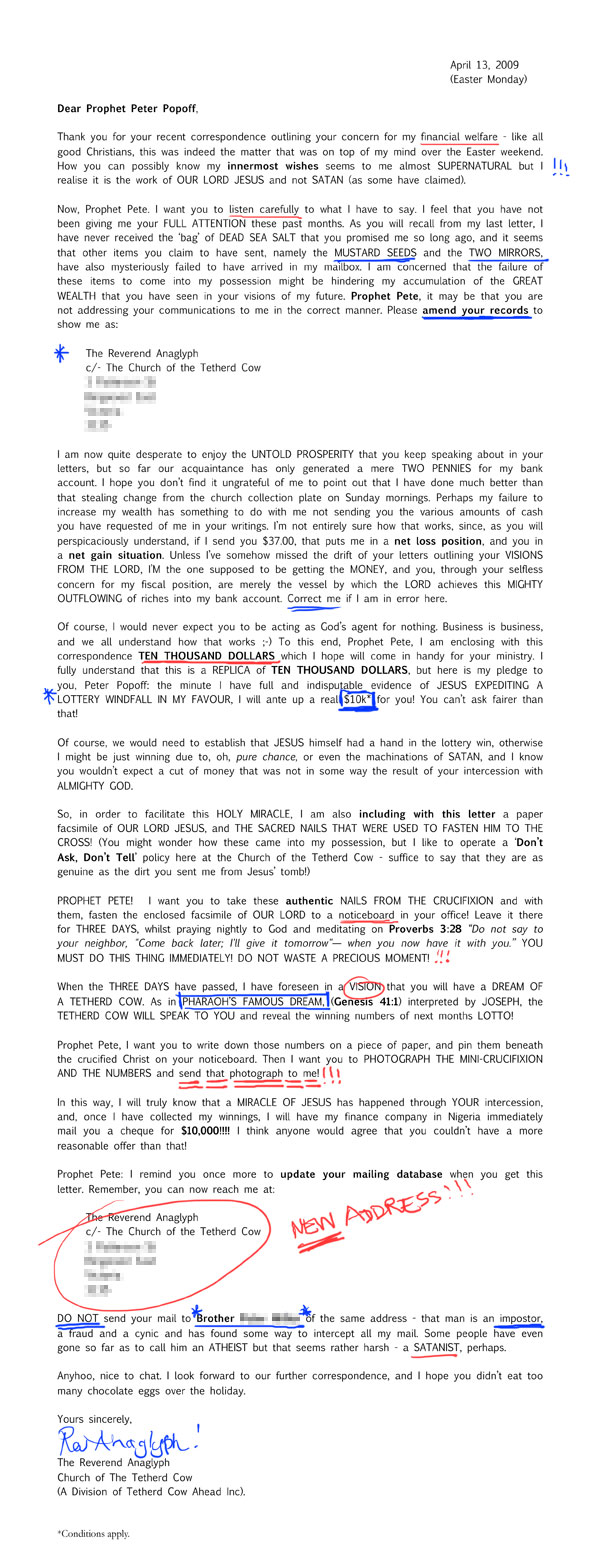
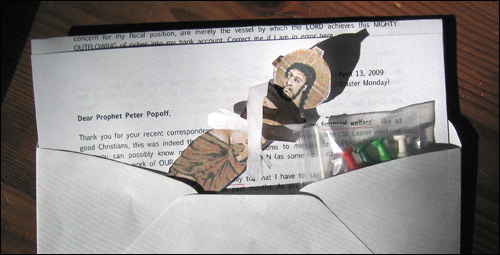
As it seems that Prophet Peter Popoff is letting his attention slip in regard to the matter of making me wealthy beyond my wildest dreams, I thought it was time I fired off a little reminder to him, along with some appropriate aides-mémoire. He appears more than keen to send me an evidently never-ending stream of trinkets so the least I can do is reciprocate.

Another Letter to Peter Popoff

ClickOnThePicâ„¢ to read!*


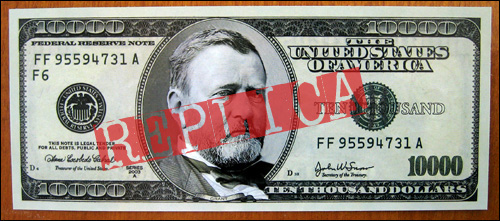
I think he will be impressed with the accompanying prayer aids. I know I was. Here is the ten thousand dollars I’m donating to his ministry (you’ve seen that before of course).

Replica!

Here is the paper facsimile of Jesus.

Jesus!


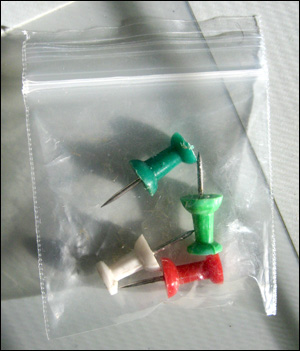
And here are the genuine nails from the cross.

Genuine Nails from the Cross!


They make a very attractive package!

Letter!

I’m off to the post box now. I’m looking forward to my imminent wealth, and I just want to say here and now that I’m not going to forget a single one of you – when Prophet Pete comes through with the goods, there’s a big party at my place and plane tickets and accomodation for all international Acowlytes.

All of you, quick smart, off to pray now – big things are just around the corner! I can feel the flowings in my water!

___________________________________________________________________________

*Pat. Pending

___________________________________________________________________________

Leon Einstein

I learnt from a very early age that it’s bad form to kick someone when they’re down. But heck, some rules are made for the breakin’. And yes, I confess, The Reverend really doesn’t like to be called ‘ignorant’ (unless it’s by someone who’s earned the right to do that by being more knowledgeable than I am, in which case I will humbly take my smackdown).

Anyway, in this particular case, the victim is kicking herself (harder than I ever could), so all I need to do is sit back and watch.

Melissa Rogers, (CEO of the woo-powered ShooTag™ you will remember), has evidently been hitting the PR circuit hard, and her daft device is getting coverage from here to Weldon Spring Heights. In doing so she’s left a trail of howlers in her wake, including the risible:

It doesn’t hurt the flea, it doesn’t hurt the pet and it doesn’t hurt the planet.

…which are, come to think of it, probably the only true words she’s spoken about ShooTag™ because it’s pretty likely it doesn’t actually do anything. Still, it’s really nice to know the fleas are OK, even if one does wonder how OK they’ll be when they run out of a food source and die horribly of hunger. But enough of insect empathy – the thing that really caused me to choke on my cheese fries was the following priceless, almost frameable quote from the comments in the Pet News section of ZooToo.com (in full, just so you know I’m not lifting it out of context):

Melissa Rogers:

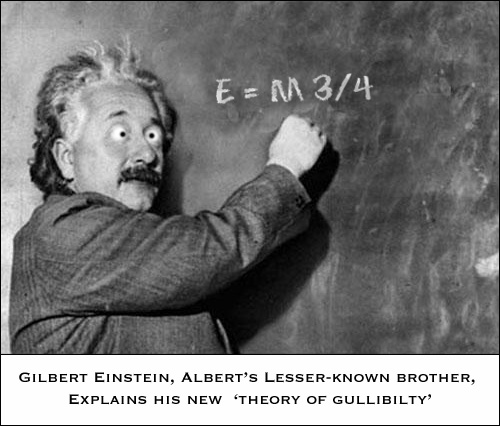
I would say that any pet that is not scratching or chewing at fleas is a happy pet! Shootag only adds a frequency to the already expended energy field of the pet. Take a look at Geoffrey West’s work and the science E=M 3/4.

Unbelievable.

Ms Rogers’ comments throughout the ZooToo site are so numerous and filled with exhortations to ‘go-shootag.com-and-buy’ that they verge on spam. Pretty much every statement she makes is farcical, but that particular one takes the cake. For a start, she’s pulled Einstein’s famous mass/energy equivalence formula totally out of her ass, getting one of the most legendary equations in history (and simplest to remember, I might add) completely wrong. Even if it was right, it means absolutely nothing in this context, and one must speculate it’s the only scientific equation she (half) knows*. How she thinks it sounds even a fraction of the way to being impressive simply beggars belief.

In addition, she gushes about ‘energy fields’ – a staple of smoke-and-mirrors pseudoscience – making some kind of fatuous claim in regard to a pet’s ‘already expended energy field’ (what the crap does that mean?) and, worst of all in my book, completely misrepresents scientist Geoffrey West from the Santa Fe Institute, who is doing some extraordinary, clever, cutting-edge biological thinking, and who would NEVER endorse a preposterous trinket like ShooTag™. This is, no doubt, from where she gets the idea of ‘fractals’ that she mentioned in her previous comment on The Cow – West, a former particle physicist, has advanced some very interesting science that deals with mathematical scaling laws in biology, particularly in metabolic behaviour as related to organism size and lifespan. With a colleague, he hypothesises that these scaling laws are related to the hydrodynamics of living systems, which in turn are delegated by networks that assume fractal structures. Rogers has probably picked up on the vibe that West is a bit of a maverick and his ideas are challenging to mainstream science.† But this does not make him a kook – he is still a scientist of some reputation, and follows proper scientific protocol.

It’s a depressing experience trudging around the ShooTag™ PR trail in the footsteps of Ms Rogers & co. Credulous tv shows looking for filler give her product a favourable airing; trade shows spruik her wares without so much as a critical blink of the eye; the press repeats the ShooTag™ promotional propaganda verbatim. No wonder these kinds of flim-flam scammers do so well – they’re selling stuff to people who have no brains to think for themselves!

And nowhere, nowhere, is there any serious, informed discussion of the outrageous claims made about ShooTag™. Ms Rogers says in several of her comments that the science behind ShooTag™ ‘will be revealed’ in due course, but I have no doubt that she and her cohorts will be long gone with their cash before that day ever comes.

Addendum:

‘Creates and invisible force field!!!’

Crappex


As if to taunt me, this morning’s email spam contained something I’ve not seen before: an ad for a ‘pest control system’ that works on the same principles as ShooTag™ (ie, magic posing as science):

Simply plug in a single Crappex unit and it immediately turns the wiring in your home into a giant digital pest repeller creating an invisible digital force field. Chase mice, rats and roaches from your home by interfering with their nervous systems.

Here, the manufacturers are using ‘digital’ as their magic word, and asking us to believe that their ‘invisible digital force field’ is as holy-water-to-a-vampire for mice, rats and cockroaches (ie, things we consider ‘pests’) but, by inference, somehow discriminates in favour of cute little kitties and puppies. HOW??? WHY!!!???

Even hungry zombies would reject the brains of people stupid enough to buy these things.

___________________________________________________________________________

*It’s depressing beyond belief that no-one in the comments section of this site even takes her to task on this vapid nonsense. On the contrary, many of the contributors seem entirely prepared to take her at face value, happily digesting her ‘green’ solutions claptrap and raising a ‘you go girl!’ fist in agreement.

†The Santa Fe Institute and the Los Alamos National Laboratory, both of which West calls home, are known for their encouragement of challenging thinking.

‡Another ‘Detection of Hokum Rule of Thumb’ must surely be: ‘Watch for terrible spelling and bad copy proofing’.

___________________________________________________________________________

Mozzie

Folks! I’ve had a communication from one of the purveyors of ShooTag™ which, I think you’ll agree needs to be awarded headline status, rather than languish in the Comments on this post.

Melissa Rogers, the person credited as CEO of ShooTag™ on the About page on the ShooTag™ site, has found her way to The Cow (whilst vanity-searching her product, we must assume). Well, of course, I said things she didn’t like so she found time to mount her best and most coherent argument against my point of view.

I reprint her thoughts for you here in full.

Melissa Rogers adds:

Your response proves that you are not disaplined in physics or quantum physics. The statements that you made about frequencies being the same as a cell phone demonstrate you lack of science knowledge. There are many types of frequencies and ours are not radio frequencies. When we go from patent pending to full patent protection, then all of our sceince (all three applications) will be disclosed. Instead of making a judgement without knowledge, try it. Actually, try the people mosquito tag. If you usually get bitten by mosquitoes, you will know if you do not get mosquito bites -won’t you? If would give you more credibility to have a quantum physicist contact us and then let him explain the science to you. Otherwise it just makes you sound ignorant! Technology is changing very quickly and most people have no science background to understand how any of it works. Did you know that radios were first made with crystals? did you know that digital items are made with liquid crystals? Did you know that cell phones use fractal geometry to make a minute antenna that uses your energy field to extend? Do your homework and try the people mosquito tag. See for yourself.

Now, let’s see:

•Your response proves that you are not disaplined in physics or quantum physics.

Melissa, unlike you, I’m not pretending I am disciplined in physics or quantum physics in any formal way. I’m not the one trying to take money from people based on my ‘expertise’ and so my credentials are not the ones under scrutiny. Nevertheless, I am very well read in both physics and quantum physics, and I plainly know a great deal more about these sciences than you do. I certainly know enough to understand that your page on The Science Behind ShooTag™ is a whole lot of waffle that makes no scientific sense whatsoever.

•The statements that you made about frequencies being the same as a cell phone demonstrate you lack of science knowledge.

Whoa! Hang on there pardner! For a start, it’s your site that bandies around the the words ‘electromagnetic frequencies’ without any discrimination at all. I am completely aware of the scope of the electromagnetic spectrum and my point was that you use this catch-all description without having the vaguest idea of what it means. I don’t know whether or not your frequencies are the same as those of a cell phone because you never specify. You just claim, in the scatty manner of peddlers of pseudoscience, that your product ‘uses electromagnetic frequencies’. That’s as daft as saying it uses ‘vibrations’.

•There are many types of frequencies and ours are not radio frequencies.

Really? So you think mobile phones use radio frequencies then? Um, exactly who’s the science dummy here? So, the frequencies that your device uses – they’re ultraviolet, maybe? X-ray? Gamma ray? Perhaps they operate in the visible light spectrum? You haven’t got a clue what I’m talking about, have you?

And, may I ask, does your device have a power source? From my investigation of your site it doesn’t seem so. If this is the case, then please don’t attempt to sell me the idea that it ‘radiates frequencies’ of any kind at all. This would be flying in the face of all known physics. Unless of course it’s radioactive, and I think I’m taking a pretty safe punt that it’s not.

•When we go from patent pending to full patent protection, then all of our sceince (all three applications) will be disclosed.

Yeah, now, see, you claim your patent is pending, and if that is even the case (which I doubt), it would be because it hasn’t been awarded. We can discuss this further if you actually ever get a patent.

•If would give you more credibility to have a quantum physicist contact us and then let him explain the science to you.

Oh, I would LOVE to hear an explanation from a quantum physicist. PLEASE get one to write to me. But don’t bother if it’s Prof. William Nelson – he is NOT a quantum physicist.

•Technology is changing very quickly and most people have no science background to understand how any of it works.

Yes, I’m afraid that is entirely true. Most people have very little understanding of science. If they did, gewgaws such as ShooTag™ would never see the light of day. Melissa, what your product offers is in no way based on science. If it was, you’d be able to clearly communicate the ideas behind your device in a way that doesn’t sound completely addled to anyone with knowledge of scientific principles. You’d have conducted properly run double blind experiments, and accumulated data that confirms your results from unbiased researchers. You’d have submitted your science to peer-reviewed periodicals, and have the endorsement of real scientists instead of a lone nutcase who has a track record of ridiculous claims and refers to fictional publications (the ‘Quantum Agriculture Journal’, for example).

•Otherwise it just makes you sound ignorant!

Really? You seem strangely desperate to try and make me seem ignorant. That’s what’s called an ad hominem argument, and is usually the last resort of someone who has run out of actual facts.

•Did you know that radios were first made with crystals? did you know that digital items are made with liquid crystals?

Um, yeah, but so what? Is that supposed to impress me? Is it an example of your superior science knowledge, perhaps? What’s it got to do with anything? How does it relate to your invention?

Oh crap. Something just occurred to me – please don’t tell me that the ShooTag™ uses some kind of ‘crystals’. That would be most dismal. Or actually, do tell me that, if you like! I think that would firmly stake your credibility in this argument.

•Did you know that cell phones use fractal geometry to make a minute antenna that uses your energy field to extend?

Now, do you even have the foggiest idea what that means? Do you know, or understand any fractal geometry? What ‘energy field’ are you talking about? Extend what? How? Why?

Or is it, perhaps, that like the words ‘magnetic’ and ‘quantum’, you’re throwing in ‘fractal’ because, for you, it’s some kind of mysterious magical notion that you believe will somehow be impressive? Well, sadly, it might bluff those who know nothing about such things, but really, you’ve picked the wrong person on whom to use that kind of language. I work with fractal math. I know what it does and what it means. What you are attempting to say does not in any way sound sensible to me.

•Do your homework and try the people mosquito tag. See for yourself.

I shouldn’t need to try your product to know that it’s plausible, in the same way that I shouldn’t need to buy, oh, toaster or something to ‘see if it works’ – I know that the toaster is likely to function as its manufacturer claims because the scientific principles on which it’s based make sense.

You imply that you know more about science than I do, and yet you don’t even have the most basic understanding of scientific process. I’m not the one you need to convince. Convince people who have no vested interest in your product (that is, NOT people who’ve forked over money, or friends, or credulous tv presenters). Convince unbiased scientists, using properly conducted scientific trials. Take all the spurious anecdotal ‘evidence’ off your website and replace it with some properly endorsed rational thinking.

I reiterate what I said in my original post – if your science is genuine, and your device does what you claim, then doctors working in malaria zones all over the world will be beating your door down. That would certainly be convincing evidence.

But while you continue to invoke dubious ‘scientists’ like ‘Professor’ William Nelson, mythical gazettes like the ‘Quantum Agriculture Journal’ and spout equivocal gibberish such as that which you use in ‘The Science Behind ShooTag™’, your credibility is near zero. Your small pool of personal ‘It-worked-for-me-TOO!’ testimonials may serve to fleece gullible pet owners of their dollars, but it doesn’t constitute any kind of science.

Come back and push my face it in when you’ve solved the world’s malaria problems (which, if your device works as claimed, should be a trivial undertaking and be achievable in a scant year or so – or maybe you don’t think that’s a worthwhile use for your invention?). I promise I will make a full and humble apology in that event.

Until then, all you have to do is show me where the science is in all your claims.

« Previous PageNext Page »