Hmmm…


Do you ever look at things and think… hmmm… I wonder how that came to be? Take this roll of toilet paper (or ‘bathroom tissue’ as the Americans call it, because they can’t bring themselves to say that word. You know. TOILET. This is in keeping with the more comprehensive American belief that if you don’t acknowledge an ‘icky’ thing exists – like, oh, Palestine, say, or sex, or atheists – everything is SO much nicer). ((I exclude from this assessment, of course, Americans who are reading Tetherd Cow Ahead. Or who can read, generally.)) ((Whenever I hear an American say ‘I’m going to the bathroom’ I have to strongly fight the urge to say ‘Really? Again? You must be so clean – you just had a bath a couple of hours ago!’))

Anyway, back to this roll of toilet stuff with which you wipe your ass after you’ve had a shit.

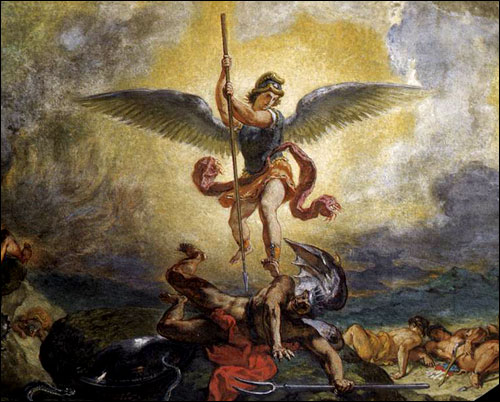
Why is it named in the way it is? Are angels particularly known for their softness? It’s not an attribute that immediately springs into my mind when I imagine an angel. Take this angel, for example. It is the Archangel Michael:

Does this picture say ‘softness’ to you? That spear looks sharp to me. Not the kind of thing I want near my tender parts (I will observe that he has funky shoes though).

Here is another picture of a some angels:

These ones have swords. Would you let angels like this go swinging their sabres around in the vicinity of your nether regions? I wouldn’t. And here’s another picture of the Angel Michael. Can you see what he’s doing with that pointy spear?

Yes! That’s right! He’s aiming to stick it right up Lucifer’s bottom! Is that a caring, comfortable, soft image, my friends? I think not!

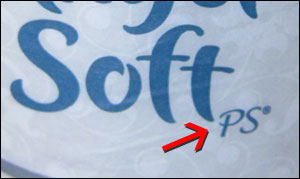
So how is it, do you think, that advertising people arrived at the brilliant idea of calling toilet paper ‘Angel Soft’, when it’s apparent to anyone with a modicum of religious art experience that angels are anything but soft? How can they get away with such a blatant untruth? Well, as usual, the ad people have included an escape clause in their work. Did you spot it?

There it is! Those rascally advertising types! They’ve registered the term ‘PS’ and tacked it onto their brand name! Genius!

So, their product can now be called ‘Angel Soft (PS®)’, where the PS obviously signifies:

PS: If it feels like someone’s sticking a sword up your ass, then it’s not our fault. You should have paid more attention in Sunday School.


Halloween is one of my favourite festivals as you all know. It is the time of the year when we celebrate the dark and drear, when our imaginations wander to the chilly side of existence and we contemplate those things that cannot come out to play in the light of day.

So it is deeply disturbing to me, to see the Halloween tradition becoming cuter and cuter as the years go by. Cute pumpkins, cheery ghosts, jolly vampires, happy Frankenstein’s monsters… what the hell is with all that? Halloween is supposed to SCARE you, people. It’s not about CUTE. If you want cute you can get it any time of the year. In fact, all you wimps who want a Festival of Cute, why don’t you go make one. Put it in February, as far away from Halloween as possible. Then you can all go and revel in your Anne Geddes photographs and Hello Kitty pinkitude together and leave the rest of us to enjoy a decent scare-fest.

A few days ago in my post iPods Will Kill You! a couple of commenters thought I might be over-analyzing the current trend for the Fairfax media (among others) to be engaging in Apple-bashing. Naturally enough, my antennae have been quivering ever since, on the lookout for some further substantiation of my claim. Indeed, the ink was hardly dry on that post before Universal Head pointed out another instance in the Sydney Morning Herald the very next day.

And this morning, this, under the headline ‘Smart phone, pity criminals are proving even smarter’:

The global obsession with the iPhone is not only becoming a threat to security: an entire criminal industry has sprung up around it, says the head of the Australian Crime Commission.

The story goes on to detail how the head of the ACC, John Lawler, ‘said’ at an Australian Institute of Criminology conference, that Apple’s iPhone was a veritable treasure trove of criminal opportunity.

Only thing is, if you read the article carefully, Mr Lawler is never quoted once as having said anything of the sort. He never specifically names the iPhone in any of his attributed quotes. He certainly mentions ‘personal communication devices’ and ‘instant services’ but these are catchall phrases that cover a lot of ground

Now, I’m not saying that Mr Lawler didn’t actually mention the iPhone during his presentation, but there is no evidence of that in this article. The thing is, the piece is written in such a way that a casual reader could easily come away with the impression that he did.

Applying a little critical thinking to this story reveals it to be a wonderland of misdirection. Let me guide you through:

The global obsession with the iPhone…

The ‘obsession’ with the iPhone is no more an obsession than is the desire to own any other popular product. This so-called obsession is an invention of the media. People like their iPhones because they are useful and appealing. Why is that obsessive? Popularity doesn’t equal obsession, it just equals popularity. If anyone is obsessed with the iPhone, it’s the newspapers. They’re the ones obsessively telling us at every opportunity about how we’re obsessed with the iPhone.

This year Apple’s chief financial officer told a shareholder meeting that more than 70 Fortune 100 companies were either using or trying out iPhones, and it was rapidly replacing the BlackBerry as the must-have business phone.

This sentence follows quickly on the heels of Mr Lawler’s quote, deftly conflating the two paragraphs to give the inference that this was also said by him. The intention is obviously to imply to the reader that he also went on to say, in the next paragraph:

But unlike the BlackBerry and other smartphones, the iPhone does not allow a company’s IT staff to install and upgrade its own security software, leaving business networks at risk of penetration.

Whether nor not these are Mr Lawler’s thoughts (and this is far from clear), a discerning person can only respond SO WHAT? The banality of this statement is profound on so many levels. How many people with BlackBerries have security software installed by their IT department? I’d wager next to none. And, even if they do, what the heck does that entail? Some password protection? You can do that on the iPhone. Encrypted files? You can do that on the iPhone. A kill switch? The iPhone has that. What we’re supposed to believe here is that IT departments are the be-all and end-all of security – a myth kept in circulation largely by IT departments. The ultimate security on any system has to do with user responsibility. If the IT departments of corporations are really concerned about security they would do well to spend less time trying to solve problems with tech fixes and instead devote some serious energy to teaching their users some basic computer hygiene. My iPhone is secure. You can’t get my data if you find and steal my phone. And if you did steal it, I would remotely kill it (if you hadn’t already done it yourself by attempting to circumvent the security). Does the ACC think this is impossible on a iPhone? I don’t believe they’re that naive.

And anyway, let’s say the contention is true. Do we really want to compare it to the security of the open-system Android, or the plethora of Nokias, Samsungs and Sonys out there? Or perhaps the new Windows 7 phone? (Windows – now there’s a secure and virus-free environment!) The fact is that, as popular as the iPhone is, it is still well and truly outnumbered by other brands. This being the case, rather than be concerned with the security-catastrophe-that-is to-come when iPhones rule the planet, why is this story not about the security disaster that is already in place?

Mr Lawler also said the increasing ubiquity of the phone meant that criminals were finding more and more opportunities to use it to intrude, to steal and to defraud.

Well, DUH. I can’t even comment on this, except to say that once again this is not a direct quote from John Lawler. Why is the reporter giving us Mr Lawler’s non-specific-brand terms like ‘communications devices’ in direct first-person quotes and yet attributing anything about the iPhone at second hand? I’ll tell you exactly why – because if Mr Lawler didn’t single out the iPhone by name in his talk, it’s very easy for the reporter to say he intended ‘the phone’ in a much more general sense (as in ‘the mobile phone’). With that in mind, read that paragraph again and you’ll see what I mean. The English language is a sublimely slippery substance.

In fact, the next direct quote from John Lawler again mentions only ubiquitous technology:

”With the explosive uptake of personal communication devices there are certainly already opportunities that appeal to organised criminals,” said Mr Lawler.

That’s a sensible, if very general observation. Organised criminals use mobile phones! So do librarians.

Even the desire for the phone is creating a burgeoning black market, he said.

Yes, as has the desire for PS3s, Gucci handbags and cigarettes. Black markets spring up anywhere and everywhere that there is an item of value that can be produced without imprimatur and sold for less than a legitimate vendor’s prices. This is perhaps a point of interest, but hardly the stuff of news.

The most disturbing thing about this whole pile of non-news is that in the course of less than one day it’s been disseminated so widely that trying to search for any actual information about what John Lawler might really have said at the Institute of Criminology conference turns up only myriads of requoted versions of the Fairfax article. Pretty much all of them bandying around headlines like ‘iPhone Poses Threat to Security!’ Hundreds of dumb zines and tech blogs have just taken the Fairfax article completely at face value without an ounce of critical appraisal. Most of them quote the article word for word. Some of them get opinions from their own ‘experts’ expounding the crumminess of the iPhone’s security. Many of them plainly have vested interests or agendas. ((If you have time, go read some of the ones linked in the Google search. It is an astounding (and depressing) eye-opening example of uncritical re-mouthing of something that has low information and high titillation value.)) If this is not about trying to denigrate Apple products, then it has that sum effect anyway. Everyone who uncritically picked up this story did so because it felt good to put the boot in.

I would sincerely like to know what John Lawler said at that conference. Did he single out iPhones as promoting such a large and serious security problem? If so, what were his reasons, given that iPhones are no less secure than many other devices on the market? ((I’m not claiming that iPhones are the Fort Knox of mobile phones, by the way – just that as security risks go – as devices – they’re neither here nor there. They could be better, sure, but they are decent enough if you take the trouble to use their security features properly.)) Or did he, as I suspect, merely mention the iPhone as one of a growing number of mobile personal communication and computation devices that should take security more seriously?

I will continue to investigate this as I am able, but if anyone was at that conference, or has any more information, I’d love to hear from you.



You’re probably aware that Google has just launched their ‘predictive’ search engine Google Instant – a web version of the kind of ‘pre’ search which has already made its way into many desktop and phone apps. It’s actually pretty impressive. Not really the kind of news I care about airing here on The Cow, but the reason I bring it up is as a result of this quote, made by Google VP (the usually sensible) Marissa Mayer at the press launch in San Francisco: ((She also used the vacuous phrase ‘It’s a quantum leap forward…’))

We are actually predicting what query you are likely to do and giving you results for that. There is actually a psychic element to it.

No there is not, Marissa. There is actually no psychic element to it. It’s a technological element. PLEASE. The loonies don’t need any more encouragement.

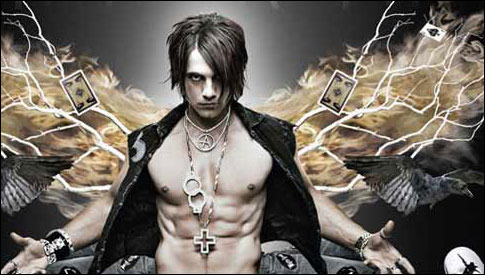
While we’re on the subject of television, in the last couple of weeks I’ve also caught a few episodes of a show called ‘Criss Angel: Mindfreak’ playing on A&E. Now, for anyone who doesn’t know, Criss Angel is an illusionist in the tradition of David Copperfield, Doug Henning, Chung Ling Soo (William Robinson) and Harry Houdini. That is, a Grand Illusionist. He does the kind of BIG magic that requires a stage crew of a few dozen people, a room at a venue in Las Vegas and (in case you haven’t inferred it) money.

Criss Angel’s schtick is to attempt shake off the stuffiness and shmaltz of his tuxedoed predecessors and instill into his act a semblance of anarchistic punk, ((Indeed, his logo is the anarchist ‘A’ in a circle, with a kind of Nike-slash flourish.)) but it is, the leather and the chains and the bandana notwithstanding, exactly the same kind of spectacular theatrical routine that has defined stage magic for the best part of a century. You know the sort of thing: cut a girl in half with a circular saw/escape from a locked box dangling over a precipice/make people disappear.

I want to say from the outset that Criss Angel is VERY good at what he does. And what he does, in exact terms, is to make people believe things that seem contrary to the laws of reality. The key words here are ‘believe’ and ‘seem’. ((Criss Angel’s Las Vegas show is, in fact, called ‘Believe’. The word, etched in twenty foot high letters on billboards across the city, seems more like a brute-force brainwashing command than an advertisment.))

Watching his show is a revealing exercise in how the impressionable mind works, and an excellent disciplinary pastime for the rational thinker.

Now I don’t know how Criss Angel accomplishes many of his illusions. I’d be disappointed if I did, because I really like good stage illusionists and I expect them to be able to outwit me if they’re worth their paycheck. But there’s one thing I can tell you for sure: Criss Angel, when performing his act – despite his frequent declarations to the contrary – does not care too much about telling ‘the truth’. ((Just like Britain’s Derren Brown who masterfully uses any method available to trick his audience.)) And neither do his stage crew or his film crew. What you see on Mindfreak is rarely what you have been told you’re seeing. ((I need to point out here that this is not surprising – stage illusionists excel in leading you to believe things that aren’t true. It is, after all, their job. Criss Angel takes things one step further by exploiting the ‘natural’ trust that people have when they see something on television. For some reason it doesn’t occur to most people that a magician on tv would use the medium itself to trick them. Think again folks!))

Here’s an example: Criss appears outside his permanent ‘magic’ home at the Luxor in Las Vegas, with a crowd of ‘random’ bystanders. He reaches into a bush and introduces them to a ‘pet’ that the management of the Luxor won’t let him keep in the hotel: a large scorpion. It’s a real live scorpion for sure – there’s no doubt about that.

The onlookers ook and gasp as he lets it crawl over his hands, and then, with a nice piece of sleight-of-hand, magics it away in a puff of smoke. But the real trick is yet to come. Angel reaches over and grabs an attractive (of course) girl from the crowd and gives her a big kiss, whereupon she mugs wide-eyed and ‘surprised’ and opens her mouth to reveal the scorpion crawling out.

This is one of the the oldest and most frequently-employed gambits in the book of magic – the girl, despite her convincing acting, is indisputably an accomplice. There is simply no other way to achieve a illusion like this. You can’t get a seven-inch-long scorpion into an unsuspecting girl’s mouth without her consent. I know – I’ve tried. ((That’s a joke.)) Seriously – this is the only way this trick can work, and even though no-one wants to believe it, magicians make frequent use of accomplices. ((If you still don’t believe me, watch the video very carefully – despite what Mr Angel wants you to think, there is no way he passed the scorpion from his mouth to the girl’s mouth with that surprisingly chaste ‘stage’ kiss. His ‘mouth acting’ of regurgitating the scorpion is, of course, purely a distraction. Therefore there are really only two possibilities: the scorpion got into the girl’s mouth via real magic, or, when the camera wasn’t on her, and when the crowd was totally engrossed with Angel making the first scorpion disappear, the girl was surreptitiously stuffing a second scorpion into her gob. You decide which of those two scenarios seems most plausible…))

Now I don’t want to seem like I’m making light of Mr Angel’s accomplishments as an entertainer. As I said, he’s good at what he does. Many of his tricks (especially the smaller ones) are quite astonishing. ((Even if quite a few of them have a pedigree stretching back a good many decades.)) But when Criss Angel ranges through the adoring crowd after setting the scene for his next conjuration and proclaims that there’s ‘NO BULLSHIT!’ there’s one thing that’s for certain – the greatest piece of magic in his entire repertoire is his ability to convince his audience that that statement is true.

The internet is over.

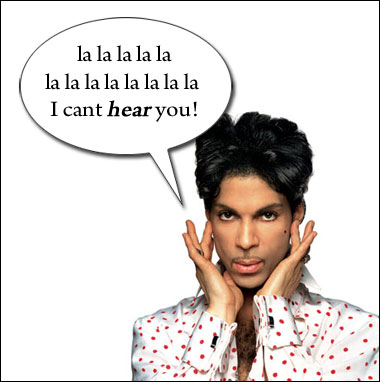
Yes, dear friends, you are all living in denial. According to the artist formerly known as the artist formerly known as Prince, and now known as Prince once more, the internet is just ‘a hip fad like MTV’ and is now outdated.

And running with his new-found insight, Prince is breaking all the boundaries and taking the extraordinary steps of releasing his new music album only as a CD! Genius. He’s chosen to do this through the innovative new distribution conduit of the newspaper! What a visionary!!


« Previous PageNext Page »