Geek


This is a necessarily longish story for Joe about how, in spite of the fact that I don’t believe in EVP (Electronic Voice Phenomena), it up and bit me on the bum.

EVP is the term given for the discovery on previously recorded magnetic tape of strange indistinct voices that weren’t there when the original recording was made.

This phenomenon was first ‘discovered’ in 1959 by philosopher and birdwatcher Friedrich Jurgenson while he was recording bird sounds in the backyard of his Swedish house, and later brought to greater attention by Latvian author Konstantin Raudive. The voices captured in this way are sometimes referred to as ‘Raudive Voices’.

Now I should say here that both Friedrich Jurgenson and Konstantin Raudive believed that these faint voices that appeared in the etheric hiss of the magnetic tape were nothing less than the spirits of the dead attempting to make contact with us living folk from ‘the other side’. Not only that, Jurgenson and Raudive were of the mind that they could actually communicate with these spirits by asking questions and then leaving pauses in which the voices might answer.

I don’t for a moment believe that’s so, but from the first time I heard of this peculiar phenomenon many years ago I found it deeply intriguing.

I was aware that Konstantin Raudive had written a book about his encounters with the voices (he made something like 70,000 recordings, believe it or not) called Breakthrough, and I had tried for many years to find an edition of it, but that turned out to be easier said than done. Not many copies were printed and it is an obscure work that probably held little interest for most people. These days, like so many arcane works, portions of the text are available on line, but at the time of this tale that wasn’t the case. It was a very rare book. Eventually I gave up the search and more or less forgot about it.

When was developing ideas for my CD Houdini, I wanted to include a piece based on EVP. I wasn’t quite sure exactly how I was going to go about it or what I was going to do, but earlyish one Sunday morning I lay in bed thinking about Breakthrough and how great it would be if I had a copy for inspiration or possibly source material. Then a thought popped into my head with such eerie clarity that I said it out loud: “Goulds!”

This is what a Sydney bookshop guide says about Goulds:

A Sydney institution, Goulds stocks mostly secondhand books – piles and piles of them, in dusty disorganised piles spread over two stories. It also has videos, vinyl records, and magazines. There are a pair of friendly twin cats which frequent the place.

Goulds is literally five minutes walk from my house and one of my favourite places in Sydney. It seems plain idiotic to me now that I hadn’t at least tried to find Breakthrough there.

There are few things I like better on a Sunday morning than to wander through the ramshackle aisles of a secondhand bookshop, so I got up, grabbed a coffee and made my way to Goulds. If you didn’t understand it from the description above, I should say that Goulds’ book classification system is eccentric at best and insane otherwise. That’s being charitable. And it’s a huge place. Looking for a particular title in there is not a task taken on lightly, or with more than an infinitesimal hope of success.

Nevertheless, it was worth a try.

This is what happened. In real time. I walked into the ground floor entrance. I thought “Hmmm, now where would the most likely place for such a book be?” I headed up the aisle where I thought my best chance lay, picked a shelf at random, ran my hand along the first three or four books, and pulled out a copy of Breakthrough.

Really.

It cost me $7.

[To Be Continued]

OK, this is a heads-up people. It’s just over a week to International Talk Like a Pirate Day. Time to get the eye-patches & wooden legs out of storage, get yer pirattitude on and brush up on yer pirate lingo.

If ye don’t know what I’m yabberin’ about me hearties, then ye better be goin’ here. Learn how to talk like a pirate, what it be all about (hint: NOTHING SENSIBLE) and all the best pirate pick-up lines (such as the effective yet subtle “Prepare to be boarded!”).

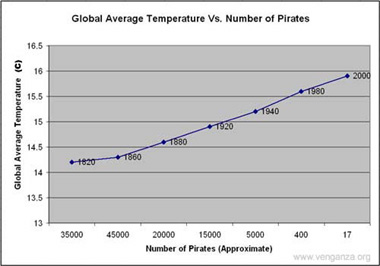
Lest ye think it’s all silliness, let me refer ye to this important data on the official Flying Spaghetti Monster site which plots the decline in pirate numbers against global warming:

So ye can see it be all scientific-like: by being pirattical, ye may well be helping the environment. For me own part, on the Big Day I will be answerin’ the telephone as Cap’n Pete, keepin’ a plentiful supply of grog on hand and working all day with my pirate keyboard:

So ye lice-infested bilge rats, go find yerselves a parrot and ye proper pirate name, prepare to hoist the Jolly Roger and say after me: “Arrrrr!!”

an·a·glyph: n:

A moving or still picture consisting of two slightly different perspectives of the same subject in contrasting colors that are superimposed on each other, producing a three-dimensional effect when viewed through two correspondingly colored filters.

Don’t look for anything deep in it. I just like the 3D version of Creature from the Black Lagoon.

I really like codes and ciphers and hidden messages.

When I was a kid my friends and I would exchange sheets of blank white paper with secret messages laboriously written out in lemon juice, invisible to casual scrutiny until you held the note over a lit candle. The heat of the flame would coax the words to appear in a satisfyingly aged-looking sepia hue accompanied by the acrid acidic smell of scorched citrus. How clever we felt. No-one could know our secrets!

These days the art of codes and ciphers – “cryptography” as it is more seriously known – is more or less the domain of the very very smart, involving complex and sophisticated concepts and lots of computer power. I have trouble understanding how to even implement something like PGP, let alone having the vaguest clue how it works.

I really like a lot of things about the modern world. Unlike Dennis Wilson, I think I was made for these times. But sometimes I long for the days of simple cleverness where a cool idea could be executed with ingredients from the kitchen cupboard.


A Long Story Involving Music, Death, Snow and Coincidence

One Saturday morning in late 1991 I was woken from a deep sleep by the most ethereal of sounds. It was a perfect pure human voice singing Rachmaninoff’s ‘Vocalise’… no wait a minute, it’s wasn’t a voice, it was… a violin… and yet…

I came into full consciousness too late to catch anything much of the back-announce, except for the name of the artist: Clara Rockmore. It was enough to chase down the recording. It turned out that the sound I heard wasn’t a voice, or a violin, but that most enigmatic and fascinating of electronic instruments, the theremin.

As a teenager I had a fleeting interest in theremins, and even tried to build one out of an old electronics kit I hacked for the purpose. It wasn’t too successful, and I really didn’t have the chops to do it properly. Besides, I had bigger fish to fry; I had become obsessed with the gadget that had newly arrived in the local music shop – a music ‘synthesizer’ called a MiniMoog.

Long story short: MiniMoog → rock & roll band → sound & music for school plays → film school → my own film company → lying in bed listening to Clara Rockmore effortlessly play the theremin, perhaps one of the most difficult-to-master instruments of all time.

I tracked down that recording of ‘Vocalise’ and discovered to my mild surprise that it had been produced by Robert Moog, inventor of that MiniMoog that had set me on my career path, and a man considered by many to be The Father of Electronic Music. As it turned out, Bob’s own career was directly related to his interest in, and manufacture of theremins as a teenager.

The comprehensive liner notes with the CD outlined the amazing story of Lev Sergeyevich Termen (Leon Theremin) and the invention of his extraordinary electronic musical instrument. That’s a different long story, and way too fascinating for brevity, but you should read it on Wikipedia sometime. What was most astonishing to me was that, at the time, Leon Theremin was still alive, at the grand old age of 95. And, as far as I knew, there was no filmic document of this important man and his contribution to music and technology.

I was very well placed to set up such a documentary, and I immediately started collecting information. I got in contact with a number of people and soon enough with a chap at Berkeley who told me in an email “I think someone’s already making a movie – you should speak to Bob Moog”

And I did. Yes, said Bob, a fellow called Steven Martin had almost completed his film Theremin: An Electronic Odyssey, after a difficult three year process. In keeping with my inept abilities as a surfer I had sensed the wave coming too late, and Steven Martin was already riding it to shore. Tarnation.

I had a number of very nice conversations with Bob though, so I didn’t feel too bad about losing the doco, him being a hero of mine and all. I also discovered that through his company Big Briar (now Moog Music), Bob was making theremins again. It was too good an opportunity to miss and I browsed their catalogue and arranged for Big Briar to make for me one of their beautiful cherry wood Model 91Cs.

As fate would have it, the proposed completion date for my theremin would see me in North Carolina where I was to meet up with my business partner at the time, Alex, on the set of the new film he was directing, the soon-to-become ill-fated The Crow.

Big Briar/Moog Music is located in Leicester in NC, and it was a simple matter to arrange a slight detour at the end of my trip to collect my theremin in person. More importantly of course it would allow me the exciting opportunity to meet and shake hands with the man whose name was synonymous with electronic music.

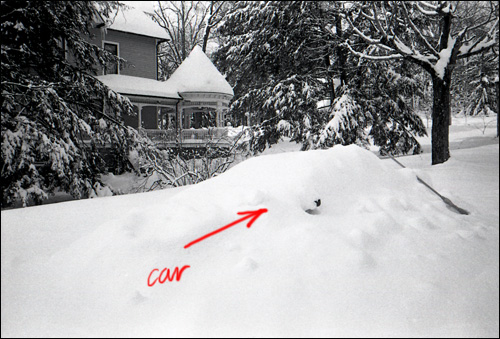
It was never to happen. 1993 saw one of the worst storms to ever hit the east coast of the US, with North Carolina copping one of the biggest snowfalls in its history. The day before, I arrived with my travelling companions in Asheville NC, about a twenty minute trip to Leicester. The fairy-tale sprinkling of snow that started on that night was a big novelty for us Australians. “How very Winter Wonderland!” we cried, as we grappled with the concept of driving in treacherously icy conditions and on the wrong side of the road. It became something less of a novelty the next day when we had to dig down through several feet of snow to our rental cars. That was just to get our luggage. Those cars weren’t going nowhere. Neither was anything else in Asheville.

We stuck it out in Asheville for three days but things weren’t getting better in a hurry. Leicester was completely cut off from the world, and any possibility of getting there and back in time to meet our flight back to Oz was remote. We had no choice but to grab the first local flight out of Asheville (after a terrifying drive-cum-slalom in a taxi to the airport) and head back to a country where there isn’t ever much snow. Certainly not enough to bury cars.

My theremin was shipped to me not long after, and Bob phoned several times to chat, and make sure everything had arrived in good condition.

Steven Martin’s documentary was completed in 1993. It was an insightful and moving account of the story of the theremin. Lev Sergeyevich Termen died not long after the film’s release at the age of 97. Bob Moog sent me an email on that day. It said:

I thought you would like to know that Lev Termen died today, at the age of 97. Lately, he has been working on a device to reverse the aging process. Sadly for all of us, he was not able to finish that work.

I was very saddened to hear that Bob Moog himself died last Sunday. The enormous grief in the electronic music community can be felt on the Moog Music site, and on the Caring Bridge site, where thousands of people have left their condolences and sympathies, as well as thoughts and reminiscences about Dr Moog.

Unlike Leon Theremin, Bob Moog runs little risk of being forgotten. His legacy to the musical world is imprinted so strongly that the word ‘moog’ is almost a generic term for an analog synthesizer. And now, his instruments have been created virtually, as software emulations, for a whole new generation of sound-makers to discover.

So, at the end of this lengthy post, I would like to bid a personal farewell to Dr Robert Moog, the great man who I almost met. So long Bob. I feel I knew you well enough to call you a friend. Forgive me if that’s presumptuous. I’m not so presumptuous as to speculate on whether there is a heaven or not, but in my mind’s eye I cannot help but see you ascending a glittering stairway to some such place, dressed in a magnificent white tux, and accompanied, in a manner befitting your stature, by a chorus of a thousand angels playing perfect theremin.

70 days and counting till Serenity! w00t!

Impress your less hip friends: get the Joss t-shirt from ThinkGeek (or buy it for me for my birthday) ;-) [Link]

« Previous PageNext Page »