The internet is over.

Yes, dear friends, you are all living in denial. According to the artist formerly known as the artist formerly known as Prince, and now known as Prince once more, the internet is just ‘a hip fad like MTV’ and is now outdated.

And running with his new-found insight, Prince is breaking all the boundaries and taking the extraordinary steps of releasing his new music album only as a CD! Genius. He’s chosen to do this through the innovative new distribution conduit of the newspaper! What a visionary!!


Even though I’m very fond of the ‘yarn’ type joke, I think my favourite kind of prepared humour is the one-liner. There is consummate comedy skill in creating a joke that is as funny as possible in the fewest number of words. Many of the best one-liners are crafted in the ubiquitous someone-walks-into-a-bar format, and I’m sure you know a few. My favourite of these is:

A woman walks into a bar and asks for a double entrendre and the bartender gives her one.

The briefest one I know is:

A baby seal walks into a club…

One-liners are not limited to the ‘bar’ joke though. Another one of my favourites you’ve all heard (and I like to think you laughed at it, even if Yuliya didn’t):

A man walks up to a Buddhist hot dog seller and says ‘Make me one with everything’.

So, faithful Acowlytes – your favourite? Remember – one line (my purist aesthetic decrees this should be one sentence, although I know there are those who disagree with this strict ruling).


You will remember that a little while back we learned that Rupert Murdoch, using his needle-sharp insight into how people use the internet, stumbled on the notion that it would be a good idea to start charging visitors to read the online version of his flagship newspaper The Times. Consequently, the last month has seen The Times subscription gateway come into operation and readers have been asked to sign up (without paying) before they can get access to stories on The Times site. Here’s a graph that reflects the status of readership figures for various online UK newspapers since April.
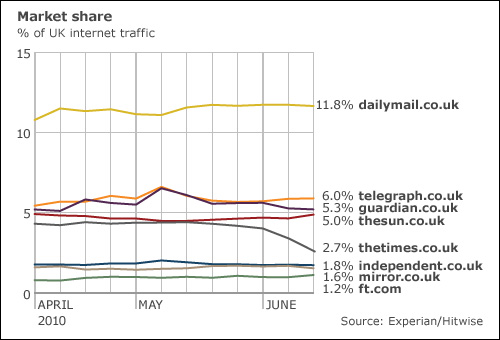
Notice anything? And need I point out that this graph reflects only the sign-up process – no money has so far changed hands. Now, to my eye that looks like The Times online has lost nearly half its readers in a month. And the curve doesn’t look like it’s intending to taper off anytime soon, and that’s before we get to the point of actual money being forked out. ((Quite interestingly, the curve visibly trends downwards well before the subscription requirement kicked in. I surmise that this indicates people started abandoning the Times pretty much as soon as they heard that it was going to start charging money. If I was head honcho, I would have taken this as an extremely worrying omen.))

Rory Cellan-Jones, on his blog at the BBC, has speculated that The Times really only has to hang on to about 5% of its former readership ‘to have the champagne corks popping in Wapping’. I predict that the readership will fall right through that number and bottom out at nearly zero. Rory puts his finger right on it in his post:

My suspicion is that the main problem with this experiment is what I’d call friction. Web users have got used to clicking simply from one page to another without hindrance. Any element of friction – the aggravation of having to pay or just log in – acts as an incentive to head elsewhere in a hurry. I tried an experiment this morning, posting a link on Twitter to an article by the very funny Times columnist Caitlin Moran. Plenty of people clicked on the link – but when they were taken directly to the Times pay-station, they all appear to have left without paying.

To anyone who’s been looking at web media for any length of time, this is truly a no-brainer. Why would you bother? Rupert is pinning all his hopes on one single idea: that people care enough about the quality of the journalism (and whatever else The Times has to offer) to pay for it. ((It also breaks one of the most important pieces of functionality of the web, and very few of the Old Guard understand this because it is such an alien concept to them: the ability to cross-link. Anyone who writes a blog (or anything written specifically for online diffusion) understands automatically how powerful a utility this is. The web is a ‘web’ because it builds itself on connectivity. If I want to write something on Tetherd Cow I can easily bolster my story with examples, references and asides that anyone can check instantly. But there’s NO WAY I can do that with the Times any longer. If I cross-linked to an article in the Times, my readers would simply behave as those in Cellan_Jones experiment, above. Murdoch’s idea is fundamentally destructive to the very foundations of the internet. Where we see the awesome power of the building up of information structures, he wants to create cloistered communities that he can control. This, in my opinion, is what will ruin him. He does not grok the net.))

Rupert, I’m sorry to say that the 21st Century is going to give you a bigger ass-walloping than you ever thought possible.

Let me explain it in a way that even Mr Murdoch might understand. Are you sitting comfortably? Very well, let’s begin.

Once upon a time, when horses and buggies were the fastest forms of transport and people cleaned chimneys by crawling up them with big brooms, accounts of what was happening in ‘the world’ started to get circulated via a system called ‘the newspaper‘. The newspaper gathered up a collection of what its publishers deemed the most relevant and interesting bits of news and gossip of the moment, and then distributed them to the community. The newspaper was a marvellous idea for its time, but, for all its charm and utility it did have some limitations: it was largely a local phenomenon, it cost money to make and deliver to the people who wanted it, and it had a kind of inbuilt time delay (if news happened, you had to wait till the next newspaper was made in order to know about it). But because it was a physical object, and it was a convenient way of learning about the latest goings-on in the world, people were prepared to pay some small amount of money to take possession of their daily newspaper. Plus, you could wrap fish & chips in it when you’d finished reading it. (It also had another limitation, but one that few people were aware of at the time: it was a one way street. That is, the newspaper could tell you things, but you could not reply to those things, nor enquire after their veracity.)

Eventually, after a few decades of news distribution of this form, a few cunning people realised that if they could gain control of the newspaper business on a large enough scale, they could earn themselves quite a bit of money. And so newspaper tycoons came into existence. The object of being a newspaper tycoon was to gather up as many small local newspapers as you could find, and either put them out of business, or amalgamate them into your empire. This concept made a small number of crafty men (for they were ALL men) very wealthy indeed. It had the added bonus, for those men, of giving them extraordinary political power, because after all, they controlled what people knew about the world. This state of affairs existed for the better part of a century, with the newspapers becoming more and more ubiquitous and the newspaper men more and more wealthy and more and more powerful.

But then, late in the 20th century, a completely unexpected thing happened – a wonderful piece of technology called ‘the internet‘ came along. The internet was really nothing more than a way in which everyone on the planet could easily and instantly talk to everybody else, no matter how geographically separated they were. It was a simple but powerful idea. And the more people who understood this idea, the more powerful it became. Before anybody really even knew what was happening the internet became connected to all kinds of places across the whole world, and people happily discovered that news and gossip and all kinds of other information could now be exchanged rapidly and for free. People liked that! And the internet was unlike the newspaper in one very important way: nobody ‘owned’ it and nobody could own it. ((You can bet your humidified Havana cigar that there are those who, if they’d known how it was going to turn out, would have moved heaven and earth to have gained control of it…))

So who do you think were the most unhappy about this state of affairs? That’s right – the newspaper tycoons. They were VERY VERY upset, indeed. People were talking to each other and learning about their world for free! What a terrible, terrible thing!

Thanks to their innate carnivorous business instincts, though, the tycoons became aware very rapidly that this ‘internet’ was something quite big and important, and they could see that people had taken to it like ducks to water. Unfortunately they could only see this through spectacles that had little dollar signs embossed all across the lenses, and so their vision was not very clear. The first thing they did was to nab themselves some real estate on this internet thingy. After all, it was FREE, what did they have to lose? Of course, the people who were already on the internet were happy to see their old friends from the newspaper business there and started visiting these new sites from the old guard – but they didn’t just hang out at one newspaper… oh no! They were now reading six or seven or maybe even ten newspapers, and not just newspapers from their home town either! And not only that, they were getting news from sites that weren’t actually newspaper sites but had news anyway, like blogs and ezines and social networks and all manner of other strange ideas! All for free!

The newspaper tycoons weren’t used to the concept of ‘free’. It was not something that was in their world view. When they said the word ‘free’, as they sometimes did, they meant ‘we’re giving you a nice little morsel but it has a hook hidden inside it’. The concept of ‘free’ as in ‘you can get it with no strings attached’ was as alien to the newspaper tycoons as was the idea of travelling economy class, so they looked upon what was happening on the Internet with a great deal of bewilderment and frustration. All these people were here doing stuff and hanging around but the tycoons couldn’t figure out a way to make money from it! How they hated that! How dare people amuse themselves!

So instead of making some kind of effort to understand what was going on with the Internet, as some of their cleverer and less mercenary colleagues did, the tycoons contrived to do the least effective thing possible: they attempted to make the Internet play by their Old Rules. Unfortunately, the people using the internet could see immediately that the Old Rules really suited no-one except the tycoons. The only option open to the tycoons now was to try and make their Old Way look more enticing than all the New Things the Internet was offering. They did this mostly by telling everyone how TERRIBLE the New Way was and how much BETTER the Old Way was. They said this loudly and often.

‘If you continue to get your news for free,’ they cried ‘You’ll only get TERRIBLE quality news. WE are the keepers of GOOD quality news!’

Unfortunately, the people using the internet already knew that this was a stupid and desperate tactic. They knew that not only was the news from the New internet way just as good (and sometimes even better) than the Old newspaper way, but that the Old newspaper way gave them TERRIBLE quality news as often as not too!

In spite of this obvious failing, the tycoons quite idiotically convinced themselves their argument was good enough to charge money for their Old News, just like they used to do when the world was all nice and simple, before smoking tobacco caused cancer and when it was perfectly acceptable to feast on endangered species of quail and unsustainable caviar stocks. And so they said to the Internet people:

‘Now we want you to PAY for our Old Ideas, even though we have made exactly NO CONTRIBUTION to this new way of doing things…’

Well, we’ll have to leave our story there for the moment, because the last words have not quite been written. I suggest that ‘Happily ever after’ is not on the cards for those old newspaper tycoons, though. They are facing the end of their dynasty and they stand, as emperors have often done, bewildered in the empty halls of their palaces while the revolutionaries hammer at the gates.

Will Rupert get his 5% faithful? Will the champagne corks be popping in Wapping? Will the line on that graph level out before it hits sea level? Six months is about what I think it will take to give us the ending to this story.


Cowpokes! The End is Nigh! Run for the hills! What with the threats of terrorism, biological warfare, solar flares, tsunamis, the flipping of the magnetic poles, an atheist woman as head of the Australian government and a black man as the head of the US government, it will be a MIRACLE if we last even another week! But, dear feiends, have no fear! Should one (or more!) of the aforementioned catastrophes overtake us, the folks over at Vivos have anticipated every eventuality for the approaching apocalypse and are offering the ultimate ‘life assurance’ and ‘the greatest chance of future restoration of the world as we know it, regardless of the catastrophe’.

Here – let them tell you about it in their own words:

Millions of people believe that we are living in the “end times”. Many are looking for a viable solution to survive potential future Earth devastating events. Eventually, our planet will realize another devastating catastrophe, whether manmade, or a cyclical force of nature. Disasters are rare and unexpected, but on any sort of long timeline, they’re inevitable. It’s time to prepare!

Vivos is a privately funded venture, with no religious affiliations, building a global network of underground shelters, to accommodate thousands of people. Vivos will provide a life assurance solution for those that wish to be prepared to survive these potential events, whether they occur now, in 2012, or in decades to come

Yes, by purchasing a share in a Vivos community bunker, or getting them to build your own bespoke shelter, you can survive the End Times and walk out refreshed into a world full of bracing post-catastrophe horror! To see what you’ll get for your money, you can take a tour around a typical Vivos facility, furnished with all the comforts of home, including attractive paintings of idyllic landscapes that you’ll never see again:

Geez guys, could you have found a more gloomy and depressing piece of music for that? Are you selling a shelter or a tomb here?

Seriously, no matter how hard I try, I can’t think of any calamity listed on the Vivos site that seems worse than ending up in some underground IKEA nightmare with a bunch of people who are inclined to believe that the world is going to end in 2012 ‘because the Mayan calendar says so’. ((You can watch a video on the Vivos site about how the ‘incredibly precise’ Mayan calendar (‘… a calendar more accurate even than our own’) predicts the world will end in 2012.)) Let me see: Electromagnetic Pulse? Nope. Killer comet? Nope. Planet X? Nope. Super volcano? Nope. ((I’m a little surprised to see that Zombie Attack and Alien Invasion aren’t featured, to be honest. If nothing else, they’d make for some really cool additional icons.)) I’d rather take my chances with any of those.

What are these people thinking? Have they never seen a post-apocalyptic movie? Have they never played Fallout? Do they really want to climb out of their bunkers after a year of mind-numbing boredom to find themselves wandering around a planet full of shotgun-wielding mutant vigilantes with no morals and bad personal hygiene? Or worse, Fundamental Islamic militia?

There are so many things wrong with this unhinged doom-laden vision that it’s hard to know where to start. From the hysterical countdown to annihilation (905 days, 06 hours, 31 minutes, 24 seconds remaining) to the hyper-paranoid ‘scenarios’ videos (Nuclear Terrorism! Surviving Anarchy! Secret Government Shelters!) the website plays out like some bad Hollywood projection of the Apocalypse. It takes mere seconds to find places where this plan will start splitting at the seams.

Take a quick tour around the Vivos Knowledge Base and see how many opportunities for failure you can find. The spectacular promises (hydroponic gardens to support 200 people for more than a year, 24 hour power generation with supplemental wind and solar, hotel-style amenities, impregnable defences to resist volcanic eruption, seismic disturbance and biological contamination) fairly reek of hyperbole. ((For a start – where are they getting their air from? Filtered air from outside will be useless in a case of chemical attack, and it’s not like they can stockpile a year’s worth of oxygen for 200 people…)) Half these things are all but impossible to achieve. And if Vivos doesn’t deliver, what are you going to do when the anarchist Muslim terrorist bio-freaks come pouring through your Vivos shelter airlock? Ask for your money back?

Tetherd Cow Advice: If you’re worried about the Apocalypse arriving in 2012, ((You can bet your Nigerian fortune that I’ll be revisiting all these predictions in 2013!)) stock up on single malt whisky and plan to be somewhere with a good view. In the meantime, send me your bank account details. After all, you can’t take it with you.

___________________________________________________________________________

Big thanks to Atlas for bringing Vivos to my attention.

A recent Cow commenter, Nancy, from Sweden, tells us that ShooTag is now on sale in her country. ((And TCA saved her some money! Like any good sensible person she did some research before she forked out.)) A quick lookup verifies that yes, the ShooTaggers are making inroads into Europe with the same unfounded claims of efficacy for their product as they’ve used elsewhere. Clearly, the critical faculties of the world are in dire trouble. I even turned up this link (page has been redacted by ShooTag revisionists) which trumpets that the Finnish Olympic Team ‘is now using shoo!TAG products for protection against mosquitos !!!’ I fervently hope that this is an idle boast from the sales agent and that the Finnish Olympic Team is not so stupid as to endorse this silly item.

My friends over at the JREF have pointed out, though, that Europe might not be the virgin territory that the ShooTaggers perhaps expect. Yes folks, Europe has their own flavour of pet wootag and it’s called The Anibio Tic-Clip®.


Anibio appears to be a German company but handily, they do have a link to a pdf in English on their site which ‘explains’ how Tic-Clip works:


Ready-to-use tic-clip tags are carrying a specially charged layer of highly radiating, bioenergetic with a very high storage capacity. (Bioenergetic = dextropolarised electromagnetic energy). This creates a special oscillation-field around the tag and thus around the animal. Tics and fleas will not react to the animal anymore.

Whoa! Dextropolarised! Now there’s a word you don’t hear every day. You can look it up if you want – I did – but really, it’s one more instance of a new contextually-meaningless woo buzz word like ‘quantum’ or ‘magnetic’ and I won’t labour the point here. You can already tell that this ‘scientific’ explanation is just another load of baloney in the same vein as the ShooTag nonsense. And this one works without a clumsy magnetic strip! ShooTag! Your technology is so-o-o-o yesterday!

The pdf also urges the visitor to read this important information: ((We assume it’s important because the exhortation has lots of exclamation marks.))

This product was developed after many years of research together with the Germany based company Hess & Volk GmbH and has archived spectacular success in tic and flea prevention all over Europe. Many successful breeders are using it. Similar to holistic approaches you are unable to see or feel ((…or, in fact, determine any effect of…)) the Bioernergetic potential, but the positive results over the last couple of years are proving the strength of this toxin-free solution.

If you thought that the highlighted and underlined areas might prove to be a link to Messrs Hess & Volk’s ‘archive of spectacular success in tick and flea prevention’, I fear you will be bitterly disappointed. That would be altogether far too convenient. In fact, searching on Hess & Volk turns up lots of links pointing back to Anibio, but not much else. Now where oh where might we have seen that kind of behaviour before?

Elsewhere, an American distributor of Tic-Clip has some more enlightenment for us:

The mechanism of the Tic-Clip’s action is a bit abstract when compared with the traditional insect repellents, but this product is the result of many years of research and delivers results that dispel skepticism. Holistic products that work similarly with bioenergetic fields, like flower essences and homeopathic remedies, still lie outside the mainstream, but devoted users will tell you that the results can be truly amazing, even without their really understanding exactly how they work.

Hahahaha! The mechanism is a bit ‘abstract’? Judging by the rest of the paragraph, I think the phrase they’re looking for might be ‘The mechanism is a big steaming heap of claptrap’.

Still, maybe something’s being lost in interpretation here? Let’s go to the original German Anibio site with our friend the Babelfish and get it straight from the mund des pferdes.


Oooh. There’s a graph. That’s scientific. It’s supposed to be showing us how the Tic-Clip’s effectiveness works over time. With an efficacy of 2 years at a price of €24.90 (US$36.39) it’s MUCH better value than ShooTag’s measly 4 months for US$39.95! What does Babelfish tell us that the manufacturer is offering for that money:

Ready for use TIC tie-clip supporter contains an bioenergetic load, a special layer with high radiation potential and has a high storage capacity. In the surrounding field of the supporter, and thus in the environment of the animal (independent of its size and kind of skin), develops then a special oscillation field, which protects now dogs and cats against Zecken and fleas. The TIC tie-clip supporter is fastened with the attached rings to collar or table-ware (material plays thereby no role). On the time, on which a ring is drawn by the supporter, the TIC tie-clip up to 2 works years

OK… that’s making about as much sense as anything else we’ve read I guess. Once the Tic-Clip is properly fastened to the table-ware, it does seem to offer everything that ShooTag does at least. The Tic-Clip appears to be more robust too: the site has some caveats on effectiveness, but they don’t include the lengthy excuses that ShooTag provides for conditions under which their product might not work.

So the Tetherd Cow Ahead shoppers’ advice is: If you’re on the lookout for a completely useless product that does absolutely nothing in the way of keeping insect pests off your pets, there’s no contest – you get hugely better value for money by wasting your cash on Anibio Tic-Clip® than you do on Energetic Solutions Shoo!TAG™ ((I really wonder what the ShooTag people make of something like this. Do they scoff at the opposition: ‘That’s SO far-fetched! Look at the dumb claims they’re making! That will never work!’, or do they gaze on in envy: ‘How are they doing this without a magnetic stripe? How the hell are they achieving a 2 year efficacy? Can we steal their technology?’. My brain does little flip-flops when I try to imagine how these people think.))

As we have seen in numerous posts on The Cow, pseudoscience veritably thrives in all those places where complex processes have subjective outcomes. It does especially well if those outcomes promise big rewards of money, fame or health. One outcome that is primed for exploitation is vanity, and although we’ve covered quite a few areas of jiggery pokery, one that hasn’t made an appearance up till now is the multi billion dollar cosmetics industry. Since it deals with highly subjective issues of appearance, youth and beauty, you can bet your lash-lengthening mascara that we don’t have to look very far in this field before we stumble across hogwash.

A couple of nights ago on tv I saw an ad for a skincare product by Estée Lauder called ‘Advanced Night Repair – Synchronized Recovery Complex’ ((You can almost feel the copywriters hammering that one out…)) that boasted that its wonderful skin revitalizing technology was ‘inspired by DNA research’. Hahahaha! ‘Inspired’ by DNA research! It was such a piece of waffle that it even had Violet Towne, Vermilion and Viridian hooting with derision. ((It has to be said that I’ve taught them well.)) The crux here of course is that ‘inspiration’ means absolutely toss-all as a credential. I could claim that Tetherd Cow Ahead is ‘inspired’ by Shakespeare but that doesn’t mean that it’s:

•As good as Shakespeare
•Similar in content to Shakespeare or, in fact,
•That it has anything to do with Shakespeare whatsoever.

It could simply mean that I read some Shakespeare and thought: ‘That old Shakespeare was a clever geezer, wasn’t he? You know what? That’s inspired me to start up a blog!’ You could never prove one way or another that this wasn’t the case. The trick is that the makers of this product can happily tell you that they were ‘inspired’ by DNA research (which sounds like it could be impressive) while simultaneously telling you nothing at all.

With that in mind, I did a search for beauty products ‘inspired by DNA research’ and came upon a treasure trove of nonsense. The first stop was a product called PerfectSkin™. Of course the first thing I did was visit the PerfectSkin™ science page, because, as we all know, the science pages of people who are trying to sell you fantastical promises are always good value. I suggest you go to the Perfect Science Labs™ page now and take it in. There will be a quiz when you get back.

OK. Did the pictures of serious (but attractive) women in lab coats and masks convince you? No? How about the blurb:

Perfect Science Labs worked with world renowned chemist and skincare scientist Dr. Ron DiSalvo to incorporate the most recent groundbreaking discoveries in skincare, including patented ingredients to create PerfectSkin’s miracle breakthrough 3D BioRepair Complex. This revolutionary complex inspired by DNA research contains a blast of powerful vitamins, antioxidants, and a patented newly discovered exotic plant enzyme, OGG-1 (8-oxo-guanine DNA glycosylase), that kill harmful free radicals, which attack and damage your healthy skin. ((All emphases in the original))

Jeepers creepers! That sounds like it’s the answer to all of humankinds’ most pressing problems, don’t it!

It appears that when you’ve run out of words like ‘quantum’, ‘magnetic’, ‘energy’ and ‘vibration’ to describe your new dubious product, the newest, hippest, most phantasmagorical epithet you can now add is that it’s ‘3D’. Just excuse me while I fall on my corkscrew. Could there be any more meaningless a grab for credibility? Well, yes, I guess the quickly following ‘inspired by DNA research’ shows us that there can. And if you’re looking for enlightenment in the next bit where ‘OGG1 kills harmful free radicals’, well, let me save you the effort – there ain’t any.

OGG1 is an enzyme implicit in cell repair but evidence for its efficacy as a topical agent is dubious at best. It certainly doesn’t ‘kill’ free radicals. Being about as chemically simple as you can get, free radicals are not actually alive under any interpretation of the concept. ((The terms ‘free radicals’ and ‘antioxidants’ have become buzzwords. If you ask most people about those things they will almost certainly have the view that they are things that are not good for you. But if you ask them why they think that, you’ll find without any shadow of a doubt that they have inherited the notion from the advertising of cosmetic and ‘health’ related products. Try it. You’ll see how right I am!)) And anyway, there is much debate about the role of free radicals in respect to human health. The evidence that they cause the kind of aging damage that was once suspected is currently being challenged.

Elsewhere on the PerfectSkin™ site we find the ubiquitous testimonials page. As we have seen with other purveyors of pseudoscience like Shoo!TAG, testimonials are absolutely indispensable when you don’t have actual science on your side. I’d like to reproduce one of the ‘Before & After’ comparisons here for you, but intellectual property issues cause me to err on the side of not getting sued. Go there now and look at any one of the testimonials before reading on.

Without exception, every one of these ‘Before & After’ examples is deceitful.

•Before: Ambivalent expression; bad lighting; shiny face; no makeup.
•After: Happy expression; flattering lighting; professional makeup job; in some cases, digital retouching.

My personal feeling is that if someone is prepared to lie to me quite so badly that I can detect it in seconds, why would I trust anything else they have to say, especially when it invokes technical concepts that are complicated and leave acres of wiggle room?

This kind of deception is not only common in the cosmetic industry, it almost seems de rigueur. Searching further on our term ‘inspired by DNA research’ brings up all manner of doublespeak and flim flam. There is so much of it that I could probably start up a blog completely dedicated to the subject. You can venture on for yourself if you so desire. But before we finish, I’ll leave you with one more colourful example:

This is Morrocco Method Simply Pure Sea Essence Shampoo.

This synergistic blend of enlivened, charged botanicals and hand-picked herbs are mixed, blended, and bottled according to the moon cycles used by ancient farmers.

For the Morrocco Method Sea Essence Shampoo we go to the sea waters off the coast of Brittany, said to be among the cleanest waters on earth. We combine ocean water with living sea plants: algae, kelp and seaweed. Ocean water is practically identical to human blood plasma. Sea vegetables have a uniquely high level of DNA, RNA, and nucleic factors, the building blocks of life itself. As well, this shampoo is chock full of silicon which promotes healthy growth.

Bwahahahaha! What fun. Let’s deconstruct that, shall we:

•‘This synergistic blend of enlivened, charged botanicals…’

What the fuck does that even mean?

•‘…bottled according to the moon cycles used by ancient farmers.’

And that is efficacious… how?

•’…the sea waters off the coast of Brittany, said to be among the cleanest waters on earth’

‘Said’ by whom? Your mum?

•‘Ocean water is practically identical to human blood plasma.’

Well, yeah, depending on your definition of ‘practically identical’. As in ‘Tetherd Cow Ahead is practically identical to the combined works of Shakespeare.’

•’Sea vegetables have a uniquely high level of DNA, RNA, and nucleic factors, the building blocks of life itself.’

I don’t think they have a clue what they’re talking about here: ‘a uniquely high level of DNA’? What does that even mean? And anyway, by inference, WHAT, exactly?

•‘As well, this shampoo is chock full of silicon…’

If it was ‘chock full’ of silicon it would be a bottle of sand (and anyway – isn’t it already chock full of DNA?). ((I have a suggestion for the makers of Morrocco Method – why not consider homeopathy? Then the product doesn’t have to be chock full of anything. In fact, the less chock full it is, the better!))

•‘…which promotes healthy growth.’

Silicon promotes healthy growth? Why? There’s no silicon in your hair! We’re carbon-based lifeforms you idiot.

Yes folks, no matter how many flavours of silliness you want, the cosmetics industry has them all!


« Previous PageNext Page »