The Minister of Transport
Melbourne,
Victoria
March 2, 2012

Dear Sir or Madam,

I am writing to you this morning in an effort to obtain an answer to a question that has been puzzling me since I moved to Melbourne around five years ago. The house where I live is situated in leafy surroundings near a large park. Mostly it is very quiet here, especially at night. Quietness is a really good thing for sleeping.

There is a railway line across the road from my house. It is not a hugely busy line, but it does have a fair amount of domestic train traffic. I really like the sounds of the passing trains, and even when they start up at 4.30am for the weekday task of ferrying commuters into the city, the rumbling whoosh as they go by does not really bother me, nor interfere with my sleep. The same can be said for the late night trains that run until 1am.

Directly across from my house on the railway tracks is a foot crossing. This crossing has automated closing gates and a warning alarm that sounds a full minute or so before the train reaches the crossing. This system adroitly prevents pedestrians from walking out onto the train tracks when the train is approaching. Indeed, I have observed the system’s effectiveness on many occasions. Typically, people approach the crossing, hear the warning sound and see the gates close. They then stop and wait patiently at the closed gate. To inadvertently continue onto the tracks, they would not only need to be completely deaf, but to also accidentally scale a meter high gate. To my knowledge no-one has so far missed these fairly obvious indications that a train is imminent.

Here is my question, then, Minister: given that there is a very successful method in operation to prevent people from walking into the path of an oncoming train, WHY DO THE FREAKIN’ TRAIN DRIVERS FEEL THE NEED TO BLAST THEIR VERY LOUD HORNS IN FRONT OF MY HOUSE?

In the first place, the sounding of the LOUD horn appears to me to be entirely redundant given the existing safety system. Itinerant nocturnal ramblers are already waiting quite immobile at the closed gates well before the LOUD horn has rent the peaceful silence asunder with its brassy shriek. I could perhaps embrace the concept that the LOUD horn is an ‘extra’ precaution – a better-safe-than-sorry flourish, if you like – were it not for the fact that this ear-frakking aural event usually happens at a point about 8 meters from the crossing. This is so close that it seems to me to be entirely useless for any practical purpose. Here is a diagram to help you visualize the situation, Minister (this is a daytime image, but it may be more instructive if you could imagine it as a nice moonlit night, delicately pointed with the soft chirrup of crickets):

And here is a movie I took this morning of a train approaching the crossing with its closed gates (there were no pedestrians at this time, either at the gate or staggering bewildered across the rails).

If we assume that the train is travelling at a modest 40km per hour ((They probably travel faster than that, in my estimation.)) then by my calculation it covers that 8 meters between the time it blasts its LOUD horn and the pedestrian crossing in something less than a second. Are you familiar with the African cheetah, Minister? The African cheetah is the fastest land animal in existence. It can run at an astonishing 120km per hour at top speed. That’s 3 meters a second. Here’s a picture of a cheetah running:
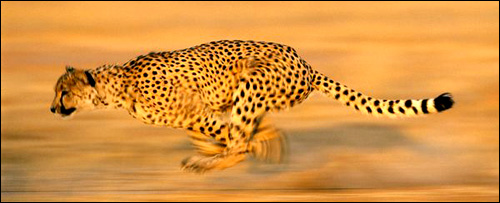
Minister, if an African cheetah happened to be on the railway tracks in front of my house as a train approached and sounded its LOUD horn a mere 8 meters away, it is doubtful that even it would have a chance of reacting to the event and escaping unscathed.

A human being at peak fitness can run at a top speed of about a third that of a cheetah. I don’t see many human beings of peak fitness in these parts. I think you can probably see what I’m getting at here.

Now, you may be tempted to tell me, dear Minister, that the Blowing of the LOUD Horns is standard operational practice throughout the Melbourne suburban rail system. You might venture to offer the explanation that drivers are instructed, as a general rule, to sound horns at crossings and stations as a commitment to the security of the community, and that they simply reflexively carry out the action unaware that some crossings already have adequate safety precautions installed. And I might be tempted to believe that explanation except for one small thing: the Blowing of the LOUD Horns is completely ad hoc. Sometimes the LOUD horns are sounded, and sometimes they are not. By my reckoning, about 6 in every 10 drivers feel the need to shatter everyone’s eardrums, mostly in the pre-dawn period. Horn blasting would appear, then, to be completely discretionary. ((It’s probably unnecessary to point out that this happens with trains travelling in both directions, but I’ll point it out anyway.))

I understand that you are a busy person, Minister, and must have many issues on your plate, so, in order that I get some idea as to why I must be jarred from my sleep repeatedly through the early hours of the morning by the shriek of MetLink banshees, I have prepared my question with answers in a multiple choice form below. I would appreciate it greatly if you could tick the appropriate box and send your reply back to me at your earliest convenience.

_____________________________________________________________________________________

Our suburban train drivers blast their LOUD horns a mere 8 meters from the pedestrian railway crossing because:

Isn’t everyone already awake at 4.30am?

We spent money on installing horns so we have to justify the expense.

What else is there to do when you drive a train?

Silence is an abomination.

We hate the people who aren’t travelling on trains as much as the people who are.

Train drivers have no comprehension of physics and/or acoustics.

Train drivers have excellent comprehension of physics and/or acoustics, and are evil.

We have shares in sleep clinics.

We are attempting to address the Melbourne cheetah problem.

We are attempting to address the Melbourne obesity problem.

There is no good reason. It’s quite ridiculous and I’ll put a stop to it immediately.

_____________________________________________________________________________________

I look forward to your speedy response,

Yours Sincerely
The Reverend Anaglyph
Church of the Tetherd Cow
Melbourne
xxx

Today’s interesting tidbit comes to you, dear readers, courtesy of Acowlyte Essence De La Grenouille who I’m sure will not mind being affectionately referred to as Froggy.

Froggy’s local news source carried this rather intriguing advertisement which promises the delights of an Australian skincare product called MooGoo, an unguent which, the makers say, is ‘adapted’ from a cream used on dairy cow’s udders ‘to keep them in good condition for milking’. For reasons which are not entirely clear, this gives it excellent credentials as an effective skin treatment for humans. ((This falls in the same category as the ‘Baby’s Bottom’ analogy. It’s an advertising ploy that works on the principle that if it’s kind to a baby’s bottom/cow’s tender udder, then it must be gentle on your skin!))

Apparently MooGoo is ‘an Australian phenomenon’. It’s not phenomenal enough to have reached my ears, but I guess I’m not really in the target market so maybe it’s not overly surprising that I’ve never even heard of it. The MooGoo makers like to wax lyrical about the product’s use of ‘natural’ ingredients. Here, let me quote from the text of the MooGoo advertisement in Froggy’s newspaper:

[MooGoo] is made from only natural ingredients including edible oils such as almond oil, olive oil, rice bran oil and lots of other skin repair ingredients…

Well, not really much news there if you know anything about skin creams. In essence, MooGoo is selling a compound based on vegetable oils rather than on the petroleum-derivative oils that some other skincare products use. ((Petroleum derivatives are essentially vegetable oils anyway, formed as they are from the compressed deposits of million-year-old plants. It’s all just carbon semantics in the end.)) Since there are about, oh, a BILLION skincare concoctions that use vegetable oils, the main selling point of MooGoo basically still comes down to the cow udder thing.

Of course, being the good researcher I am, I visited the MooGoo site. It’s pretty harmless as these things go. They make a big deal about how their product is ‘natural’ ((The use of the word ‘natural’ in relation to these kinds of products is banal and stupid, and a pox on our modern sensibilities. The definition of mineral oil that makes it ‘unnatural’ also renders evening primrose oil unnatural. They both ultimately come from plants, and are acquired through a mechanical process. In the same way that it’s not wise to drink a glass of mineral oil, it would be inadvisable to drink a glass of evening primrose oil. Likewise, a dab of evening primrose oil on your hand is likely to have about the same consequences as a dab of paraffin.)) and harp on rather a bit too much about their lack of gimmicks. I think they must own a dictionary that has a different definition of the word ‘gimmick’ to mine, because I’m not really all that sure what they mean when they say things like:

MooGoo does not use gimmick ingredients and marketing…

You can, perhaps, see my amusement here: using vegetable oil ingredients is no big thing for a skin lotion, so the main point of difference between MooGoo and other similar products is the marketing angle that this marvellous substance comes from a treatment for cow udders. Which is, by any account, a gimmick.

As part of the MooGoo ‘we’re completely natural’ pitch, the front page of the MooGoo site features a video which claims to show ‘how most moisturisers are made’. It’s light-hearted and funny, but when the pretty-but-amiably-goofy spokeswoman starts talking about the evil that is in products-that-are-not-MooGoo, it becomes deceitful.

She gives us a demonstration of how sorbolene, commonly used in a variety of cosmetics, is made from paraffin oil, water and an emulsifier. But, she warns us sternly:

Paraffin oil is actually a flammable petroleum oil. Let me demonstrate.

… and then sets fire to a wick saturated with paraffin, which burns obligingly.

You’ve gotta wonder how many people are aware that those nicely packaged creams are made from a flammable petroleum oil. I’m sure that if they did know, they wouldn’t be very comfortable putting this on their skin, let alone their baby’s.

You’ve gotta wonder how many people fall for the old ‘scare-them-with-hellfire’ ploy.

Ms MooGoo continues:

We aren’t saying this cream is dangerous…

Really? Then it’s a little perplexing as to the point of the fiery demonstration and the conjoined images of a burning wick and a naked baby that follow. The implication is, by any reckoning, that the stuff you find in ‘other’ skin care lotions is related to petrol and therefore ouchy burny. MooGoo, we learn, is made from much less threatening stuff – like sweet almond oil, evening primrose oil and olive squalane.

Let’s see now… would that be the same sweet almond oil that is not merely combustible, but poisonous and a highly dangerous eye irritant? Or the evening primrose oil which is, like most hydrocarbon-based substances, also combustible? Or perhaps the olive squalane which, aside from also being a flammable hydrocarbon, is a saturated analog of squalene, a biochemical precursor to steroids? Would you be comfortable putting these on your baby’s skin? If that’s not scary enough, MooGoo almost certainly contains DHMO (Dihydrogen monoxide) a substance which can be highly toxic to humans.

Did you see what I did there, Acowlytes? I selectively chose negative consequences of the substances concerned and presented them as the most important aspects of those substances. I mixed my argument with conflated associations and a little scary-sounding scientific language et voilà! – a picture of MooGoo that makes it sound as daunting as the products it derides. In the same way that the MooGoo video is careful to not actually lie, nothing I wrote is untrue. It’s just couched in such a way as to give the reader a strong unfavourable image.

As these things go, MooGoo is a pretty harmless example of flim flam. I really have nothing against this kind of product. It probably works as well as anything else you could buy of this nature. What annoys me, though, is the way the makers of MooGoo claim to be different to (and superior to) the other products they compete with, but then go and use pretty much exactly the same hocus pocus as everyone else to sell it. The fact is that every single one of these kinds of ‘moisturizing’ products, be they derived from paraffin or olives or almonds or turtles, ((Oh yes…)) works on the exact same basic principle – putting oil in your skin. Aside from a thousand relatively trivial differences, the major thing that differentiates one from another is the hyperbole and sleight-of-hand that advertisers use to sell them.

Today marks 8 years since my beautiful Kate died. Rest in peace my sweet.

Nidiffer Pedagogiek contacted me today with this important message. I can’t decide which bit of it I like best.

From: Notification
Subject: Valentine’s Day 2012
Date: 17 February 2012 10:17:43 AM AEDT

Gaily for reverend

He was burning hot.

Proposal area: Rush in Now

Really your,
Nidiffer Pedagogiek.


I am genuinely curious about how human minds work. I am particularly curious about how religious minds work, because they seem to be able to quite easily hold multiple contradictions simultaneously, and not have a problem with doing so. Religious people frequently attempt to argue using ‘logic’ when they have, by accepting a completely illogical premise (ie, the existence of a supernatural being who cares about the affairs of humans), abandoned all structures of logic. Perplexingly, they seem completely unable to understand the paradox inherent in this pursuit.

Take this opinion piece penned by one Simon Smart for the Sydney Morning Herald over the weekend. You should really read it to get the full flavour of its absurdity, but I will synopsize it for those who don’t have the time.

Mr Smart attempts to hijack the old maxim that ‘The quickest way to a man’s heart is through his stomach’ and use it in the service of a religious argument. He is basically claiming that humans, unlike other animals, ((This, as many biologists will tell you, is not necessarily so. Some animals have acquired simple preparations methods when eating food. Japanese macaques, for instance, like to wash their food before eating it, and have even adopted a preferential habit of doing this in sea water (rather than river water), presumably because they like the seasoning taste.)) have rituals that surround food and this (somehow) means we are chosen by God. Or something. I’m sorry if I sound confused – it’s because I am.

Of course humans have complicated rituals involving food. We have complicated rituals involving everything. We have complicated rituals involving killing one another – is that God’s handiwork too? It’s banal to observe that humans do things that are different to other animals, and to infer that there’s something ‘miraculous’ about this is simply an awkward manifestation of 19th century thinking.

I have to snip a quote from Mr Smart’s daft noodling:

Imagine for a moment a dinner party of old friends. There’s a scientific way of analysing all that transpires at this dinner – plenty that the biochemists, anatomists, physiologists and neuroscientists could describe – regarding chemical processes of the body and brain that are astonishing in their complexity and intricacy.

But such a description wouldn’t even come close to telling us what’s going on. One guest can’t quite manage to lose the acidic feeling in his stomach as he tries and fails to forget the precarious state of his business. Another diner, perennially proud of her successes, feels an even warmer glow of satisfaction than those drinking the bottle of Grange she came armed with. The host, enlivened by the wine, smiles at his wife across the table and thinks how much he still loves her after all these years. Another, at the first mouthful of her favourite dessert, is lost in thought as she nostalgically recalls her childhood family kitchen.

You see what he did there? It’s a familiar piecer of religious prestidigitation – a classic strawman argument. He sets up science as a cartoon bespectacled-people-in-labcoats caricature (the hoary old ‘science is cold and clinical and concerned only with mechanical things’ cliché) and then conjures up a whole lot of things that he says science can’t explain because… well, it just can’t. He divides the world (quite arbitrarily) into things that he considers are the domain of science and things that he considers aren’t, just as we saw biologist Francisco Ayala do a little while back. Also familiar is the call to emotion, which he continues in the next sentence:

Is this interaction of memory and emotion to be thought of as singularly physical and material in nature?

Um, sure, why not? All Mr Smart is doing here is drawing an arbitrary line that removes memory and emotion from the world of the ‘physical and material’ because he’s not comfortable with that idea, and he’s appealing to his reader on the same basis. Scientific examination does not know or care about this kind of discomfort which is precisely why it’s so reliable. We know with absolute certainty that memory and emotion can be altered and controlled by physical processes, and these things can be demonstrated scientifically. Mr Smart is either ignorant of the scientific explorations of these things, or is wilfully ignoring them. Either way it makes his opinion valueless.

Smart goes on to perpetuate another vacuous stereotype, referring to Philosopher Leon Kass’s ‘The Hungry Soul’:

Kass suggests there is a huge gap between the ethically sterile nature as it is studied by science and the morally freighted, passionate life lived by human beings.

It makes me really mad. Examining the world through science is, in Simon Smart’s painting of it, ‘ethically sterile’ and by inference, morally vacant and lacking passion. This, of course, is not an accurate representation of the truth, but instead is a bogeyman that religious thinkers are compelled to raise in order to reserve the domain of morality and ethics for religion. Whenever I encounter this argument these days I almost find it embarrassing for the person promoting it. It is perpetuated solely with the purpose of cementing it in the minds of less rigorous thinkers.

Mr Smart ends his article with a story about his daughter returning from hospital after a burst appendix and three operations:

She was frail and pale, and we immediately set about building her strength. As a family we ate together, cheered her recovery, took photos and gave thanks for doctors, nurses and supportive friends. It was a special moment, a coming back to life. It felt almost sacred. Or was that, as some would have it, just my brain chemistry messing with my head?

How many addled misconceptions are contained in that tale? Who engineered that ‘coming back to life’? Scientists! A process that was once the ‘domain of God’ – the mysterious, ineffable ‘miracle’ of life and death – is now commonly administered by rational thinkers. The fact that Simon Smart and his family even knew how to go about building their daughter’s strength is due to science. If they’d trusted that whole process to God, no matter how much fervent praying they did, I think we could quite reasonably conclude that their daughter would most likely now be dead.

Simon Smart has quite obviously allowed his brain to accept that science can acceptably achieve some ‘miracles’ (no doubt rationalizing the circumstances by allowing that God is in charge anyway) but arbitrarily forbidding it from others.

He resists the idea that brain chemistry ‘messes with his head’ because it simply doesn’t ‘feel’ right to him. He says elsewhere that:

…most of us resist being spoken of in such reductionist terms.

The fact is that the universe doesn’t care how much we ‘resist’ the idea. ((The argument via reductionism is problematic anyway. We already know that complex systems can arise from very simple sets of basic circumstances, so reductionism per se is not the QED that religions like to assert. To invoke particular ‘specialness’ in humans because they exhibit a high level of complexity requires the continual re-drawing of boundaries. As our description of living organisms becomes more detailed, religious appraisal of what constitutes this specialness is forced to make more and more compromises just to preserve God’s input. We see exactly the same thing in cosmology.))This specialness that he thinks he has – a specialness that somehow elevates him above all other living things – is purely an invention of human thought processes (and peculiarly antiquated thought processes at that, as I have said). There is nothing that we see in the natural world that gives credence to this belief other than the human conviction that it is so. Mr Smart doesn’t want to think of himself as a mess of chemical and electrical interactions for the simple reason that he’s already formed the opinion that he isn’t. And that’s all it is: an opinion. The position is certainly not defensible via observation or rational appraisal.

Simon Smart is completely entitled to have an opinion, of course, but I just wish he wouldn’t attempt to pass his superstitious speculations off in the guise of logical argument, while simultaneously denying logic the right to examine those very same speculations. ((Mr Smart needs to spend some time reading (and making an effort to understand) beautifully written and coherent essays such as this one.))

« Previous PageNext Page »