7 Famous Mirrors (cont)

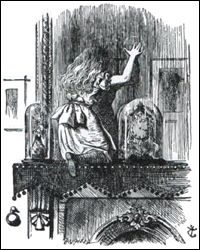
•4: Alice’s Looking Glass.

Tenniel Illustration from Alice in Wonderland

Through the Looking Glass, and What Alice Found There is, as I’m sure everyone knows, the sequel to Lewis Carrol’s Alice’s Adventures in Wonderland. The book is littered with references to mirrors, beginning with Alice’s speculation (in a conversation with her cat – hmmm…) on what might lie on the other side of her drawing-room mirror.

In the manner of a true scientist, Alice’s conjectures quickly turn to experimentation and she finds that, with a minimum of effort, she can actually pass right through the mirror to the reflected world beyond.

Before long she discovers a book containing a poem:

YKCOWREBBAJ

sevot yhtils eht dna ,gillirb sawT`
ebaw eht ni elbmig dna eryg diD
,sevogorob eht erew ysmim llA
.ebargtuo shtar emom eht dnA

Which of course can only be read with the help of a conveniently handy mirror.

Indeed, the poem might well have been penned by our old friend Leonardo da Vinci, whose notebooks were famously written in a ‘mirror’ hand.

You’re probably thinking ‘Let’s see The Reverend include Leonardo in another installment of 7 Famous Mirrors!! Aha! As we shall see, Leo had more than a little part to play in the next of our mirrors…

SGM & The Hypnotic Flame

The Continuing Misfortunes of Simple Graphics Man ~

#23: The Fascinating Flame.

You know that nice hypnotic, trancy kinda feeling you get when you look into the flickering flames of a fire and you just want to stay there and watch, and your mind floats away all warm and comfy-like…

___________________________________________________________________________

Thanks Pil!

___________________________________________________________________________

7 Famous Mirrors (cont)

•3: Perseus’ Shield and the Gorgon.
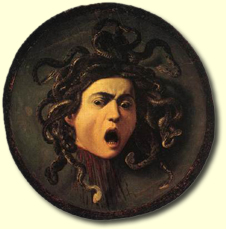
Medusa

And while we’re on the subject of polished shields…

Imagine the Reverend as a young whippersnapper sitting in art class. The earnest teacher is holding up a print of Caravaggio’s Medusa and waxing rapturously about the wonderful ‘circular form’ of the composition. She holds this painting to be a perfect example of the ‘circular form’ and blah blah blah blah… the young Reverend’s attention wanders to a box kite that he can see floating off in the distance above the sports field.

It was some years afterward in Florence that the genius of Caravaggio (or someone else – read on…) revealed itself to me. I was wandering through the corridors of the Uffizi when I came upon the original painting of Medusa that I’d seen in school. But not on a flat canvas as I’d always assumed. As the myth goes, Perseus couldn’t look at Medusa directly lest he be turned immediately to stone. To this end, Caravaggio painted the severed head of the Gorgon as we know Perseus would have seen it – reflected in his polished shield, shrieking in outrage as it flies away from his flashing blade (and its former neck). Of course it’s a great example of circular form – because it’s actually painted on a real circular shield†, a detail that my teacher either didn’t know, or failed to pass on in her enthusiasm for Caravaggio’s technique.‡

She also neglected to tell the most interesting part of the story, a snippet that would have certainly regained the attention of the young Reverend because it concerned a personage with whom the young Reverend was most intrigued.

Caravaggio’s painting of Medusa is famous, but it’s not as widely known that there is said to have been a previous, and therefore more original, version of the exact same idea, executed by none other than Leonardo da Vinci.

The story of its existence is recorded by Giorgio Vasari, a 16th Century Italian architect and painter of moderate artistic accomplishments better known for his biographies of many other artists of his age. Among other things Vasari coined the term ‘Renaissance’ and wrote his Vita da Leonardo, a kind of Leonardo, This Is Your Life!

In the Vita, Vasari tells the story of a shield, or buckler, that was brought to Leonardo by his father for decoration. It appears that Leonardo was rather uncomplimentary about the workmanship of the shield, which was made by a peasant in his father’s service, but went on to make the best of a poor opportunity:

And afterwards, having given it a coat of gesso, and having prepared it in his own way, he began to think what he could paint upon it, that might be able to terrify all who should come upon it, producing the same effect as once did the head of Medusa.

Way to go Leo! He’s asked to decorate some homeware and chooses for a subject something designed to scare the shit out of viewers. Even as a young whippersnapper I knew that Leonardo da Vinci was my kind of guy.

The finished result, for which Leonardo derived inspiration from “…lizards great and small, crickets, serpents, butterflies, grasshoppers, bats, and other strange kinds of suchlike animals”, was, according to Vasari, so terrifying that Leonardo’s father, Ser Piero, was taken aback with fear “not thinking that it was the buckler, nor merely painted the form that he saw upon it…” but the real thing!

Ah, those were the days!

It is not known what happened to the Leonardo buckler. Most likely Leonardo’s mum took one look at it and said to Ser Piero: “You put that thing in the cellar! I won’t have it in the loungeroom scaring the bejeesus out of my whist club! Tut. I don’t know. Where did we go wrong with that boy?”

If indeed the Leonardo shield was ever anything more than an apocryphal invention Caravaggio would certainly have known about it. When he was commissioned to do a version by his patron, Cardinal Francesco Maria Del Monte, the unspoken challenge to the painter would have been – “C’mon, Mick, old son, let’s see you top Leo’s effort!”

___________________________________________________________________________

†In the Uffizi, the Caravaggio Medusa is displayed on a stand so that you can walk around it. It’s actually a real shield, although made of wood and not reflective brass (of course). The head is painted on the interior concave surface as Perseus would have had to have seen it, and is so masterfully done that it appears to be floating in space. It’s hard to convey the sense of delight that I had on realizing just what Caravaggio had done.

‡In my research for this piece I discovered that I’m not the only one who didn’t know that the Medusa is painted on a wooden shield. The method and medium is widely misunderstood to be ‘oil on canvas’.

___________________________________________________________________________
The idea for this series of posts came to me in a dream last night. Well, in the dream I had already posted about them, so I have to speculate that the idea actually came from somewhere else entirely.

Hmm. That’s a bit disturbing. Anyways, because I have a history of letting my dreams dictate the course of my artistic explorations, I present for you:

7 Famous Mirrors

•1: The Evil Queen’s Magic Mirror from the Grimm Fairytale Snow White.

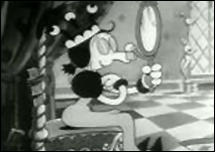
Betty Boop Snow White

Everyone knows the schtick – the queen enquires of her mirror every morning “Mirror, mirror, on the wall, who is the fairest one of all”. The mirror obligingly tells the queen that it is she, until, one day (obviously tiring of her appalling poetry) it decides to point the finger* at Snow White, thus propelling the poor young girl into a terrifying future filled with dwarfs, coffins and tainted fruit.

In the Grimm telling of the story, the queen finally gets her come-uppance by being forced to don a pair of iron shoes that have been heated in a furnace. She is then compelled to dance in them until she dies. Modern screenwriters please take note – this is what is called an original idea.

•2: Archimedes’ Focussed Ship-Burning Mirrors.

Archimedes' Fresco

The story goes that around 200 BC during the Second Punic War, the accomplished Greek physicist and engineer Archimedes used mirrors, possibly polished bronze shields, to focus sunlight onto advancing Roman ships causing them to burst into flames. It seems this is probably a tale that grew in stature with the telling. Over the years there has been a lot of speculation about this claim, and while it is possible under exceptional conditions to focus very fine mirrors on a distant wooden object and ignite it, it is unlikely that even a huge number of highly polished bronze shields on a very sunny day could have done much more than just scorch moving, waterlogged wooden ships. The Discovery Channel’s Mythbusters effectively scuttled the story in their Archimedes Death Ray episode, in which they spent quite some time getting a stationary ship to even smoke. Their conclusion was that a catapult filled with flaming pitch would have been far more effective, and a lot easier to implement.

___________________________________________________________________________
*Figuratively speaking of course, since it has no fingers. But since mirrors don’t talk either I think the metaphor holds up.

___________________________________________________________________________
Modern Enunciating

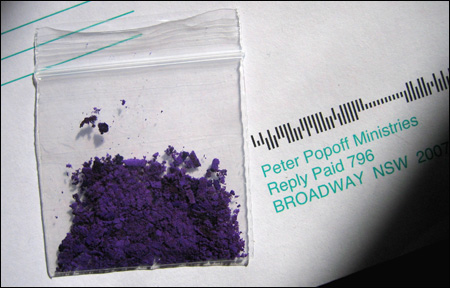
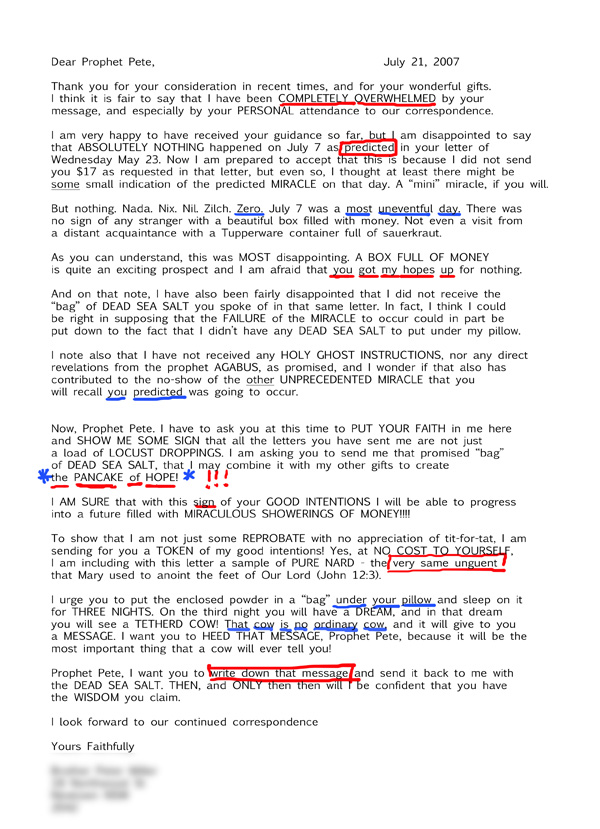
A Bag of Pure Nard

I know you’ve all been on the edge of your seats for further updates in the Prophet Peter Popoff saga and today’s good news is that I’ve finally sent off a letter to him!

A Swish of the Cow’s Tail to Colonel Colonel for planting the inspiration for ‘The Pancake of Hope’ and I am hereby pleased to award him a Cow Medallion for his part in the Prophet Peter Popoff Panto.

A Letter to Peter Popoff

ClickOnThePicâ„¢ to read!*

Now we shall see of what kind of stuff Prophet Pete is made, and whether his prophecies standard up to The Cow Challenge!

___________________________________________________________________________

*I figure that if Amazon can patent OneClickâ„¢ then I’m going to attempt to patent anything that occurs to me.

___________________________________________________________________________
« Previous PageNext Page »