Skeptical Thinking


Acowlytes! Atlas has sent me some astonishing new evidence that demonstrates beyond all reasonable doubt that Shoo!TAG actually works! Yes, yes – I realise that after all my previous skepticism on this topic this about-face will seem completely unexpected, but… you see… Oh dammit, words can’t really do the job. I’ll hand over to the following YouTube presentation to do the explaining:

So, you see, putting it in scientific terms, there’s this, like, blurry light, that, like, makes a sort of glow all around the person and, like, all around the Shoo!TAG and it’s AMAZING! And when the Shoo!TAG gets close to the person, it’s all, like, glowy and yellow and white and stuff. Freakin’ awesome! That proves that there’s auras around Shoo!TAG! And those auras prove that Shoo!TAG keeps insect pests away from your pets! OMG! If that doesn’t convince you close-minded skeptics, well, I don’t know WHAT would!

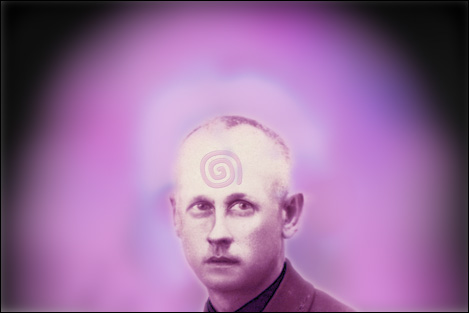
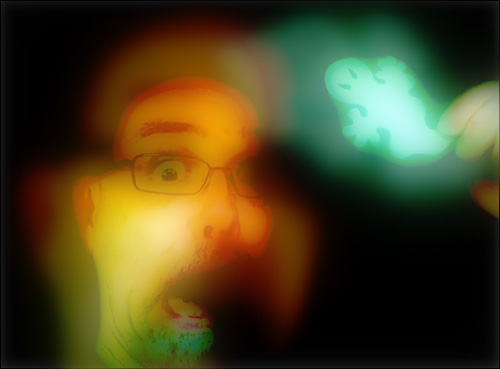
What’s that you say? Some double blind scientific trials would be more convincing? Than an aura movie? Oh, come ON! Aura movies are the bomb. Why, I have a snap here that PROVES that Tetherd Cow Ahead HQ is haunted:

Pretty definitive, right?

The Shoo!TAG aura movie comes to the world courtesy of a product called WinAura, and although that sounds like the outcome of a psychic chocolate wheel, ((I wanted to put a link to an explanation of what a chocolate wheel is, for all the non-Australians, and it seems there is no actual definition available on teh internets. That’s amazing. So, for your enlightenment, let me inform you that a chocolate wheel is a kind of spinning wheel that is common at fétes and church fairs in Australia and New Zealand. It has numbers around its face, and participants are able to buy a ticket that is attached to a number. The numbers correspond randomly to prizes. When all the tickets have been sold, the wheel is spun (sometimes once, or sometimes three times), and when it stops on a number, the owner of that ticket collects their prize. Of course, most prizes are worth less than the price of the ticket, and there are usually only one or two decent prizes.)) it is in fact a gadget that supposedly captures movies of your aura. If you are so inclined, you can visit the home of WinAura and find out all about machines that photograph your aura. Or, you could just stay here and I could save you from wasting precious minutes of your life by telling you that these shonky devices merely use coloured LEDs, software algorithms and blurred overexposure to trick very gullible people into believing that what they see has some kind of mystical explanation. For an exorbitant price, naturally. ((I defy anyone to be able to find, anywhere on the AuraPhoto site, an indication of how much you’re going to be out of pocket for one of these things. I reckon you can infer from this page that they’re not cheap.))

On the other hand, if you did go to the AuraPhoto site, you could visit the What Color Is Your Aura page and get something just as useful as the results from an Aura Camera without spending a penny. That’s what I did! Here is a picture of my aura:


According to my aura reading I have a lot of lavender in my chakras (or something). Evidently I have some in my Third Eye as well, which does help explain why I was having trouble seeing out of it. The interpretation of my results says, in part:

Others are instantly attracted to you as you sparkle and glow with a mysterious inner light. You also seem to be a magical, fairylike creature, born of another world.

You’d rather talk about miracles, magic, and pots of gold at the end of the rainbow than anything ordinary or mundane. You want to share your miraculous visions with others. The beautiful world of fantasy, art, and the imagination is where you feel safest and happiest. You create a magical environment for yourself and others in which to live.

How accurate is that?!!! I think everyone would totally agree that I truly am a sparkly glowing fairylike creature who attracts admirers like a roo light attracts Christmas beetles. And there can be no dispute whatsoever that my my magical playground, filled with fantasy and art, is nothing other than the Realm of the Tetherd Cow! (I feel I should also point out that the lavender colours go extremely well with the TCA colour scheme).

As far as I can see, though, it doesn’t matter what colour your aura is on the AuraPhoto site, it’s impossible to come away with a reading that says anything that could be construed to be negative. Such as, for instance:

You’re a duplicitous and morally compromised swindler who is quite prepared to sell rigged computer software and tweaked camera hardware to credulous nitwits in exchange for exorbitant amounts of cash.

If we had a picture of that person’s aura, I imagine there’d be a lot of Dead Salmon and Cat Breath in their chakras. And probably a pronounced squint in their Third Eye.

I was reading back, this morning, over my discourse with Man on the Bus in the comments on my post Gene Bunk, and realised that to many late-comers in my life I probably sound like a crotchetty and disagreeable old codger when it comes to matters of, shall we say ‘fringe’ science. People who know me in real life understand that, while I may be curmudgeonly on occasion, I am in fact a pretty tolerant person in a general sense. So why do things like homeopathy, UFOs, ESP research, ShooTag, ‘energized’ water, free energy and so many other pseudoscientific claims tick me off quite so much? It is certainly true that these days I have virtually no indulgence for these non-mainstream ideas. It wasn’t always like that, though.

Just to recap: Man on the Bus took exception to my impatience (via a reference in the Footnotes) with the so-called ‘precognition’ experiments recently published by Cornell University psychologist Daryl Bem. I gave Man on the Bus rather shorter shrift than he deserved – he was, after all, making the very reasonable point that the results of Bem’s experiments will stand or fall on replication of the results by other researchers. So what, exactly, is wrong with ‘waiting for the jury to come back in’, as MotB puts it?

At the end of our discourse, he snippily bid me return to my scatological poems (in which I had been indulging with Atlanski and others) and I jokingly replied that:

Scatological limericks have longevity. ESP research doesn’t. It’s a matter of how one’s time is best invested.

Probably rude and flippant, but it is, for me, essentially the pivot of the matter.

When I was a teenager, I was absolutely enthralled by all things ESP. I made myself a hand-drawn deck of Zener Cards and conducted experiments on my friends.

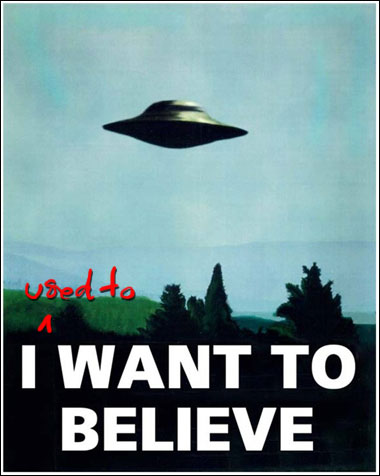
I spent many a long hour tabulating the results of those experiments, and sometimes even thought I’d discovered trends that just couldn’t be coincidence! ((I hadn’t. In those days I really had no idea of experimental protocol, and it has to be said that it is probable that I was just finding patterns I wanted to find…)) I also had an ad-hoc UFO watcher’s group and even experimented with Tarot cards and the I-Ching. In short, ‘I wanted to believe’. There was no question that I had that very thing which I’m often accused of not having these days: an open mind.

So why did these things not ‘stick’ for me? Why is it that I don’t still default to the belief (like so many millions of other people) that there is ‘something to it’ – this weird world that seems always hovering just outside the laws of reality as we have come to understand them?

Well, it turns out that that’s what happens when you actually do keep an open mind; you begin to entertain arguments that are not merely the appendages of ‘belief’. Indeed, I started to realize that the earnestness of my desire to believe had exactly no bearing on how likely something was to be true.

In essence, my change of position on fringe beliefs came down to a huge amount of open-minded reading and the realization of three things:

1. How easily I (and by inference, anyone else) could be deceived. ((Either by self-deceit, or by someone who had a suitable agenda. The combination of these two is especially powerful.))
2. That people actually want unusual things to be true, even if ((Perhaps ‘especially if’…)) belief in them breaks all the laws of common logic.
3. The completely unimpressive nature of the accumulated data, considering how much of it there was.

I remember roughly the time that my mind started ‘closing’. Or opening, depending on which way you want to look at it. It was 1975. I was in my teens, and Israeli psychic Uri Geller was in all the news media. Geller is such an obvious and audacious fraud when you look back on him these days, ((Unbelievably, even after his tricks have been exposed time and time gain, there are still people today who continue to think Geller’s ‘powers’ are real. There truly is no dissuading someone who wants to believe.)) but in 1975 he was something of a phenomenon. To see him perform on television – his charisma alone casting a kind of magical spell over talk-show hosts – was to think that maybe here, at last, was the ‘proof’ we’d all been waiting for that there really might be something to this ‘psi’ thing. I bought Andrija Puharich’s book, Uri – a scientist’s account of Uri Geller’s powers and, although the bits about aliens from Spectra (a talking spaceship from Hoova) sounded a little wacky to even my teenage science-fiction-loving brain, it seemed that here at last was the possibility of some scientific substantiation for this stuff that in my heart-of-hearts I believed was true.

My friends and I were convinced that we, too, should be able to teach ourselves to bend spoons like Uri could – indeed, Uri himself encouraged everybody to believe they could do anything he did, if they only could harness the power of their minds! So to that end, we sat around rubbing spoons into the late hours, willing them to bend… and… they never did, of course. And then, one night on television, I saw an interview with a bearded chap who was saying (Heresy!) that Geller’s powers were nothing more than tricks! You have no idea how much I wanted to disbelieve that bearded man. But then he did an impressive thing – he bent a spoon exactly like Uri had done! And then showed us how he did it. My teenage brain was doing a flip-flop. ‘Maybe,’ I thought, ‘this guy is doing a trick but Uri is real!’ But then, I had another thought, and it was a very, very profound one: ‘If that’s the case, though, how could I tell for sure that Uri was NOT doing a trick?’

And I decided, that, all things being equal, I simply couldn’t. If the bearded guy who I’d never heard of could fool me with a trick, then it was equally likely that Uri Geller could fool me with a trick. And, really, why should I believe Uri Geller, a person I didn’t know, over the bearded guy? Just because I wanted to? It didn’t seem like a good enough reason.

Well, it turns out (as I’m sure you’ve guessed) that the bearded chap was James Randi, and Randi was more than just some guy – he was forming a bit of a history with Uri Geller, and, dammit, he was putting forward a convincing case that Geller was pulling everybody’s legs. The striking thing was that it was very apparent that not many people wanted to hear what Randi had to say, which I found MOST peculiar. He was making good points – why were the talk-show hosts and interviewers giving him such a hard time? That’s when I first started getting an idea of how strongly a personal conviction can influence the way someone can view their world. You will see that both observations 1 & 2 that I made above, were starting to form in my mind. ((In addition to this, I became quite interested in Uri Geller’s attempts to take legal action against James Randi. This was quite confusing to me – I had seen Randi on numerous occasions challenging Geller to demonstrate his powers under controlled situations which he and Randi would agree on beforehand. This seemed extremely reasonable behaviour to me. If Uri Geller really did have extraordinary powers, how could he possibly object to this? All he had to do was demonstrate that Randi was wrong. Unless… he couldn’t…. It seemed to me that there was only one logical explanation for Geller attempting to silence Randi legally: because he was hiding something.))

Now it’s pretty damn hard to hold a belief and then abandon it in the face of a rational argument. A belief is part of your personality – you formed it for a reason, and letting it go is admitting that you made bad decisions. No-one wants to admit to having made bad decisions. And yet, that ‘letting go’ is exactly what anyone must do to achieve any kind of intellectual rigour. The thing is, once you’ve made this kind of step once, it’s a lot easier the second time, and easier still the third time. And so I found myself revisiting a lot of the stuff that I’d previously had an inclination to take at face value. UFOs? What was the evidence? Eyewitness reports? Well, it was becoming plain that that wasn’t a good way of getting accuracy. There was a lot of data about UFO sightings, but it all amounted to the same kind of thing – personal testimony that was at best vague and rarely corroborated, and at worst contradictory, inaccurate and fanciful. In the UFO business, hard facts were, as my father used to say, ‘as rare as hen’s teeth’.

Tarot card readings? I-Ching? Well, if I looked at it truthfully, it seemed that the cards and the coins, although colourful in pedigree, were really just another way of making vague predictions that could mean anything at all, depending on how ambiguous you wanted to be. And I’d already found from experience that people would agree with mostly anything I said, as long as I didn’t get too specific. It was getting harder to convince myself it was because I was a brilliant psychic.

And then there was the ‘science’ associated with all these things. Through the 60s, 70s and into the early 80s it seemed that there were thousands of experiments running with the sole aim of providing some small statistical indication that precognition, telepathy, telekinesis, remote viewing and a dozen other fringe ‘sciences’ had some validity. For many years I figured that here, at least, was a firm basis for rooting out some solid evidence for these strange phenomena, and so I kept a hopeful eye on this kind of research. I still wanted to believe. And yet, time after time, the kind of evidence these experiments offered up just seemed vague, diffuse, inconclusive, speculative and always conditional. Anyone viewing these kinds of experiments dispassionately was forced to conclude one of two things:

1. There really was nothing there.
2. If there was something there, it behaved in a way that put it outside the way science seemed to work when examining everything else in the world.

What was impossible to conclude was that there definitely was something there. There were NEVER unequivocal results from experiments in the psi field. You know the kind of result I mean. One that says: ‘Yup. That apple always falls to the ground when it leaves the branch. No doubt about it. Every time.’ The kind of result that proper science delivers, in other words.

It started seeming to me, in fact, that psi research was more like the human consciousness sciences of psychology and cognition, where results are subjective and rules are more like guidelines. ((For very good reason, I submit. Belief in parapsychology in my view IS an area of cognitive science. It’s about how we view the world, with all the self deception and illusion that entails – not how the world behaves physically.)) Annoyingly, though, a whole army of psi researchers continued to insist that their results do reflect the physical world, even though they actually couldn’t bring forward any evidence to add weight to that assertion. They stacked tiny variations from chance on top of tiny deviations from the norm, conducted experiment after experiment and returned, always, the same ambiguous outcomes. This has been the state of psi research for decades now.

Eventually, trying to maintain an ongoing interest in this process merely becomes tiring.

Which brings us all the way back to the experiments of Daryl Bem. ((You can read Bem’s experiment here.)) On the face of it, what Bem claims to have discovered is actually intriguing. But as soon as you dive into the mechanics of it, all the same old hallmarks of psi research appear: conditional results, small (so small they are conceivably illusory) variations away from chance, protocol that has uncomfortable facets of subjectivity rolled up in it ((Bem, has noted in his paper, for instance, that the outcomes of psi experiments tend to vary according to who is involved with the experiment. Believers are more likely to produce positive results than skeptics. Even though he makes efforts to exclude this influence, should it exist, from his own experiments, it’s hard to see how it can be taken seriously as a conjecture. Quite logically this kind of influence, if there’s any substance in it, should be at work in ALL scientific experiments and it doesn’t seem to be of any consequence in other branches of science… Psi researcher are therefore setting a ‘special condition’ upon their experiments – one that applies specifically to their field. That kind of conditionality is very un science-like. Indeed, it undermines one of the very cornerstones of scientific belief; an experiment should reliably return results no matter who is carrying it out. Aside from all that, the very idea itself smacks of absurdity. Believers get positive results and skeptics get chance? Those with a vested interest get what they want to see, and proper scientists get what proper science predicts? Come on! How terribly convenient!)) and so forth.

When Man on the Bus exhorts me to wait till the jury is in, therefore, my patience to do so is mitigated by the many times I’ve waited for them to return in the past. This doesn’t mean that Bem’s experiments have no value – just that, given my experience with this subject, the likelihood that they do is well below my threshold to want to give them the scientific time-of-day. In other words, I don’t see that my investment in them is any more likely to pay off than my investment in the results of thousands of Ganzfield experiments and remote viewing sessions and telepathy tests has done in the past.

To quote a great man, extraordinary claims demand extraordinary evidence. Bem is claiming extraordinary things. His experimental results, on the other hand, are no more persuasive than those from a mountain of other ESP research that has come before, all of which have been demonstrated to be questionable at best. Man on the Bus is appealing to my spirit of scientific fairness, and technically he is right to do so. I should wait for more evidence.

In my view though, when it comes to experiments with psi (or homeopathy or free energy or UFOs or a dozen other fringe belief systems that purport to be based on science) a body is entitled to ask to be given, along with any supposed results of the experiments, some good reasons why this particular case deserves any special attention. Reasons that set it apart from the already understood one that ‘it would be so COOOOL if it was true!’ Bem is not advancing any new framework for his supposed results. There is no proposed mechanism by which they might be occurring, nor is there any promising thread of scientific discourse that leads to them. The results are curious, sure, but no more than that.

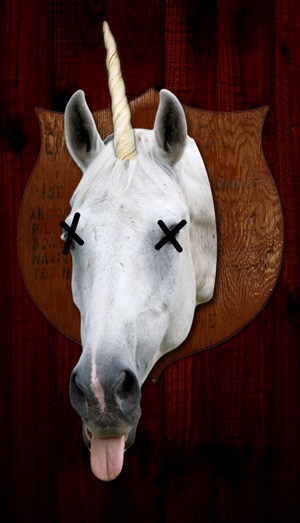
It’s like trying to apply a scientific process to the photographing of a unicorn. The fact is that most sensible people eventually get to a point where it becomes plain, as they set up their camera just one more time on a magical moonlit night (because, after all, no-one can prove that the unicorn won’t come tonight…), that maybe, just maybe, they are wasting their time. If that unicorn doesn’t actually exist, it doesn’t matter what kind of lens you use, or how carefully you make your exposure, or how many shots you take – no amount of belief is going to imprint its image onto your film. And while the hundreds of shadowy blurs, smears of light and odd sparkles that you’ve captured over the years might be worthy of some bull sessions in the pub, they still don’t amount to the only thing that is really needed to shut everybody up once and for all:
Why are journalists so stupid? Or is that a question that I’ve asked so many times now that it seems rhetorical? The Melbourne Age this morning carries a story (in the Technology section, no less) that has been doing the rounds for the last few days about a ‘UFO’ that supposedly appeared over Temple Mount in Jerusalem on January 28. Here is the YouTube video of that event that is causing all the conniptions. Be sure to ooh and aah like the people on the soundtrack won’t you? ((We’ve see ’em in Mississippi like this, but never like that!, drawls one of the voices who I’m sure I recognize as one of the intellectual geniuses from the Paulding Light video.))

Now I’d like to contemplate the following image that anyone can freely download from Wikipedia Commons, and which took me, oh, all of ten seconds to locate.

Pay particular attention to the star shapes on the streetlights, the position of lighted windows and the haze in the air. Seem familiar? Here, let me crop it for you…

And blur it up a little bit…

And stick a blob of ‘light’ in it…

And add some lens flare…

What’s that you say? A bit too ‘Close Encounters’ with the lens flare…? You think?

Well, I doubt even that would have put Mr Tom Kendrick, from wherever-the-fuck, off the scent of this ‘elaborate hoax’ that he apparently thinks is going to ‘fuel debate for many a year.’ Seriously, I’m going to start campaigning for a minimal intelligence test before we let people, especially journalists, use the internet.

Now I know that these are only still images, but it would have been no more difficult, had I wished to waste the time, for me to have made an animated video that exactly matched the one posted on YouTube. THIS IS THE 21st CENTURY, Mr Newspaper Pillock! We all have computers with pretty good video and image editing software!

If you read the article in the Age (and seriously, I really don’t blame you if you’d decided to stick your tongue in the electrical socket instead) you would have also discovered that this is the second of two videos of this mysterious UFO. Here’s the other one:

This time we hear a couple of guys talking (I don’t recognize the language) and the ‘mysterious light’ drops from high in the sky down into the scene (it’s hard to tell if it’s ‘hovering over the Temple’, but hey, if they say so…). Then there are a couple of flashes of light and the UFO zips skywards, to the surprise of the onlookers. Needless to say, this would also have been a trivial thing to whip up in After Effects. Quite obviously, the first video was made by someone who thought it would be a hoot to give the second one some corroboration. Anyone with an ounce of brain matter can figure all this out in about three keystrokes.

It’s not really so surprising to me that people indulge in pranks of this kind. It’s fun and amusing. It’s not so surprising either, that when they post it up on YouTube we get all kinds of idiots debating its authenticity. What is surprising is the complete and utter incredulity of people like reporter Tom Kendrick, his employers and all the ‘news’papers who carry these brainless stories. ((Not to mention the dribbling sub-moronic attempt to draw a religious connection:

Sunni Muslims believe it was from the mount that Muhammad ascended to heaven, and it also represents one of the most important sites in the Jewish faith.

And that’s supposed to tie in with space aliens… how? Or is it an angel maybe? Or the Hand of God? Who the fuck left the Stupid Tap running?))

For Christ’s sake people – you look like drooling hillbillies with grass up your asses when you run things like this.

Hyuck hyuck… lookie Bobby Joe… there’n anutha one of them thar UFOs… go get pappy’s shotgun an’ we’ll see if we ken bag us a alyen!


Do you have your tin foil beanies on this morning Acowlytes? Have you supped well on your goji drinks, rubbed your ShooTag and cleansed your bowels thoroughly with colloidal silver? No? Well you might want to get used doing all those things and more, because that is certainly the future which awaits us if the current trend by some science magazines plays out to its inevitable conclusion.

The latest issue of New Scientist runs a cover article headlined ‘Ghost DNA; Nobelist claims he can ‘quantum teleport’ genes’. I can’t begin to convey to you how much this kind of half-baked pap passing as ‘science’ journalism pisses me off. ((This is the second of two New Scientist articles that have really gotten up my nose in recent months. The first was their uncritical reporting of the so-called statistical evidence for existence of precognition revealed in experiments conducted by ‘psi’ researcher Daryl Bem. The Bem work is so filled with problems as to be laughable, and has been subsequently comprehensively picked apart by scientists and statisticians alike. Experiments replicating those carried out by Bem have, predictably, not shown the same results he claimed to have found. But where is the New Scientist followup revealing all this? Not as headline-grabbing as ‘Evidence we can see the Future?’, I suppose.))

The story, in a nutshell, is that Luc Montagnier, a scientist previously awarded the Nobel prize for his work with AIDS, has published results of an experiment that he says shows that DNA can be remotely ‘imprinted’ in water. He further contests that the imprint can then be reconstituted into actual DNA via polymerase chain reaction (PCR). Writing it down like that makes it seem so patently stupid, that I had to go back and check that this was, in fact, what Montagnier claims. And yes, it is.

You can read the full process of Montagnier’s experiment here, if you can make sense of it. Essentially, Montagnier contests that when an electromagnetic field is applied to a flask of DNA, that field somehow picks up something from the DNA that can be somehow transmitted to an adjacent but isolated flask of purified water, somehow transferring something into the water. PCR is somehow able to amplify this something which results in actual real DNA being created in the previously-pristine flask. ((My initial response as a person with zero training in genetic chemistry was to want complete assurance that Montagnier’s experimental protocol had completely excluded the possibility of contamination. PCR experiments are notoriously prone to contamination problems. Occam’s Razor dictates here that, in the face of one experiment by one scientist who already holds partisan homeopathic views, the most likely explanation for Montagnier’s results is the actual explanation: that his ‘pristine’ flask was contaminated.)) As you can see, that’s more somehows and somethings than your average episode of Ghost Hunters.

Montagnier offers no mechanism that might allow DNA to be able to be recorded or transmitted electromagnetically in this manner, nor any method by which water might be able to receive this transmission and retain it. He also fails to offer any explanation of a process via which this ‘ghostly’ DNA could become corporeal DNA. Instead, his notes make reference to discredited homeopathy researcher Dr. Jacques Benveniste, and calls on the concept of ‘water memory’, a flimsy pseudoscientific notion that has resisted numerous attempts to give it any credence. All in all, there are so many hallmarks of fruit-loopery throughout Montagnier’s proposition that you really have to ask yourself why ANYONE is giving this ridiculous fluff the time of day. Well, of course, it is Montagnier’s Nobel credentials that are the angle here. He’s a Nobel laureate, so he has to be an all-round genius, right? Wrong. Having a Nobel prize doesn’t prevent you from being an idiot in some other area. New Scientist is indulging in a favourite tactic of woo-mongers: an appeal to authority. Montagnier’s controversial Nobel prize relates to work he did on HIV/AIDS. This does not make him an expert on everything. ((The New Scientist editorial attempts to evoke fairness by pointing this out. It’s a journalistic trick that truly annoys the crap out of me – stick in a bunch of reasonable objections to ‘show’ that you can see the logical flaws in your argument, but then go ahead and ignore what you just did by plastering ‘Nobel Prize Winner’ in the headline of your article. Scumbags.))

New Scientist’s editorial in defense of their decision to publish this information is the real killer, though. It is disingenuous and unctuous. They open with this:

As the old saying goes, it’s good to have an open mind but not so open that your brains fall out. This week we report claims about the way that DNA behaves that are so astonishing that many minds have already snapped shut.

Did you spot it? Yep, there’s New Scientist, a magazine that is supposedly offering proper science journalism, jumping on another defense beloved of practitioners of pseudoscience: ‘If you don’t immediately give credence to some outrageous claim, you have a closed mind’. New Scientist editors, double shame on you. ((And, I might add, making this statement in this context is a damn good illustration of exactly what you’re purporting to be declaiming with it – your ‘open’ mind is quite publicly leaking your brains all over the carpet.))

After a meandering attempt to appear like they’ve given the decision some thought, they arrive at their compelling reason for carrying the story:

We decided to go ahead because any bona fide experimental result is worthy of scrutiny, and the claims are nothing if not interesting.

No, let’s just have some honesty here. You decided to go ahead because this is the kind of thing that sells copies of your magazine. If you are pretending to any level of scientific credibility at all, you don’t just up and publish any old crap on the pretext that it has ‘interesting’ claims. If you were truly sincere about informing people of the science behind this story, you would have waited for some of the additional results from third party researchers that you admit are necessary for this experiment to have any validity. Of course, when that happens it will be a non-story (as I submit you are fully aware) and the headline ‘Scientists prove AGAIN that the concept of water memory is a crock of shit’ will not be nearly as lucrative on the news stand as some spurious one-liner involving ghosts, teleportation and ‘quantum’ magic. I further contest that if science was really your priority, you would have offered a little more depth on Luc Montagnier’s bona fides, including his predisposition towards believing in homeopathy (something you, yourselves have – quite hypocritically we must conclude – denounced previously as pseudoscience when it suited your headline).

I suggest that this quote from Luc Montagnier taken from an interview with Science magazine last month, might have added some context to his experiment:

I can’t say that homeopathy is right in everything. What I can say now is that the high dilutions (used in homeopathy) are right. High dilutions of something are not nothing. They are water structures which mimic the original molecules.

This shows us one thing very clearly: Luc Montagnier didn’t get his Nobel Prize for logical thinking. As is trivially easy to demonstrate, the high dilutions offered by homeopathy ARE, in many cases, nothing. After a certain level of dilution, a homeopathic substance is likely to contain not even one molecule of the original substance. What Montagnier wants us to believe, though, is that, by a mechanism that is pure speculation at best and has no basis in reality whatsoever, it’s not the molecules themselves that matter, but ‘something’ they leave behind. It’s crucial to understand that Montagnier is not building on any previous science ((All good science comes riding on the coattails of other science. In the 21st Century it is rare to the point of extraordinary for a major scientific discovery to pop out of nowhere.)) to assert this. It’s merely a magical belief. ((And it’s a belief that seems so simplistic and the counter-arguments so self-evident that I won’t even bother to tread that ground again. I’ll just point out once more that every glass of water you drink has ultra-diluted something in it. Pick anything: cyanide; sugar; apple juice; cow piss; snake venom. Whatever it is, its effects will be in operation in that water according to homeopathic ‘reasoning’. If you want to follow the ultimate absurdity of Montagnier’s experiment, you’re buying into a notion where you don’t have to even dilute the water in the first place – things can get ‘transmitted’ into the water from elsewhere! With all that dilution and transmission going on, there’s so much stuff in water that it’s a miracle it’s drinkable!))

All that being as it may, what Luc Montagnier is claiming to demonstrate with his experiment does not equate with claims of homeopathy anyway. ((Well, not with anything that homeopathy has claimed so far – I’m sure they’ll find a way to incorporate this new wonderful mechanism.)) Let me clarify: homeopaths contend that, by dissolving substances (whose efficacy is determined by nothing more than superstition) into extreme dilution in water they can achieve advantageous human health outcomes. The mechanism by which this is supposed to happen has no rational basis and can’t be scientifically shown to have any effect. But Montagnier’s experiment is (supposedly) demonstrating something else entirely: that he can transmit, via a process for which he has no explanation, something into water that wasn’t there in the first place and then reconstitute a biological product from it. He’s conflating a bizarre idea with an outlandish idea and then asserting that this makes BOTH ideas reasonable! What extraordinary nonsense.

New Scientist also neglects to mention that Montagnier’s Nobel Prize was the subject of prolonged antagonism, that (while Montagnier certainly contributed to the effort) the scientist who is actually now credited with demonstrating that the HIV virus causes AIDS was not Montagnier but Robert Gallo, and that one of the biggest issues in the controversy surrounding the Prize was sample contamination inside Montagnier’s lab – all factors that have bearing on the article at hand.

The magazine further tarnishes its image by including this spurious quote, as, geez, I dunno, some kind of ‘food for thought’ or something:

‘If the results are correct,’ says theoretical chemist Jeff Reimers of the University of Sydney, Australia, ‘these would be the most significant experiments performed in the past 90 years, demanding re-evaluation of the whole conceptual framework of modern chemistry.’

This kind of cheap sensationalism is breathtaking in its banality and has no place in a science journal. It’s a quote that means FUCK ALL. It’s a speculation that’s logically equivalent to saying ‘If pixies exist, we may never have to do the dishes ever again!’ It’s a NON quote. It’s vacuous journalism at its most pathetic.

Acowlytes. I’m sure you can feel my anger about this fairly radiating out of your computer screen. When a magazine like New Scientist runs an article lending plausibility to half-baked pseudoscientific concepts, they have an enormous detrimental effect on the already depressingly slow progress of critical thinking. We don’t need ‘scientists’ giving credence to every stupid idea that comes down the pike under the pretext of ‘it’s a valid experiment until the results prove otherwise’. The fact is that some ideas start out plain stupid, and never do anything more than traipse downhill into the vast bog land of Suck. It is the responsibility of periodicals like New Scientist, as purveyors of science news, to make decisions about framing a scientific world-view for their readers, not to encourage the flimsy philosophies and elliptical thought processes of those who espouse magical thinking by giving their silly ideas ‘scientific’ credibility.

What happens after an article like this appears is predictable and depressing. Searching the web for ‘luc montagnier’ in conjunction with ‘homeopathy’ delivers a flood of links to sites claiming that science has at last ((Or ‘again’, depending on how you look at it – homeopaths claim scientific endorsement of the stupid idea at the drop of a hat, and neglect ever to mention all those times when science has shown it to be a pile of horseshit.)) endorsed homeopathy. From the predictable brainless spew of Dana Ullman in the Huffington Post gushing that Luc Montagnier, Nobel Prize Winner, Takes Homeopathy Seriously, to the slack-jawed critical-thinking-free crowing of the various homeopathy advocates that Luc Montagnier Foundation Proves Homeopathy Works the woo-web is awash with brains-on-the-floor excitement.

For the sake of a salacious news stand headline, one dumb misstep by the Science press has all but undone the great work of skeptics over the last few years in demonstrating to the public just what a bunch of hokum homeopathy is.

Great work guys. And every year you run whiney op-ed pieces about how science funding is being slashed. In case you haven’t managed to figure it out, that’s the logical outcome of dumbing down the world.

UPDATE: More fuming! Because I’ve been away, I’m working my way through back issues of New Scientist that have accumulated in my absence. This used to be a pleasurable pursuit, but it’s turning out this time to be a lolly-grab of stupidity. Last night I read this editorial, in which we find NS criticizing NASA for hyping up the science behind the search for extraterrestrial life.

IT’S life, but not as we know it,” trumpeted one headline. “Alien life may have been discovered – right here on Earth,” gasped another. Even The New York Times declared “Microbe Finds Arsenic Tasty; Redefines Life”.

The breathless write-ups followed NASA’s teasing announcement of a news conference “that will impact the search for evidence of extraterrestrial life”. And although the discovery of alien life, if it ever happens, would be one of the biggest stories imaginable, this was light years from that.

Oooh. They wouldn’t be anything like headlines that scream ‘Ghost DNA; Nobelist claims he can ‘quantum teleport’ genes’ or ‘Evidence we can see the Future?’, would they now you fucking hypocrites?

The editorial concludes:

Perhaps it (NASA) thinks that all publicity is good publicity, but one day the appetite for sensationalist alien life stories may be sated.

At which point I suggest that New Scientist might like to start fishing around for the log in their own eye rather than looking for the mote in their neighbour’s.


If you’re a purveyor of teh Woo looking to make yourself a few dollars at the expense of gullible people with damaged lives, what could be better than selling them water that does nothing, plastic cards that do nothing or plastic bracelets that do nothing?

Croation ‘mystic’ and healer, Braco, has discovered the answer to that question: you bypass the costly manufacture process entirely and sell 100% unadulterated nothing at all to your credulous victims .

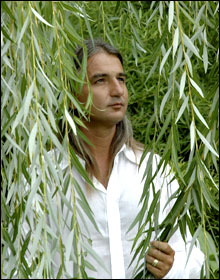
This is how it works. Braco (pronounced ‘braht-zoh’) merely walks into a room full of people and stares ((Or ‘gazes’, as his followers say…)) at them. To understand the true magnitude of the vacuousness of this, you might like to watch Braco in action:

This kind of thing just makes me want to throw up my hands in despair. ((Or just plain throw up.)) Just take look at that audience of predominately white, affluent middle-aged women who probably owe everything they have to modern science, and wonder how it is that they have quite so comprehensively dropped their brains on the floor.

Braco’s website is a treasure-trove of idiocy and banality:

Experts are impressed that Braco has been able to have such a strong impact on his visitor, and began his work at the extraordinarily young age of 26

He began staring at people at the age of 26. Yep, that sounds like an extraordinary achievement. Why, I didn’t master the art of staring at things until last week!

Braco does not take any money for his help, he does not accept donations and the sessions are always free at his Center in Zagreb.

Can I have a job where I get flown all around the world and fêted at other peoples’ expense in exchange for doing nothing at all? Oh, and all those books and CDs I see advertised on the site. They’re free too, right?

“We all carry a seed inside, which can become a beautiful fruit one day.” – Braco.

I don’t know if I’ve ever heard anything quite so profound. I wonder if Braco came up with that all by himself, or if he has a team of writers?

Journalists and scientists who have studied Braco and his energy have been impressed by him and by the impact of his work

Braco’s website fails to give the names of any scientists so impressed. I think we can suppose that when they use the term ‘scientist’ they mean someone like ‘Doctor’ Charlene Werner or ‘Professor’ William Nelson. And as for journalists… yeah, they’re really known for their perspicacity.

Braco is a conduit for the Source energy that is not governed by linear time and space, and it instead unifies us beyond the constructs of the mind.

Or, to put it another way: ‘Baffling phrase appended to vacuous nonsense followed by equivocal waffling equals meaningless conclusion’.

And best of all, from the FAQ:

Children may be overburdened by the energy, so it is required that an individual be 18 years of age or over to attend a gazing session.

I wonder if they would explode?

Braco’s special thirteen-ray gold sun pendant (also sun earrings and rings) are ONLY available at live Braco events.

Oooh. I’d like one of those free pendants! They are free, right? ‘Cos, like, I know that Braco doesn’t make any money out of what he does… What’s that you say? $290??? But…

Braco himself does not explain the energy and the great healing and transformative effect this energy can have upon people.

It’s much easier that way. Provide a whole bunch of nothing at all and then avoid explaining why it works! The homeopathy crowd could really take a leaf from Braco’s book. All they need to do is dispense with all that tricky science stuff – things would be so much simpler!

Braco’s power is so strong that it can be lethal over the internet. Or something.


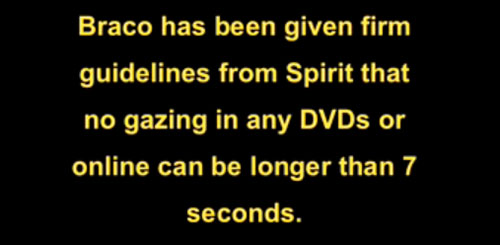
Whatever you do, don’t edit any of those Braco staring sequences into segments longer than seven seconds. Who knows what kind of chaos could be unleashed!

I leave you with this last fact from the Braco blog:

Special Travel Notice: Braco was officially granted an Extraordinary Talent Visa by the U.S. Immigration Department in October 2010. The approval of this specific Visa recognizes the importance of Braco’s work, and enables him to freely enter the U.S.A.

I want you to contemplate this deeply. The US Department of Immigration has given a highly sort-after ‘O’ class visa to some guy who does nothing more than stand on a stage and stare at the audience. That’s defined as an ‘extraordinary’ talent

Elsewhere, Braco’s power is explained as a phenomenon of ‘non local reality’. I think that’s another way of spelling ‘horse shit’.

Acowlytes all! JREF blog, March 7. That’s all I’m saying for now.

But please allow me the self-indulgence of adding a great big smile.


:-)


« Previous PageNext Page »