Technology


One of the great things about traveling is that it opens up whole new vistas of opportunity for Cow Scrutiny. This post is the first in what I think is likely to be a continuing riff, as I commence my long stay in the US. These posts will all be grouped together under the new Stranger in a Strange Land category. ((As if I don’t have enough categories already!))

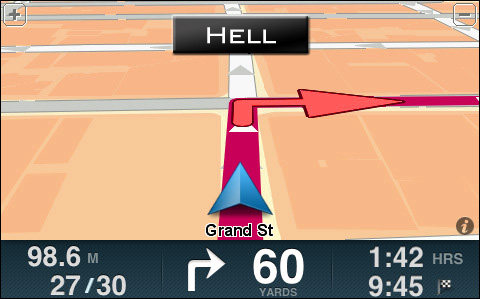
Of course, one of the first things a Stranger in a Strange Land needs is a guide. And when in Rome Los Angeles, the must-have accessory is satellite navigation. On my arrival, therefore, I was provided with a TomTom XL – the XL presumably referring to the ‘extra large’ screen that I requested (it actually doesn’t seem particularly ‘extra’ large to me, which is remarkable in a land where ‘extra large’ usually means ‘so big that a normal human can’t deal with it in any meaningful way’).

The TomTom XL is a masterpiece of irritating technology. The TomTom people have taken the miracle of Global Positioning and created a way to interface with it that is clumsy and frustrating. It is a breathtaking accomplishment. Never in my life have I sworn at an inanimate object quite so much. ((I mean, seriously. Operating systems don’t need to be like this folks. This is why we Apple fanboys bang on so much about how good Apple stuff is – it’s all in the operating system and the interface! TomTom people – just take a look at the Maps app in the iPhone. See how EASY that is to use? There ya go.)) Of course, my hatred for it is amplified by the fact that it has a robot voice that pretends it knows more about the world than I do, and we all know how fond I am of that idea.

One of the ‘features’ of the TomTom system though, is that you can log in to the TomTom site and change the default voice (Female Moron #1) for one of hundreds of alternatives. Some of these are for sale and feature the professionally recorded voices of luminaries like Kim Cattrall and Burt Reynolds (I kid you not) or ‘humourous’ instructions provided by C3PO and SpongeBob. Why ANYBODY thinks this kind of thing is a good idea is completely beyond me, unless of course you opt to choose the voice of someone you really hate in order that your levels of rage and frustration from using the device can be amplified just that little bit more. The last thing I want to hear as I miss the exit to the freeway because the damn thing told me to ‘go straight on‘ when it should have said ‘take the right lane‘ ((I’m not exaggerating – the TomTom frequently tells you to do something which is plainly not correct, and I have become convinced that it is maliciously programmed to do so.)) is Yoda advising me that I should have used The Force.

Most of the downloadable voices on the TomTom site are free, however and (Oh frabjous day!) are created by the TomTom community. Now the fact that a person is willing to even admit that they belong to the TomTom community is enough to indicate what kind of very special surprises might be in store here. Sure, there are pages of interminable ‘My Sister’s Funny Voice’ and ‘Me Doing Impressions of a Dalek’ ((Still not exaggerating.)) but there are also some gems. Such as the voice of Alan from the Macedonia Primitive Baptist Church. ((Now, I didn’t even know there was a thing called the Primitive Baptist Church, but the words ‘primitive’ and ‘Baptist’ do sit quite comfortably together.))


Hey hey! Christian navigation! That’s bound to be laff riot. A typical ‘instruction’ from Alan’s voice is:

God has blessed you on your journey. You have reached your destination.

Of course if God doesn’t bless you on your journey and you die horribly in a collision with a truck you won’t ever get that message, but hey, that’s how religion works, right?

My mind goes wild when I try to imagine Alan’s other instructions. OK, we’re coming to an intersection… Alan! Which way do I go?

At the next intersection, take your advice from Genesis 13:9: Is not the whole land before thee? separate thyself, I pray thee, from me: if thou wilt take the left hand, then I will go to the right; or if thou depart to the right hand, then I will go to the left.

Or, on approaching the entrance to the freeway:

You are about to enter the freeway. Let me remind you of Isaiah 35:8: And an highway shall be there, and a way, and it shall be called The way of holiness; the unclean shall not pass over it; but it shall be for those: the wayfaring men, though fools, shall not err therein.

Yes, I can see it now. First traffic lights and Alan and the TomTom would be out the car window and into the LA River.

I’ve been here one week and already I can see the root cause of America’s road rage problems. What, with all the sugar in the breakfast cereals and celebrity voices directing traffic it’s a miracle that anybody gets anywhere in one piece.


If these were an actual product ((I’m pretty sure someone just photoshopped this up, sadly.)) they would be the perfect way to end any argument in which a religiously-inclined person attempts to use logic to justify faith.


The internet is over.

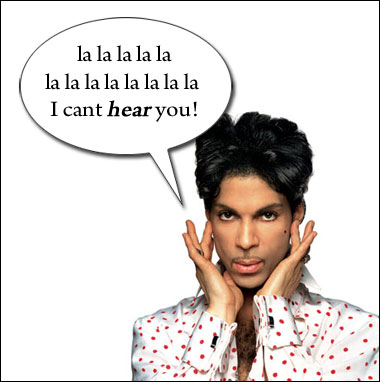
Yes, dear friends, you are all living in denial. According to the artist formerly known as the artist formerly known as Prince, and now known as Prince once more, the internet is just ‘a hip fad like MTV’ and is now outdated.

And running with his new-found insight, Prince is breaking all the boundaries and taking the extraordinary steps of releasing his new music album only as a CD! Genius. He’s chosen to do this through the innovative new distribution conduit of the newspaper! What a visionary!!


You will remember that a little while back we learned that Rupert Murdoch, using his needle-sharp insight into how people use the internet, stumbled on the notion that it would be a good idea to start charging visitors to read the online version of his flagship newspaper The Times. Consequently, the last month has seen The Times subscription gateway come into operation and readers have been asked to sign up (without paying) before they can get access to stories on The Times site. Here’s a graph that reflects the status of readership figures for various online UK newspapers since April.
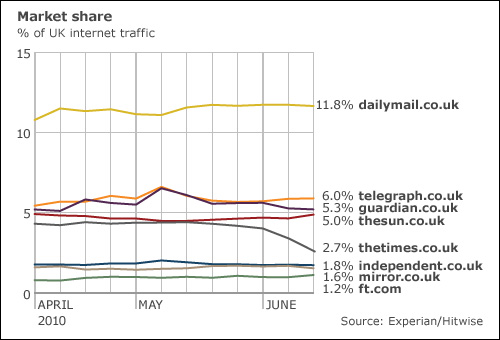
Notice anything? And need I point out that this graph reflects only the sign-up process – no money has so far changed hands. Now, to my eye that looks like The Times online has lost nearly half its readers in a month. And the curve doesn’t look like it’s intending to taper off anytime soon, and that’s before we get to the point of actual money being forked out. ((Quite interestingly, the curve visibly trends downwards well before the subscription requirement kicked in. I surmise that this indicates people started abandoning the Times pretty much as soon as they heard that it was going to start charging money. If I was head honcho, I would have taken this as an extremely worrying omen.))

Rory Cellan-Jones, on his blog at the BBC, has speculated that The Times really only has to hang on to about 5% of its former readership ‘to have the champagne corks popping in Wapping’. I predict that the readership will fall right through that number and bottom out at nearly zero. Rory puts his finger right on it in his post:

My suspicion is that the main problem with this experiment is what I’d call friction. Web users have got used to clicking simply from one page to another without hindrance. Any element of friction – the aggravation of having to pay or just log in – acts as an incentive to head elsewhere in a hurry. I tried an experiment this morning, posting a link on Twitter to an article by the very funny Times columnist Caitlin Moran. Plenty of people clicked on the link – but when they were taken directly to the Times pay-station, they all appear to have left without paying.

To anyone who’s been looking at web media for any length of time, this is truly a no-brainer. Why would you bother? Rupert is pinning all his hopes on one single idea: that people care enough about the quality of the journalism (and whatever else The Times has to offer) to pay for it. ((It also breaks one of the most important pieces of functionality of the web, and very few of the Old Guard understand this because it is such an alien concept to them: the ability to cross-link. Anyone who writes a blog (or anything written specifically for online diffusion) understands automatically how powerful a utility this is. The web is a ‘web’ because it builds itself on connectivity. If I want to write something on Tetherd Cow I can easily bolster my story with examples, references and asides that anyone can check instantly. But there’s NO WAY I can do that with the Times any longer. If I cross-linked to an article in the Times, my readers would simply behave as those in Cellan_Jones experiment, above. Murdoch’s idea is fundamentally destructive to the very foundations of the internet. Where we see the awesome power of the building up of information structures, he wants to create cloistered communities that he can control. This, in my opinion, is what will ruin him. He does not grok the net.))

Rupert, I’m sorry to say that the 21st Century is going to give you a bigger ass-walloping than you ever thought possible.

Let me explain it in a way that even Mr Murdoch might understand. Are you sitting comfortably? Very well, let’s begin.

Once upon a time, when horses and buggies were the fastest forms of transport and people cleaned chimneys by crawling up them with big brooms, accounts of what was happening in ‘the world’ started to get circulated via a system called ‘the newspaper‘. The newspaper gathered up a collection of what its publishers deemed the most relevant and interesting bits of news and gossip of the moment, and then distributed them to the community. The newspaper was a marvellous idea for its time, but, for all its charm and utility it did have some limitations: it was largely a local phenomenon, it cost money to make and deliver to the people who wanted it, and it had a kind of inbuilt time delay (if news happened, you had to wait till the next newspaper was made in order to know about it). But because it was a physical object, and it was a convenient way of learning about the latest goings-on in the world, people were prepared to pay some small amount of money to take possession of their daily newspaper. Plus, you could wrap fish & chips in it when you’d finished reading it. (It also had another limitation, but one that few people were aware of at the time: it was a one way street. That is, the newspaper could tell you things, but you could not reply to those things, nor enquire after their veracity.)

Eventually, after a few decades of news distribution of this form, a few cunning people realised that if they could gain control of the newspaper business on a large enough scale, they could earn themselves quite a bit of money. And so newspaper tycoons came into existence. The object of being a newspaper tycoon was to gather up as many small local newspapers as you could find, and either put them out of business, or amalgamate them into your empire. This concept made a small number of crafty men (for they were ALL men) very wealthy indeed. It had the added bonus, for those men, of giving them extraordinary political power, because after all, they controlled what people knew about the world. This state of affairs existed for the better part of a century, with the newspapers becoming more and more ubiquitous and the newspaper men more and more wealthy and more and more powerful.

But then, late in the 20th century, a completely unexpected thing happened – a wonderful piece of technology called ‘the internet‘ came along. The internet was really nothing more than a way in which everyone on the planet could easily and instantly talk to everybody else, no matter how geographically separated they were. It was a simple but powerful idea. And the more people who understood this idea, the more powerful it became. Before anybody really even knew what was happening the internet became connected to all kinds of places across the whole world, and people happily discovered that news and gossip and all kinds of other information could now be exchanged rapidly and for free. People liked that! And the internet was unlike the newspaper in one very important way: nobody ‘owned’ it and nobody could own it. ((You can bet your humidified Havana cigar that there are those who, if they’d known how it was going to turn out, would have moved heaven and earth to have gained control of it…))

So who do you think were the most unhappy about this state of affairs? That’s right – the newspaper tycoons. They were VERY VERY upset, indeed. People were talking to each other and learning about their world for free! What a terrible, terrible thing!

Thanks to their innate carnivorous business instincts, though, the tycoons became aware very rapidly that this ‘internet’ was something quite big and important, and they could see that people had taken to it like ducks to water. Unfortunately they could only see this through spectacles that had little dollar signs embossed all across the lenses, and so their vision was not very clear. The first thing they did was to nab themselves some real estate on this internet thingy. After all, it was FREE, what did they have to lose? Of course, the people who were already on the internet were happy to see their old friends from the newspaper business there and started visiting these new sites from the old guard – but they didn’t just hang out at one newspaper… oh no! They were now reading six or seven or maybe even ten newspapers, and not just newspapers from their home town either! And not only that, they were getting news from sites that weren’t actually newspaper sites but had news anyway, like blogs and ezines and social networks and all manner of other strange ideas! All for free!

The newspaper tycoons weren’t used to the concept of ‘free’. It was not something that was in their world view. When they said the word ‘free’, as they sometimes did, they meant ‘we’re giving you a nice little morsel but it has a hook hidden inside it’. The concept of ‘free’ as in ‘you can get it with no strings attached’ was as alien to the newspaper tycoons as was the idea of travelling economy class, so they looked upon what was happening on the Internet with a great deal of bewilderment and frustration. All these people were here doing stuff and hanging around but the tycoons couldn’t figure out a way to make money from it! How they hated that! How dare people amuse themselves!

So instead of making some kind of effort to understand what was going on with the Internet, as some of their cleverer and less mercenary colleagues did, the tycoons contrived to do the least effective thing possible: they attempted to make the Internet play by their Old Rules. Unfortunately, the people using the internet could see immediately that the Old Rules really suited no-one except the tycoons. The only option open to the tycoons now was to try and make their Old Way look more enticing than all the New Things the Internet was offering. They did this mostly by telling everyone how TERRIBLE the New Way was and how much BETTER the Old Way was. They said this loudly and often.

‘If you continue to get your news for free,’ they cried ‘You’ll only get TERRIBLE quality news. WE are the keepers of GOOD quality news!’

Unfortunately, the people using the internet already knew that this was a stupid and desperate tactic. They knew that not only was the news from the New internet way just as good (and sometimes even better) than the Old newspaper way, but that the Old newspaper way gave them TERRIBLE quality news as often as not too!

In spite of this obvious failing, the tycoons quite idiotically convinced themselves their argument was good enough to charge money for their Old News, just like they used to do when the world was all nice and simple, before smoking tobacco caused cancer and when it was perfectly acceptable to feast on endangered species of quail and unsustainable caviar stocks. And so they said to the Internet people:

‘Now we want you to PAY for our Old Ideas, even though we have made exactly NO CONTRIBUTION to this new way of doing things…’

Well, we’ll have to leave our story there for the moment, because the last words have not quite been written. I suggest that ‘Happily ever after’ is not on the cards for those old newspaper tycoons, though. They are facing the end of their dynasty and they stand, as emperors have often done, bewildered in the empty halls of their palaces while the revolutionaries hammer at the gates.

Will Rupert get his 5% faithful? Will the champagne corks be popping in Wapping? Will the line on that graph level out before it hits sea level? Six months is about what I think it will take to give us the ending to this story.
Cowpokes! The End is Nigh! Run for the hills! What with the threats of terrorism, biological warfare, solar flares, tsunamis, the flipping of the magnetic poles, an atheist woman as head of the Australian government and a black man as the head of the US government, it will be a MIRACLE if we last even another week! But, dear feiends, have no fear! Should one (or more!) of the aforementioned catastrophes overtake us, the folks over at Vivos have anticipated every eventuality for the approaching apocalypse and are offering the ultimate ‘life assurance’ and ‘the greatest chance of future restoration of the world as we know it, regardless of the catastrophe’.

Here – let them tell you about it in their own words:

Millions of people believe that we are living in the “end times”. Many are looking for a viable solution to survive potential future Earth devastating events. Eventually, our planet will realize another devastating catastrophe, whether manmade, or a cyclical force of nature. Disasters are rare and unexpected, but on any sort of long timeline, they’re inevitable. It’s time to prepare!

Vivos is a privately funded venture, with no religious affiliations, building a global network of underground shelters, to accommodate thousands of people. Vivos will provide a life assurance solution for those that wish to be prepared to survive these potential events, whether they occur now, in 2012, or in decades to come

Yes, by purchasing a share in a Vivos community bunker, or getting them to build your own bespoke shelter, you can survive the End Times and walk out refreshed into a world full of bracing post-catastrophe horror! To see what you’ll get for your money, you can take a tour around a typical Vivos facility, furnished with all the comforts of home, including attractive paintings of idyllic landscapes that you’ll never see again:

Geez guys, could you have found a more gloomy and depressing piece of music for that? Are you selling a shelter or a tomb here?

Seriously, no matter how hard I try, I can’t think of any calamity listed on the Vivos site that seems worse than ending up in some underground IKEA nightmare with a bunch of people who are inclined to believe that the world is going to end in 2012 ‘because the Mayan calendar says so’. ((You can watch a video on the Vivos site about how the ‘incredibly precise’ Mayan calendar (‘… a calendar more accurate even than our own’) predicts the world will end in 2012.)) Let me see: Electromagnetic Pulse? Nope. Killer comet? Nope. Planet X? Nope. Super volcano? Nope. ((I’m a little surprised to see that Zombie Attack and Alien Invasion aren’t featured, to be honest. If nothing else, they’d make for some really cool additional icons.)) I’d rather take my chances with any of those.

What are these people thinking? Have they never seen a post-apocalyptic movie? Have they never played Fallout? Do they really want to climb out of their bunkers after a year of mind-numbing boredom to find themselves wandering around a planet full of shotgun-wielding mutant vigilantes with no morals and bad personal hygiene? Or worse, Fundamental Islamic militia?

There are so many things wrong with this unhinged doom-laden vision that it’s hard to know where to start. From the hysterical countdown to annihilation (905 days, 06 hours, 31 minutes, 24 seconds remaining) to the hyper-paranoid ‘scenarios’ videos (Nuclear Terrorism! Surviving Anarchy! Secret Government Shelters!) the website plays out like some bad Hollywood projection of the Apocalypse. It takes mere seconds to find places where this plan will start splitting at the seams.

Take a quick tour around the Vivos Knowledge Base and see how many opportunities for failure you can find. The spectacular promises (hydroponic gardens to support 200 people for more than a year, 24 hour power generation with supplemental wind and solar, hotel-style amenities, impregnable defences to resist volcanic eruption, seismic disturbance and biological contamination) fairly reek of hyperbole. ((For a start – where are they getting their air from? Filtered air from outside will be useless in a case of chemical attack, and it’s not like they can stockpile a year’s worth of oxygen for 200 people…)) Half these things are all but impossible to achieve. And if Vivos doesn’t deliver, what are you going to do when the anarchist Muslim terrorist bio-freaks come pouring through your Vivos shelter airlock? Ask for your money back?

Tetherd Cow Advice: If you’re worried about the Apocalypse arriving in 2012, ((You can bet your Nigerian fortune that I’ll be revisiting all these predictions in 2013!)) stock up on single malt whisky and plan to be somewhere with a good view. In the meantime, send me your bank account details. After all, you can’t take it with you.

___________________________________________________________________________

Big thanks to Atlas for bringing Vivos to my attention.


Yes, I know I’ve talked about it several times already, but this time it’s serious.

‘Cyber sickness’ warning ahead of 3D revolution’ screams the headline. Again, you will not be at all surprised to learn that it’s from the Melbourne Age.

Up to 10 per cent of people who watch 3D images on television, at the movies or while gaming suffer ”cyber sickness” symptoms such as blurred vision, nausea and dizziness, health experts have warned.

Those experts! If it wasn’t for them, the world would be a much cheerier place. But wait! It’s WORSE THAN YOU THINK:

But they say the number of people affected by cyber sickness could rise to unknown proportions with the advent of the 3D TV era…

Did you hear that? UNKNOWN PROPORTIONS! It could be a veritable cyber-sickness pandemic. Forget getting immunised for swine flu – if these experts are right we’ll all be taking major doses of stereoids to fend off the 3DTs.

The article gushes breathlessly onward:

Virtual reality pioneer Mark Pesce, an honorary lecturer at the University of Sydney, said the majority of occasional 3D viewers would love the experience, but he warned that the health effects of heavy use of 3D media – which trick the eye by changing the depth perception of a person’s vision – had not been tested.

Um… actually, that’s not how 3D works at all – there is no ‘tricking the eye by changing depth perception’ Mr… who wrote this damned thing… let’s just scroll back up to the by-line… oh, WHAT a surprise. It’s Stephen Cauchi, King of the the Non-News at the wheel again. Geez. Have they hired this guy specifically to reduce the Age’s credibility or something? ((I swear I’m not witch-hunting this guy. I literally did what I just wrote – I was reading the article and thought ‘Man this is terrible!’, looked at the byline…)) Anyway, to continue, 3D works by exploiting the effect of stereopsis which is the natural way we achieve depth perception. What Mr Cauchi just said is word fluff. It is completely free of actual meaning.

Like last post’s Government Weather Control article that we saw from Mr Cauchi, as the story continues the sensible people start to appear, and we find Victorian Eye and Ear Hospital ophthalmologist Lionel Kowal saying that the number of people who reported problems with 3D is ‘probably closer to 5 per cent than 10 per cent.’ Then, we hear from Kathryn Rose, an associate professor in orthoptics at the University of Sydney, who thinks that ‘about 3 per cent of the population would not be able to watch 3D TV’.

3 percent? 3 percent? Do I hear 2 percent? 2 percent over in the back? 1.5 percent? Can I get a 1?

The article ends with a quote from Newcastle University neurobiologis Alan Brichta:

‘Right now we don’t have all the information but my gut feeling says [cyber sickness] is not going to be a major issue.’

Are you with me here in this insanity, dear Acowlytes? We’ve gone from an epidemic of ‘cyber sickness’ of UNKNOWN PROPORTIONS to ‘er.. actually, not a major issue…’ in the space of one information-free waffle fest.

Like the Government Weather Control story, I propose this whole air-headed notion could have been summed up in one short sentence:

A tiny minority of people might find 3D media a little unsettling but most people won’t.

Again, short on pizazz, but it’s exactly the same content and it would have saved precious digital bits for something that was actually worth calling NEWS.


« Previous PageNext Page »