Ephemera


Stefan Marti at MIT’s Media Lab Speech Interface Group has come up with a idea he calls the Autonomous Active Intermediary. This is essentially a device that acts as a facilitator between a person and their communications network. To this end, Stefan has come up with The Cellular Squirrel, an agent that sits between you and your mobile phone.

The basic concept goes something like this: mobile phones are very intrusive and distracting and integrating them into your personal situations is never elegant. So why not do something really natural and familiar to everybody, like have a squirrel take your calls!

This is how Stefan puts it:

The conversational agent is able to converse with caller and callee—at the same time, mediating between them, and possibly suggesting modality crossovers. It deals with incoming communication attempts when the user cannot or does not want to. It’s a dual conversational agent since it can converse with both user and caller simultaneously, mediating between them.

Oh, I can really see how that’s going to turn out…

Caller: Hello, is that Pete?

Squirrel: No, this is his squirrel.

Caller: His squirrel? O-o-k-a-a-y… can I talk to Pete?

Squirrel: What’s it about? He’s pretty busy.

Caller: Um, I’d really rather discuss this with him than with a squirrel.

Squirrel (sighs): Oh very well, I’ll see if he can talk to you.

Squirrel (to Pete): Hey dude, there’s some glue-sniffer on the line, too good to talk to a squirrel. Whaddya want me to do?

Pete: I’m busy nailing up this wainscotting, can you take a message?

Squirrel (to Pete): Sure chief, anything you say.

Squirrel (to caller): Well nuts to you fella – he says he don’t want to talk jive with no squirrel-hater. State your business or shuffle off to Buffalo.

I don’t want to seem like I’m completely ridiculing this idea. I can see how it could be really cool. One of the (many) things I like about Philip Pullman’s amazing ‘His Dark Materials’ books is the animal daemons that Lyra and her folk have with them always. I’d really like a little animal familiar, especially in this enlightened time when nobody holds silly superstitious beliefs that can get you hung as a witch. Much.

I kind of fancy a parrot, myself, it being in keeping with my piratical bent & all. It obviously leapt pretty smartly into Stefan’s mind also, because he already has a working prototype of one of those as well:

But for Stefan, the squirrel is obviously the agent du jour. I have to admit, it has some surreal cachet. I long to be able to say:

“Hey man, good to see you! We should do lunch. I’ll get my squirrel to talk to your squirrel and we’ll sort something out!”


Another curio from Mysterious Corner. This is a little birdy button that tweets when you press it.

Download (Click to play…)

I wish I could tell you a story about it, but again, I can’t remember where it came from.

In the corner of my loungeroom is a small shelf which for possibly understandable reasons has come to be dubbed ‘Mysterious Corner’. It is laden with all manner of arcane trinkets, and I thought I might share a few of them with readers of The Cow. Today I have for your delectation Jesus Saves:

It’s a money box, if you didn’t pick that up. I can’t remember where it came from… (Cissy Strutt?). It has remained empty since I’ve had it. I’m not sure if there is anything allegorical in that.

I know you have all been anxiously awaiting the leopard toilet seat. The linguistically excitable Innovations copywriters spruik it like this:

Put a leopard in your bathroom!

Replace your drab toilet seat with this easy to install, stunning leopard-design toilet seat.

…it will look exotic with any colour scheme.

I don’t know about you, but I like a level of comfort and safety to be present in the toilet environment. Evidently not everyone feels that way or else you wouldn’t get this kind of thing.

The Cow suggests that you might feel more at ease with one of these accompanied by one of these.

Try this (you will need about ten uninterrupted minutes):

Tune your tv to a channel that is just static. Make sure it’s not close to any actual transmission – it should be pure static. Turn the volume up to a comfortable level, not too loud. Sit close enough to the screen that it fills up most of your view. Now just watch attentively. In a few minutes you will start to see things. Shapes, movements at first, but then, possibly, faces, figures, objects. Soon enough you will hear voices in the static, and perhaps even music.

Go outside and look at the clouds. It doesn’t take long to find a face or an animal.

Hardly a week goes by these days without a tv report about someone finding a figure of The Virgin Mary in a cheese sandwich or an image of Mother Theresa in a cinnamon bun.

It’s plain to me what’s going on here – we see or hear a fuzzy enough data cloud and our brains leap in and impose some order on it. I imagine that once long ago when we were all living in the long grasses on the veldt, this capability came in mighty useful in picking out the shape of a hungry predator camouflaged in the shadows.

The whole thing comes unstuck though when there is actually nothing in the data but noise. Given a sufficient motivation, we can find pretty much anything we want in that chaos.

If it’s a case of lying on the grass looking at the clouds and playing ‘Find Elvis’ we pretty much understand it for what it is. Occasionally though, some suggestible people start to believe that it can’t just be randomness and that there is a message there, typically from God or the spirit world, trying to get through to us.

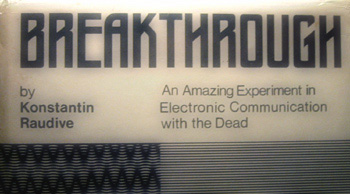
It’s instructive to listen to some EVP recordings without reading what the ‘voices’ are meant to be saying. The CD I mentioned in the last post The Ghost Orchid has a large selection of recordings of alleged spirit communications. The first time I listened to it, I couldn’t hear any sensible words at all in the faint voice-like sounds. Sure, they sound like voices (mostly…), but to my ear, just static-affected grabs of partially tuned radio signals. I could make a stab at what they might be saying, but I wouldn’t wager my house on any of it. Reading the transcriptions, though, like reading the transcriptions in Breakthrough is very instructive. It is clear that most of the content in these messages is coming from the mind of the interpreter rather than anything the voices are ‘saying’. In some cases, what I am being told the voices are saying does not in any way sound to me like what I am hearing.

I like ghost stories, but I don’t believe in ghosts. I think that the fact that large numbers of people are convinced they have been abducted by aliens is fascinating, even though I don’t believe for a moment they have. I find the fin de siecle obsession with Spiritualism endlessly intriguing but I don’t think there is a life after death. I thought the whole ‘Crop Circle’ phenomenon was wonderful, but I didn’t for an instant think that the circles were being made by extraterrestrials. What interests me is not so much these phenomena per se, but the people involved with them.

Human beings are amazing in the breadth of their capacity to be fooled. More than that, we want to be fooled, which is why it is so easy. Ask any magician.

Breakthrough is pretty much unreadable. A small portion of the book is given over to explanations of how the ‘spirit’ voices are captured and to rambling accounts, daft philosophizing and pseudo-scientific jargon about the voices and hypnosis and psychology and acoustics and all manner of other abstruse matters.

The larger part of the book consists of transcripts of what the voices had to say. Here’s the thing that becomes apparent very quickly on reading them: if these really are the spirits of the dead trying to communicate with us, then they have either all gone completely senile, or only the loonies are bothering to keep in contact.

These are some of the things the spirits wanted Raudive to know (the messages were also polylingual, just to add an even more insane dimension to the process):

Nedoma zirgi (Horses don’t think)

Matei sip galva (Mother has a headache)

Golva! Golvas nav! Konstantin, Konstantin, esmu ar tevi vienmer (Head! No head! Konstantin, Konstantin, I am always with you)

Vi koordinati (We are co-ordinated)

Kosta, van, pietiek ar muziku (Kosta, friend, it is sufficient with the music)

Konstantin, streite nicht! (Konstantin, don’t quarrel)

…and on and on and on for hundreds of pages with thousands of other incomprehensible and/or dreary snippets. The voices seem entirely incapable of stringing together more that about a half a dozen words into any semblence of coherence.

Man, and I thought this life was confusing and full of trivia. Heaven comes across as some kind of huge dull and sprawling cocktail party filled with the kind of people you’d step in front of buses to avoid. All on acid.

(If you want to hear some EVP the best all-in-one-place collection I’ve found is a CD called The Ghost Orchid. And if you want to make your own recordings of ghostly voices you can find out how here.)

But I digress. Back to the story. As you will recall, in last week’s episode I had forked out my 7 bucks for a copy of Breakthrough. Now I had some inspirational material for my piece.

What I thought of doing was this: since EVP is a technologically-based phenomenon, I would take the process one step further than plain ol’ magnetic tape and bring it into the computer era (there are now numerous examples of the Dear Departed communicating via computers, but that’s a story for another post, perhaps). My concept was to choose some of the phrases from the transcripts of Raudive’s recordings, and then use the speech function of my Mac to say them out loud. A dismebodied voice speaking the words of disembodied voices. Out of this, I would assemble a soundscape. Nifty, huh?

I typed out about a page of stuff. Then I realized the text was on the wrong computer, so I transferred it across to my work machine… and this is where another bizarre thing happened. Somehow, I have no idea how, the text I had typed out got completely corrupted in the transfer. Not a corrupted file mind you, just a completely corrupted rendering of the text. The document that opened was pages of unintelligible gibberish; fragments of words and bits of punctuation peppered throughout with lots of weird arcane-looking characters that I didn’t even know existed. This had never happened to me before, and it has never happened since.

Then I had a screwy idea: what if I got the computer to speak this stuff?

It was truly eerie. My Mac was speaking in tongues. Long experience has taught me that when an opportunity like this presents itself in the studio, you record it immediately in case something happens and you can’t reproduce it.

So I did. And then the computer crashed. And when it came back up, I could no longer open the text file.

Make of all this what you will. It gave me an interesting track. Like Marie Ann, the Marquise du Deffand once said: “I don’t believe in ghosts, but I am afraid of them…”

Here’s how the piece eventually sounded: Incantation [mp3 file]

[To Be Continued]

« Previous PageNext Page »