Thu 25 Aug 2011
Eppur si muove
Posted by anaglyph under Australiana, Religion, Science, Skeptical Thinking
[11] Comments
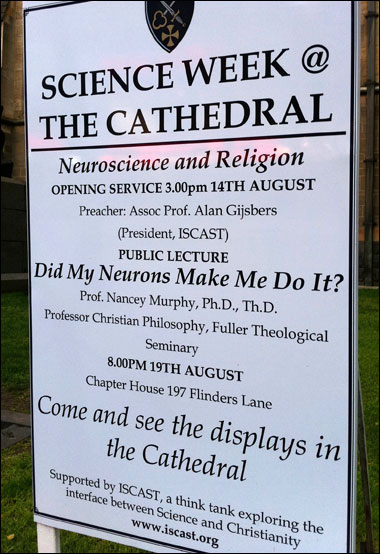
I snapped this sign in front of St Paul’s Cathedral, in inner city Melbourne last week.
The duplicity of the intent here is only eclipsed by its inanity. Professor Nancey Murphy is the author of ‘Did My Neurons Make Me Do It?: Philosophical and Neurobiological Perspectives on Moral Responsibility and Free Will’. She is also an ordained minister of The Church of the Brethren, a Christian sect so confused that it has split into numerous splinter groups that are, apparently, able to interpret the Word of God to be whatever suits their personal agenda. ((It should be said that The Brethren are not alone in this pursuit. Christianity itself is really just one big collection of groups that have decided that what God meant is dependent on your point of view.)) If Prof Murphy is a hard core member of The Brethren, though, she believes that the Bible is the inerrant word of God (with all that entails).
My brain finds it hard to contain the idea that someone can take that stance and still call themselves a scientist. Her interpretation of what science is, seems, apparently, to be as flexible as the interpretation of God’s Word among members of her belief system.
As for ISCAST, ‘a think tank exploring the interface between science and Christianity’, I have prepared a little diagram illustrating what I see as the principal difficulty in exploring that interface:
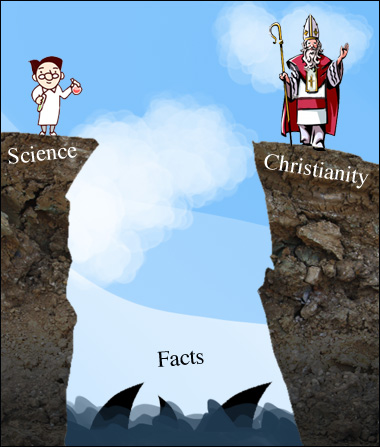
You see, when you accept the idea that a magical being created us and everything we see for inscrutable purposes of its own, you have abandoned all notions of science. Now, personally speaking, I don’t care one whit if Professor Murphy or anyone else cares to invent such fanciful stories, but it pisses me off when:
1: They think they have the right to push those ideas down my throat, and,
2: They think their ideas are better than everyone else’s ideas because their magical being told them so, and,
3: They attempt to conflate those ideas with science.
But I said ‘duplicity’ didn’t I?
I was intending to make this post a humorous jab at a daft sign, but in looking up St Paul’s Cathedral I inadvertently stumbled upon one of the most worrying, irrational, fearful and misleading documents I’ve seen in a long time. St Paul’s, it appears, is affiliated with an organization called Transforming Melbourne, a group that defines itself as ‘a Movement of Christians praying and acting together with the vision that God will renew His Church and not only bring new life to the people of our city, but transform its culture and society.’
Praying? Not a lot of science there, that’s for sure.
The document I mentioned is called ‘The Vital Role of the Church and Christian Faith in Our Society’ by Rob Isaachsen, Founder of Transforming Melbourne, and is something of a manifest of the group’s ideals. The preamble to it on the Transforming Melbourne site begins:
MPs, Christians and others have no idea that
OUR SOCIETY DEPENDS ON CHRISTIAN FAITH AND THE CHURCH
It then lists some ‘statistics’ that are supposed to convince us of how terrific the Christian Church is, before concluding:
The highly intentional atheist and secular humanist movements are seeking to influence governments to remove the freedom of the Church and Christian agencies to provide their community support, and Christian education programmes and Chaplaincy in schools which foster Christian values in society.
If they succeed in restricting Christian care and education the result will be the undermining of society itself.
This kind of addled fear-mongering makes my skin crawl and my blood boil. Yes folks, what it comes down to is that the people behind Transforming Melbourne believe that the EVIL ATHEISTS are attempting to get rid of the WONDERFUL CHRISTIANS because, for some reason, the EVIL ATHEIST agenda is to ‘undermine society itself’. Do these people really think like that? Are they really that simple-minded? Because if that’s the case it’s pretty damn clear why I don’t want Christian chaplains giving moral advice to my kids.
So it turns out that the real reason that the Cathedral is having Science Week is nothing at all to do with science (surprise) but is in fact a sleight-of-hand designed to give the appearance of open-mindedness and acceptance. There is no intent to explore an ‘interface’ between science and religion here. Make no mistake: these people do NOT care about science. If it was up to them, they’d as soon see their God wipe this troublesome ‘science’ thing from the planet.
What’s happening here is that they are afraid. Scientific thought represents the biggest real threat that religion will ever face. And now, with atheists and humanists asserting their human rights to create communities that are not built on superstition and fear, but instead on critical thinking, scientific inquiry and rationally considered ethics and morals, the Christian Church is resorting to one of its favourite techniques: instead of facing their challengers bravely, ((For surely, if their God is actually right as they claim, they have NOTHING to fear…)) they are attempting to subsume them. To make them feel at home. To feign charity. To pretend they’re on their side. But all they are really concerned with is promoting their agenda.
It has worked many times in the past when their competition was also fearful and held irrational beliefs, but this time it won’t.
(I’m going to examine some of the Transforming Melbourne document in the next post. It’s full of such egregious and erroneous claims that it simply can’t go unconfronted.)