Tue 16 Apr 2013
The Curse of the Crying Boy
Posted by anaglyph under Creepy, Ephemera, Hmmm..., Hokum, Scary, Skeptical Thinking, WooWoo
[20] Comments

A few days ago Violet Towne and I were down on the south coast of Victoria on a short break. On a day too rainy and bleak to be at the seaside we dropped into an antique and junk place for a rummage, as we like to do, and I was delighted to discover, in one of the more secluded nooks of the building, a framed print of one of the Giovanni Bragolin ‘Crying Boys’.
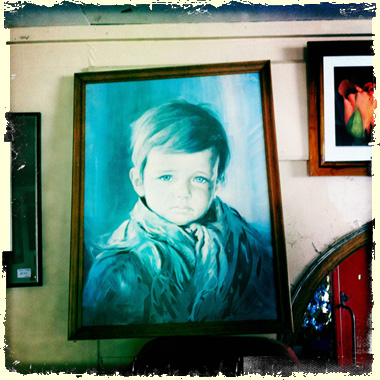
I was surprised to find that VT did not know the story of the ‘curse’ associated with the Crying Boy, and I thought I might take this opportunity to recap it here for others of you who may not have encountered this quirky piece of urban legend.
Giovanni Bragolin – known also as Bruno Amadio – was a trained classical painter and probably painted the original Crying Boy portraits – all variations on a similar theme – sometime in the early 1950s. It is likely that they were created specifically to sell to tourists as a money-making venture. Whatever the case, at some point Bragolin was evidently fortunate enough to secure a deal to have the paintings copied and printed and made widely available in English department stores in the late 1950s. There were probably many thousands made. ((Actual statistics are hard to come by, with various reports citing quantities from 50,000 to a quarter of a million, but given the widespread popularity of the prints, and the fact that they still turn up in junk shops on the other side of the planet, we can be fairly sure that a large number of them were made.))
For reasons that escape me personally, the Crying Boys were monumentally popular and ended up in households all over Britain (and elsewhere in lesser numbers). And there they hung for decades, doing nothing more confronting than offending the sensibilities of those with good taste. Until…
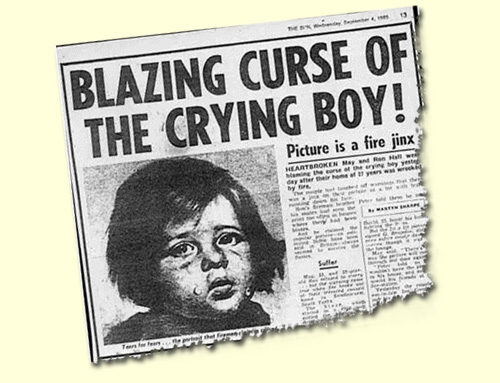
On the 4th of September 1985, Britain’s popular tabloid, the Sun, ran a story about a fire that destroyed the home of Ron and May Hall, a working class couple from the town of Rotherham in South Yorkshire. The couple put the blame for the blaze on the ‘unlucky’ portrait of the Crying Boy which hung in their living room, which – according to the report – escaped the fire completely unscathed. Not only that, said the Sun, but it was common knowledge among firemen that there had been numerous other instances of this same scenario unfolding in blazes across England: homes devastated by fire, watched over by the completely untouched portrait of a Crying Boy. The picture, the firemen said, was cursed. ((No fireman actually said this, as it turns out, but the Sun was very happy to let the implication stick.))
The next day the Sun ran a followup story claiming that their offices had been flooded with calls from readers with pictures of the Crying Boy on their walls, all fearing that they might become victims of the jinxed painting. And so the legend of the Curse of the Crying Boy was born.
Some stories are just made to gather momentum, and this was one. Everyone had a ‘friend of a friend’ who had been affected in some way by the image. Rumours grew that not only did the painting survive house fires, but it could not be burned even if you tried. People who attempted to get rid of the picture fell afoul of bad luck, and some even reported seeing it move on the wall all by itself.
To add kerosene to the flames, it turned out that there were numerous incarnations of the Crying Boy theme painted by other artists – it was a veritable plague of Crying Boys. As I mentioned earlier, they were – puzzlingly – exceptionally popular, and the conjecture must be that in the 70s and 80s in England, if there was a house fire anywhere there was a fair to middling chance that the tenants were in possession of a Crying Boy. This possibly goes at least a little way towards providing some basis for the idea of the curse, but in all probability it can mostly be put down to a case of overactive imaginations and rumour run riot. ((There are many ‘supernatural’ explanations, of course, but they are banal and tedious and probably without any foundation in fact. You can, if you are so inclined, chase them up via the excellent Fortean Times redux of the Crying Boy Curse.))
The Sun (perhaps in a moment of conscience, but probably more because they knew how to ride a story to death) did a shout out to readers who were afraid that the picture might bring them ill luck. Send them to us, they said, and we’ll dispose of them for you! The offices of the paper had soon accumulated a staggering 2,500 copies of the Crying Boy, which demonstrates two things clearly, I think: just how popular the damn thing was, and also how frighteningly superstitious the readers of the Sun were.
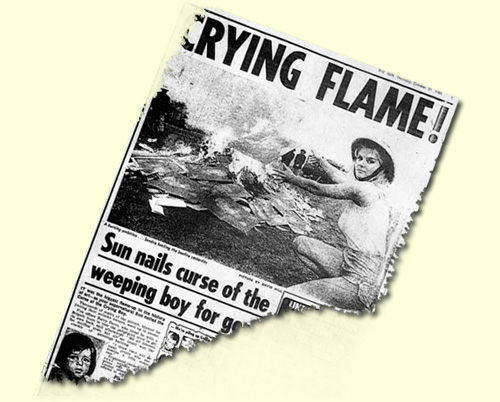
In an act that just smacks of the British tabloid mindset of the 1980s, on Halloween 1985, Sun employees stacked the prints into a huge pile and they were set ablaze by a popular Page 3 girl. It could only have been more perfect if she’d been topless.
An urban legend isn’t quelled quite so neatly, though, and the Curse of the Crying Boy didn’t simply go up in smoke with the bonfire. Over the next decade it neatly transmogrified from fleeting newspaper titillation into full-blown myth, and lives on today, with many new riffs on the original story. Hang a Crying Boy next to a Crying Girl (yes, they exist too), it is said, and the bad luck will be thwarted. Hang ten copies of the Crying Boy together and the bad vibes are similarly dissipated (you’ll need some good luck finding ten copies these days, though). Whole narratives have arisen around the artist who painted the original picture and the supposed identity of the Boy himself, all with little or no basis in fact. Stories of disasters involving the Boy now come from countries all across the world and he is so embedded in popular culture that he even sports a Facebook page, of sorts. ((It’s a bit of a pathetic effort, really, and could be HUGELY more entertaining in my opinion.))
But I can sense the question on your minds, Faithful Cowpokes: did I buy the copy I saw? Sadly, I didn’t. I probably should have, but the truth is that I wasn’t totally familiar with the version hanging in the antique shop, and didn’t know if it was ‘the real deal’ as it were. That’s why I snapped the pic of it that you saw above – I wanted to check its provenence (there was no mobile reception, otherwise I’d have done it on the spot).
Oh, and anyway, as if I’d hang it in my house. Are you crazy?
___________________________________________________________________________
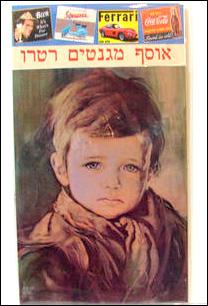
UPDATE: The Crying Boy spotted on eBay in Israel. Printed on a magnet! (WARNING: May cause your fridge to burst into flames)
___________________________________________________________________________
UPDATE #2: VT bought me one for a present! It now hangs in my office.