Technology


A Scary Robot Thing

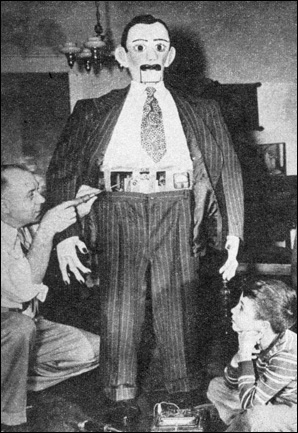
Whilst browsing over at Modern Mechanix just now, I found the pic above captioned thus:

Dancing Robot performs a merry jig by remote control. Patrick Rizzo who built it in his spare time, claims the $100,000 creature is the first of its type.

Oh great, that’s all we need – a robot crossed with a ventriloquist doll. That dances.

A Very Scary Robot

Popular Mechanics website recently carried an article about the ‘fragility’ of the nascent robotics industry and the unlikeliness that we’ll be seeing robots making our martinis anytime soon. Colin Angle, the CEO of iRobot (a company that specializes in ‘home robotics’*) said in his keynote address at the RoboBusiness conference in Pittsburgh last month that ‘the killer app that will drive the industry hasn’t yet emerged‘.

When he says ‘killer app’ I don’t think he’s talking about the heavily armed SWORDS† robots that the US military deployed in Iraq in 2007 and then immediately undeployed when the robotic gun ‘started moving when it was not intended to move‘… Before it could shoot when it was not intended to shoot, one speculates.

You all know my thoughts on robots. I’m thinking that we still have a ways to go even with trusting them to dust the china before we start handing out the AK47s. Not that the US Military (nor indeed the voting majority of the democracy that is the United States of America) seems to require much in the way of actual intelligence (artificial or otherwise) in that respect.

___________________________________________________________________________

*When they say home robotics, they evidently mean vacuum cleaners at this point in time…

†Special Weapons Observation Reconnaissance Detection System. Well whaddya want? It’s the military – they’re not known for their literary acumen.

Image swiped from the unmatchably geek-cool Modern Mechanix. Go there now and marvel at the treasures.

___________________________________________________________________________

Microsoft, in their desperation to get the drop on Apple’s ability to spin gold out of new gadgetry innovation, are frantically searching for something, anything, in an effort to increase their cool factor. They are not good at this. Maybe you remember Zune? Or The Surface? Well, Zune was just a case of imitation I guess, but it doesn’t take a genius to see that no-one aside from Tom Cruise is going think that a table is a better interface for a computer than it is a thing to stop your coffee falling on the floor.

Mr Gates’ wizards’ latest Next Big Thing is called MySong*

Here, let the Ian Simon, Dan Morris and Sumit Basu, the brains behind MySong at their lab at Microsoft Research, tell you all about it:

MySong automatically chooses chords to accompany a vocal melody, allowing a user with no musical training to rapidly create accompanied music. MySong is a creative tool for folks who like to sing but would never get a chance to experiment with creating real original music.

OK, so that’s a big ask: you sing, MySong plays along. If someone told me that some software dudes had accomplished that feat, I’d be mighty impressed. But, you guessed it – in the manner of most things Microsoft, it kinda sorta of works. Only kinda sorta. That might be sufferable† when it’s software that deals with word-processing or spreadsheets or operating systems, but when it comes to music, ‘kinda-sorta’ is nothing short of disastrous.

Check out this video tour of the features of MySong, including someone using it to make an accompaniment for her rendition of The Way You Look Tonight.

Old Blue Eyes she ain’t. And that’s part of the reason that MySong is destined to be a Surface-class turkey. The inventors of MySong continue with their spruik:

Come on, you know who you are… you sing in the car, or in the shower, or you go to karaoke clubs, or you just once in a while find yourself singing along with catchy commercial jingles.

Yes. Apparently, this invention is being pitched at people who can’t sing, and who, very sensibly, restrict their efforts to places where no-one else can hear them. In the YouTube example above, the woman crooner dishes out an out-of-tune vocal line, and MySong responds by providing a suitably toneless accompaniment. Perfect! But what the hell are you going to do with that??? My brain just makes little fizzing noises when I try to work out whether the Microsoft thinktank has actually thought this one through.

Let’s just do a bit of psychological reverse engineering. If someone is an average-to-bad singer, what’s the thing that they’d really like to see in a piece of software of this kind? I’d guess it’d be something that made them sound like Frank, or Dean, or Celine, or Aretha or maybe even Elvis, swinging onstage to the beat of a thirty-piece Big Band – something they could play around to their friends and say ‘Hey, this is me! I could be doing Vegas!’

Instead, with MySong they end up with a terrible recording of their out-of-tune moaning backed with clunky tuneless noodling on synthetic instruments that they would only dare play in the shower or in the car. Sum advance: zero.‡ Or possibly negative, if you factor in psychological damage.

True enough, it’s only early days for MySong, and maybe it might turn into something one day. But hey Bill, here’s a tip: when your boffins come to you with this kind of project, you ask them if it’s Vegas-worthy. If they say no, send ’em back to their cubicle. For God’s sake don’t let them go public with it!

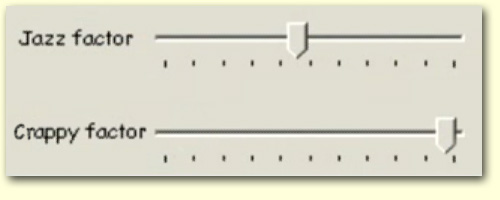
Persevere through the YouTube vid if you can, faithful Acowlytes. It has some real clunkers. For example, here’s a screen shot of some of the controls you can set on MySong:

MySong is Jazzy & Happy

Man oh man. In a Microsoft Music World there’d be a button for everything. Happy, jazzy, jivey, jolly! No thinking required!

But here’s a how it should really be:

MySong is actually crappy

I’m sure the technical feat that Messrs Simon, Morris & Basu have accomplished is of some magnitude, but all their toil amounts to further fuel for the fire of what I shall now call The Reverend’s Rule: Just because you can get a computer to do something, doesn’t necessarily mean that you should.

ADDENDUM: In a curious piece of synchronicity, the dudes at Celemony, the genii behind the awesome pitch tracking/correction software Melodyne, have announced their new software Direct Note Access. To explain briefly: Melodyne allowed you to take a musical recording of a single monophonic instrument – a violin, or a trumpet, or a voice, for instance – and gain control over every note, so that you could pitch correct errors, or even create harmony melodies by arranging the first recording as a second part. Now, DNA allows you to do the same thing with polyphonic recordings. That is, you can take a recording of a guitar strumming chords, and then unravel the recording to gain control over each individual note of the chord. It is nothing short of astonishing. Check it out.

___________________________________________________________________________

*Apple’s insistence on calling all its products “i” something is irritating enough, but Microsoft’s ‘My’ prefix is so pathetic as to be almost a cry for help. I wonder what Freud would make about this all blatant ego-technocentricity? Aside from anything else, aren’t they just plain embarrassed to be so obviously unoriginal?

†Although, quite honestly, I really don’t know how anyone can put up with the clunky retarded piece of techno-obfuscation that is Windows. Having to recently field a number of Windows ‘issues’ for Violet Towne, I am completely convinced that the only reason it exists is some kind of plot to keep IT nerds employed.

‡Well, zero for punter, $$$ for Microsoft. Hmmm. I guess that wouldn’t be the first time they’ve palmed off something of useless utility onto someone who didn’t actually want it.

___________________________________________________________________________

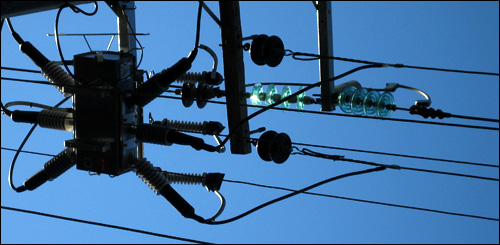
Some power lines

So. It’s a hideously hot night, last night in Melbourne town, and Violet Towne and I are trying to get some sleep. Just as we finally doze off, there is an almighty explosion and flash of brilliant light right in front of our house. All the power goes out and the street is plunged into darkness. We both sit bolt upright. The night is dead silent, ringing with the echo of the sound. In a few minutes, the electronic devices in the house beep back into life and the streetlights flicker back on.

Adrenalin having propelled us from bed, we make a cursory investigation, but it’s too dark, and we go back to attempt to sleep.

This morning the grim scenario was all too clear.

A Dead Possum

At least the poor little blighter went quickly. I reckon that his soul was in cat possum heaven before his body hit the ground.

A Robot Joke

Magnus dishes out

I’ve been reading a lot of stuff lately about people (mainly Japanese people, it has to be said) extolling the virtues of the imminent Robot Revolution. I’m sure you all saw scientists at Tokyo’s Waseda University recently wheeling out their Twendy-one, a kind of home-help robot designed for aged-care, and last year Hiroshi Ishiguro of Osaka University was appearing all over the media with his ‘actroids’, including the odd ventriloquist-doll-like ReplieeQ1 who is variously described as ‘scarily realistic’ and ‘scarily life-like’ but seems to me just plain ‘scarily scary‘.*

I’m not too impressed about the idea of robots getting to be all pally with us, despite the enthusiasm coming out of Nippon. As much as I really loved the concept of our funky metal friends when I was a kid watching The Jetsons and Lost in Space, I’ve seen the future of robotic intrusion into our lives, and I just know that if our destiny is going to involve robots, I’m much more likely to be teaming up with Magnus, Robot Fighter than with little Jimmy Sparks.

I am, of course, extrapolating from the way robots currently ‘help’ us with our affairs. I’m sure you’ve tangled with the ‘proto-bots’ too, but let me elaborate.

Telstra, Australia’s biggest telco, has had in operation for a while now for our convenience, a voice-recognition fembot to handle incoming calls. I often find myself having to call Telstra and I have come to dread the experience. This is how my conversation with this artificial ‘intelligence’ typically proceeds (try to imagine a sing-songy overly-chummy female voice for the fembot):

Fembot: Welcome to Telstra. So that I can direct your call to the right place, in just a few words please tell me the reason for your call.

Me: Incorrect charges on my bill.

Fembot: That would be about a single bill? Does that sound OK?

Me: What? A single bill? What does that mean?

Fembot: I’m sorry, I didn’t quite get that. Let’s try again. In just a few words, tell me the reason for your call.

Me: You’ve charged me for calls I didn’t make. Again.

Fembot: I think there could be faults or problems with your phone, does that sound OK?

Me: No!

Fembot: And is that for a mobile?

Me: What? No. It’s not a mobile.

Fembot: Can you give me the number of the mobile?

Me: It’s not a mobile!

Fembot: And what number would that mobile be?

Me (grrr): I want to talk to an operator.

Fembot: So that I can direct your call, please tell me in a few words the reason for your call.

Me: Aaaaargh! Operator. Operator. Give me a human. Operator. Operator. Operator.

Fembot: OK, please wait and I’ll get a customer service representative.

When the human comes online, we are invariably able to sort the problem out in seconds.

How many things do I resent about talking to the fembot? For a start, I despise the way it assumes a cloak of intelligence and power right from the get-go. By giving the impression that it has some kind of control over what it offers to be able to do for me, it looks all the more moronic for not being able to understand the most basic of syntax; I am phoning to try and sort out a problem and find that I’m immediately talking to an IDIOT. Let me ask you: if you were setting up a business, how likely is it that you go out and hire the stupidest person you could find, and then put them on the switchboard? Well, it’s worse than that.

Next, I loathe the maladroit attempt by the programmers to make the fembot appear chummy. Gone is the stilted computer formant voice of yesterday, replaced now with a studied, efficient-but-friendly, carefully modulated, fluid female phrasing that manages to come across as simultaneously condescending and obsequious. The sing-song inflections are reminiscent of the way someone might speak to a very young child, and the colloquial tone (Does that sound OK?) is merely grating and infuriating when intoned by a gadget whose nearest relative is a talking clock. At least when you got the phoneme-retarded cut-up voices of the past you were comprehensively aware that it was a clunky computer trick that you were dealing with.

But most of all I am maddened by the fact that every time I call I am completely unable to resist being drawn into talking to the damn thing as if it was an actual person, and wasting a good minute or so getting exactly to where I should have been at ‘Hello’.

The technicians who build these machines have got it in their heads that if they make them more people-like, we will accept them more easily, but for me, at least, the closer these things come to having the semblance of humanness, the greater is my desire to punch them. And, in contrast to the way I might deal with a real human idiot, there’s really no moral reason to curb that inclination.

This is what I fear about the coming of the real Robots. At least when the android is separated from me by a phone line, the most I can do is yell at the damn thing (which, I might add, I have done on numerous occasions).† But if Robo was in arm’s reach, then I swear, the word robocide will enter the lexicon faster than you can say klaatu barada nikto. This of course would necessitate the invention of laws. Not as Mr Asimov supposed, Three Laws designed to stop robots from harming humans, but instead, a single Law to stop humans turning robots into boat anchors.

This explains, at least, why they’re practising with robots in aged care: lowered retaliation factor. Better to send the droids up against feeble old folks than aspiring Magnuses.

It’s obvious though, that the boffins, as much as they might know all the ins & outs of their mechanical friends, don’t have even the vaguest concept about aged care. I’m just itching to watch the first practical tests when they send ReplieeQ17 in to deal with some old codger with dementia. I expect it to go something like this:

RQ17: Hello Mr ÄŒapek. I am here to prepare your breakfast. In just a few words, tell me what you would like?

Old Codger: You say what, young fella?

RQ17: I’m sorry I missed that, let’s try it again. Can you tell me, in just a few words, what you would like for breakfast?

Old Codger: Breakfast? Breakfast? What happened to lunch?

RQ17: Would that be oatmeal and fruit? Does that sound OK?

Old Codger (hits robot with cane): Are you trying to steal my money?!

RQ17: Did you say “my money is missing”?

Old Codger: YOU STOLE MY MONEY!

RQ17: I’m sorry, I didn’t catch that. Would you like to report a robbery? Does that sound right?

Old Codger: There’s something wrong with your face. Are you a Chinaman? Where’s my breakfast anyway?

RQ17: In just a few words, tell me what you would like for breakfast and I will prepare it for you.

Old Codger: A Chinaman stole my money! I knew it!

Well, you get the drift.

Personally, when all’s said and done, if it really is necessary to have a Robot Revolution, I want my robots to look and act like robots. If there’s a problem, I don’t need some kind of creepy pseudo-human standing there and negotiating with me. I just want a big clunky tin can filled with flashing lights, wobbling the claws on the end of its vacuum-cleaner arms, and blurting out in a grating metallic voice:‘Warning! Warning Will Robinson!’

___________________________________________________________________________

*Hiroshi Ishiguro has also created Geminoid HI-1, a robot that looks exactly like himself. Well, exactly like himself if he was a spastically jerking animatronic life-size doll.

†I’m not alone in this it would seem. Current research into voice recognition systems for handling telephone enquiry lines is examining ways to extract ’emotional’ tones from callers’ voices in an effort to recognize unhappy campers. Presumably these callers are then somehow dealt with differently to people stupid patient enough to play footsie with the robots.

A special thanks to Pete at Headless Hollow for the Magnus scan. I grew up reading Magnus comics and I really loved the wacky robots-gone-amok future that they suggested.

___________________________________________________________________________
« Previous PageNext Page »