Web Politics


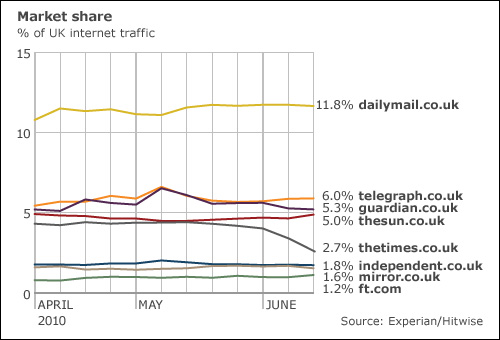
You will remember that a little while back we learned that Rupert Murdoch, using his needle-sharp insight into how people use the internet, stumbled on the notion that it would be a good idea to start charging visitors to read the online version of his flagship newspaper The Times. Consequently, the last month has seen The Times subscription gateway come into operation and readers have been asked to sign up (without paying) before they can get access to stories on The Times site. Here’s a graph that reflects the status of readership figures for various online UK newspapers since April.

Notice anything? And need I point out that this graph reflects only the sign-up process – no money has so far changed hands. Now, to my eye that looks like The Times online has lost nearly half its readers in a month. And the curve doesn’t look like it’s intending to taper off anytime soon, and that’s before we get to the point of actual money being forked out.(i)

Rory Cellan-Jones, on his blog at the BBC, has speculated that The Times really only has to hang on to about 5% of its former readership ‘to have the champagne corks popping in Wapping’. I predict that the readership will fall right through that number and bottom out at nearly zero. Rory puts his finger right on it in his post:

My suspicion is that the main problem with this experiment is what I’d call friction. Web users have got used to clicking simply from one page to another without hindrance. Any element of friction – the aggravation of having to pay or just log in – acts as an incentive to head elsewhere in a hurry. I tried an experiment this morning, posting a link on Twitter to an article by the very funny Times columnist Caitlin Moran. Plenty of people clicked on the link – but when they were taken directly to the Times pay-station, they all appear to have left without paying.

To anyone who’s been looking at web media for any length of time, this is truly a no-brainer. Why would you bother? Rupert is pinning all his hopes on one single idea: that people care enough about the quality of the journalism (and whatever else The Times has to offer) to pay for it.(ii)

Rupert, I’m sorry to say that the 21st Century is going to give you a bigger ass-walloping than you ever thought possible.

Let me explain it in a way that even Mr Murdoch might understand. Are you sitting comfortably? Very well, let’s begin.

Once upon a time, when horses and buggies were the fastest forms of transport and people cleaned chimneys by crawling up them with big brooms, accounts of what was happening in ‘the world’ started to get circulated via a system called ‘the newspaper‘. The newspaper gathered up a collection of what its publishers deemed the most relevant and interesting bits of news and gossip of the moment, and then distributed them to the community. The newspaper was a marvellous idea for its time, but, for all its charm and utility it did have some limitations: it was largely a local phenomenon, it cost money to make and deliver to the people who wanted it, and it had a kind of inbuilt time delay (if news happened, you had to wait till the next newspaper was made in order to know about it). But because it was a physical object, and it was a convenient way of learning about the latest goings-on in the world, people were prepared to pay some small amount of money to take possession of their daily newspaper. Plus, you could wrap fish & chips in it when you’d finished reading it. (It also had another limitation, but one that few people were aware of at the time: it was a one way street. That is, the newspaper could tell you things, but you could not reply to those things, nor enquire after their veracity.)

Eventually, after a few decades of news distribution of this form, a few cunning people realised that if they could gain control of the newspaper business on a large enough scale, they could earn themselves quite a bit of money. And so newspaper tycoons came into existence. The object of being a newspaper tycoon was to gather up as many small local newspapers as you could find, and either put them out of business, or amalgamate them into your empire. This concept made a small number of crafty men (for they were ALL men) very wealthy indeed. It had the added bonus, for those men, of giving them extraordinary political power, because after all, they controlled what people knew about the world. This state of affairs existed for the better part of a century, with the newspapers becoming more and more ubiquitous and the newspaper men more and more wealthy and more and more powerful.

But then, late in the 20th century, a completely unexpected thing happened – a wonderful piece of technology called ‘the internet‘ came along. The internet was really nothing more than a way in which everyone on the planet could easily and instantly talk to everybody else, no matter how geographically separated they were. It was a simple but powerful idea. And the more people who understood this idea, the more powerful it became. Before anybody really even knew what was happening the internet became connected to all kinds of places across the whole world, and people happily discovered that news and gossip and all kinds of other information could now be exchanged rapidly and for free. People liked that! And the internet was unlike the newspaper in one very important way: nobody ‘owned’ it and nobody could own it.(iii)

So who do you think were the most unhappy about this state of affairs? That’s right – the newspaper tycoons. They were VERY VERY upset, indeed. People were talking to each other and learning about their world for free! What a terrible, terrible thing!

Thanks to their innate carnivorous business instincts, though, the tycoons became aware very rapidly that this ‘internet’ was something quite big and important, and they could see that people had taken to it like ducks to water. Unfortunately they could only see this through spectacles that had little dollar signs embossed all across the lenses, and so their vision was not very clear. The first thing they did was to nab themselves some real estate on this internet thingy. After all, it was FREE, what did they have to lose? Of course, the people who were already on the internet were happy to see their old friends from the newspaper business there and started visiting these new sites from the old guard – but they didn’t just hang out at one newspaper… oh no! They were now reading six or seven or maybe even ten newspapers, and not just newspapers from their home town either! And not only that, they were getting news from sites that weren’t actually newspaper sites but had news anyway, like blogs and ezines and social networks and all manner of other strange ideas! All for free!

The newspaper tycoons weren’t used to the concept of ‘free’. It was not something that was in their world view. When they said the word ‘free’, as they sometimes did, they meant ‘we’re giving you a nice little morsel but it has a hook hidden inside it’. The concept of ‘free’ as in ‘you can get it with no strings attached’ was as alien to the newspaper tycoons as was the idea of travelling economy class, so they looked upon what was happening on the Internet with a great deal of bewilderment and frustration. All these people were here doing stuff and hanging around but the tycoons couldn’t figure out a way to make money from it! How they hated that! How dare people amuse themselves!

So instead of making some kind of effort to understand what was going on with the Internet, as some of their cleverer and less mercenary colleagues did, the tycoons contrived to do the least effective thing possible: they attempted to make the Internet play by their Old Rules. Unfortunately, the people using the internet could see immediately that the Old Rules really suited no-one except the tycoons. The only option open to the tycoons now was to try and make their Old Way look more enticing than all the New Things the Internet was offering. They did this mostly by telling everyone how TERRIBLE the New Way was and how much BETTER the Old Way was. They said this loudly and often.

‘If you continue to get your news for free,’ they cried ‘You’ll only get TERRIBLE quality news. WE are the keepers of GOOD quality news!’

Unfortunately, the people using the internet already knew that this was a stupid and desperate tactic. They knew that not only was the news from the New internet way just as good (and sometimes even better) than the Old newspaper way, but that the Old newspaper way gave them TERRIBLE quality news as often as not too!

In spite of this obvious failing, the tycoons quite idiotically convinced themselves their argument was good enough to charge money for their Old News, just like they used to do when the world was all nice and simple, before smoking tobacco caused cancer and when it was perfectly acceptable to feast on endangered species of quail and unsustainable caviar stocks. And so they said to the Internet people:

‘Now we want you to PAY for our Old Ideas, even though we have made exactly NO CONTRIBUTION to this new way of doing things…’

Well, we’ll have to leave our story there for the moment, because the last words have not quite been written. I suggest that ‘Happily ever after’ is not on the cards for those old newspaper tycoons, though. They are facing the end of their dynasty and they stand, as emperors have often done, bewildered in the empty halls of their palaces while the revolutionaries hammer at the gates.

Will Rupert get his 5% faithful? Will the champagne corks be popping in Wapping? Will the line on that graph level out before it hits sea level? Six months is about what I think it will take to give us the ending to this story.

_________________________________________________________________________
Footnotes:

  1. Quite interestingly, the curve visibly trends downwards well before the subscription requirement kicked in. I surmise that this indicates people started abandoning the Times pretty much as soon as they heard that it was going to start charging money. If I was head honcho, I would have taken this as an extremely worrying omen. []
  2. It also breaks one of the most important pieces of functionality of the web, and very few of the Old Guard understand this because it is such an alien concept to them: the ability to cross-link. Anyone who writes a blog (or anything written specifically for online diffusion) understands automatically how powerful a utility this is. The web is a ‘web’ because it builds itself on connectivity. If I want to write something on Tetherd Cow I can easily bolster my story with examples, references and asides that anyone can check instantly. But there’s NO WAY I can do that with the Times any longer. If I cross-linked to an article in the Times, my readers would simply behave as those in Cellan_Jones experiment, above. Murdoch’s idea is fundamentally destructive to the very foundations of the internet. Where we see the awesome power of the building up of information structures, he wants to create cloistered communities that he can control. This, in my opinion, is what will ruin him. He does not grok the net. []
  3. You can bet your humidified Havana cigar that there are those who, if they’d known how it was going to turn out, would have moved heaven and earth to have gained control of it… []

_________________________________________________________________________

Bookmark and Share

You will remember that some time back I was musing about the exploration of models for earning income in the new media paradigm.

At that time I installed the Collection Plate, to the right there in the sidebar, just to see whether visitors could even be bothered to flick a virtual coin my way when they found something on The Cow that they liked. Well, it’s been a mixed response. As I might have guessed, the click count was proportionately high toward the beginning and has now tapered off. Even factoring in King Willy’s irritating clicking frenzy in the early days, I can see that there was interest when it was a fresh idea, but has now settled into a predictable low-level trickle. Not surprising really.

As of today the plate has collected 860 coins – if we assume that people might have dropped in 5c a hit, that’s a grand sum of 43 bucks in 3 months. It’s obvious that I’m not headed off to the Maldives anytime soon. Still, my readership is small (if entirely faithful) so those figures are obviously dependent upon traffic – it’s not bad for someone who’s busking in a back alley on a cloudy day.

When I installed the Collection Plate, you may recall that I mentioned, somewhere during the discussion, a concept called Flattr – a micropayment ‘sharing’ system being set up by Peter Sunde, one of the Creators of Pirate Bay. Well, I was recently invited to join the Flattr beta project and you will infer by the Flattr icon underneath the Collection Plate over to the side there, that I have accepted a role in the Flattr experiment.

This is how Flattr is supposed to work:

First of all, you need a Flattr account. Currently these are given by invitation only, but the idea is that when Flattr is launched, anyone can get an account just by signing up. When you have your account, you decide how much money per month you’d like to spend to ‘Flattr’ people who you visit on the web. This money goes into your Flattr account – you can’t get it back. Then, over the month, the amount of money you decide upon – say five dollars (or Euros, as it is at the moment) is divided up by the number of times you click on Flattr buttons you encounter while traipsing around the intertubes. That amount of money then goes into each Flattr account you clicked on. In other words, if you only click one Flattr button on one site, that site gets the whole five bucks. If you click on two Flattr buttons, each site gets $2.50. And so forth. If you don’t click on any Flattr buttons, all your monthly allowance goes to a charity.

I’m giving Flattr a try, but I have numerous reservations about its concept. Let me elaborate:

•Straight off the bat, when I activated my Flattr account I was asked to nominate an amount of money I wanted to spend to Flattr people each month. This is too damn tricky, I think. I simply don’t know what kind of a figure I think is reasonable to spend on my internet travels. Heck, mostly I get my stuff for free right now – why should I pay? I don’t think I’m the only one that will ask that question. This idea is too much like subscription models that have already shown to be less than effective on the internet. And a big difference is that with subscriptions you know in advance what you’re getting, and can make an assessment of whether it’s good value.(i)

•Right from the first time I heard the concept vaunted I could see a huge drawback: Flattr must break a critical user barrier before it’s got a hope in hell of working. If Flattr buttons were everywhere, and you saw them on YouTube and Wikis and Forums and so forth, then I think you’d be inclined to join up, if for no other reason than to get a chance at a slice of the pie for yourself. But for now, the very first thing you realise after you put some money in your Flattr distribution account is that there are not many people out there that you want to Flattr. Well, sure, for the novelty you’re likely to chuck a few coins in wherever you see a Flattr button, but the idea is that you reward people who are doing great stuff, not just exchange coins with everyone else in your club.

We can see the problem here of course – Flattr needs to be ubiquitous to get the system working, but the system has to be working for Flattr to be ubiquitous. It’s an unenviable conundrum. Can Flattr pull itself up by its own bootstraps? I’m doubtful.

•You can’t proportionately award good stuff more Flattr points the more you like it. Flattr will only let you click on one unique button once a month. I think this is a problem. I understand the egalitarian idea behind sharing revenue ‘fairly’ among places that I visit, but let’s face it, I want to be able to decide that if I like someone a lot, I can click on their button three or four times to reflect that. I’ve hit this stumbling block already – I’ve visited a few sites that are linked off Flattr and, well, they’re OK, but do I really want to give them my coin? If I plonk my click down on one site, then I am under pressure to find another site just so site #1 doesn’t get my whole month’s allowance. There’s something that I find instinctively wrong about that concept.

•You can’t see (as far as I can tell) who has Flattred you. This is probably not something that would be ultimately relevant, but while Flattr is new I think it’s quite important. If someone Flattrs you, you instinctively want to see what they do also. It’s like when someone leaves a comment on The Cow – mostly I will pay their link a courtesy visit to see exactly what it is they’re about, and if I like it, I might even stay. I believe this sense of community is vital in a scheme like Flattr, at least in the early stages. (It occurs to me that it’s also a very good way of finding out exactly who actually even has an account on Flattr, since the only people who can Flattr you are Flattr users). And related to that:

•To even get a leg-up, you need to have Flattr users come visit you. I don’t see how I’m going to get this to happen unless I actively solicit visitors to The Cow. Once again, this may not be as much of a problem if Flattr becomes widespread, but for the moment it is a stumbling block. You can see how many people have Flattred me by the count on the Flattr icon. Right now it’s zero and I expect it will remain that way for some time.

How do I get you guys to join up with Flattr, so that you can Flattr me? Why, according to the Flattr website, I tell them to! So – how many of you are heading across to Flattr right now to get an account? Right, I thought so.

So, there are my thoughts on the Flattr mattr. As I said in my original article, these things interest me so I’m all for some experimentation, but I really don’t hold high hopes for Flattr. I aim to stick with it for a few months – let’s see how we go.

ADDENDUM: I thought of another instability just now. Flattr exists as a kind of community contribution idea – I Flattr you, you Flattr Gilbert, he Flattrs me, what goes around comes around. But exploitation of the system would arise very fast. Let’s say I post something on my site that really gets people’s attention. They all Flattr me, and not only that, I get quite famous, with lots of readers and a nice Flattr income. There is no incentive for me to care about belonging to the Flattr community, as such, any longer. I can reduce my Flattr contribution to the minimum allowable and just let it go to charity every month. Meanwhile I’m doing very nicely out of a constant Flattr revenue stream. I’m not suggesting this would happen a lot, but there would definitely be Mega Flattr sites that are sucking it in rather than giving it up.

Another thing that occurs to me is that knowing how much people are being Flattred is likely to influence how much they get Flattred. If I see someone with lots of Flattrs I’m likely to think – oh well, they’re doing OK, I’ll save my click for someone else. I think this could be ameliorated slightly by having the number of Flattrs NOT displayed on your icon. It may well be that doing this might counteract the situation I mentioned above.

_________________________________________________________________________
Footnotes:

  1. I suppose that you can always treat your Flattr account as a hypothetical donation to charity from the get-go – which it kind of is. []

_________________________________________________________________________

Bookmark and Share


An unbiased poll at Tetherd Cow Ahead finds that Stephen Conroy is officially a dunce!

Bookmark and Share

Senator Stephen Conroy


Spare me once more from the morons.

I’ve spoken before about senator Stephen Conroy*, the politician who somehow has ended up being Australia’s advisor on all things internet, and today the Cow’s attention turns toward him once more. This time, it’s because he has decided to offer up his advice on internet security. And Spagmonster knows that a guy with his level of 1337 k3wl is going to have some pretty U$3PhUL words to say on the matter. Am I right?

Yes, Senator Conroy, wearing his white hat out in public for all the world to see, yesterday launched Australia’s National Change Your Password Day.

“No one wants to lose their bank details to criminals or fall victim to an online scam and that’s why it’s important that people understand simple steps, such as getting a better, stronger password, can help them stay smart online and protect their personal information.”

Password? Password? Are you reading what I’m reading here? Stephen Conroy seems to be under the impression that people use only ONE PASSWORD!

Further demonstrating his uncanny 1337 (r3D3|\|714L$, Conroy goes on to recommend that:

…passwords always include letters and numbers and warned people to be vigilant. “Stop and think before you click on links or attachments.”

Jesus H. Christ. You’d think this guy has only just discovered the internet. What really worries me is that maybe that’s true.

Australians, answer me this: of all the people we could have had appointed to look after the most exciting and powerful concept to come the way of human civilization since the invention of language, why have we been saddled with a cretin? Not just someone who isn’t quite up to date with the latest and the neatest (that would be understandable) but someone who hasn’t got the faintest clue what he’s talking about. Worse, he hasn’t got the faintest clue, but he doesn’t know how to sound like he does!

Excuse me. I have to go change my password.

___________________________________________________________________________

†One can only speculate that he won the position on the hoop-la or the chocolate wheel.

‡After an ignominious (yet predictably sanctimonious) backdown on the imbecilic ‘Clean Feed’ proposal.

___________________________________________________________________________

Bookmark and Share

Along with the prestigious Cow Medals I hand out very sparingly here on The Cow, I think I’m going to have to invent some kind of trophy for the opposite end of the spectrum; an award for those who say the stupidest things on teh webs.

I’d kick off the ceremony with the CEO of Sony, Michael Lynton, who last week opined “I haven’t seen any good come out of the internet”. Translating that into something that makes sense to people who aren’t the buck-stops-here-guy for multinational companies: “I don’t get why this thing is bigger than television and getting bigger by the attosecond and we can’t figure out a way to make as much money out of it as we used to make out of all that old technology we have”.*

Mr Lynton got a good old walloping immediately on the nets of course, and tried to backpedal in an article on the Huffington Post, managing only to dig himself an even deeper hole by revealing the real extent of his failure to grok the magnitude of the thing he’s trying to get his brain around.

I cannot subscribe to the views of those online critics who insist that I “just don’t get it,”

…he protests, and then goes on to comprehensively demonstrate his inability to get it.

His Huffington Post whinge is so clubfooted, and so embarrassingly naive, that it is staggering to believe that this guy has managed to get to be the guy in charge of one of the largest corporations in the world.

He laughingly attempts to equate the ‘Information Superhighway’ with an actual ‘highway’…

In the 1950′s, the Eisenhower Administration undertook one of the most massive infrastructure projects in our nation’s history — the creation of the Interstate Highway System… Guard rails went along dangerous sections of the road. Speed and weight limits saved lives and maintenance costs. And officers of the law made sure that these rules were obeyed.

…and then suggests that unless we do something, our kids are going to grow up inside some kind of artistic vacuum, without anything at all decent to ‘enliven their culture’.

As I go into my sixth decade, I listen to people like Mr Lynton and realise that… I actually feel young again. While he stamps his foot and pouts and sulkingly packs up his marbles into his little string bag, folks all around the planet who do understand what’s going on in the 21st Century are just getting on with their business and doing very well thanks all the same.

Mr Lynton wants the world to be the way it was when his company was making packets of money and everything was nicely settled into a paradigm he could understand. By drawing stupid analogies and playing the Fear card he wants people to think the world will be a whole lot worse off without companies like Sony providing the entertainment they think we should see. The implication being, of course, that without them the alternatives couldn’t possibly be anything but inferior, and we would all be engulfed by some kind of cultural Dark Ages.

I’m getting to be an old guy now (relatively speaking, you understand), but never have I been as optimistic as I am now about the future of art. Would I be disappointed if mega budget movies like The Da Vinci Code and Spiderman disappeared off the face of the earth? Not one whit. Would I care if Mariah Carey or Avril Lavigne or Kings of Leon were taken up in the Rapture tomorrow? Not even remotely.

My Lynton – for all your wailings about the End Times, let me put this to you: an artist doesn’t need much these days to make something worth watching or listening to. And an audience doesn’t need much to experience that effort. To translate: We. Don’t. Need.You.

If you didn’t exist, music and painting and poetry and literature and film wouldn’t cease to exist. As much as you desperately might like to think you have some important part to play in the great cultural sweep of the human species, you are just an accessory. You are unimportant.

Do you get it?

No, I didn’t think so.

___________________________________________________________________________

*Or: “God in Heaven – just look at all that MONEY that we’re NOT making!”

†Surely one of the daftest most empty-headed and inappropriate expressions ever uttered…

___________________________________________________________________________

A Clean Feed

Australia is a country that is a long way from pretty much anywhere. For instance, if you had to walk to Australia from the US, it would take you nearly four months if you walked 24 hours per day and didn’t stop for lunch. And then you’d drown because most of the way it’s ocean.

Australia is also a country that lives under the illusion that it somehow has a credible presence on the world stage. I don’t exactly know how anyone here got that idea if they’ve traveled anywhere further than Bali, but that’s what our politicians keep telling us on the television.

Now for a very long time, Australia’s geographical disenchantment has been the source of hefty disadvantage when it comes to its interface with the rest of the globe. These difficulties affect political interaction, commerce, the arts and cultural discourse. This problem has come to be referred to as the Tyranny of Distance (from the title of a book and philosophies of a very famous Australian historian). For many decades, this looked like an insurmountable (or at the very least, hideously expensive) handicap for our isolated outpost.*

“If only,” people thought, “there was a way to communicate instantly with people in foreign lands! If only you could send them movies and music and pictures, collaborate on their projects, talk to them face to face and generally conduct business and social interactions as if you were just a couple of blocks away! If only they could pay you in their foreign money to do all those things via, oh, I dunno, some kind of secure money exchange that happened in real time! If only, instead of you having to sell your shiny gew-gaws to a sparse few customers in your neighbourhood, you could hawk them to a vast population of potential buyers from here to Timbuktu, all from the comfort of your own kangaroo populated home! Wouldn’t all that be just SUPER!??? Wouldn’t that almost instantly solve the difficulty of the Tyranny of Distance? Wouldn’t the democratically elected government of the Great Southern Land break open the bottles of locally-produced superior sparkling wines† and bend over backwards to see that such a magical solution was given every opportunity to work for the benefit of its citizens, its economy and its image as a forward-thinking and innovative political force of the 21st Century?”

Well, Acowlytes, that may very well have happened in some alternate reality where unicorns feast on sugar berries and rainbows grace every dew-frosted morning, but it’s not so, evidently, in the reality which we currently inhabit.

Some of you may have noticed that I’m sporting a new badge in the side bar over there to the right. This is because I’m really pissed-off that our government, notably their mouthpiece, the poorly informed Senator Stephen Conroy, is now trying to institute a level of censorship on the internet in Australia that is equalled in its draconian scope only by the restrictions on the personal freedoms imposed on the citizens of China and North Korea by their respective governments. And why? Solely because Senator Conroy (presumably goaded by a similarly unsophisticated lobby group) is apparently convinced that internet porn is going to flood into Australia and corrupt the minds of our youngsters, turning them into sex-obsessed Satan-worshipping crack-heads, and somehow usher in The End of Days. Or something.‡

I won’t explain the whole thing here – the proposal that has been advanced is so monumentally daft that a schoolkid can see the problems with it (and undoubtedly circumvent it faster than Senator Conroy can tie his shoelaces) – but if you are interested in further reading, the Electronic Frontiers Australia has a comprehensive and rational deconstruction of it on their ‘No Clean Feed’ site. (If you’re an Australian blogger, please go read it, and take some time to mount a protest in any of the manners suggested by EFA. This will affect you).

Briefly, the scheme that Conroy’s office has concocted, spearheaded by people who evidently think that the internet is some form of television, calls for censored content filtering to be imposed at ISP level on everything that comes into the country. It is entirely boggling to the mind that they believe this is even feasible, let alone that it will work. I can’t begin to imagine what kind of intellectual cripples are advising the government on the strategies they are suggesting should be implemented.** One thing is certain, any type of filtering on the scale called for by the so-called ‘Clean Feed’ proposal will bog down the net in Australia to a crawl and make standard commerce a chore beyond measure. Hear me Mr Conroy: these things are already becoming a problem, even before your dumb scheme kicks in.††

The image that leaps repeatedly to mind is that of a bunch of vigilantes from a medieval city deciding to burn all the bridges that lead into town in an attempt to keep out snakes.

For those of us who rely on the net as part of our business, particularly if we engage in significant international communication and data exchange on a regular basis, Senator Conroy’s idiotic concept is lunacy on an unparalleled scale. Our internet system is already over-priced and inadequate, a situation that our new Prime Minister, Kevin Rudd has pledged to rectify with extravagant overhauls of the current infrastructure. That was all looking like a promising move forward until Stephen Conroy’s torch-bearing villagers arrived on the scene.

And if Senator Conroy’s department being completely wrong isn’t bad enough, they don’t want to be told they’re wrong either. Mark Newton, a network engineer with an Australian ISP, Internode, who wrote an incisive and highly critical appraisal of the Clean Feed proposal (as is his right as an Australian citizen) has been the target of attempted bullying by Senator Conroy’s office in an effort to silence his dissent.

In his letter, Newton completely discredits Government assertions that trials have shown that a filtering scheme is viable. Confronted with Newton’s devastating demolition of their cunning plan, the Government’s response (in what can only be described as a typical last resort of desperate politics), was to promptly distance itself from the whole affair by laying the responsibility for the trials at the feet of the previous Government. So much for informed debate.

So, dear Potential Foreign Business Partner: if you’re thinking of taking your business to China or North Korea because they’re giving you a better deal, remember that, until global warming sets in, we still have better beaches. And Kangaroos. And the flights here are only going to get cheaper, right?

UPDATE: Even though opposition to the Clean Feed is growing (thank Spagmonster someone’s noticed…) Stephen Conroy continues to fail to understand the problem. In this morning’s Melbourne Age he is quoted as saying:

I will accept some debate around what should and should not be on the internet — I am not a wowser. I am not looking to blanket-ban some of the material that it is being claimed I want to blanket-ban, but some material online, such as child pornography, is illegal.

Senator Conroy, you really don’t get it, do you? We all agree that the internet allows some people to gain access to some material that is not desirable by our consensual moral standards. That’s not an argument that anyone has mounted. And there is a LOT of material online that is illegal. That’s not in dispute either. It is magnanimous of you to suggest that you will deign to ‘accept some debate’ about it, but that is entirely beside the point. What you think ‘should and should not be on the internet’ is as irrelevant as what you think should or should not be in people’s heads. You cannot do anything about that. And trying to make the internet into what you think it should be by using your silly filtering system is entirely impractical. It won’t work. It is a DUMB IDEA and it is not the way to tackle the problem.

___________________________________________________________________________

*Fortunately we had a lot of things we could dig out of the ground that other people were prepared to pay lots of money for us to send to them, so our fate as a permanent continent-sized penal colony was averted.

†Not Champagne, of course.

‡This certainly has to be along the lines of how these people think. You really have to wonder about the magnitude of their obsession. No-one’s going to argue that there is a level of undesirable material out there on the net, just like there is in the real world, but speaking as a person who spends a good portion of every day online, it’s not something that ever has an impact on my usual daily life. You can close your eyes and hide under the covers and pretend it’s not there Senator Conroy, but that don’t change a thing. Why not handle it productively and, oh, educate people better. Oops. Silly me. WAY too hard an option.

**One can only speculate that anyone with any expertise in such matters is cynically accepting Government money in the full knowledge that any system they may be attempting to set up will comprehensively fail. Either that or they’re idiots.

††And aside from that, do you have any idea how much this makes us look like utter inbred hillbillies to the rest of the world?

___________________________________________________________________________

Bookmark and Share

Once again, the n00bs in the Australian Government’s technology departments (this time the Australian Communications and Media Authority) demonstrate their complete lack of acumen when it comes to the way the internet functions. This from Ars Technica:

Websites originating in Australia will soon be subject to a rating system that will tell users whether the content is appropriate for children of different ages.

Oh right. And exactly how is that going to work ACMA? What determines a website that ‘originates in Australia’? Tetherd Cow is written by an Australian, in an Australian city, on a computer connected to an Australian ISP. But, like HUNDREDS OF THOUSANDS of other websites, the physical bits of TCA reside in a storage system in another country.

Please don’t embarrass us in the eyes of the world you stupid oafs. The internet is not, and will never be, confined to geographical borders. Let me ask you a question – if you think this scheme has even the remotest plausibility, why can’t you stop Russian spammers from filling up my Inbox?

Bookmark and Share

UPDATE to the UPDATE: Blogger folk – here’s what you need to know to set your comments to allow links to blogs on other platforms. First, you need to log into your blog via Blogger in Draft, which is a kind of sandpit or beta Blogger that exists, supposedly, so that you can play with Blogger features before they’re actually released. What the hell is that? They implement a feature (OpenID) blog-wide on the main platform but you can only change it from the beta??? O-k-a-a-a-y… Anyways, once you’re in Blogger in Draft go to Settings->Comments and check ‘Registered Users – Includes OpenID‘

So, after spending ten minutes figuring this out, and with help from someone who was clued-in, I don’t feel quite as bad that I flew off the handle at Blogger. What kind of idiots alter their current release software to take away utility that existed previously and that can only be restored if you happen to be running the beta? And where is the notification on your Blogger Dashboard that says ‘Parts of your blog have been changed, and will not be accesssible to you unless you go and log in to another site entirely’?

I say to you again: WordPress, peeps.

UPDATE: rd5 comments that the reason this happens is due to Blogger implementing OpenID! So all you folks on Blogger, please read the comments on this post to find out how to allow other blog platforms to get active links. And I’ll just go eat a slice of Humble Pie that comes direct from the Oven of Shame set at gas mark ‘Egg on your Face’ ‡

________________________________________________________________________________________

Once upon a time, so long ago that it seems like just a bad dream, Tetherd Cow Ahead started its life on the Blogger™ platform. All went well for a while, and indeed, I am grateful that Blogger™ was such an easy way for me to start The Cow rolling.*

But then, not long after Blogger™ was acquired by Google™, things started going haywire. There was the dreaded ‘smenita’ affair that intermittently took down Blogger™ Comments for weeks. After that, there was a several-week-long crapshoot in which nobody (including me) could tell whether or not The Cow was likely to be functioning or commentable. This was made aggravatingly worse by the fact that Blogger™ personnel went completely incommunicado, and made no effort whatsoever to let users know what was going on, let alone apologize for the problems. Then there were numerous smaller but infinitely annoying shutdowns and faults that served to make a quick read of The Cow into an interminable chore. Again, with no explanations from Blogger™. After weeks of frustration I’d had enough and (with surprisingly little effort) I migrated The Cow over to WordPress where I’ve maintained it with no trouble ever since.

Only now, it seems, I have cause to bitch about Blogger™ once again.

I visit many friends who have their digs on Blogger.™ Up until now, whenever I have left a comment, I have been able to enter my name as either a user from a Blogger™ account (which I can do, since my old account is still active)†, a name & url combination (which creates a direct link on my name to the url, in most cases TCA) or post anonymously.

My preference is to leave my name linked directly to my (non-Blogger™) blog. This means that if you want to visit my blog, you simply click on my name.

Over the last few days though, I have noticed a disturbing difference in the way that Blogger™ allows a visitor to comment: now, instead of having the option to link my name to a url, I am only allowed a non-linkable ‘nickname’. Either that or I must have a Blogger™ account. In other words, I can no longer leave my name as ‘reverend anaglyph’ and have it link back to Tetherd Cow Ahead.

This is a really shabby and pathetic impediment for Blogger™ (and one must therefore assume Google™) to have foisted on its users. It effectively says to your commenters: you cannot comment and be linked to your own blog without being a member of the Blogger™ club. It is, in fact, antithetical to the very concept of blogging.

If you have been thinking about shifting your blog elsewhere (and I do recommend WordPress supported by your own host if you can afford it) then now is the time to do it, as a protest to this extremely Microsoftian draconian imposition. Either that, or write to Google/Blogger™™™™™ and use strong language on them.

Blogging is about interaction, not about clubs & closed doors. These kinds of ideas will bring the utility of the internet to its knees if they get a grip. Acowlytes! Protest them, and protest them strongly!

ADDENDUM: And here’s a thought: if, in the course of your wonderful philosophizing, you manage to attract new readers to your blog, and they reside on platforms external to Blogger™ (and there are now dozens of free blogging sites) you can almost certainly kiss them goodbye as new connections in your blogging circle. Why? Because no-one will be able to follow them back to their own place to engage in the community that is set up by such a practice. Why should they visit you and engage in your show if their is no possibility of reciprocation? My best blogging buddies – indeed, nearly all my current blogging friends – came here via other people’s blogs, often on other platforms.

If you think I’m over-reacting a bit on this, go spend some time trawling around a closed community, like, oh, MySpace let’s say, and see exactly what calibre of intellectual tête-à-tête a whole lot of inbreeding gets you.

For my own part, this very problem has prevented me from engaging in the TypePad and LiveJournal communities – every time I find myself at a TypePad blog and want to strike up some banter with the writer, I am supposed to ‘Join Up’ to do so. Bollocks! They’re gated communities by any other name, desperately trying to keep out the riff-raff.

Viva la revolucion! To the guillotine with the lot of them!

___________________________________________________________________________

‡TCA consumes and recommends The It Crowd.

*And as we all know, a rolling cow gathers no moss! (Cow rolling should not be confused with cow tipping which is a different thing altogether)

†On a technical note: I’ve hacked my Blogger site in such a way that if I do leave my Blogger name, you now never see my old blog – instead, you are whisked immediately to the proper home of TCA. I’m lucky – I know how to do these things, but it’s probably outside the capabilities of many less technically inclined bloggers.

Hey CowPokes!! Don’t Forget: the Christmas Competition is still running! Be sure to get yer entry in!

___________________________________________________________________________

Bookmark and Share

A Dime per Chime

So I was over at Modern Mechanics having a browse as I’m wont to do, and I found this great article about an invention to keep canvassers and peddlers from ringing your doorbell.

The principle is simple enough – the doorbell won’t ring unless you first pay a dime into the slot, thereby discouraging anyone without a legitimate purpose. If you’re an approved caller, your dime can be refunded on opening of the door. If you’re just a hustler you lose your dime and it goes to charity. Brilliant enough – there are times when I would have found this mighty handy.

Then I had a brainwave (and I’m actually being serious here folks, for a change): take this idea and remodel it for the digital world and you have a fantastic method of stopping email spam in it’s tracks.

Now there have been a few different pay-per-mail schemes mooted in the past, but they tend to come from people like Microsoft who have a view setting up yet another revenue stream (and heck knows they really need it). They invariably operate on the principle that you make a micropayment for each email you send. In other words, it’s using the old Post Office concept – you stamp your mail to send it. And it costs you.

I’m suggesting something significantly different.

Here’s how I propose it would work: If someone wants to send you an email they must pay you a small fee – say the equivalent of a mailed letter. Their email goes into your Inbox and when you see who it’s from, you approve it and their fee is refunded. You only need to do this once for every sender.

Spammers would be completely stymied – sending millions of unsolicited emails would cost a fortune. Genuine advertisers could still send you email, but they would have to pay – and if you declined their dime, they would lose it.

The money would be held in some kind of escrow, and from time to time you would approve its donation to charity. The escrow slush fund could also finance the service that facilitates the process.

This idea also answers one of the the most widely-voiced objections to a ‘paid’ email system: that users would have to start paying for something that is already free. With my Dime Per Chime™ scheme the end user doesn’t pay at all!¹

Sum effect: End user happy, charities happy, spammers very very unhappy. O frabjous day!

Is this not genius?

Help me beta it Cowerati!

___________________________________________________________________________

¹In fact the biggest drawback I can see is that it might become too effective, thereby rendering the whole idea worthless…

___________________________________________________________________________

Bookmark and Share

Mark my words: Google is the Roman Empire of web colonization, and the beginning of its decline is already being chalked in big letters.

Honestly, their rise in profile is commensurate with their increase in stupidity. I’ve talked before about the impending disaster of the Ne’er-Do-Evil, but consider this latest piece of idiocy: Google’s lawyers have taken action against several media organizations in an effort to stop them using the word ‘google’ as a verb unless they’re referring directly to a search made on the Google engine.

HELLO GOOGLE! IS ANYBODY HOME?

I almost wept at their daftness. Well I would have, but it’s hard to pull the kleenex out of these damn velcro pockets without making a mess. And everyone knows that tiny bits of kleenex are almost as difficult to hoover up as styrofoam or q-tips.

Did Google somehow just forget which century they’re living in? Do they actually read anything online? Did someone remove the word ‘ubiquity’ from the Google Law Department’s dictionary?

Google has, up until recently, had everyone believing that they have grokked the internet paradigm for Century 21, but in this startlingly moronic lunge for control over the idiom, the concepts involved seem to be running off Google’s lawyers like jello off teflon.

Next Page »