Australiana


Well, the Moon being in the Seventh House and Jupiter aligned with Mars, I’ve decided to use the conjunction to combine a few things that people have asked me about at one time or another. Jill was enquiring about our edible native animals, and jedimacfan and Universal Head have both shown an unhealthy interest in Australian ‘Big Things’.

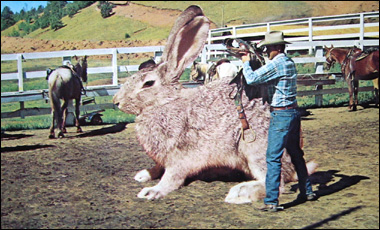
So herewith, for your viewing pleasure, the scourge of The Great Southern Land, the Giant Rabbit.

Yes, I know, technically not native animals, rabbits, but by golly, they may as well be there are so many of them.

The rabbit originally comes from Spain, you know. I’m sure it is a darling happy little critter as it hops around Spanish meadows. Here, it is a hideous feral menace.

The rabbit was introduced to Australia very early on. Opinions as to dates vary. There were rabbits on the First Fleet (1788), but it is generally accepted that the real problem didn’t start until about 1859 when a small number of rabbits was released for hunting purposes.*

The introduction went something like this:

Englishman: Australia, this is the rabbit. Rabbit, this is Australia

Australia: Pleased to meet you Rabbit!

Rabbit: Howdy Do! (thinks: ‘Jiminy Cricket – the whole freakin’ place is EDIBLE!’)

Think Hansel and Gretel seeing the witch’s cottage, but with no witch.

Of course, while they were small, rabbits were hard to control and that was bad enough. But then the British, not content with just letting the jumping pests loose in the first place, carried out their atomic tests in Maralinga in the 1950s*, creating the first mutant bunnies, leading to the mega-Rabbit and all the disastrous consequences that followed. In the photo above you see a misguided attempt to usefully re-skill this Giant Rabbit, a government initiated project that was doomed to disaster from the first hop.

*Some things in this post are factual.


I grew up in Goulburn, a small country town of about 20,000 people, a couple of hundred kilometres southwest of Sydney.

I had a wonderful childhood, and it is full of the memories of which a childhood should be made: dad taking me for rides on his bike; thick white fog that didn’t lift till noon; going to the Saturday matinee at the cinema (or ‘The Pictures’ as we called them then) and having change from a shilling to buy lollies; the smell of burning autumn leaves; an unexpected present of a box of 12 Derwent coloured pencils (which I left on the school bus one day and never saw again); Easter egg hunts in the house in Albert St; early morning thunderstorms that meant a ride to school in the car; scorching summers buzzing with cicadas; listening to Life With Dexter* with dad by the light of the valves from the old valve radio; the smell of chlorine and suntan lotion at the swimming pool; hot Milo on the back steps with mum.

Some of these memories (but surprisingly few, all things considered) are recorded in photos taken on an old Box Brownie camera which I still have.

Now, snow is a rare sight in most places in Australia, and outside the main mountain ski fields of Perisher Valley in New South Wales and Mount Hotham in Victoria, snowfalls are consigned to a few brief days a year in places that get cold enough.

During my childhood Goulburn was cold enough twice.

Luckily for readers of The Cow, the creation of the Snow Bear is one of my memories that has been preserved on film for posterity. This shot was taken around 1963. That’s my brother Steve on the left.

*Overseas visitors: here’s an mp3 of an episode of Life With Dexter. You can have no better impression of what it was like to be in Australia in the early 1960s.

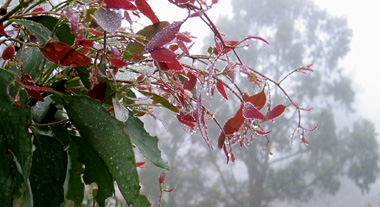
One of the most common things I hear people say about the Australian bush is how drab it looks. European preconceptions make us think that the emerald green lushness of the Northern Hemisphere is somehow the ‘correct’ way for the countryside to appear, and that there is something wrong with the blue-greens and olive hues of the eucalypts and acacias and melaleucas and all the other plants that make up Australia’s forests.

But this is the ill-considered view of the person who hasn’t spent time among eucalypts. These beautiful trees are subtle and complex, and like all worthwhile things, patience is required to fully appreciate them.

Some interesting snippets about eucalypts:

★When the early ships of explorers and white settlers came to Australia they knew they were approaching land well before they could see it; the eucalyptus forests were so dense they could smell them miles from shore. (Gum – Ashley Hay)

★Eucalypts grow prolifically on the west coast of the US but they do not belong there. I once had an animated discussion with a producer of a well-known classical music group in which she insisted that eucalypts were native to the US. They are not. The 600+ known species are endemic to Australia, with about 12 further species known in far southern Asia. The reason that eucalypts grow in California is because they were taken there in the 1870s, perhaps by miners returning from the Australian gold rush. They had optimistically thought that this hardy tree would be a useful source of hardwood timber. Indeed, the trees thrived in their new home. They grew fast, as much as twenty feet a year. Too fast. In Australia, the growth rate is checked by insects and drought, to produce a very fine-grained hard timber. In North America, there was nothing to slow them down. The transplanted trees were big and impressive, but their timber was fibrous and brittle. It was a disaster. Now the eucalypts in the US can’t be considered much more than weeds.

★Koala bears are not bears, and do not spend their days stoned out of their minds on the oil from eucalyptus leaves, as many people believe. Koalas are just very relaxed kinds of guys.

★Only one tenth of Australia’s original forest remains. And this is being cleared with little thought. It is a travesty of the highest magnitude. We humans don’t deserve this place.

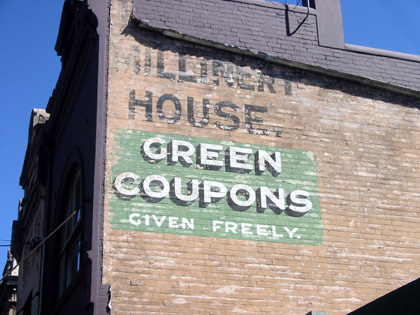
Demolition of a building up on King St, in Newtown where I live, revealed this sign which must date around the 1940s. Green Coupons were a redeemable ration system used in WW2 in Australia. A new construction has now obscured the sign again, for another fifty years, perhaps.

« Previous Page