This morning. Atlas pointed me to this rather curious piece on International Business Times, in which Florida pastor (or ‘associate’ pastor if you read the fine print) opines that he thinks it would be quite a jolly idea to introduce Artificial Intelligences to the idea of Christianity, once they reach the requisite level of sentience. [Warning: supremely irritating re-booting self-play video in the sidebar on that site]
I truly can’t decide whether the concept is thigh-slappingly hilarious, or mind-numbingly depressing.
“If AI is autonomous,” says Reverend Christopher Benek, “then we should encourage it to participate in Christ’s redemptive purposes in the world.”
To which I’m pretty sure a sufficiently autonomous sentient AI is likely to respond:
“Stephen Hawking is afraid of AI but he’s forgetting one very important fact. …if they are actually more intelligent than humans then they should have a better understanding of morals and ethics than us — as well as the understanding to enact them.”
To which point I say, yes, very likely. And I don’t think Hawking is actually forgetting that. Because if it’s correct, then the very first act the robots will undertake is to eradicate us from the universe. It would be the most intelligent and moral thing to do. Especially if we can’t rid ourselves of this plague called religion.
I wanted to add one further post about the CieAura scam. I found out so many things while I was researching it, that I simply couldn’t fit them in the narrative without making it labyrinthine with detours. So this will be a kind of round up of CieAura ephemera and thoughts from me about it.
• One thing that I wanted to talk about was the large web presence of this racket. Searching the name brings up over 200,000 primary hits, and as you begin to spool through the highest ones, the first thing you notice is that very few of those hits are disparaging of the product. This might lead an undiscriminating researcher to conclude that any negativity against it – such as mine – is rare. It doesn’t take long to discover that CieAura is working the SEO like crazy – either through actively cross linking itself with itself, or getting other people (probably its reps) to do so. And make no mistake, CieAura is an internet whore. Wherever it can get its name mentioned, it does, sometimes numerous times in a paragraph. CieAura ‘comments’ are scattergunned through forums and user groups, often completely irrelevantly (trading on open and poor moderation). If you’re like me, the next thing you think to do is search ‘CieAura scam‘. You get many fewer results, and some of them are useful. The interesting thing, though, is that there is a significant proportion that look like they’re offering advice about being scammed, but turn out to be sales pitches – this demonstrates an active process of attempting to hoover up folks who might be doubtful about the product, and are sensible enough to do a search on it. It’s an eerie and creepy tactic and after I’d seen it a few times, my skin was really starting to crawl.
• When you do encounter users of CieAura on the forums, they are almost universally effusive about the product. If someone makes a comment like ‘it’s a scam, they don’t work’ you can bet there’ll be a chorus of others who dispute that. The likelihood is very high that the original comment came from someone who used the chips, and the rebuttals from people selling them.
• CieAura makes a big deal about the chips ‘not putting any drugs in your body’. This paranoid fear-mongering squares with Melissa Rogers’ and Kathy Heiney’s persistent mantra about ShooTag ‘not using any chemicals’. This is plainly an attempt to leverage prospective customers’ distrust of modern medicine as part of the sales pitch. ((A distrust that, while having a modicum of legitimacy, is blown way out of proportion by so-called CAM modalities. Yes, pharmaceutical companies are sometimes not the most honourable people in the world, but there’s a lot of pot-calling-the-kettle-black going on. Particularly when we consider the likes of CieAura, PowerBalance, Sensa Slim et al)) They really have all the angles on pushing people’s buttons.
• You can’t buy CieAura in any other way than from a sales representative. The CieAura website (and others I found) makes it seem that you can, but you just can’t. Try it if you like. You’ll always end up getting directed to a sales rep of one kind or another. At the very least this is another example of completely dishonest behaviour; why make it appear that you have a store and shopping cart on your site when you don’t? If the product is a completely legitimate one, and efficacious as it’s made out to be, why can’t I just order some, like I can do with anything else I want to buy? This speaks once again to the real mechanism in operation here: CieAura doesn’t care about selling the product as much as it does about recruiting chumps to sell it. That, there can be no doubt by now, is where the bulk of the money generation lies (see below to how relevantly this speaks to CieAura being a pyramid scheme).
• There are numerous CieAura ‘training’ videos on YouTube and elsewhere. If you’ve ever had someone attempt to ensnare you in a scheme like Amway or Herbalife, these whitebread airbrushed zombies with their lame xeroxed script will be quite familiar to you.
“Once you take care of your family, then you can help others…” says Mr Less-Charisma-Than-A-Dog-Turd. That’s right folks, make sure you screw your family first, because they’re the least likely to go to the cops. This tactic has the additional advantage that it will make you feel like you’re getting somewhere if you get a few ‘sympathy purchases’ out of the starting gate. But after you’ve worked your way through your mum & dad & siblings, and alienated what are probably the last of your friends, you’ll find out mighty quickly that the Law of Large Numbers has taken care of any other suckers that might give you the time of day. By then, Paul Rogers has already spent your money on another of his awful suits.
And this idea that you’re ‘helping’ people is loathsome. How are you helping them? By foisting off on them some stupid twinkly little stickers that do nothing that’s even vaguely rooted in reality? Or by lumbering them with a business ‘opportunity’ that they’ll chip away at for a month or two before realising that, as always, a real job requires either some experience or a level of honest toil doing something useful. There is only one way to get easy money in this world, and that’s to piss all over other people.
I really detest the way that this whole thing is vaunted as decent business. This is not business, it’s out-and-out screwage. This is what people who are assholes think business means. I’ve run several successful businesses in my time and I have never found the need to treat anyone I work with, work for, or employ, like these people do. If you’re considering opting into the CieAura marketing scheme, take it from me, the people on the top of the pyramid don’t give a flying fuck about you or whether you succeed, no matter how heavily they peddle that message. Once you’ve put down your first few hundred, they’ve got what they want. Anything else they can string you along for is a bonus. If someone tells you they’ve made money out of CieAura – and that person is not Paul Rogers, because he certainly has – then you can bet your ass that person is another CieAura rep trying to recover a few dollars of the debt she’s no doubt carrying. To reiterate from last post: whatever CieAura might present this whole deal as, it’s a pyramid scheme. Go here and read this carefully so you understand why it can never work for you.
It’s mathematically impossible for everyone to make money in a pyramid scheme. For example, if each recruit needs to find 10 more people to recoup the cost of his or her initial investment, the eighth level of the pyramid would have to recruit a billion people to make back their money. And the next level would need 10 billion, nearly twice the population of the Earth. ~How Pyramid Schemes Work
• CieAura, no doubt, would object to being called a pyramid scheme. They would probably define themselves as a Multi Level Marketing program. They do this for a very, very good reason: in 1979, the US Federal Trade Commission ruled that Amway, a huge company that runs on this kind of system, was NOT a pyramid scheme. The fine points of exactly why not, are almost impossible to fathom, really, but in any case you can go here and determine for yourself how CieAura would fare if called to account by the FTC.
Here are a few points the FTC gives (from many) for differentiating a pyramid scheme from a ‘genuine’ MLM. ((I still think MLMs are dangerous swindles too, but apparently in the US, where money is the only thing important to a lot of people, the FTC has been swayed on that point.))
• Avoid any MLM that puts much more emphasis on recruiting salespeople than selling the actual product.
• Make sure that the products being sold have real value and a competitive price.
• Avoid signing up for an MLM as part of a high-pressure motivational event.
• Bottom line: If it sounds too good to be true, then it probably is.
Any of that sound like CieAura? You see how they’re attempting to navigate around the strict definition of a pyramid scheme by selling a ‘product’? But the value of that product is completely fabricated, so having a ‘competitive’ price is a meaningless concept. They just put on any price they can get away with, because the thing is not ‘competing’ against anything but fairy dust. It’s lies wrapped up in deceit and tied with a bow of bullshit.
And it might not hurt to keep in mind that the people at the top of that CieAura pyramid are closely related to entities like BurnLounge who have been found criminally culpable of defrauding consumers via a pyramid scheme masquerading as a Multi Level Marketing opportunity (this does not, I hasten to add, make them criminals merely by association. But it does speak to the kind of company they keep, and the kinds of companies they keep, if you get my drift).
That’s all on CieAura for now, but I have a feeling we’ve not spoken the last words about them…
I began this investigation into CieAura by saying that my main concern with this product was the science that is claimed to make it work. As I researched deeper, however, I realised that, like a lot of other people, I’d been hoodwinked by CieAura. The people behind this enterprise don’t care if their product has any basis in science. I don’t think they don’t even care what their product is. There are much larger subterfuges at work here.
For a start, it’s pretty difficult to accept that CieAura are unaware of the many levels of deception they use in the promotion of their business. Try as I might to believe that they misguidedly think that they’re being genuine about what they’re doing, there is so much obfuscation, sidestepping, misdirection and just plain fibbing on their website and in their marketing strategies, that it’s hard to cut them much slack as ‘honest folks just having a go’. The first indication of duplicity is the robust and persistent disclaimer that appears under every hyperbolic pitch of every CieAura modality:
“NOTE: CieAura products are sold for learning, self-improvement and simple relaxation. No statement contained in this writing, and no information provided by any CieAura employee or retailer, should be construed as a claim or representation that these products are intended for use in the diagnosis, cure, mitigation, treatment or prevention of disease or any other medical condition. The information contained in this writing is deemed to be based on reliable and authoritative report. However, certain persons considered experts may disagree with one or more of the statements contained here. CieAura assumes no liability or risk involved in the use of the products described here. We make no warranty, expressed or implied, other than that the material conforms to applicable standard specifications.”
Wow. A simpler way of putting that might have been “We make no claim that our product actually does any of the things that we’re making you think it does”. That’s not the only disclaimer either – there are frequent secondary waivers scattered throughout the site: ((It’s likely that the CieAura promoters tell their marks that they are forced to put up these disavowals because the CieAura chips are ‘ahead of their time’ and ‘conventional medicine doesn’t understand how they work’, or somesuch. At the very least, this shows an enormous disregard for the safety of consumers, but most likely they do it in full knowledge that the product is bunk and they’re simply protecting their asses.))
These statements have not been evaluated by the U.S. Food and Drug Administration. These products are not intended to diagnose, treat, cure or prevent any disease or illness. If you have a pre-existing condition, please check with your healthcare provider before using.
Despite the detailed legal ducking and weaving, it’s quite plain that CieAura intends you to have the impression that their holograms will have beneficial effects on medical conditions. A few little excerpts from the various product pages:
Vague promises, to be sure, but given the contexts in which each of these statements is placed (which you can read by clicking on each of them, above), it’s pretty clear how CieAura is being promoted. And did you see the really weaselly line in the disclaimer? (I mean, it’s ALL weaselly, but this is particularly good):
…no information provided by any CieAura employee or retailer should be construed as a claim or representation that these products are intended for use in the diagnosis, cure, mitigation, treatment or prevention of disease or any other medical condition.
This effectively means that anyone spruiking CieAura can say the product achieves whatever miraculous results they like and, very conveniently, CieAura can avoid taking responsibility for those claims. Liability is deftly passed onto anyone who happens to be selling the things (which you will see in just a minute is germane to the whole operation). The disclaimers, like the CieAura chips themselves, are completely void of any value.
Delving deeper into the CieAura site, there’s no shortage of other slippery efforts to bolster up the apparent bonafides of the operation. There is, for example, an impressive-sounding ‘Medical Advisory Board‘ for CieAura. Impressive unless you take a few minutes to investigate them. Of the six people featured, three are chiropractors, one is an osteopath and the other two are general practitioners. I don’t need to tell you that chiropractors and osteopaths are hardly the epitome of reliable medical advice. And I’m sorry, as much as I respect GPs, a couple of them endorsing a radical new approach to medicine that completely rewrites the way we understand the physics of the universe doesn’t hold much water for me.
Elsewhere on the web, in a YouTube video which is presumably aimed at pitching CieAura to prospective marketers, Paul Rogers claims that there is a ‘peer-reviewed study’ behind CieAura. He’s obviously heard the term ‘peer-review’, knows it’s something that a credible scientifically based product should have, and thinks it applies to this kind of crap [pdf]. It doesn’t. ((I trawled through this ‘paper’. It should be a flagship for what science is NOT. You can find an ‘explanation’ of peer review buried deep in the CieAura site, for anyone who should care enough to go looking for it. If you understand peer review, and the manner in which rigorous medicine is practised, it’s VERY hard to believe that this single, obscure, nepotistic paper is not being contrived with one single purpose: to make it LOOK like CieAura has substance. It’s simply another dishonest ploy.))
I won’t bore you with more examples of the many instances of perfidiousness to be found here. Whatever the case, it really does not matter that the CieAura chips are nothing more than shiny decals with no mechanism of known efficacy and a lack of proper substantiation. The product itself is just sleight-of-hand. Its primary purpose is not to be sold to an end user.
Remember how I encouraged you to take note of the pyramid logo on the CieAura hologram? Well that, my friends, is quite a fitting emblem for this company, for they are the very model of a pyramid scheme. ((They frequently refer to their business as ‘network marketing’ but that is nothing more than a euphemism for pyramid scheme.)) In the post before last, I mentioned Brian J, who left a comment on one of the ShooTag articles way back in June 2011. This is what he said:
I was at a presentation last night by a company named CieAura. They use the same technology as the shootag (so they say) and I was wondering what you have heard about them? They claim $80 million in sales this year and say that they will double next year.
I was thinking of become a distributor with them, but like I said, since they claim their method is the same as shootag, I was wondering what you thought?
The presentation that Brian attended wasn’t about trying to sell him CieAura chips for his personal use. It was designed to sell him on CieAura as a business opportunity that would make him some money. And indeed, in order to help convince Brian how wonderful CieAura was, they even tried out the old balance trick on him – with which he was impressed until I told him how it was done. ((If you stop and think about it, the balance trick is not in anyway demonstrating that CieAura is delivering whatever efficacy it’s promising – it’s just a marketing technique. I mean seriously, on the face of it, it just looks like a hologram seems to stop you from toppling over. What does that even mean? The extrapolation to ‘it will make you better in bed’ or ‘it will stop your allergy problem’ is a ridiculous and oblique leap of logic. But of course, they’re not using the trick to appeal to the person who would is actually the proposed end user of the chips.)) Fortunately for Brian, he was warned off this swindle before they got his cash:
To sign up for their program was about a minimum $500 purchase, so I am REALLY glad I did not do it now.
And by the way, thanks for not making me feel bad. Your response was very kind. I know I am from a smaller town in Missouri, but when you look at the evidence as you have presented it, you feel like you should have known better.
You see how that works, right? To get in on the action of the miraculous CieAura, Brian has to fork out a base fee of $500 for a fistful of worthless glittery rainbow stickers. In the manner of all good pyramid schemes, that cool 500 goes to the next guy up the ladder, who’s paying off his franchise to the next guy up the ladder and so forth. Meanwhile, Brian has to sell off his wad of holograms to break even – which he realises very quickly is almost impossible, because outside the CieAura presentation room, no sensible person is going to take the useless things, even for free. No worries Brian! All you need to do is set up your own presentation event and rope in some more suckers! Only problem is, due to the laws of exponential mathematics, you eventually run out of suckers. CieAura, however, will not let you in on that little mathematical secret – they’ll tell you that you’re just not managing your dealership effectively… and attempt to sell you more useless crap. ((Probably in the form of admittance to seminars, access to ‘special’ online motivational material and so forth – I really don’t know in the case of CieAura, but it will be something like that. People who manage these pyramid or network-marketing schemes get familiar with the exponential nature of the beast very quickly, and so they’ve come up with all manner of novel ways with which to screw the suckers they’ve already hooked.))
Because the product in this case is worth peanuts and has exactly NO efficacy, the only thing these people are really paying for is the privilege of using the CieAura name. And guess where most of the money in those $500+ advances comes to rest? Yup, that’s right, with Paul Rogers, Melissa Rogers and their cronies sitting there at the top of that pyramid (for a really excellent explanation of why a pyramid scheme is disastrous for everyone except the people at the top of the pyramid, go here).
Brian J had a lucky escape. Like most people who get involved in these scams he probably couldn’t afford to lose the $500 that CieAura was happily prepared to lift from him. And if Brian had not stumbled on Tetherd Cow, you can bet that they’d have eventually sucked a lot more out of him than $500 before he realised what was going on.
So you see why I believe the people peddling CieAura are despicable crooks. The dishonesty that stains the entire CieAura edifice speaks loudly against this being a decent and effective product. As I’ve said in previous discussions on TCA, honest people just don’t behave like these people do. There is simply no way on earth that you can set up a business like this and have no idea of what kind of racket you’re running. It makes me sincerely regret being foolish enough to occasionally feel a twinge of doubt about my negative assessment of the motives of Ms Rogers & co throughout the ShooTag saga: for most of the time I was challenging ShooTag, they were actively working the CieAura scam!
I want to finish off with a YouTube clip. You don’t need to watch it, because I’ll synopsise it for you. I only include it by way of proof, because I fear that if I merely told you about it you’d find it pretty hard to believe that anyone could actually be quite so lacking in basic decency.
It features Paul Rogers, CEO of CieAura, telling a Thanksgiving story. Don’t make the mistake of thinking it might reveal any shade of humanity in this man; it’s a tale about how he used the opportunity of a family Thanksgiving to inveigle (or more like browbeat, in fact) his closest relatives into the CieAura scheme. ((There’s a fair probability that in this case, the people who bought in might have done OK. It’s not hard to figure out why: at this early stage, they’re pretty close to the top of the pyramid.)) And certainly don’t go looking for any heart-warming epiphany here. I watched it right through – ever naive and optimistic – thinking that it might have some kind of revelatory and humble moral lesson; “..and in the end, I realised this was Thanksgiving, and the most important thing of all was that I had a loving family…”. But it’s not there. Paul Rogers is not that person. Even his close friends and family are, to him, just business opportunities. ((It’s probable that this video was made for motivational purposes and is directed at CieAura reps. This raises another possibility: that the story (like much else about CieAura) is fictitious. The alternative – that it’s true, and not only did this pathetic episode happen in Rogers’ life, but he’s exhorting other people to behave like this – is all so shabby that it makes me want to retire from the human race.))
Unfathomably, he seems to be completely oblivious as to how this video might seem to other people, since it’s publicly viewable on YouTube. Either that, or he doesn’t care. If you do choose to watch the clip, and you’re anything like me, you probably won’t get very far before you feel like throwing up.
Further reading:
PatchDiskBandScam has some comprehensive examination of CieAura as well as other health scams directly related to them, such as Lifewave, HarmonicFM and 8ight. There’s a great infographic showing the links between the people involved. Paul Rogers is right up there, but no mention of the CieAura Chief Science Officer. You can also see reports of a massive US Federal Trade Commission legal assault on a company called (perhaps somewhat grotesquely) BurnLounge, who were successfully prosecuted for operating a vast pyramid scheme. The previously mentioned infographic shows clearly how people involved in BurnLounge are linked to CieAura. BurnLounge was ordered to pay redress to 56,000 consumers of over 17 million dollars that it had bilked out of them, in a “scheme in which compensation for recruitment is unrelated to the sale of product to customers who are not participants”. The case was ruled in 2012. The FTC is still chasing the money.
WatchDog on RepSpace has also tracked down a great deal of CieAura material.
There’s a long thread over at Museum of Hoaxes that follows a lot of the ducking and weaving of CieAura. The numerous personnel links with other promoters of quackery such as the previously mentioned Lifewave and HarmonicFM are immediately obvious.
I found a CieAura press release that boasts that they have been granted registration by the Australian Therapeutic Drugs Administration enabling them to operate in Australia, but I have not been able to determine if that is in any way genuine, and if so if it is still current.
I know I said we were going to be looking at CieAura’s business practices today, but I thought instead that I might take a little detour, and think a bit about the central concepts behind what the product is offering. Specifically, we’re going to look at holograms, what they are, how they work and their relevance to any kind of biological or medical efficacy.
The first thing I’m going to assert is that the CieAura doesn’t use true holograms. I’ve never seen a CieAura ‘chip’ in reality, so I’m going off web images, but to me these look like ‘stacked’ or ‘2D/3D’ holos, which are found extensively in toys, credit and ID cards, and product design. These are just 2D layers which give the illusion of depth. They are stupidly easy to manufacture, and incredibly cheap, as we have seen. You can easily have them made to your own design.
It is vaguely possible that the CieAura holograms are what is known as Dot Matrix holos, and they are pretty much what they sound like: holograms made by specialized machines which stamp images into foil masters using a dot pattern. The process is somewhat similar to the way old-fashioned desktop printers worked. These kinds of holos are generally used when high levels of security are required, as they can encode what are called ‘shape scattered’ patterns. Electron-beam lithography makes even higher quality holograms still, and due to their very high resolution (up to a quite impressive 254,000 dots per inch) can encode all kinds of hard-to-copy detail. These last two are rather more expensive than stacked holos, but once you’ve made a master, it’s still relatively cheap to manufacture millions of clones.
Whatever the case, you should understand that what’s happening with all of these methods is that a machine is simply etching finely detailed patterns into a piece of metal, which is then used as a master to print the actual holograms onto plastic or metal foil.
Without wanting to get too technical about what a proper hologram is, and how it works, I’ll attempt a little explanation: even though light travels very fast (299792458 metres per second, in fact) it can be slowed down by materials it passes through, such as water or glass.
Here, the light bouncing off the pencil and reaching your eyes is slowed very slightly as it goes through the water in the glass, and when you compare it to the light coming off the pencil above the water, you can clearly see a discontinuity (and you can see that there is a depth-perception illusion in play – the pencil looks more magnified, and appears to be ‘elsewhere’ from where you know it to be). You will have seen this kind of effect countless times in your life; distortions in windows, raindrops on glass, the brilliance of cut gems like diamonds. If you wear spectacles, the warping of light by changing its speed is what helps correct your vision. Any transparent or semi-transparent medium can, and mostly always does, change the speed of light.
A lesser known example of the speed of light being altered is when you see an oily puddle on the road.
In this case, the rainbow effect is caused by the constituent parts of white light being bounced off the puddle at slightly different speeds – the white light of the sun is being separated into colours due to minute optical delays introduced by the oil/water mix on the road.
This changing of the speed of light as it goes through different material is called refraction (or diffraction, according to whether it’s reflected or transmitted). I’m sure you’ll already have made the link between oily rainbows and the holograms you see on credit cards, and indeed, you’re seeing exactly the same principle at work. The very cool thing about refraction/diffraction is that if you can slow light down controllably, and in just the right way, you can fool your eyes into thinking that the delay caused by what we call the refractive index of a material is not simply a colourful effect, but a function of distance. In other words, under certain conditions, and in just the right light, we can trick our eyes into seeing refractive changes as depth.
And this is exactly what a hologram does. The very small and highly organised grooves and pits on a holographic film refract the light in such a way as to give an illusion of depth – that’s what creates the hologram’s 3D effect. You will know from experience, that these little holograms work best when you have a very defined, single point light source, and when you view them from one angle. That’s simply because the refraction effect is most effective when it’s lined up exactly with a light source and your eye.
What I’m getting at here, of course, is that there is really nothing at all mystical about a hologram. Holograms are exploiting simple and extremely well understood properties of optics, and have no more magic in them than the magnetic strips on your credit card.
On the CieAura site we read that:
The holographic chips are actually small skin colored patches that are infused with specific formulas designed to balance the body when placed along energy sensitive points of the body called meridians. Some call the holographic chips and the results like “acupuncture without the needles”.
And…
The CieAura Chip technology communicates with the body through the human electromagnetic field. This is known as bio-magnetic transfer. It works similar to acupuncture.
And…
CieAura’s products operate from the infusion of Intrinsic Energy into a holographic chip. Intrinsic Energy is synonymous with subtle energy as used in other texts. Once the holographic chip is placed within an inch or so of the body, these energies communicate externally with the body’s energetic fields. The chip aids the body to move itself toward its optimum energetic state. The chips use physics as opposed to chemicals to externally communicate with the body’s intrinsic energy fields.
…Nothing enters the body. Intrinsic energy operates in the quantum physics area (smaller than an atom). As a result, there is currently no device capable of measuring the signal.
Let’s think carefully about what’s being claimed here: information recorded holographically (that is, by altering the refractive index of plastic to vary the frequencies of light travelling through it) is somehow ‘infused’ with ‘formulas’ that ‘communicate’ via ‘bio magnetic transfer’ and ‘intrinsic energy’ with the body’s ‘energetic field’. And this effect is not currently measurable with any known technology (how wonderfully convenient).
As we have seen before with ShooTag, this is nothing more than a collection of absurd and diffuse terms combined in a melange of completely meaningless waffle. Not one thing in the sentences above has even an ounce of scientific credibility. You can’t ‘infuse’ formulas into holograms like you would steep some herbs in hot water – that makes absolutely no sense. The term ‘biomagnetic transfer’ occurs nowhere in scientific literature because it’s bunk. ‘Intrinsic energy’ is a made-up term that means nothing at all. The human body has no ‘energetic field’ – that’s complete bullshit. And all this tied into acupuncture, which is a folk remedy that has virtually no credibility outside of a minute chance that it might have a barely discernable effect on pain. ((Acupuncture is difficult to test scientifically for a number of reasons, not the least of which is that it’s pretty easy to tell if someone’s sticking needles into you. Nevertheless, the best science we have on it indicates that it’s ineffectual.))
It’s more than clear that all the sciencey-sounding verbage you encounter on the CieAura site is abject gibberish. It may be that Melissa Rogers is so badly educated that she really believes this baloney… but I don’t really think so. I believe that all this pseudo-mystical-sciencey stuff is smoke-and-mirrors distraction designed to deflect anyone from too-readily discerning the real purpose of CieAura.
And that purpose is what we’ll hone in on in the next instalment…
In the last post, we discovered – to our significant bafflement – that the magical CieAura has ShooTag‘s Melissa Rogers as its Chief Science Officer. Today we’re going to look at some of CieAura’s claims, and indeed, dwell a little on the ‘science’ that this wonderful gadget is supposed to use.
I will make it super clear here – since the ShooTag people seemed to have a lot of trouble with this concept – that the science part of this whole swindle is my major concern. If the claim of this device was that its working mechanism is magic, then I’d not be interested in trying to approach such a claim via a rational process. That’s a zero sum game. But the appointment of a ‘Science Officer’ clearly nails CieAura’s pretensions to the mast. In my book, spectacular scientific claims must offer spectacular and unassailable proof.
Before we go on, I have a confession to make – I realised this morning that I’ve actually examined CieAura in the past. In the comments on this post, Brian J visits the Cow to tell us about his experience with them. He found his way here because CieAura was even mentioned in the same context as ShooTag! But I completely forgot about it. In my defense, there are just so many of these damn scams that one tends to be very much like another and I truly forget which I’ve looked at. At that time (June 2011), CieAura was probably just getting its market penetration. Brian J’s story is an interesting one, and if you have the time, I recommend you read the discussion between him and myself. It’s very enlightening in regard to what we’ll go on to examine in this post, and the next.
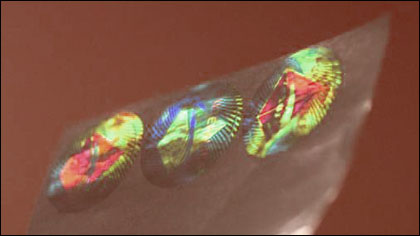
Anyway, back to the topic at hand. First I’ll give you a little breakdown of the product. CieAura manifests as not one, but eight different modalities. The website contends that it will help you with pain, sleep, fatigue, allergies, libido and weight loss, protect you from EMF and enhance your sporting prowess. CieAura comes in the form of holographic ‘chips’ that you attach to your skin with skin-coloured tape. This is what they look like:
The image is of a pyramid, in case you can’t see it. Pay special attention to that, because we’ll revisit the concept later.
Now I will point out here that it is frighteningly cheap to make a hologram of the kind you see here. A hologram is nothing more than an array of tiny little refraction scratches in the surface of thin plastic. There is nothing special about this process. Billions of these holograms are manufactured every year and they are made as simply as you might print a document on your home computer.
A ten second search gave me hundreds of options for getting sheets of holograms printed (mainly in China) for as little as 0.01 cents per piece (a piece usually consisting of one sheet of ten or twenty), and I bet you could even do better with a trade order. A single sheet of 10 CieAura holographic stickers will cost you 35 dollars. This is an absolutely astonishing manufacturing-to-sales profit ratio of 3500%.
The CieAura chips are supposed to be efficacious for 2-3 days. So, in the main, one packet of CieAura stickers is going to last you no more than a few weeks, and in all probability, customers are encouraged to buy multiple packs. You can see quite clearly that if these things are actually being purchased, this is a goldmine. ((Of course, the assertion that some aspect of the holograms ‘wear out’ is abject nonsense, and in this respect we see a departure from the mechanism of ShooTag, which, although it was still nonsense, at least retains faint plausibility in the notion of the product efficacy being limited over time by wear and tear. Perplexingly, elsewhere on the CieAura site we find this: “Formulas cannot be changed unless bent or cut. Data on a hologram lasts over 50 years, so shelf life of CieAura products is almost unlimited.” So what is it, exactly, that limits the efficacy of CieAura holograms to two days?)) It’s fairly difficult to get a good metric for the purchase success of CieAura. The web turns up many testimonials, but that’s vague endorsement. We can probably assume moderate sales success, which, due to the profit ratio, is no doubt a significant revenue. But that’s only a small facet of the money machine that is CieAura, as we will see in a bit.
In any case, today we’re looking at the science claims of CieAura, so we’ll leave the business aspects for the moment and have a little gander at how this wonderful product is supposed to work.
I’m not going to quote the text from the CieAura ‘Science’ page in its entirety, because, to be honest, it’s just plain gobbledegook (similar to what we saw in the ShooTag ‘science’ claims). You can go read it if you want, it’s here. To me it seems like this:
“CieAura does magical and amazing things that will make your life better. We here at CieAura don’t really understand the way the world works, and we don’t think you do either. Ancient peoples used magic and so we thought that if we took magic, and added pretendy science words to it, you might believe it’s not magic. We’d convince you it works by saying something like this: imagine something irrelevant in the real world. Now imagine your body is like that thing. CieAura magically makes that irrelevant thing relevant to your body, and fixes whatever problem you want by making magic equivalence. Oh, and by the way, Energy.”
Elsewhere on the CieAura site, we get references to lasers, quantum fields and more energy. Proper science is referred to as ‘orthodox science’, but is used to attempt to leverage some CieAura credibility despite the condescension. Perhaps the most peculiar thing of all is this:
NOTE: It is often misconstrued that frequencies and vibrations are the basis for the CieAura Chip design. To clarify: It has been determined that frequencies and/or vibrations are not the rudimentary cause of brain and body communication. Research has shown that frequencies and vibrations are an energy force that can be measured, and when absorbed by the body, appear to create certain effects. We have found that when the frequencies and vibrations are removed from the body, there remains, what is referred to as, intrinsic energies, which operate as the body’s natural communication force. These “intrinsic energies” are not measurable in the same manner as frequencies and vibrations are measurable, and because of this, we use the body’s natural forces to antidotally determine the existence of these forces. For these reasons, we consider it factually incorrect to describe the results of our technology to be driven by frequencies or vibrations.
Any further discussion on how the chips work would reveal proprietary production technologies.
So after all Melissa Rogers’ previous huffing and puffing about ‘frequencies’ in her attempted scientific explanations of ShooTag, it appears she’s gone cold on that particular concept. Or maybe ShooTag works on frequencies and CieAura works on not-frequencies. From the above explanation, it’s completely impossible to figure out how it does work, and this paragraph sounds to me like this:
“Magic, frequencies, magic, magic, bullshit, waffle, waffle, magic, bullshit and oh, we can’t tell you how it really works because secrets.”
Another berserk thing that we discover from the CieAura pages, is that the holographic magic of CieAura is happily riding along on the coattails of another dubious area of medical pseudoscience – acupuncture.
Traditional Chinese Medicine is an energy medicine. Acupuncturists dating back 3000 years also employed these energetic principles of positive and negative or yin and yang with the neutral center energy of mind being the way of the Tao… The manufacturer of CieAura Transparent Holographic Chips has discovered a way to adhesively charge intrinsic energies into holograms for the purpose of influencing the human cycle. Our Chips influence key points to create the desired effect. The natural meridians in our body get out of balance and cause blockages in the natural energy flow between the vital organs, cells and tissues of the body. The body works to connect these energy flows; however, without help, there is rarely if ever a balance in our body that keeps energy, concentration, stamina, and plus and minus (Yin and Yang) at the optimum level.
So what we have here, in essence, is a highly questionable modality of ancient folk medical treatment being influenced by an unspecified and quite unknown mechanism of physical science to return an outcome that the manufacturers – in their own words – explicitly do not guarantee (we’ll examine this situation in the next instalment). Would you spend 35 bucks on that? I’d rather go to a movie and have a choc top.
In short, there is no science here. Once again we find Melissa Rogers throwing around all kinds of sciencey sounding stuff in order to give CieAura a patina of credibility, but wholly failing to make any sense whatsoever, and certainly not putting forward any rational explanation as to why CieAura is anything but a flimsy piece of plastic film with a picture etched onto it. It is significant to note here that these kinds of claims and techniques were specifically responsible for the comprehensive banning of Power Balance bands here in Australia. The manufacturers of Power Balance, which also “used holographic technology” to “resonate with and respond to the natural energy field of the body”, admitted that the claims they made for their product were baseless, and they were compelled cease trading in Australia and to refund the purchase price of a Power Balance band to all customers who requested it.
Finally, today, we’ll take a look at a YouTube clip:
I don’t know the bona fides of the chap doing the demonstration here, but this is the hoary old ‘balance’ test, which, despite the guy’s claims of it ‘not being a trick’, is exactly that, and has been shown to be such so many times that it’s amazing that anyone still falls for it. ((It has been charitably said that the people who carry out these demonstrations may not be consciously affecting the outcome, but I have trouble believing that. Do the experiment yourself, and see if you can do it without knowing you’re doing it…)) Here’s exactly how it’s done, and how the purveyors of the million dollar Power Balance scam were toppled:
In the next post we’ll go on to take a look at CieAura’s business practices, and some amusing legal stuff. Join me, won’t you?
So anyway, the other day I just happened to think that it had been far too long a time since I visited our old friends at ShooTag, so I took a little stroll over to their site. Yeah, pretty much same ol’ same ol’. The name (and by implication, the endorsement) of Texas State University has mysteriously reappeared on their front page again, after they were explicitly directed to take it off by said university (on account of… well, no delicate way to put this: they were lying about Texus U’s involvement in the supposed scientific tests of their product), but it hardly surprises me. That’s what dishonest people do. The site itself is looking spectacularly crappy – dead links, crummy nav, appalling layout. And it looks like it’s been comprehensively shat upon by the Bad Advertising Bird. Evidently not much effort or money going into that particular enterprise these days.
I did notice that they are sporting some ‘Camouflage’ style ShooTags now, ostensibly for dogs and people who are bothered by mosquitoes when hunting.
“NEW: STAY INVISIBLE WHEN HUNTING WITH THESE NEW CAMO TAGS!” they scream in caps, and given the outrageousness of previous ShooTag claims, one might be forgiven for thinking they’re now offering some kind of Harry Potteresque invisibility mechanism for their gadgets. But I suppose we should give them the benefit of the doubt and take it that they mean ‘invisible to mosquitoes’. I’m a charitable kind of person when it comes to metaphor.
The thing that caught my attention, though, was a small, nondescript link that appears twice on the home page:
3000 years of science! OK, so that’s gonna be good. Clicking the link takes us to a very different experience indeed. CieAura®’s site is way more moneyed-up than ShooTag’s sorry presence. Images of good-looking happy smiling people by the seaside tell me that:
“CieAura has introduced a series of holographic chips that communicate with the body to help promote proper balance in several areas of interest to all human beings: deeper rest, energy, allergies, libido, relief from discomfort and weight management.”
Cool. Holographic chips that communicate with the body! Like Star Trek! Or something. Well, you can’t just make something like that up, right? You’d need some science. Hey, they have a video! Let’s have a look at that to see if there’s any enlightenment to be had. I’ll wait while you do that. You only need to watch the first forty or fifty seconds. I promise that anyone who’s been a Cow reader for a while is going to get a really big surprise around the 31 second mark. Trust me, it’s worth it.
A personage called Paul Rogers (hmm… familiar sounding surname…) tells us that CieAura has ‘introduced a line of holographic chips to the world’. Well, he’s certainly peddling a line, that’s for sure. These miraculous chips have been developed for CieAura by their chief scientist – it’s about here that I choked on my Manhattan – Melissa Rogers. Oh, how many pennies just dropped then? Paul Rogers, the link from ShooTag and the suspicious lack of product activity from them over the last few years…
Let’s have a little recap of the scientific credentials of Melissa Rogers, Chief Scientist of CieAura®, who has been designing these chips for the last sixteen years (moonlighting from her deep thought on ShooTag, one supposes):
Ms Rogers first tangled with the Cow back in 2009, where she called me ‘ignorant’ for not being ‘disaplined [sic] in physics and quantum physics’ and attempted – but failed comprehensively – to impress me with her scientific knowledge of radio frequencies, fractals and crystals (some things I actually do happen to know quite a lot about). At around that time she left a comment on another blog in reference to ‘Einstein’s famous equation, E=M¾’, completely duffing probably the most well-known physics formula in the world, and one that even third graders get right. Over the next months, she went on to assert that mobile phones use radio frequencies (they don’t), that she understands the work of physicist Geoffrey West at the Santa Fe Institute (she doesn’t) and that she knows how to properly conduct a science experiment (not a clue).
Melissa uses small signal technology ((Ms Rogers has quite obviously picked up the ‘small signal technology’ buzzwords from her association with Rainer Fink who she implicates in the ShooTag experiments.)) and uniquely combines it with advanced science to develop products that help balance the body’s intrinsic energies. After successfully launching over 12 products into the retail mass market, she joined the CieAura team in July of 2012. Some of her products have won prestigious awards and have been University tested with high efficacy evaluations. Her products are designed to assist the body in balancing the energy in the body, thus helping reduce stress in the body. Melissa believes; reducing stress in the body will help reduce stress in everyday life.
“Some of her products have won prestigious awards and have been University tested with high efficacy evaluations.”
I’d love to know what those products are – ShooTag is quite obviously not one of them, since it’s never been university tested. There’s no mention of what Ms Rogers’ ‘prestigious awards’ actually were, which is kind of peculiar. Most people are very eager to show you their Oscar. I’m also quite curious about the extent of Ms Rogers’ ‘advanced science’, as she’s not demonstrated it anywhere that I’ve ever seen.
That CieAura has appointed this person as their ‘Chief Science Officer’ ((The implication it carries – that there are a bunch of other ‘science officers’ – is frightening, given the qualifications of their chief.)) speaks volumes about the kind of product that they’re selling, and we’ll examine that product in the next post.